
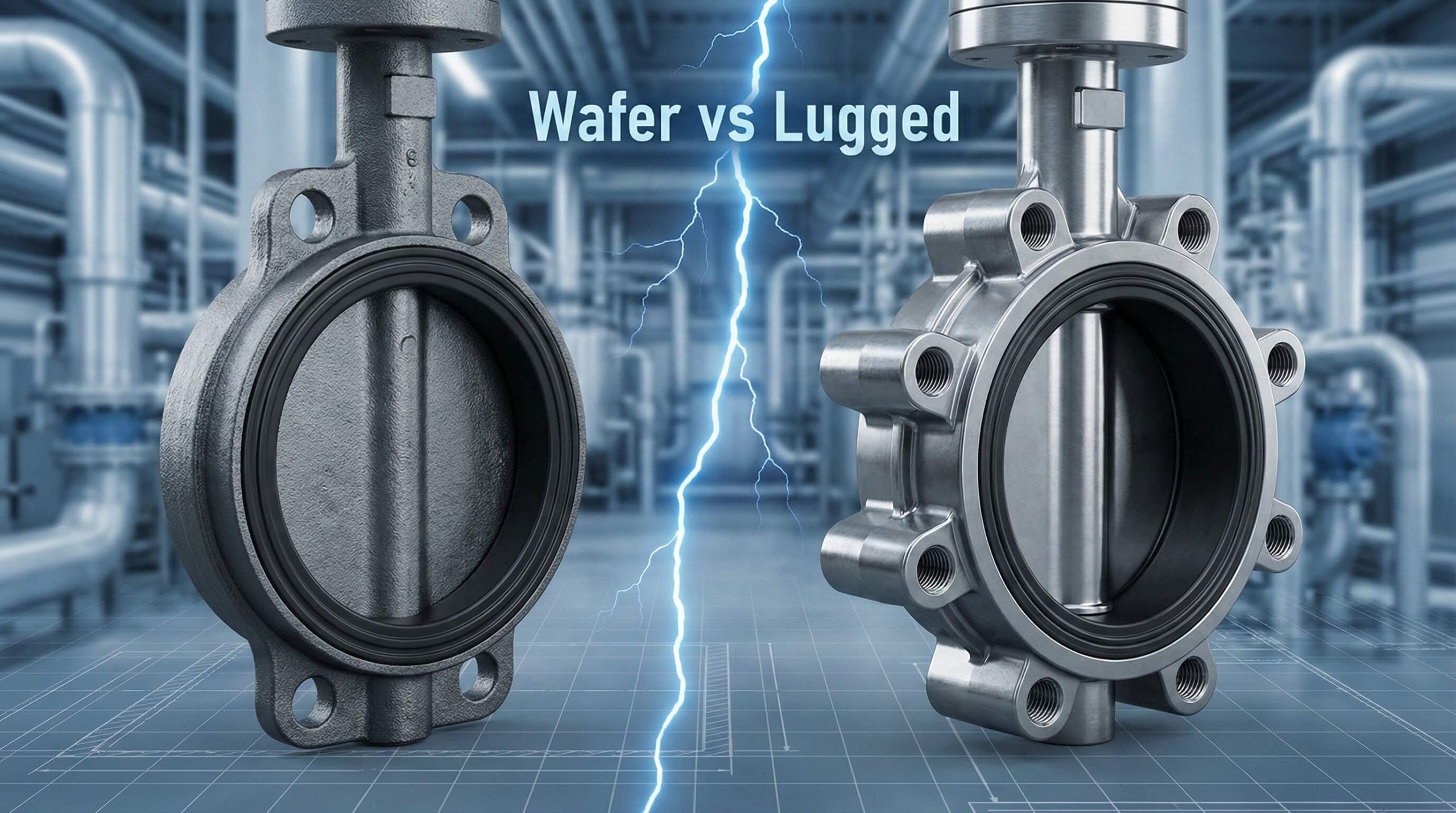
Choosing between a wafer vs lugged butterfly valve depends primarily on your need for system isolation and whether you require the ability to disconnect downstream piping while under pressure. Selecting the wrong configuration can lead to catastrophic system leaks and costly, unscheduled downtime in your facility. If you mistakenly install a wafer valve in a scenario requiring end-of-line service, you will find yourself forced to drain the entire piping network just to perform basic maintenance. To prevent these engineering bottlenecks, this guide provides a technical breakdown of the wafer vs lugged butterfly valve distinction to help you optimize your fluid control systems.
What is a wafer vs lugged butterfly valve?
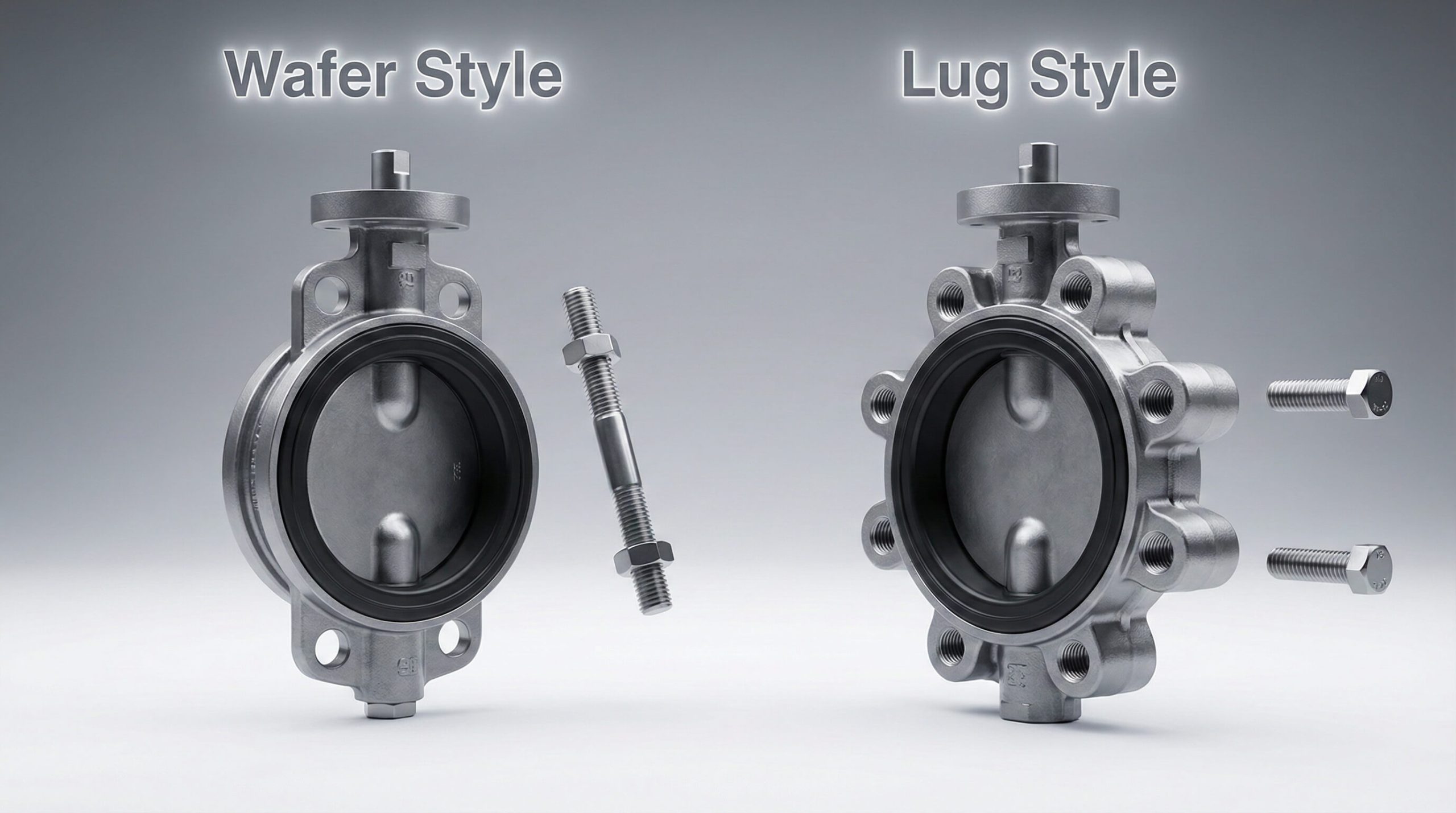
A wafer-style valve is held in place by the clamping force of two pipe flanges, while a lug-style valve is bolted directly to the flanges via threaded inserts. Understanding the basic design of a wafer vs lugged butterfly valve is the first step in ensuring your piping architecture is both safe and functional.
How does a wafer valve function in piping?
The wafer-style butterfly valve is designed to maintain a seal against bi-directional pressure differentials to prevent backflow in systems built for unidirectional flow. It is “sandwiched” between two pipe flanges using long through-bolts that span the entire width of the valve.
Think about this:
Because the valve has no independent lugs, it relies entirely on the compression of the surrounding flanges and bolts to remain in place.
- Design Characteristics:
- Lightweight and compact body construction.
- Minimal face-to-face dimensions for tight spaces.
- Features simple alignment holes for centering.
- Dependent on external flange bolting for stability.
What defines a lugged butterfly valve?
The lug-style butterfly valve features metal “lugs” protruding from the body, which have threaded holes matching the flange bolt pattern of the pipe. These threaded inserts allow the valve to be bolted directly to each individual flange, providing independent support on either side.
Look at it this way:
These threaded lugs allow you to disconnect one side of the piping while the other side remains securely under pressure.
- Design Characteristics:
- Integrated threaded lugs for secure bolt connections.
- Capability for independent flange attachment.
- Heavier body construction than wafer types.
- Native compatibility with pneumatic and electric actuation.
Key Takeaway
Wafer valves are held by friction and compression between two flanges, making them lighter and more compact. Conversely, lug valves are mechanically fastened to each flange via threaded bolts, offering more mechanical versatility and safety during maintenance.
| Feature | Wafer Style | Lug Style |
|---|---|---|
| Connection Type | Sandwiched between flanges | Bolted directly to flanges |
| Weight | Lightweight | Heavier and more robust |
| Body Holes | Alignment holes only | Threaded tapped lugs |
| Standard Support | ISO, DIN, ANSI, API | ISO, DIN, ANSI, API |
The choice between these styles determines whether you can perform maintenance without a total system shutdown.
Which wafer vs lugged butterfly valve fits my system?
Determining the right wafer vs lugged butterfly valve depends heavily on your existing flange standards and whether your system requires frequent downstream disconnections. You must evaluate the operating pressure and temperature range of your media to ensure the valve body can withstand the environmental stressors.
How do industrial standards impact selection?
Determining the right valve depends heavily on your existing flange standards, such as PN10, PN16, or ANSI 150. If your project follows strict machining standards, the valve must have high accuracy to ensure the seat creates a zero-leakage seal.
The real kicker is:
If you ignore the flange drill pattern, you will find it impossible to align the bolts correctly during the installation phase.
- Selection Criteria:
- Operating pressure ratings from PN10 to PN25.
- Temperature range capabilities from -10°C to 200°C.
- Media compatibility for water, oil, or gas.
- Flow coefficient requirements for specific sizing.
Key Takeaway
Always match the valve lug pattern to your specific pipe flange standard to ensure a leak-free installation. Accuracy in machining prevents torque mismatches and ensures the valve performs to its rated specifications during commissioning.
| Consideration | Wafer Selection | Lug Selection |
|---|---|---|
| Flange Compatibility | Fits most standard tables | Must match specific drill pattern |
| Installation Space | Ideal for tight footprints | Requires slightly more clearance |
| Actuation | Fits most standard actuators | Fits most standard actuators |
Matching the valve to your industrial standards ensures long-term reliability and prevents mechanical failure under load.
How does wafer vs lugged butterfly valve sealing differ?
Both styles utilize similar internal sealing mechanisms, but the way they interact with the pipe flange varies significantly. In a wafer vs lugged butterfly valve comparison, the integrity of the seal is often dependent on how the valve is centered within the piping.
Which seat material provides the best seal?
The rubber or EPDM seat in a wafer valve must be perfectly centered to prevent leakage during high-pressure cycles. The compression from the through-bolts in a wafer setup provides a uniform seal across the entire flange face.
Here is the secret:
Any misalignment during the installation of a wafer valve can compromise the seal integrity and lead to weeping leaks.
- Common Seal Materials:
- EPDM: Ideal for water and general utility lines.
- NBR: Best for oil and hydrocarbon applications.
- PTFE: Essential for corrosive chemical processing.
- Viton: Used for high-temperature industrial scenarios.
Key Takeaway
Seat material should be selected based on the specific media and temperature of your process line. Lug valves provide a more stable seal during the removal of downstream piping because the valve body remains fixed to the upstream flange.
| Seal Material | Temp Range | Media Suitability |
|---|---|---|
| EPDM | -10°C to 120°C | Water, HVAC, Glycol |
| NBR | -10°C to 80°C | Oils, Fats, Hydrocarbons |
| PTFE | -20°C to 200°C | Aggressive Chemicals |
Choosing the correct seat material ensures that the valve remains bubble-tight throughout its operational lifespan.
Can wafer vs lugged butterfly valve handle end-of-line?
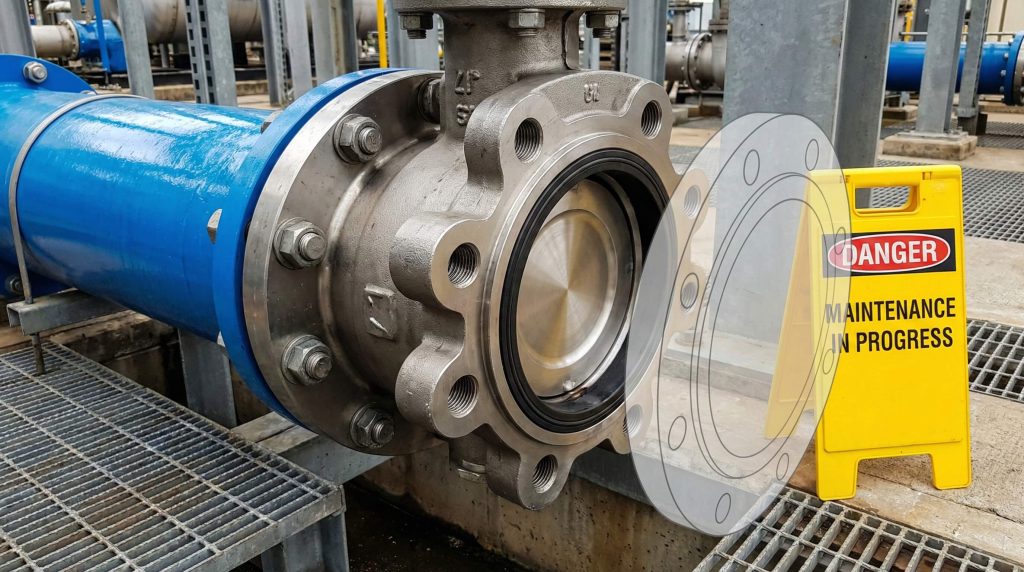
The most significant operational difference in the wafer vs lugged butterfly valve debate is the capability for end-of-line service. Only the lug-style design is engineered to allow for the removal of downstream piping while the upstream remains under pressure.
Can you disconnect a lug valve under pressure?
Lug valves are specifically engineered to allow for the removal of downstream piping while the upstream side stays pressurized. This is possible because the bolts on the upstream side remain threaded into the valve body.
But wait, there’s more:
While a lug valve can serve as a pipe end, safety engineers always recommend a blind flange for 100% security.
- End-of-Line Benefits:
- Clean out downstream tanks without stopping the flow.
- Replace downstream pumps without system drainage.
- Perform system upgrades without a total shutdown.
- Maintain constant pressure on the upstream side.
Key Takeaway
Wafer valves cannot be used for end-of-line service because they require pressure from flanges on both sides. Lug valves allow for “dead-end” service because they bolt independently to the upstream flange, providing superior operational flexibility.
| Service Type | Wafer Style | Lug Style |
|---|---|---|
| Bi-directional Flow | Yes | Yes |
| End-of-Line Service | No | Yes (with blind flange) |
| Downstream Removal | No | Yes |
Understanding end-of-line capabilities is vital for designing systems that require modular maintenance and future expansions.
What is the wafer vs lugged butterfly valve cost difference?
Wafer valves are generally the more cost-effective option for many industrial applications because they require less metal and have a simpler design. When comparing the wafer vs lugged butterfly valve, you must balance the initial purchase price against the long-term maintenance costs.
Why are wafer valves typically cheaper?
Wafer valves require less raw material in the manufacturing process, which directly reduces the price per unit. Lower material costs and reduced weight make wafer valves significantly cheaper to ship and easier for small crews to install.
It comes down to this:
You can save significant capital on large-scale municipal projects by opting for wafer valves where isolation is not a priority.
- Cost Factors:
- Material Volume: Lug valves require more ductile iron.
- Machining: Lug valves require precise threading of each hole.
- Logistics: Heavier lug valves increase freight costs.
- Hardware: Wafer valves use fewer, but longer, bolts.
Key Takeaway
Choose wafer valves for budget-sensitive projects where end-of-line service and frequent downstream maintenance are not required. The higher price of a lug valve should be viewed as an investment in maintenance flexibility and safety.
| Cost Component | Wafer Style | Lug Style |
|---|---|---|
| Initial Purchase | Lower | Higher |
| Installation Labor | Lower (Lighter) | Higher (More Bolts) |
| Long-term Value | Lower (Shutdowns required) | Higher (Faster maintenance) |
Analyzing the total cost of ownership reveals that lug valves often pay for themselves through reduced downtime.
Is wafer vs lugged butterfly valve maintenance different?
Maintenance efficiency is where the wafer vs lugged butterfly valve choice directly affects your bottom line and operational uptime. If a wafer valve fails or its seat needs replacing, the entire line segment must be depressurized and drained completely.
Does a wafer valve require more downtime?
If you need to replace a wafer valve, you must loosen all bolts, which essentially breaks the seal for the entire section. This often leads to longer downtime as you wait for the system to drain and refill.
The truth is:
The ability to isolate sections without a full system drain-down saves you thousands of dollars in labor costs.
- Maintenance Procedures:
- Wafer: Must loosen all bolts; valve requires support.
- Lug: Can remove bolts on one side only.
- Testing: Both require hydro-testing at 1.5× pressure.
- Safety: Lug valves remain anchored during repair.
Key Takeaway
Lug valves significantly reduce the “Mean Time to Repair” (MTTR) by allowing for localized maintenance. Wafer valves require more complex rigging and support during removal because they become completely loose once the flange bolts are withdrawn.
| Maintenance Metric | Wafer Style | Lug Style |
|---|---|---|
| Ease of Removal | Difficult (Full line break) | Easy (One-sided disconnect) |
| Safety Risk | Higher (Valve is loose) | Lower (Valve is bolted) |
| System Downtime | High | Low |
Efficient maintenance planning depends on selecting the valve style that allows for the fastest possible component replacement.
Which wafer vs lugged butterfly valve handles pressure?
While both valves are available in various ratings, the mechanical attachment of the lug style provides better structural integrity. In high-pressure wafer vs lugged butterfly valve applications, the way the body handles vibration can determine its lifespan.
Do lugs provide better high-pressure support?
In high-pressure applications above 16 bar, the direct bolting of a lug valve prevents the valve body from shifting. This stability is crucial for maintaining the seat’s position and preventing “creeping” leaks over time.
Here’s the kicker:
Wafer valves can struggle in systems subject to heavy vibration, which may cause the long through-bolts to stretch or loosen.
- Pressure Considerations:
- Static Pressure: Both are effective if torqued properly.
- Dynamic Loads: Lug valves resist piping stress better.
- Water Hammer: Lugged designs provide a rigid anchor.
- Alignment: Lugs prevent shifting under thermal expansion.
Key Takeaway
Lug valves are preferred for critical safety systems and high-pressure environments where stability is paramount. Wafer valves are generally sufficient for steady-state HVAC and low-pressure water lines where mechanical stress is minimal.
| Pressure Category | Wafer Performance | Lug Performance |
|---|---|---|
| Low Pressure (PN10) | Excellent | Excellent |
| High Pressure (PN25) | Standard | Superior Stability |
| Vibrating Lines | Fair | Excellent |
Reliable pressure management requires a valve body that can withstand both internal forces and external piping stresses.
What wafer vs lugged butterfly valve materials exist?
The material selection for a wafer vs lugged butterfly valve is dictated by the chemical properties of your media. For offshore or marine applications, corrosion resistance becomes the primary concern for any engineering team.
Which alloys suit corrosive media?
A stainless steel 316L lug valve offers a much longer operational life expectancy in saltwater environments than standard cast iron. You must match the body and disc material to the corrosivity of the fluid being transported.
Think about it:
Using the wrong alloy can lead to pitting and structural failure in less than a year of continuous service.
- Body Materials:
- Ductile Iron: Standard for water and wastewater.
- Carbon Steel: Common in oil and gas midstream.
- Stainless Steel: Essential for food processing.
- Bronze: Preferred for marine/offshore applications.
Key Takeaway
Traceable material certificates are vital for ensuring your valves meet the regulatory requirements of your industry. Exotic alloys are available for both wafer and lug configurations, allowing you to customize the valve to your specific environment.
| Material | Best For | Corrosion Resistance |
|---|---|---|
| Ductile Iron | Water/Wastewater | Moderate |
| Carbon Steel | Oil/Gas/Steam | Low (Requires Coating) |
| SS316L | Chemicals/Marine | High |
Material compatibility is the foundation of a safe and long-lasting fluid control system in any industrial plant.
How to install a wafer vs lugged butterfly valve?
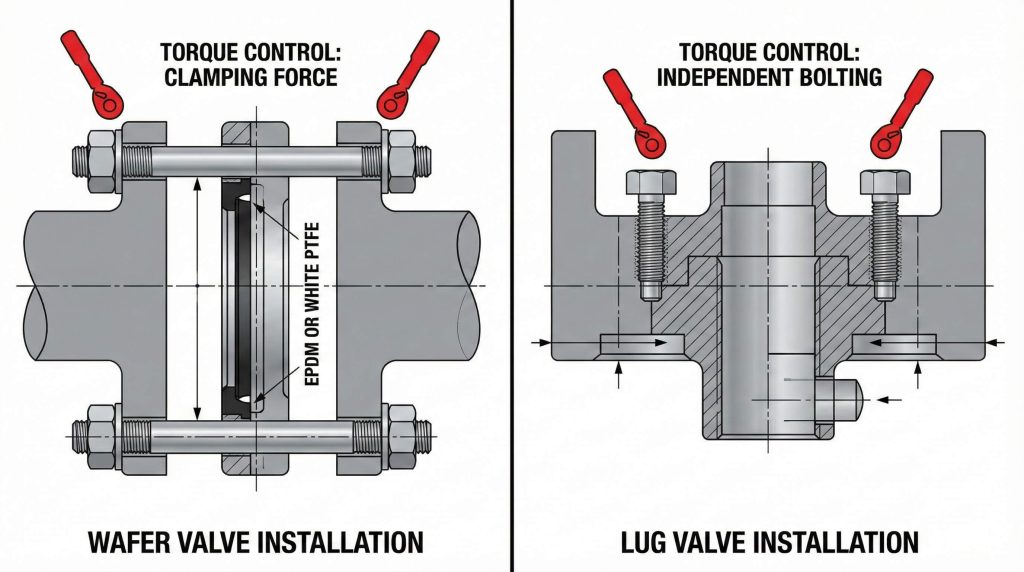
Installation processes differ primarily in the bolting hardware and the precision required for centering the valve. In the wafer vs lugged butterfly valve debate, the ease of installation can often influence the choice for large-scale deployments.
What tools are required for installation?
Wafer valves require long all-thread bolts that pass through both flanges, whereas lug valves use shorter bolts that thread into the valve body. Proper torque control is the single most important factor in preventing seat damage during the installation of either valve.
Look at it this way:
If you over-tighten the bolts on one side, you risk warping the seat and causing an immediate leak.
- Installation Checklist:
- Check flange alignment and face-to-face distance.
- Inspect seat and disc for any debris or dirt.
- Use calibrated torque wrenches for all bolts.
- Ensure the disc is “slightly open” during tightening.
Key Takeaway
Wafer installation is typically faster but requires much more care in centering the valve between the flanges. Lug installation requires more individual bolts but provides automatic alignment via the threaded lugs, reducing the risk of human error.
| Installation Step | Wafer Style | Lug Style |
|---|---|---|
| Bolting Type | Long Studs/Through-Bolts | Short Hex Bolts |
| Centering | Manual Alignment Holes | Automatic via Lug Threads |
| Torque Difficulty | Medium | Low |
Correct installation practices ensure that your valves perform reliably from the very first day of operation.
Where is wafer vs lugged butterfly valve used?
Industrial scenarios like chemical processing or power generation rely on the zero-leakage performance of these valves. When choosing a wafer vs lugged butterfly valve, you must consider the specific requirements of your target industry.
Are these valves suitable for marine use?
In the maritime industry, lug valves are almost always preferred to allow for the isolation of sea chests and ballast tanks. This allows the crew to perform maintenance on internal piping without dry-docking the entire vessel.
The bottom line is:
Your choice of valve architecture defines the operational resilience of your entire industrial facility.
- Target Industries:
- Water Treatment: Wafer for main lines, Lug for pumps.
- HVAC: Wafer for cost-effective building services.
- Oil & Gas: Lug for safety-critical isolation.
- Food/Pharma: Stainless steel wafer for sanitary lines.
Key Takeaway
Use wafer valves for non-critical, continuous flow segments where space and budget are the primary constraints. Use lug valves for points of transition, pump inlets, and tank outlets where isolation and safety are mandatory.
| Industry | Primary Choice | Reason |
|---|---|---|
| HVAC | Wafer | Cost and Space |
| Marine | Lug | Safety and Isolation |
| Chemical | Lug | Corrosive Media Handling |
Strategic valve placement ensures that your system remains easy to manage throughout its entire lifecycle.
Frequently Asked Questions
Can I use a wafer valve for end-of-line service?
No, you cannot use a wafer valve for end-of-line service because it requires pressure from flanges on both sides to remain secure. Removing one side would cause the valve to loosen and fail immediately.
What’s the best seat material for chemical processing?
PTFE (Teflon) is generally the best choice due to its extreme chemical inertness and high-temperature resistance up to 200°C. It ensures that aggressive chemicals do not degrade the seal.
How do I know if I need a lug-style valve?
You need a lug-style valve if you ever need to disconnect piping on one side of the valve while the other side is pressurized. This is also the correct choice if you are installing the valve at the end of a line.
Can I actuate both wafer and lug style valves?
Yes, you can actuate both types. Both are manufactured with standard ISO 5211 mounting pads, making them easy to integrate with pneumatic or electric actuators for automated systems.
Can I install these valves in any orientation?
Yes, but it is generally recommended to install them with the stem horizontal. This prevents debris from settling in the bottom bearing and extends the life of the valve seal.
conclusion
To ensure your fluid control systems are engineered for maximum reliability and ease of maintenance, contact us today for a technical consultation. We are dedicated to providing world-class flow control solutions that empower industrial efficiency and safety across the globe. Let our expertise help you build a more resilient infrastructure.