
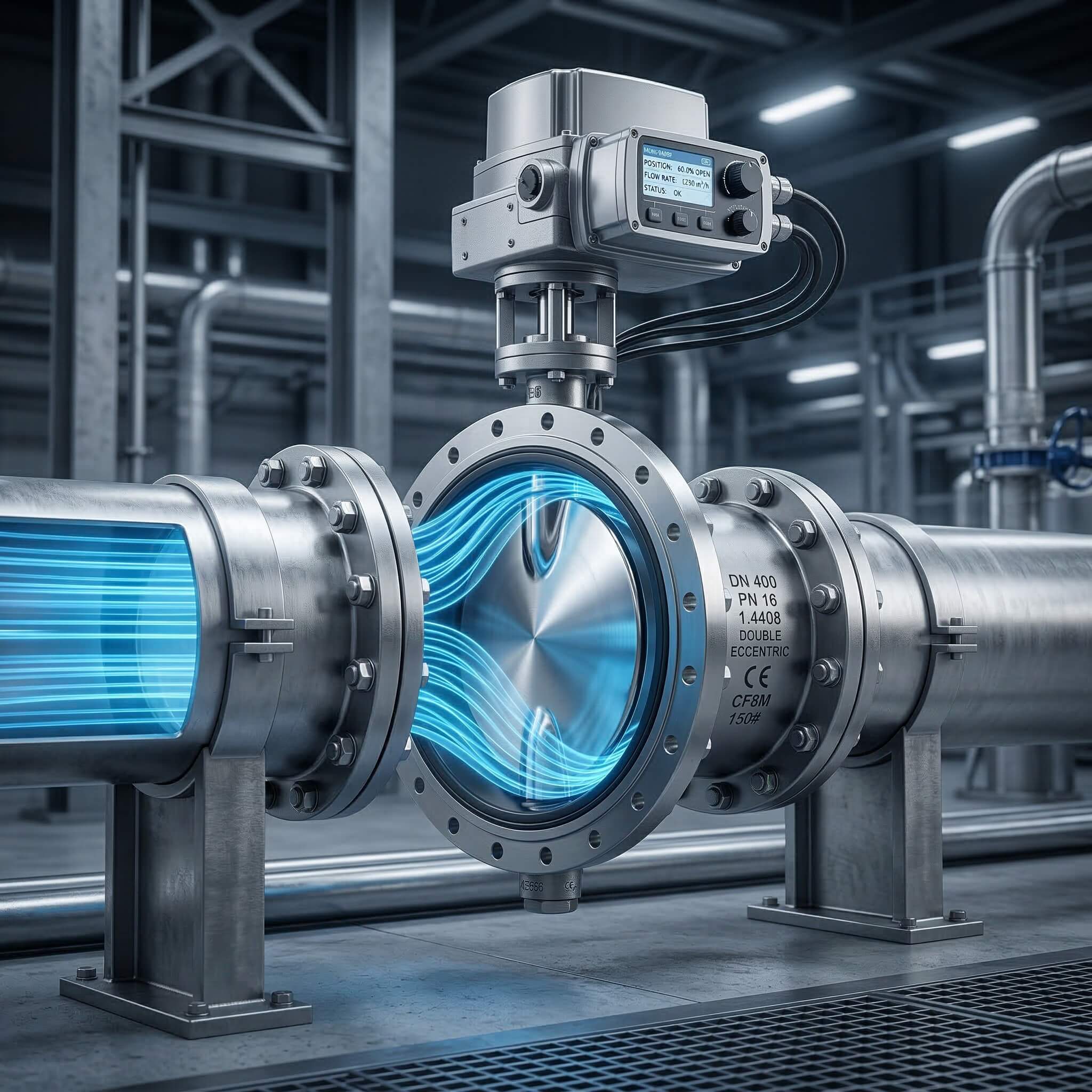
The flow coefficient of a butterfly valve, known as the Cv value, represents the volume of water at 60°F in US gallons that will flow through the valve per minute with a pressure drop of 1 psi. Imagine you are designing a high-pressure industrial cooling system where every bit of hydraulic efficiency counts. If you ignore the specific resistance of your hardware, you risk system cavitation, wasted energy, and expensive pump failures. By accurately applying butterfly valve cv values, you can optimize your fluid network for maximum throughput and safety.
What Exactly is the Valve Flow Coefficient?
The Cv value is a standardized mathematical constant that allows you to compare the flow capacities of different valves under identical conditions. Understanding butterfly valve cv values is essential for selecting the correct size for your specific piping requirements.
How is Cv defined technically?
The definition relies on a specific set of variables to ensure a level playing field for all manufacturers. When you look at technical data sheets, you are seeing the results of controlled testing environments.
- Standard Fluid: Pure water at a temperature of 60°F.
- Pressure Drop: A constant differential of 1 psi across the valve body.
- Flow Unit: Measured in US Gallons per Minute (GPM).
- Metric Equivalent: Known as the Kv value, used primarily in European standards.
Why does this metric matter to you?
Here is the kicker: without a standard coefficient, you would have no way to predict how a valve affects system pressure. You need this data to ensure your pumps are sized correctly for the friction loss.
Key Takeaway: Using standardized flow coefficients allows you to build predictable fluid systems that avoid over-pressurization and hardware strain.
| Component | Standard Unit | Reference Condition |
|---|---|---|
| Flow Rate | GPM | 60°F Water |
| Pressure Drop | 1 PSI | Constant |
The table above summarizes the core benchmarks used to establish universal flow ratings for industrial components.
How do you Calculate the Flow Coefficient?
You calculate the required Cv using the fundamental hydraulic formula: Cv = Q * sqrt(G / ΔP). Mastering these butterfly valve cv values ensures that your system maintains the intended flow rate without excessive head loss.
What are the variables in the formula?
To get an accurate result, you must input the exact operating parameters of your process line. You should never guess these numbers if you want to maintain peak efficiency.
- Q: The required flow rate in gallons per minute.
- G: The specific gravity of the fluid being transported.
- ΔP: The allowable pressure drop across the valve in psi.
Is the calculation straightforward?
But there is more. You must also consider the piping geometry and the potential for turbulent flow which can alter your results.
Key Takeaway: Applying the correct formula helps you size valves that meet flow demands while keeping energy consumption at a minimum.
| Variable | Symbol | Application |
|---|---|---|
| Flow Rate | Q | Capacity Demand |
| Specific Gravity | G | Media Density |
| Pressure Drop | ΔP | Energy Loss |
This data set identifies the primary inputs needed to solve for the necessary capacity of any valve installation.
Why is Disc Angle Crucial for Cv?
The disc angle determines the physical obstruction in the flow path, which directly dictates the butterfly valve cv values at any given moment. As you rotate the handle or actuator, the internal resistance changes significantly.
How does opening degree affect flow?
At a 10-degree opening, the valve provides very little flow and acts primarily as a seal. As you move toward 90 degrees, the disc aligns with the flow to maximize throughput.
- 10°-30°: High resistance used for fine-tuned initial flow.
- 40°-60°: Moderate resistance suitable for standard throttling.
- 70°-90°: Minimum resistance for full-capacity operations.
What happens at full opening?
The best part is that a fully open butterfly valve provides a clear path, though the disc remains in the center of the stream. You must account for this residual turbulence in your final system design.
Key Takeaway: Controlling the disc angle allows you to manage system pressure dynamically across varying operational stages.
| Angle | Flow Characteristic | Typical Usage |
|---|---|---|
| 20° | Very Low Cv | Initial Filling |
| 50° | Medium Cv | Throttling |
| 90° | Maximum Cv | Full Service |
The progression shown here highlights how disc orientation serves as the primary mechanical control for fluid volume.
How does Valve Size Influence Capacity?
Larger valves naturally possess higher capacities because they offer a wider cross-sectional area for the media to pass through. Choosing the right butterfly valve cv values for your pipe diameter prevents “bottlenecking” your system.
How does Cv scale with diameter?
A 2-inch valve has a maximum Cv around 135, while a 12-inch valve can reach over 8,000. You will see an exponential increase in capacity as the nominal size grows.
- Small Bore: Compact designs for precise, lower-volume control.
- Large Bore: Heavy-duty hardware for municipal and industrial mains.
- Intermediate: The most common sizes for factory process lines.
Can you use a smaller valve?
Believe it or not, some engineers use smaller valves with reducers to save money. However, this often leads to higher velocities and increased wear on the valve seat.
Key Takeaway: Proper sizing ensures that your valve operates within its intended velocity range to prevent premature hardware failure.
| Valve Size | Full Open Cv (Typical) | Max Velocity |
|---|---|---|
| 4 Inch | 600 | 15 FPS |
| 8 Inch | 3,100 | 12 FPS |
| 24 Inch | 43,000 | 10 FPS |
This comparison demonstrates the massive capacity jump that occurs when you increase the nominal diameter of your hardware.
What Factors Change Flow Resistance?
Internal geometry and surface finish are the primary physical factors that alter the butterfly valve cv values of a specific model. You must evaluate the construction of the valve to understand its true efficiency.
Does disc thickness matter?
Thin, streamlined discs create less turbulence and provide a higher Cv than thicker, heavy-duty discs. You should look for polished surfaces if your application requires high-velocity flow.
- Disc Profile: Aerodynamic shapes reduce drag and pressure drop.
- Shaft Design: Thinner shafts increase the effective flow area.
- Seat Material: Smooth liners like PTFE minimize friction loss.
What about the body style?
Make no mistake: wafer and lug styles can have slightly different internal profiles. These variations might seem small but can impact your total head loss in large networks.
Does seat design influence flow?
You will find that high-performance valves often use offset designs to pull the disc away from the seat quickly. This reduces the interference that can cause flow disturbances at small opening angles.
Key Takeaway: Selecting a valve with an optimized internal profile reduces the energy your pumps need to move fluid through the system.
| Design Factor | Impact on Cv | Benefit |
|---|---|---|
| Polished Disc | Increase | Lower Friction |
| Double Offset | Increase | Reduced Wear |
| Thick Stem | Decrease | Higher Strength |
This table analyzes how specific engineering choices directly affect the hydraulic performance of the final product.
Is the Cv Value Progression Linear?
No, the progression of flow capacity in a butterfly valve is distinctly non-linear, which is a critical detail for your control logic. Your butterfly valve cv values will stay low during the first 30 degrees of movement before spiking.
Why is the curve non-linear?
Because of the disc’s circular shape, the open area does not increase at a constant rate relative to the handle rotation. You need to account for this “equal percentage” or “modified linear” behavior in your actuators.
- Early Phase: 0-30 degrees provides very little area change.
- Mid Phase: 30-60 degrees sees a rapid increase in flow.
- Final Phase: 60-90 degrees offers the maximum throughput gains.
How do you program your controllers?
It gets better: modern digital actuators can be calibrated to compensate for this curve. This allows you to achieve linear flow control even though the valve itself is non-linear.
Key Takeaway: Understanding the non-linear nature of flow progression prevents erratic control and system hunting during automated operations.
| Opening % | Cv % of Max | Control Type |
|---|---|---|
| 25% | < 10% | Poor |
| 50% | 30% – 40% | Moderate |
| 100% | 100% | Excellent |
The percentage breakdown here illustrates why the majority of your flow control happens in the latter half of the valve’s rotation.
How to Use Cv for Throttling Services?
For effective throttling, you should size the valve so that your normal operating flow occurs between 30 and 70 degrees of opening. Matching your butterfly valve cv values to your process demand prevents the valve from working too close to the seat.
What happens if the valve is too large?
If you oversize the valve, you will have to keep it nearly closed to reach your target flow. This causes “seat wire-drawing” and high-frequency vibrations that can destroy the liner.
- Ideal Range: 50-70 degrees for stable, long-term control.
- Risk Zone: < 20 degrees leads to erosion and cavitation.
- Upper Limit: > 80 degrees offers very little control sensitivity.
Can you avoid these issues?
Here is the secret: always check the Cv at the 60-degree mark against your average flow requirement. If they match, you have chosen a valve that will provide years of reliable service.
Key Takeaway: Operating within the “sweet spot” of the Cv curve extends the life of your valve and improves process stability.
| Strategy | Goal | Result |
|---|---|---|
| Proper Sizing | 60° Operation | High Stability |
| Oversizing | < 20° Operation | Seat Erosion |
| Undersizing | 90° Operation | Pressure Loss |
The strategies listed above show the direct relationship between sizing decisions and the mechanical health of your system.
What is the Impact of Fluid Density?
The specific gravity of your media is a critical multiplier when you are calculating required butterfly valve cv values. Since Cv is based on water, denser fluids will require a higher coefficient to achieve the same flow rate.
How do you adjust for heavy fluids?
If you are moving chemicals or slurries, you must use the specific gravity (G) in your formula. Ignoring this will lead to a valve that is too small for the actual process conditions.
- Water: G = 1.0 (Standard baseline).
- Oil: G = 0.8 (Requires lower Cv for same flow).
- Brine: G = 1.2 (Requires higher Cv for same flow).
Does viscosity play a role?
But wait, there is more. Extremely viscous fluids like heavy syrups may require additional correction factors beyond simple specific gravity to account for laminar flow resistance.
Key Takeaway: Adjusting for fluid density ensures that your valve provides sufficient capacity even when handling heavy or non-standard media.
| Fluid Type | Specific Gravity | Cv Correction |
|---|---|---|
| Freshwater | 1.00 | None |
| Seawater | 1.03 | Minor |
| Thick Slurry | 1.50+ | Major |
This table highlights why you must know your media properties before finalizing your hardware selection.
Why Should You Verify Manufacturer Data?
Theoretical values provided in general tables are excellent for estimation, but you must verify the certified butterfly valve cv values from your specific supplier. Small differences in manufacturing tolerances can lead to significant performance deviations.
Are all valves the same?
Different manufacturers use unique disc shapes and shaft thicknesses. You should always request the exact flow curve for the model number you intend to install.
- Batch Testing: Ensures the valve meets the catalog specifications.
- Certification: Look for ISO or CE marks that guarantee testing standards.
- Field Data: Real-world performance often reveals turbulence not seen in labs.
How do you protect your project?
The bottom line is simple: trust but verify. Always cross-reference the manufacturer’s Cv table with your calculated system requirements before placing a large order.
Key Takeaway: Verification protects you from installation errors and ensures that the hardware performs as promised in your technical specifications.
| Documentation | Source | Purpose |
|---|---|---|
| Data Sheet | Manufacturer | Design Specs |
| Test Report | QA Department | Quality Proof |
| Flow Curve | Engineering | Control Logic |
The documents mentioned here provide the necessary proof that your chosen valve will handle the hydraulic load of your system.
How to Select the Right Valve Design?
Your final choice between concentric, double-offset, or triple-offset designs will determine the ultimate butterfly valve cv values and longevity of your system. Each architecture offers a different balance of flow capacity and sealing performance.
Which design offers the highest Cv?
Concentric valves often provide the highest raw Cv because they have the simplest internal profiles. However, they may not handle high pressures as well as offset designs.
- Concentric: Best for low-pressure water and general utilities.
- Double Offset: Ideal for high-performance and chemical applications.
- Triple Offset: The top choice for high-pressure, zero-leakage steam.
What is the final step?
You are now ready to make an informed decision. By combining your knowledge of Cv formulas, disc angles, and fluid properties, you can select a valve that excels in your specific environment.
Key Takeaway: Matching the valve architecture to your flow requirements ensures the best possible return on investment for your infrastructure.
| Design Type | Best Application | Relative Cv |
|---|---|---|
| Concentric | Water / HVAC | Highest |
| Double Offset | Oil / Gas | High |
| Triple Offset | Steam / Critical | Moderate |
This final summary helps you categorize valve types based on their hydraulic efficiency and intended industrial service.
Frequently Asked Questions (FAQ)
Can I calculate the Cv value if I don’t know the pressure drop?
No, you must have the pressure drop (ΔP) to solve the standard equation. If the value is unknown, you should estimate it based on the maximum allowable loss for your downstream equipment.
What’s the best way to determine if a valve is undersized?
Check if the valve must stay at a 90-degree opening to meet your average flow needs. If there is no “room to grow” or if the pressure drop exceeds 5 psi, the valve is likely too small.
How do I know if the Cv value in the catalog is reliable?
Verify that the manufacturer tests their products according to international standards like ISA or IEC. Reliable suppliers will provide certified test reports upon request to prove their data accuracy.
Can I use a butterfly valve for high-precision gas throttling?
Yes, but you must use the gas-specific Cv formula which accounts for temperature and inlet pressure. You should also ensure the valve operates in the 30-70 degree range for the best results.
What’s the best material for a high-Cv valve disc?
Stainless steel with a polished finish is generally best for maximizing flow. The smooth surface reduces boundary layer friction, which slightly improves the effective flow coefficient compared to rough castings.
Conclusion
Selecting the perfect fluid control component requires a deep understanding of hydraulic variables and mechanical design. To ensure your system achieves peak performance with the most accurate flow coefficients, contact us today for professional engineering support and premium valve solutions. Our team is dedicated to providing the traceable quality and technical precision your critical applications demand. By mastering the science of flow, we help you build more efficient, reliable, and sustainable industrial networks for the future.