
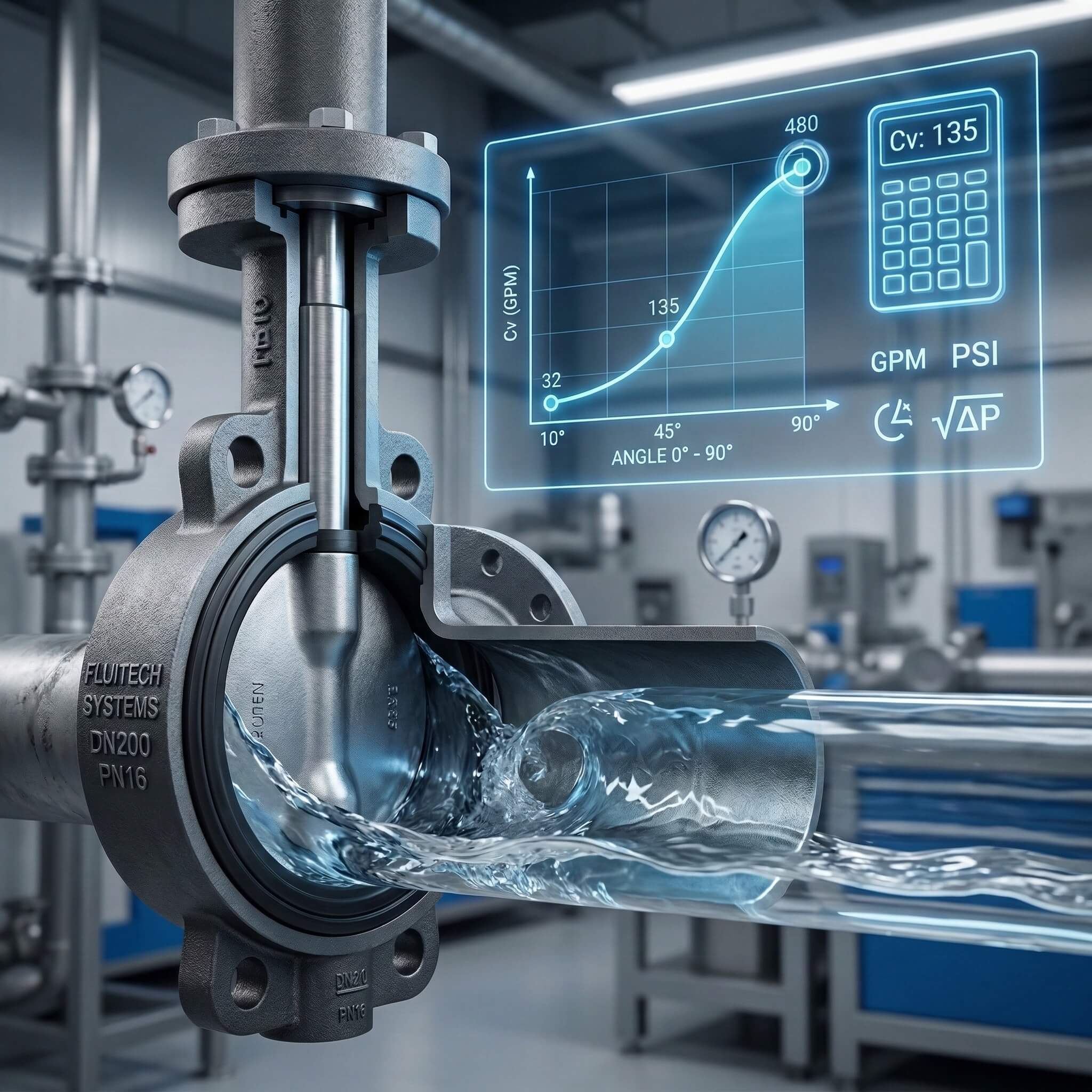
Butterfly valve flow characteristics are the mathematical and physical behaviors of fluid as it passes through a quarter-turn valve at various opening angles. Inefficient fluid management often stems from a poor understanding of flow coefficients, leading to system-wide imbalances and energy waste. Selecting the wrong valve for high-flow applications can cause cavitation, excessive noise, and premature component failure, jeopardizing your entire production schedule. By mastering the specific butterfly valve characteristic of your hardware, you can optimize Cv values and ensure long-term reliability in your industrial piping.
What defines a butterfly valve characteristic?
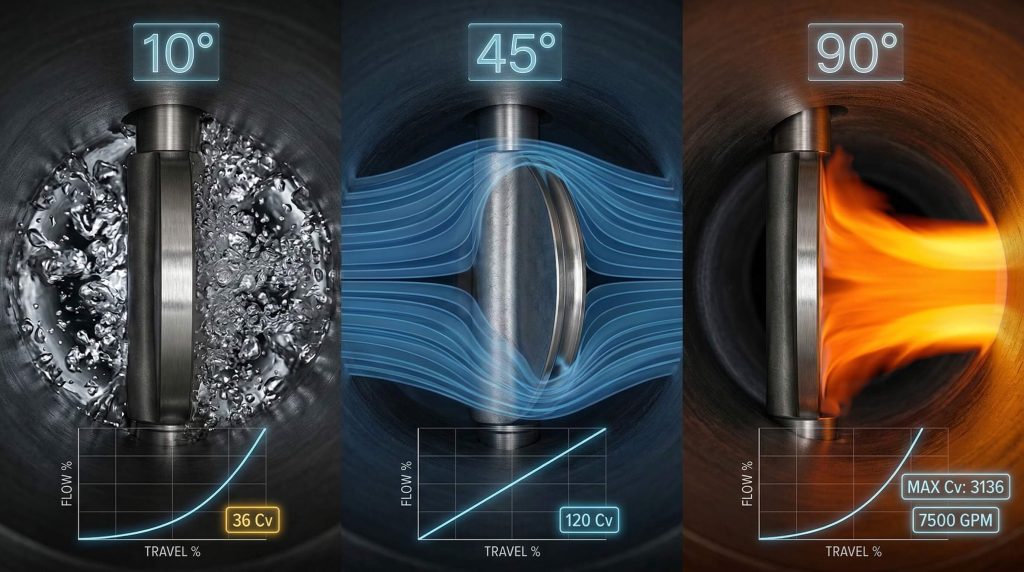
A butterfly valve characteristic is primarily defined by the relationship between the disc’s angular position and the resulting flow capacity (Cv). When you evaluate a butterfly valve characteristic, you are looking at how the internal geometry influences turbulence. This data is essential for engineers sizing actuators and predicting pressure drops. Proper analysis prevents mechanical wear during high-velocity operations.
Quarter-Turn Operational Dynamics
You will notice that the 90-degree rotation of the disc dictates the entire flow profile. As you turn the handle or actuator, the disc moves from a position parallel to the flow to one that is perpendicular. Here is the deal: even minor deviations in the angle can drastically shift the flow volume. This sensitivity makes precision engineering critical for throttling applications.
Core Components and Flow Path
You should focus on how the valve body, stem, and disc interact with the moving media. Each component presents a unique obstruction that contributes to the overall flow profile.
- Body: Houses the internal components and determines the path.
- Stem: Transmits torque to the disc without obstructing the flow excessively.
- Disc: The primary flow control element that pivots within the stream.
Is the disc shape critical for performance?
You can significantly reduce initial flow resistance by selecting an optimized disc geometry. Streamlined discs allow fluid to bypass the obstruction with minimal energy loss compared to flat designs.
Key Takeaway: Understanding the interaction between internal parts and the rotating disc allows you to predict system performance with high accuracy.
| Component | Role in Flow | Impact Level |
|---|---|---|
| Disc | Flow Modulation | High |
| Body | Pressure Containment | Medium |
| Stem | Position Control | High |
The synergy between these components establishes the baseline for all subsequent fluid calculations in your industrial network.
How does Cv impact butterfly valve characteristic?
The flow coefficient, or Cv, impacts the butterfly valve characteristic by quantifying the volume of fluid that can pass through the device at a specific pressure drop. A higher Cv indicates that the butterfly valve characteristic allows for greater flow with less resistance. Engineers use this value to ensure that the pump systems are not overworked. Matching Cv to your system requirements is the first step toward operational efficiency.
The Science of Flow Coefficients (Cv)
You define Cv as the number of gallons per minute (GPM) of 60°F water that will flow through a valve at a 1 psi pressure drop. This standard measurement allows you to compare different valve sizes and models across the industry. But wait, there is more: the Cv value is not static and changes as the valve disc rotates.
Cv Correlation with Opening Angles
You will find that the flow capacity increases exponentially as the valve transitions from 10° to 90°. At low opening angles, the Cv is minimal, restricting flow for fine control. As you reach the full-open position, the Cv reaches its peak, allowing for maximum throughput with minimal restriction.
Standard Cv Values for Industrial Sizes
You can use standard tables to estimate the flow capacity of your specific valve installation. These values vary based on whether you are using a concentric or high-performance eccentric design.
Key Takeaway: Precise Cv data is the foundation of energy-efficient valve selection, preventing costly system imbalances and pump failures.
| Valve Size | 30° Opening Cv | 60° Opening Cv | 90° Opening Cv |
|---|---|---|---|
| DN50 (2″) | 12 | 64 | 135 |
| DN100 (4″) | 36 | 230 | 600 |
| DN200 (8″) | 188 | 1202 | 3136 |
Analyzing these values ensures that your selected hardware can handle peak flow demands without creating unnecessary bottlenecks.
Why is pressure drop a butterfly valve characteristic?
Pressure drop is considered a butterfly valve characteristic because it represents the energy loss incurred as fluid encounters the physical obstruction of the disc. When you analyze the butterfly valve characteristic, you must account for the “K” factor or resistance coefficient. This data helps in predicting the total dynamic head of a piping system. Reducing this drop is a primary goal for any high-performance fluid network.
Energy Loss and Resistance Factors
You can quantify energy loss by examining how the disc shape disrupts the flow path. The bottom line is this: every internal surface that the fluid touches creates friction and turbulence. This resistance translates into a measurable drop in pressure between the inlet and outlet ports.
Turbulence at Partial Openings
You should be aware that turbulence is most significant during the early stages of the opening cycle. As the fluid is forced through a narrow gap between the disc and seat, its velocity increases. This high-velocity state creates vortices that can lead to cavitation if the pressure drops below the fluid’s vapor pressure.
Optimizing for Low-Pressure Systems
You can select streamlined disc designs to minimize these energy losses in sensitive systems. By reducing the thickness of the disc edges, you allow the fluid to rejoin the main stream more smoothly.
Key Takeaway: Minimizing pressure drop through superior disc design directly translates to lower pumping costs and improved system longevity.
| Flow Condition | Resistance Factor | Energy Loss |
|---|---|---|
| Fully Open | Very Low | Minimal |
| 45° Open | Moderate | Significant |
| 10° Open | High | Maximum |
Careful monitoring of these resistance factors prevents mechanical fatigue and ensures the system operates within its designed parameters.
What is a linear butterfly valve characteristic?
A linear butterfly valve characteristic occurs when the flow rate changes in direct proportion to the percentage of the valve’s opening travel. This specific butterfly valve characteristic is highly valued in simple liquid distribution systems. It allows for predictable automation without the need for complex control algorithms. You will find this behavior most often in valves that are properly sized for their specific pipe diameter.
Proportional Flow Control
You can expect that a 50% opening will result in approximately 50% of the maximum flow capacity. You might be wondering: is this always the case in industrial settings? While the theoretical curve is linear, actual installation conditions like pipe friction can slightly skew the results.
Ideal Scenarios for Linear Regulation
You should use linear valves for applications where the system pressure remains relatively constant. This makes them ideal for water supply lines and simple liquid transfers.
- Constant head systems
- Direct distribution networks
- Manual throttling stations
Can linear response simplify automation?
You will find that your actuators require less complex programming when working with linear valves. The direct relationship between signal and output reduces the risk of overshoot in automated control loops.
Key Takeaway: Linear characteristics provide a straightforward and reliable solution for systems where simple, predictable flow control is the priority.
| Opening % | Signal % | Flow % (Linear) |
|---|---|---|
| 25% | 25% | 25% |
| 50% | 50% | 50% |
| 75% | 75% | 75% |
Selecting this profile reduces the engineering time required for system calibration and ensures long-term operational stability.
How does equal percentage butterfly valve characteristic work?
The equal percentage butterfly valve characteristic works by ensuring that the flow increases exponentially rather than proportionally as the disc rotates. This butterfly valve characteristic is essential for systems requiring fine modulation at low flow rates. By providing smaller changes at the start of the stroke, it prevents “hunting” in automated controllers. It is the preferred choice for many thermal management applications.
Exponential Flow Growth
You will see that each increment of opening results in an equal percentage change in the existing flow rate. Now, let’s dive deeper: this means a move from 20% to 30% opening might increase flow by 50% of the current value. This sensitivity allows you to maintain tight control even when the valve is nearly closed.
Fine-Tuning Low-Flow Applications
You can use this characteristic to manage systems where the initial flow requirements are very small. It prevents the sudden “surge” often associated with linear valves at low opening angles.
- Chemical dosing
- Small-scale HVAC balancing
- Precision cooling loops
Heat Exchanger and HVAC Integration
You should integrate equal percentage valves in heat exchangers to compensate for non-linear thermal transfer. This pairing ensures that the heat output remains steady even as fluid volumes fluctuate.
Key Takeaway: Equal percentage profiles provide the precision needed for complex control loops, ensuring high stability in sensitive industrial processes.
| Opening % | Linear Flow | Equal % Flow |
|---|---|---|
| 20% | 20% | 5% |
| 50% | 50% | 25% |
| 80% | 80% | 65% |
This control logic is the industry standard for maintaining equilibrium in systems with varying pressure and temperature demands.
Is fast opening a common butterfly valve characteristic?
Fast opening is a butterfly valve characteristic where the majority of the flow capacity is achieved within the first few degrees of rotation. This butterfly valve characteristic is primarily used for isolation rather than modulation. You will find these valves in emergency shut-off systems or rapid tank-filling operations. It allows for nearly instantaneous flow when the system is activated.
Rapid Initial Saturation
You can achieve maximum flow almost immediately after the disc leaves the seat. Here is the kicker: while this is great for on-off service, it makes throttling nearly impossible. Even a small movement can cause a massive spike in flow, leading to system shock.
On-Off Isolation vs. Throttling
You should use fast-opening designs exclusively for isolation purposes in your piping network. Attempting to throttle with these valves can lead to “water hammer,” which can rupture pipes or damage expensive pumps.
- Emergency isolation valves
- High-speed filling lines
- Drain and blowdown service
Selecting Actuators for High-Speed Cycles
You must pair these valves with fast-acting pneumatic or hydraulic actuators to capitalize on their design. This ensures that the transition from closed to fully open happens in milliseconds when required.
Key Takeaway: Fast-opening characteristics are the ultimate choice for safety and speed, providing immediate flow control in critical industrial environments.
| Opening Angle | Flow Capacity | Application |
|---|---|---|
| 15° | 70% | Isolation |
| 45° | 95% | Isolation |
| 90° | 100% | Full Flow |
This design philosophy prioritizes speed over precision, making it a specialized tool for specific high-stakes industrial tasks.
How does size change every butterfly valve characteristic?
The physical size of the unit changes every butterfly valve characteristic by altering the ratio of the disc area to the pipe diameter. When you increase the size, the butterfly valve characteristic becomes more sensitive to positional changes. Larger valves can handle massive volumes but require more torque to operate. Managing these forces is key to preventing premature failure in large-scale municipal projects.
Sensitivity in Large Diameter Valves
You will notice that a DN1200 valve exhibits much higher sensitivity at small opening angles than a DN50 unit. It gets better: even a 1-degree movement in a large valve can release thousands of gallons per minute. You must account for this sensitivity when choosing your control systems.
Managing High-Velocity Media
You should be careful when handling high-velocity fluids in larger valves to prevent erosion. The edges of the disc are particularly susceptible to wear when they are only partially open in a high-speed stream.
- Use hardened materials for large disc edges.
- Install flow straighteners upstream.
- Monitor for vibrations in the valve stem.
Does larger size always mean higher efficiency?
You can achieve higher Cv values with larger valves, but you must balance this against the space and weight constraints of your facility. Larger units often require heavy-duty gearboxes or high-output actuators to overcome fluid torque.
Key Takeaway: Scaling up your valve size requires a corresponding increase in control precision and structural reinforcement to maintain system integrity.
| Size Range | Primary Benefit | Main Challenge |
|---|---|---|
| DN50-DN300 | High Precision | Limited Flow |
| DN400-DN800 | High Throughput | Torque Management |
| DN900+ | Industrial Capacity | Control Sensitivity |
Understanding these size-based shifts ensures that your large-bore installations remain safe and efficient throughout their lifecycle.
Which design alters the butterfly valve characteristic?
The internal design, such as concentric or eccentric offsets, radically alters the butterfly valve characteristic by changing how the disc seats. While a gate valve uses a vertical wedge, the butterfly valve relies on a rotating disc that can be offset to reduce friction. This mechanical shift impacts the seal integrity and the torque required for operation. Choosing the right offset is the difference between a leaky system and a high-performance network.
Concentric vs. Eccentric Offsets
You will find concentric designs in low-pressure systems where the stem passes through the center of the disc. Think about this: this design is simple but causes high friction against the seat. Eccentric designs, including double and triple offsets, move the stem away from the sealing surface to minimize wear.
Disc Geometry and Turbulence Reduction
You can optimize the flow path by selecting thin-profile or contoured discs. These designs are often found in high-performance valves intended for gas or high-velocity liquid service.
- Thin discs: Reduce physical obstruction.
- Contoured discs: Guide fluid smoothly around the stem.
- Specialized coatings: Reduce surface friction.
Material Selection and Surface Finish
You should consider that even the surface roughness of the disc can impact the flow coefficient. Polished stainless steel discs offer lower resistance than cast iron alternatives, especially in food and beverage applications. You might also compare these to a ball valve or a check valve depending on your specific layout requirements.
Key Takeaway: Advanced eccentric designs offer superior sealing and flow control, making them the standard for high-pressure industrial applications.
| Design Type | Sealing Style | Performance Level |
|---|---|---|
| Concentric | Interference Seal | Standard |
| Double Offset | Cam-Action Seal | High |
| Triple Offset | Metal-to-Metal | Extreme |
Selecting the appropriate design ensures that your hardware can withstand the rigors of high-cycle industrial service without losing its sealing capability.
How does temperature limit butterfly valve characteristic?
Temperature limits every butterfly valve characteristic by affecting the material properties of the seals and the expansion of the metal components. A high butterfly valve characteristic can be compromised if the seat deforms due to extreme heat. You must ensure that your valve selection matches the thermal profile of your media. Failure to do so can result in seized stems or catastrophic leaks during thermal cycles.
Thermal Expansion and Sealing Integrity
You will experience changes in the interference between the disc and seat as temperatures rise. Here is the truth: different materials expand at different rates. If your valve uses a rubber seat, it may swell in high temperatures, increasing the torque required to close it.
Cold-Start Risks and Material Brittleness
You should be wary of using standard ductile iron valves in cryogenic or sub-zero environments. At extremely low temperatures, metals can become brittle and fracture under the stress of operation.
- Use stainless steel for low-temp service.
- Select PTFE or metal seats for high-temp service.
- Ensure actuators are rated for the environment.
Maintaining Torque Consistency
You can maintain consistent operation by choosing valves designed with thermal expansion joints or specialized clearances. This prevents the disc from becoming stuck in the seat during a sudden temperature spike.
Key Takeaway: Thermal management is non-negotiable for valve reliability, requiring a perfect match between material science and operational reality.
| Temperature Range | Recommended Seal | Body Material |
|---|---|---|
| -20°C to 120°C | EPDM / NBR | Ductile Iron |
| 120°C to 200°C | PTFE / Viton | Carbon Steel |
| 200°C+ | Metal Seat | Stainless Steel |
Careful attention to these thermal limits protects your infrastructure from the damaging effects of expansion and contraction.
Can pressure affect each butterfly valve characteristic?
Pressure affects each butterfly valve characteristic by exerting force on the disc, which can influence sealing and torque. High-pressure systems can cause the disc to deflect, potentially altering the butterfly valve characteristic during high-flow events. You must select a pressure rating that exceeds your system’s maximum surge potential. This ensures that the valve remains functional even during unexpected process upsets.
Dynamic Torque and Static Pressure
You will feel the impact of media pressure most when trying to open or close the valve. Look at it this way: the pressure pushes against the disc like wind against a sail. High differential pressure requires significantly more torque to overcome, which must be reflected in your actuator sizing.
Vacuum Application Constraints
You should know that standard butterfly valves are not always suitable for high-vacuum service. The seals are often designed to hold pressure in one direction, and a vacuum can pull the seat away from the body, leading to a failure.
- Specialized reinforced seats for vacuum.
- Bubble-tight testing protocols.
- Double-offset designs for better suction resistance.
High-Pressure Sealing Technologies
You can leverage triple-offset technology for critical high-pressure steam or oil lines. These valves use a non-rubbing, metal-to-metal seal that remains tight even under thousands of pounds of pressure.
Key Takeaway: Pressure management requires robust engineering and specialized sealing technologies to ensure safety and performance in high-stress environments.
| Pressure Class | Typical Rating | Application |
|---|---|---|
| PN10 | 150 psi | Water / HVAC |
| PN16 | 230 psi | Industrial Process |
| PN25+ | 360+ psi | Steam / Oil & Gas |
Monitoring these pressure thresholds is essential for preventing structural damage and ensuring the long-term safety of your facility.
Conclusion
Selecting the right valve involves more than just matching pipe diameters; it requires a deep dive into flow coefficients and resistance patterns. At Ruitoflow, we provide the technical documentation and ISO-certified hardware necessary to ensure your fluid systems operate at peak efficiency. We solve the challenges of cavitation, energy waste, and mechanical wear with precision engineering and traceable quality assurance. For a personalized consultation on your next EPC or municipal project, contact us today to secure precision-engineered valve solutions that guarantee long-term performance. Our vision is to empower global industry with reliable, cost-effective fluid control systems that never compromise on safety.
Frequently Asked Questions
- Can I use a butterfly valve for high-pressure gas?
Yes, but you must use specialized high-performance or triple-offset designs. Standard soft-seated valves may not handle the high velocities and potential for seat erosion found in gas applications. - What is the best butterfly valve characteristic for HVAC?
The equal percentage characteristic is typically the best choice for HVAC systems. It compensates for the non-linear heat transfer of coils, providing much more stable temperature control. - How do I know if the Cv value matches my pump?
You must calculate the required Cv using the maximum flow rate and your allowable pressure drop. If the valve’s Cv is too low, your pump will have to work harder, wasting energy and potentially failing early. - Can I achieve zero leakage with an eccentric disc?
Yes, high-performance eccentric valves with PTFE or metal seats are engineered for Class VI bubble-tight shut-off. This makes them suitable for critical isolation in chemical and petrochemical plants. - What is the best way to calculate pressure drop?
The standard formula for pressure drop is ΔP = G × (Q / Cv)², where G is the specific gravity of the fluid and Q is the flow rate. Using accurate Cv data from the manufacturer is essential for a correct result.