
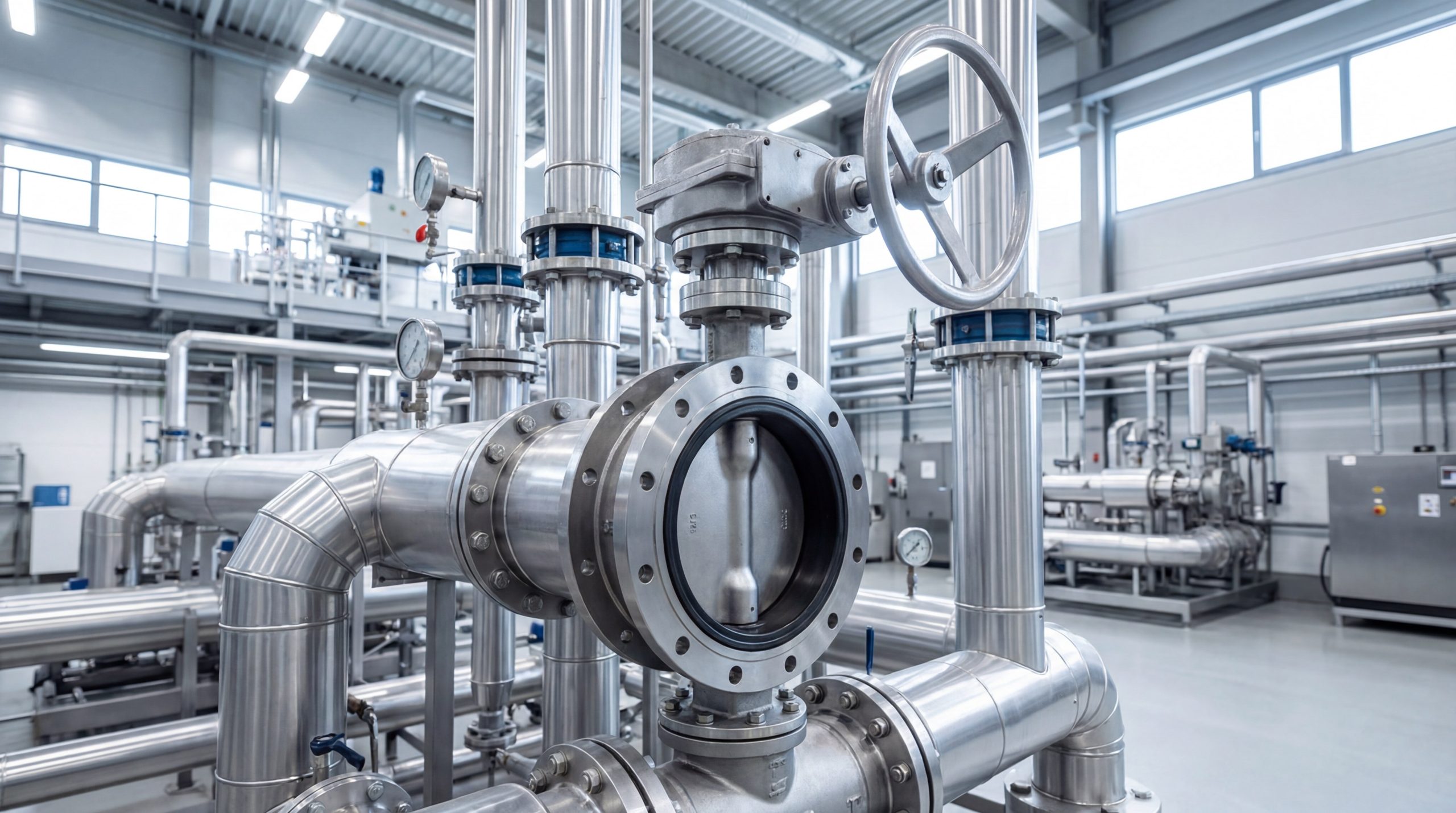
Butterfly valve flow characteristics and the Cv coefficient define the relationship between the degree of valve opening and the volume of fluid passing through the system at a specific pressure drop. Imagine you are managing a high-pressure municipal water network where a slight fluctuation in flow can cause water hammer or pipe fatigue. You face the constant struggle of balancing system demand with mechanical stability, often dealing with the noise and vibration that signal an improperly sized valve.
If you ignore the specific flow profile of your equipment, you risk cavitation and premature seat erosion, leading to expensive emergency shutdowns. The solution is to integrate a precisely mapped butterfly valve flow characteristic curve into your system design to ensure predictable throttling and isolation.
What defines the butterfly valve flow characteristic curve?
The butterfly valve flow characteristic curve is a graphical representation of how the flow coefficient (Cv) changes as the valve disc rotates from 0° to 90°. It serves as the primary data set for engineers to determine if a valve can handle modulating service or is limited to simple on-off isolation.
Understanding the Flow Coefficient (Cv)
The Cv value indicates the GPM of water that will pass through the valve with a 1 PSI pressure drop. You use this metric to size your pumps and piping correctly to avoid over-pressurization.
- Cv definition: Gallons per minute at 1 PSI drop.
- Kv definition: Cubic meters per hour at 1 bar drop.
- Conversion: Cv = 1.156 x Kv.
Think about it:
Without a verified Cv, your system sizing is essentially guesswork.
| Angle | Flow Characteristic | Control Profile |
|---|---|---|
| 0° – 30° | Minimal Flow | High Sensitivity |
| 30° – 70° | Linear Growth | Optimal Control |
| 70° – 90° | Maximum Flow | Full Capacity |
Accurate Cv mapping ensures that the valve operates within its most stable physical range.
Key Takeaway
Utilizing a verified characteristic curve allows you to predict system behavior with 99% accuracy, preventing mechanical failures and ensuring long-term operational efficiency.
How does the butterfly valve flow characteristic curve affect Cv?
The butterfly valve flow characteristic curve dictates the specific Cv value at every increment of disc rotation, identifying the valve’s capacity at partial openings. Because the disc remains in the flow stream, the geometry of the obstruction significantly influences the coefficient compared to full-bore valves.
Disc Obstruction and Capacity
Even when fully open, the thickness of the disc reduces the total available area for fluid passage. You must account for this inherent resistance when calculating your system’s total head loss.
- Full Open: Disc is parallel to flow.
- Partial Open: Disc creates turbulence.
- Full Closed: Disc seals against the seat.
But here is the kicker:
A thin-profile disc can increase your Cv by up to 15% in the same nominal pipe size.
| Opening % | Relative Cv | Flow State |
|---|---|---|
| 25% | 15% of Max | Throttling |
| 50% | 45% of Max | Mid-Range |
| 100% | 100% of Max | Full Flow |
The relationship between opening percentage and Cv is non-linear, requiring careful calibration of the actuator.
Key Takeaway
By understanding how the curve impacts Cv at partial angles, you can select an actuator that provides the necessary torque and precision for your specific flow requirements.
Is the butterfly valve flow characteristic curve linear or equal?
Most standard butterfly valves exhibit a “Modified Equal Percentage” or “Linear” butterfly valve flow characteristic curve depending on their internal geometry and seat design. The equal percentage profile is highly valued for modulating service because it provides finer control at lower flow rates.
Linear Flow vs Equal Percentage
In a linear system, the flow rate is directly proportional to the disc’s angle of rotation. However, you often find that equal percentage is better for heat exchangers where temperature control requires logarithmic adjustments.
- Linear: Constant sensitivity across the stroke.
- Equal %: Higher sensitivity as the valve opens wider.
- Modified: A hybrid approach for general industrial use.
The best part?
An equal percentage curve prevents the “hunting” effect in automated control loops.
| Characteristic | Response Rate | Application |
|---|---|---|
| Linear | Proportional | Constant Pressure |
| Equal % | Logarithmic | Temperature Control |
| Modified | Hybrid | General Water/HVAC |
The choice between these curves depends entirely on whether your priority is simple volume control or complex process modulation.
Key Takeaway
Selecting the correct curve type eliminates system instability, ensuring that your automated controllers can maintain setpoints without overshooting or oscillating.
How to calculate the butterfly valve flow characteristic curve?
To calculate the butterfly valve flow characteristic curve, you must use the standard formula where Cv is equated to the flow rate divided by the square root of the pressure drop. This calculation is essential when specifying valves for critical EPC and OEM projects where documentation is mandatory.
The Standard Sizing Formula
You apply the formula $Cv = Q \sqrt{SG / \Delta P}$ to find the required coefficient for your specific process conditions. This ensures the valve is neither oversized, which causes hunting, nor undersized, which causes excessive pressure drop.
- Q: Flow rate in GPM.
- SG: Specific gravity of the fluid.
- Delta P: Pressure drop across the valve.
But wait, there’s more:
You also need to account for the pipe’s internal diameter, as it creates a “piping geometry factor” that adjusts the theoretical curve.
| Variable | Unit | System Impact |
|---|---|---|
| Q | GPM | Defines Capacity |
| SG | Ratio | Affects Density |
| Delta P | PSI | Determines Energy Loss |
Calculating these values accurately prevents the valve from operating in the high-noise cavitation zone.
Key Takeaway
Precise mathematical modeling of the flow curve reduces energy consumption by ensuring your pumps aren’t working against unnecessary valve resistance.
Does size impact the butterfly valve flow characteristic curve?
Yes, the nominal diameter of the valve significantly shifts the butterfly valve flow characteristic curve, as larger valves generally have a more favorable ratio of open area to disc thickness. As you move from DN50 to DN1200, the flow behavior becomes more predictable and less turbulent.
Size vs. Flow Sensitivity
Smaller valves are more sensitive to slight adjustments in disc position. You will notice that a 5-degree change in a DN50 valve has a much larger percentage impact on flow than in a DN1000 valve.
- DN50-DN300: High sensitivity, fast response.
- DN350-DN600: Moderate control, stable throttling.
- DN700-DN3000: High flow capacity, low pressure drop.
The bottom line:
Larger valves offer much higher Cv values with proportionally lower energy loss per unit of volume.
| Valve Size (DN) | Full Open Cv (Typical) | Control Range |
|---|---|---|
| 50 | 135 | 30° – 75° |
| 300 | 8,250 | 25° – 80° |
| 1000 | 119,750 | 20° – 85° |
Scaling the valve size correctly ensures that your flow velocity remains within the recommended 3-5 m/s range.
Key Takeaway
Matching the valve size to the flow characteristic ensures that your system operates at peak efficiency without the risk of localized erosion or vibration.
Can offset designs alter the butterfly valve flow characteristic curve?
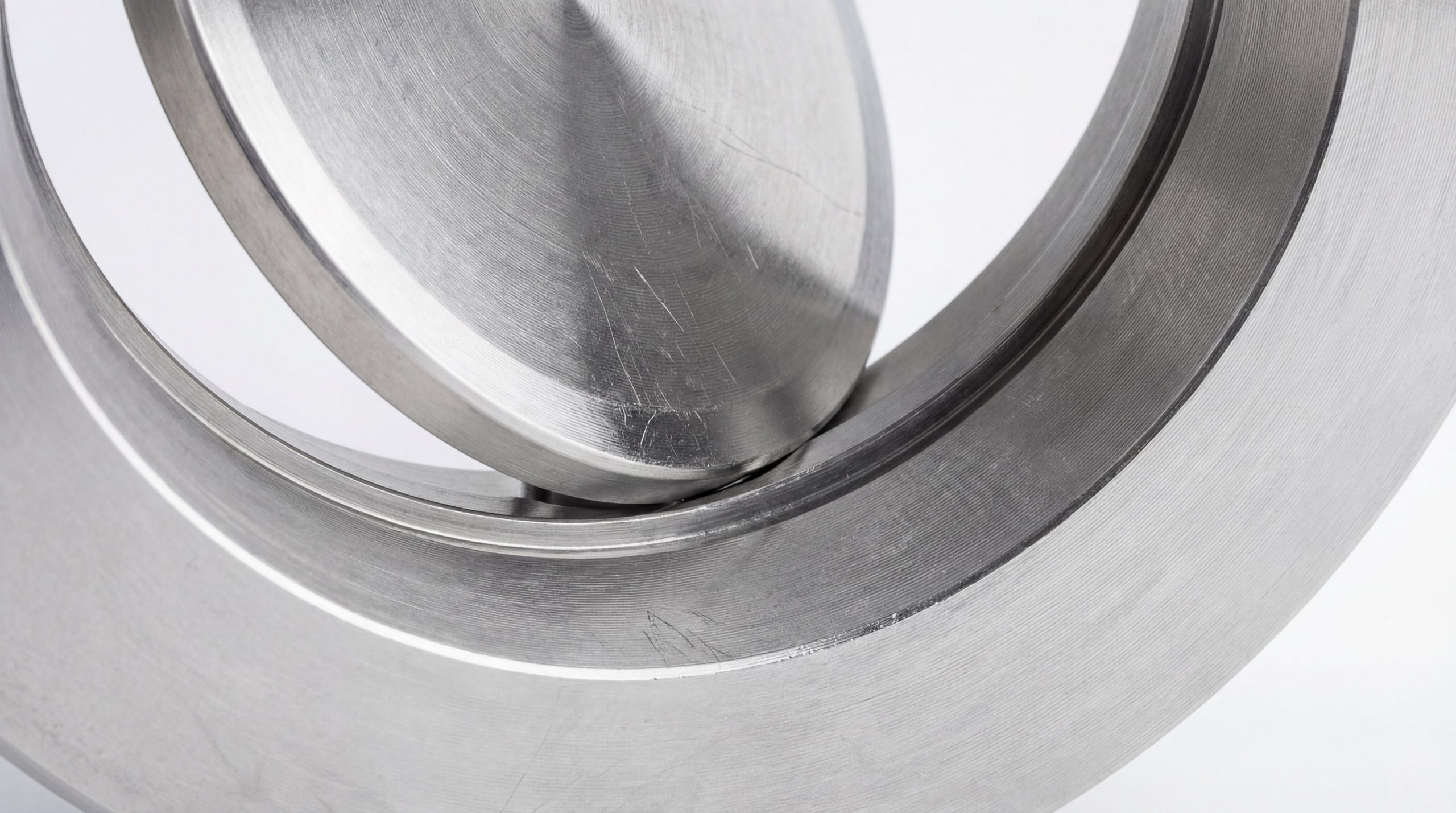
High-performance double and triple offset designs significantly modify the butterfly valve flow characteristic curve by changing how the disc interacts with the seat. These designs lift the disc out of the seat immediately upon rotation, reducing friction and allowing for a smoother initial flow profile.
Eccentric vs. Concentric Profiles
Concentric designs often create more initial turbulence because the disc stays in contact with the seat longer. In contrast, you will find that eccentric designs provide a more consistent equal percentage curve for high-pressure applications.
- Concentric: Ideal for low-pressure water/HVAC.
- Double Offset: Best for steam and chemical processing.
- Triple Offset: Required for high-pressure, zero-leakage service.
Think about it:
If the disc rubs against the seat during the first 10 degrees, you lose precision exactly where you need it most.
| Design Type | Seat Contact | Flow Efficiency |
|---|---|---|
| Concentric | Continuous | Standard |
| Double Offset | Minimal | High |
| Triple Offset | Zero (until closed) | Maximum |
Offset valves are engineered for systems where mechanical wear and flow accuracy cannot be compromised.
Key Takeaway
Switching to an offset design provides a more repeatable and durable flow characteristic, especially in high-cycle or high-pressure environments.
What is the best butterfly valve flow characteristic curve range?
For most industrial applications, the most effective part of the butterfly valve flow characteristic curve is found between 30 degrees and 70 degrees of disc opening. Operating outside of this range often leads to poor control resolution or excessive mechanical stress on the valve components.
Avoiding the Danger Zones
You should avoid throttling below 20 degrees, as the high-velocity fluid can “wire-draw” the seat, leading to permanent leakage. Conversely, above 80 degrees, the valve provides very little additional control for the amount of rotation.
- 0-20°: Risk of seat erosion and cavitation.
- 30-70°: Optimal control and modulation range.
- 80-90°: Maximum flow with minimal control gain.
But here is the kicker:
A valve that is always 90% open is likely oversized and represents a wasted investment in hardware.
| Opening Angle | Control Stability | Risk Factor |
|---|---|---|
| 15° | Very Poor | High (Erosion) |
| 45° | Excellent | Low |
| 85° | Poor | Low (Capacity) |
Maintaining your operating setpoint in the 50% open range gives you the flexibility to handle both surge flows and low-demand periods.
Key Takeaway
Staying within the 30-70 degree window maximizes the lifespan of your valve seats while providing the most stable process control.
How does pressure drop impact butterfly valve flow characteristic curve?
A high pressure drop (Delta-P) across the butterfly valve flow characteristic curve accelerates the fluid velocity, which can lead to noise, vibration, and cavitation. You must balance the need for flow control with the physical limitations of the valve materials and the surrounding piping.
Cavitation and Choked Flow
When the pressure drop is too high, the liquid can reach its vapor pressure, forming bubbles that collapse violently against the disc. This phenomenon can destroy a stainless steel disc in a matter of weeks if the curve is not properly managed.
- Symptom: Loud “gravel” noise in the pipes.
- Cause: High Delta-P relative to inlet pressure.
- Result: Pitting on the disc and seat surfaces.
The best part?
Selecting a valve with a high-recovery characteristic can help mitigate these pressure drop issues.
| Delta-P State | Fluid Behavior | Recommended Action |
|---|---|---|
| Low (< 5 PSI) | Laminar/Stable | Standard Operation |
| Mid (5-15 PSI) | Minor Turbulence | Monitor Vibration |
| High (> 15 PSI) | Risk of Cavitation | Install Anti-Cavitation Trim |
Managing pressure drop is a critical step in ensuring the “quiet” operation of your industrial facility.
Key Takeaway
Controlling the pressure drop across the valve prevents the destructive forces of cavitation, ensuring your system remains on-line and maintenance-free.
Can seals modify the butterfly valve flow characteristic curve?
The material and profile of the seat seal can subtly change the butterfly valve flow characteristic curve by altering the internal diameter and the “breakaway” torque required to start the flow. Soft elastomer seats like EPDM or NBR provide a tighter shut-off but may slightly compress and change the flow path at high pressures.
Seating Interference and Flow
You must consider how the seal’s protrusion into the flow stream affects the Cv at small opening angles. Metal-to-metal seats in high-performance valves offer a more rigid geometry, ensuring the characteristic curve remains consistent over thousands of cycles.
- EPDM/NBR: Excellent sealing, moderate flow impact.
- PTFE: Low friction, chemical resistance.
- Metal: Consistent geometry, high-temperature stability.
But wait, there’s more:
A worn seat can actually increase your Cv slightly while losing its ability to provide bubble-tight shut-off.
| Seal Material | Friction Level | Geometry Stability |
|---|---|---|
| Elastomer | High | Moderate |
| PTFE | Low | High |
| Metal | Moderate | Very High |
Selecting the right seal ensures that the valve’s performance matches the theoretical curve for its entire service life.
Key Takeaway
By choosing a seal material that matches your media and pressure, you guarantee that the flow characteristics remain within the design specifications.
How do I know if the butterfly valve flow characteristic curve is off?
If your system experiences unpredictable surges or if the actuator is constantly “hunting” for a position, your actual butterfly valve flow characteristic curve likely deviates from the design data. This often happens due to internal buildup, seat wear, or improper installation relative to pipe bends.
Troubleshooting Flow Discrepancies
You can identify curve shifts by comparing the actual flow rate at a specific angle to the manufacturer’s Cv table. If there is a discrepancy of more than 10%, it is time to inspect the valve for disc pitting or debris.
- Hunting: Actuator moves back and forth constantly.
- Lag: Flow doesn’t increase when the valve opens.
- Surge: Flow jumps suddenly at a certain angle.
The bottom line:
A simple flow test can save you thousands in energy costs and prevented downtime.
| Symptom | Probable Cause | Diagnostic Step |
|---|---|---|
| Unstable Flow | Upstream Turbulence | Check pipe distance |
| Reduced Max Cv | Internal Build-up | Visual Inspection |
| Poor Throttling | Oversized Valve | Recalculate Cv |
Regular monitoring ensures that your valves continue to provide the precise control required for modern industrial processes.
Key Takeaway
Routine verification of the flow curve identifies potential failures before they occur, allowing for scheduled maintenance rather than emergency repairs.
Conclusion
Understanding the butterfly valve flow characteristic curve and the Cv coefficient is the only way to ensure precision in modern fluid control. We have explored how disc geometry, size, and pressure drop interact to define system stability and efficiency. By applying these engineering principles, you eliminate the risks of cavitation, vibration, and energy waste.
If you are ready to optimize your industrial process with precision-engineered valves, contact us today for a technical consultation.
Brand Stance: RUITO is committed to providing traceable, high-reliability valve solutions that meet the most demanding international standards for EPC and OEM projects worldwide.
Frequently Asked Questions
Can I use a butterfly valve for high-precision gas throttling?
Yes, but only if you select a high-performance double or triple offset design with an equal percentage characteristic. Standard concentric valves may lack the resolution needed for sensitive gas applications.
What’s the best way to prevent cavitation in butterfly valves?
The best way is to ensure the pressure drop across the valve remains within the manufacturer’s recommended limits and to avoid operating the valve at opening angles below 20 degrees.
How do I know if my butterfly valve is oversized?
If your valve spends most of its operational life open less than 20% to maintain the required flow rate, it is definitely oversized and will suffer from poor control and seat wear.
Can I replace a gate valve with a butterfly valve to save space?
Yes, in most cases you can replace a gate valve with a butterfly valve, which offers a significant weight reduction and a much shorter face-to-face dimension, provided the pressure drop is acceptable.
How do I know if the Cv value includes the actuator’s influence?
The Cv value is a mechanical property of the valve body and disc; however, the actuator must be sized to ensure the valve can reach the specific angles required to achieve those Cv values under full line pressure.