
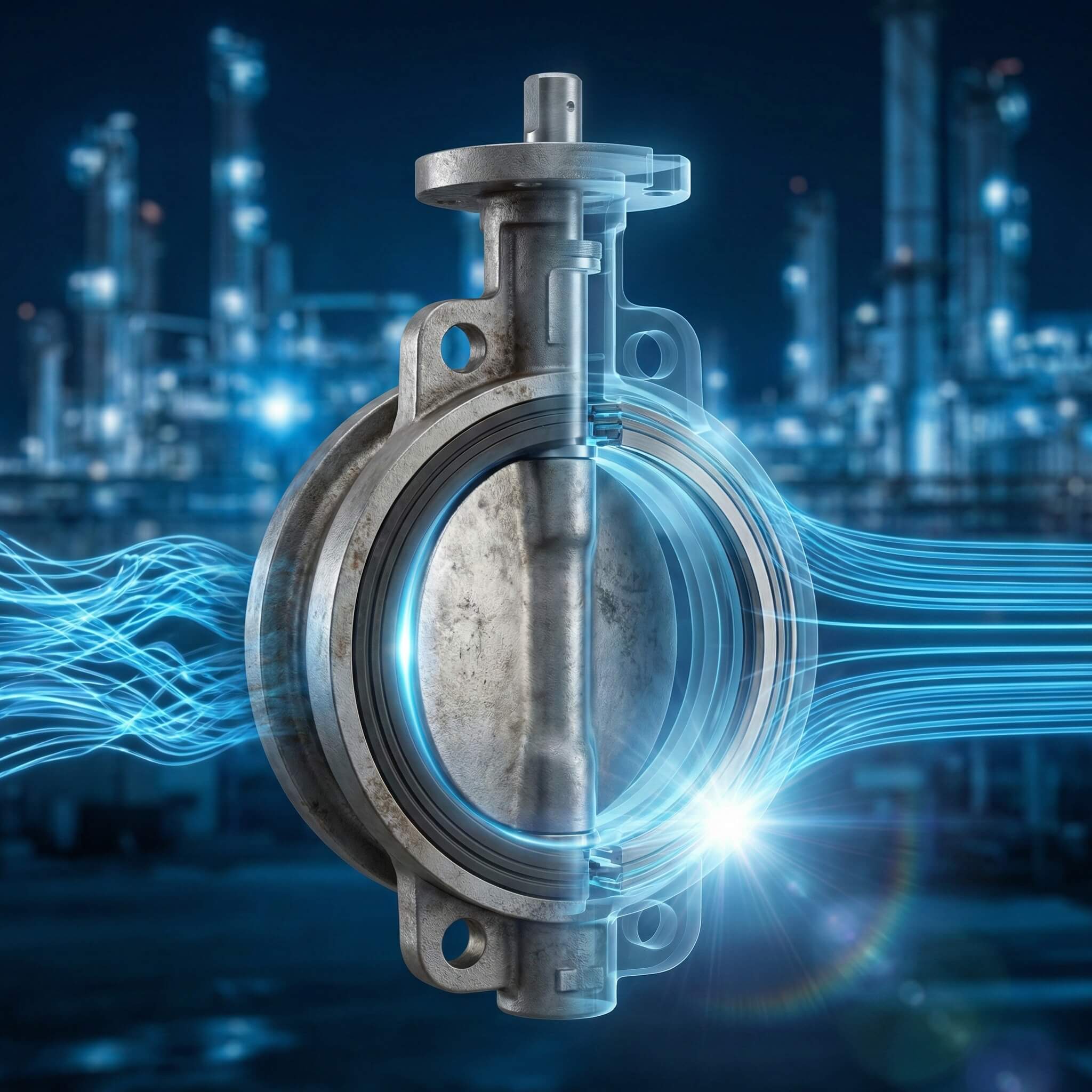
High-performance butterfly valves ensure operational reliability by utilizing offset geometry and advanced metallurgy to withstand intense industrial pressure. Conventional valves often struggle with high-pressure spikes and extreme temperatures, leading to seat erosion, leaks, and costly system downtime. In industries like oil and gas or chemical processing, a minor leak due to insufficient butterfly valve pressure handling can result in environmental hazards, safety violations, and significant financial losses. The solution lies in RUITO high-performance designs, featuring double and triple offset engineering that provides the robust sealing required for the most demanding environments.
What defines high-performance butterfly valve pressure?
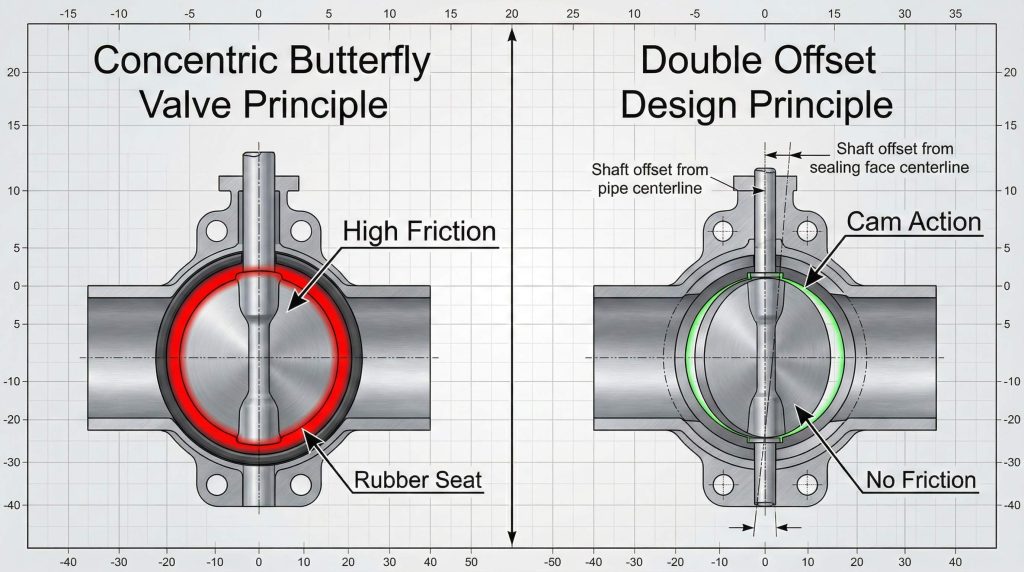
High-performance butterfly valve pressure management is defined by the valve’s ability to maintain a bubble-tight seal under rigorous stress. You must look beyond standard concentric models to find the durability required for industrial scaling. These valves integrate specialized materials and geometric offsets that facilitate higher pressure-to-weight ratios than generic alternatives.
The concept of eccentricity in valve design
Here’s the deal: standard valves use a central stem that forces the disc into the seat throughout the entire stroke. High-performance models utilize eccentric (offset) shafts to move the disc away from the seat during travel. This reduces friction and allows the valve to handle higher pressure loads without wearing out the sealing surface.
- Single Offset: The stem is located behind the centerline of the sealing surface.
- Double Offset: The stem is both behind the centerline and slightly to one side.
- Triple Offset: Adds a third geometric offset in the sealing cone.
Why is bi-directional sealing important?
Bi-directional sealing ensures that the valve can hold back pressure from either side of the pipeline. In complex systems, flow back-pressure can occur unexpectedly, making this feature a critical safety requirement. You gain peace of mind knowing the valve won’t fail if the system experiences a reverse flow surge.
- Prevents downstream contamination during maintenance.
- Reduces the risk of seat blowout under vacuum conditions.
- Enhances overall system flexibility in multi-directional piping.
Key Takeaway: High-performance valves are defined by their offset stems and specialized materials that allow them to exceed the limitations of general-purpose valves.
| Feature | Standard Valve | High-Performance Valve |
|---|---|---|
| Stem Design | Concentric | Double or Triple Offset |
| Sealing Friction | Continuous during rotation | Minimized through eccentricity |
| Pressure Rating | Typically lower (PN10/16) | High (PN25/40/ANSI Class) |
Eccentric design directly correlates with a reduction in mechanical wear, which is the primary driver of long-term reliability in pressure-heavy systems.
How does structure impact butterfly valve pressure?
The internal structure of the valve determines how it distributes forces when managing butterfly valve pressure in a live system. You will find that high-performance structures are engineered to eliminate the “scrubbing” action that destroys standard resilient seats. By optimizing the contact angle, these valves provide a more secure seal at higher operating loads.
Limitations of general-use elastomers
Think about this: standard elastomer seats often deform or tear when exposed to high-velocity flow or pressure spikes. While they are cost-effective for water, they lack the chemical and thermal resistance required for steam or corrosive chemicals. Using the wrong material can lead to premature failure and total system shutdown.
- EPDM and Buna-N have limited temperature ranges.
- Elastomers can “cold flow” or lose shape under high static pressure.
- Chemical degradation can harden the seat, causing it to crack.
How does double-offset positioning reduce seat wear?
The double-offset design is specifically engineered to lift the disc off the seat almost immediately upon opening. This “cam action” means the disc only contacts the seat during the final degrees of closing. You effectively eliminate the friction that would otherwise compromise the integrity of the seal over time.
- Reduces operating torque, allowing for smaller actuators.
- Extends the life of the seat by 3 to 5 times.
- Ensures consistent sealing performance across thousands of cycles.
Key Takeaway: Moving the disc center away from the seat center minimizes friction and significantly extends the valve’s operational life.
| Component | Structural Benefit | Impact on Pressure |
|---|---|---|
| Offset Stem | Reduces seat contact | Decreases mechanical fatigue |
| Disc Geometry | Optimized flow profile | Minimizes turbulence and erosion |
| Cam Action | Rapid seat disengagement | Lowers torque and seal wear |
A structural shift from concentric to double-offset is the most cost-effective way to upgrade a system’s pressure handling capabilities without increasing weight.
Why is butterfly valve pressure handling critical?
In heavy industry, butterfly valve pressure handling is the primary barrier between controlled production and a catastrophic system failure. You cannot afford to underestimate the impact of fluid velocity and pressure surges on your hardware. High-performance valves are designed to absorb these shocks while maintaining a zero-leakage profile.
Understanding the impact of high-velocity flow
High-velocity flow creates a “venturi effect” that can cause disc flutter if the valve isn’t structurally sound. Why does this matter? Constant vibration leads to stem fatigue and seat deformation, eventually allowing media to bypass the seal. High-performance valves use reinforced stems to ensure the disc remains stable under high flow rates.
- Reduces noise and vibration in the pipeline.
- Prevents cavitation damage on the downstream side.
- Maintains precise flow control even at partial openings.
How does temperature affect the maximum pressure rating?
You must remember that as temperatures rise, the maximum allowable pressure of any valve material decreases. A valve rated for 40 bar at room temperature might only safely handle 25 bar at 200°C. High-performance valves use materials that retain their tensile strength at elevated temperatures to prevent body deformation.
- Consult P-T (Pressure-Temperature) charts for every application.
- Consider the thermal expansion of the seat material.
- Select metal-seated valves for temperatures exceeding 250°C.
Key Takeaway: Selecting a valve with a pressure rating that accounts for thermal fluctuations is vital for maintaining system integrity.
| Parameter | Impact | Requirement |
|---|---|---|
| High Velocity | Disc instability | Reinforced stem support |
| Low Temperature | Material brittleness | Specialized cryogenic alloys |
| High Temperature | Seat softening | Metal or reinforced PTFE seats |
The synergy between temperature control and pressure containment is the foundation of a safe industrial piping layout.
What materials affect butterfly valve pressure?
Material selection is the first line of defense in managing butterfly valve pressure and preventing internal corrosion. You need to match the metallurgy of the valve body and disc to the chemical profile of your media. Choosing the wrong alloy can lead to “pitting,” which creates localized pressure points and eventual leaks.
Stainless steel vs. Carbon steel: Which should you choose?
Is it worth the investment? Carbon steel is excellent for high-pressure applications where corrosion is not a major concern, such as oil or gas transport. However, for corrosive chemical processing or food-grade applications, stainless steel is mandatory to maintain structural integrity.
- WCB Carbon Steel: Cost-effective, high tensile strength.
- 316 Stainless Steel: Superior corrosion resistance, better for high temperatures.
- Duplex Steel: Combines high strength with exceptional resistance to stress corrosion.
The role of PTFE and Graphite in seat design
The seat material is what actually holds the pressure against the disc surface. PTFE (Teflon) is preferred for its low friction and chemical inertness, but it can be reinforced with glass or carbon for higher pressure. In extreme fire-safe or high-heat scenarios, graphite-reinforced metal seats are the industry standard.
- Virgin PTFE: Best for chemical purity.
- Reinforced PTFE: Higher pressure resistance.
- Flexible Graphite: Used in fire-safe designs to maintain a seal during a blaze.
Key Takeaway: Material selection must be precisely matched to the chemical reactivity and pressure requirements of the media.
| Material Type | Max Temperature | Chemical Resistance |
|---|---|---|
| Carbon Steel | Up to 425°C | Moderate |
| 316 Stainless | Up to 550°C | High |
| PTFE (Seat) | Up to 200°C | Excellent |
Correct material pairing prevents galvanic corrosion, which is a hidden killer of valve pressure ratings in offshore or chemical environments.
How does cam action influence butterfly valve pressure?
The “cam action” of a high-performance valve is the mechanical secret to its superior butterfly valve pressure performance. You will notice that as the valve begins to open, the disc moves in a double-eccentric path that creates a “camming” effect. This ensures that the seal is only engaged when it is absolutely necessary to stop flow.
The mechanics of cam action sealing
How does this work? In a double-offset valve, the first offset allows the disc to rotate away from the seat, and the second offset moves it away from the centerline. This combination causes the disc to lift off the seat like a cam, preventing any dragging or scraping.
- Eliminates seat deformation at the top and bottom of the stem.
- Allows for a 360-degree uninterrupted sealing surface.
- Provides a tighter seal the more pressure is applied (pressure-assisted).
Can double offset valves handle bi-directional flow efficiently?
Yes, they can, but here is the deal: the pressure-assisted nature of the seal means one direction is usually “preferred.” When pressure comes from the seat-side, it pushes the seat into the disc, creating a tighter seal. When it comes from the disc-side, the mechanical torque of the actuator must be sufficient to maintain the seal.
- Ensure your actuator is sized for the “unpreferred” flow direction.
- Verify that the seat is retained securely in the body.
- Use bi-directional tested valves for manifold applications.
Key Takeaway: The “cam action” allows the disc to lift off the seat immediately upon opening, reducing torque and wear.
| Movement Stage | Cam Action Effect | Pressure Result |
|---|---|---|
| Initial Opening | Rapid disc lift | Reduced torque requirement |
| Full Rotation | Zero seat contact | No frictional wear during stroke |
| Final Closing | Compression seal | High-integrity pressure barrier |
The mechanical advantage provided by cam action allows for precise control even when the valve is under full line pressure.
Is triple offset best for butterfly valve pressure?
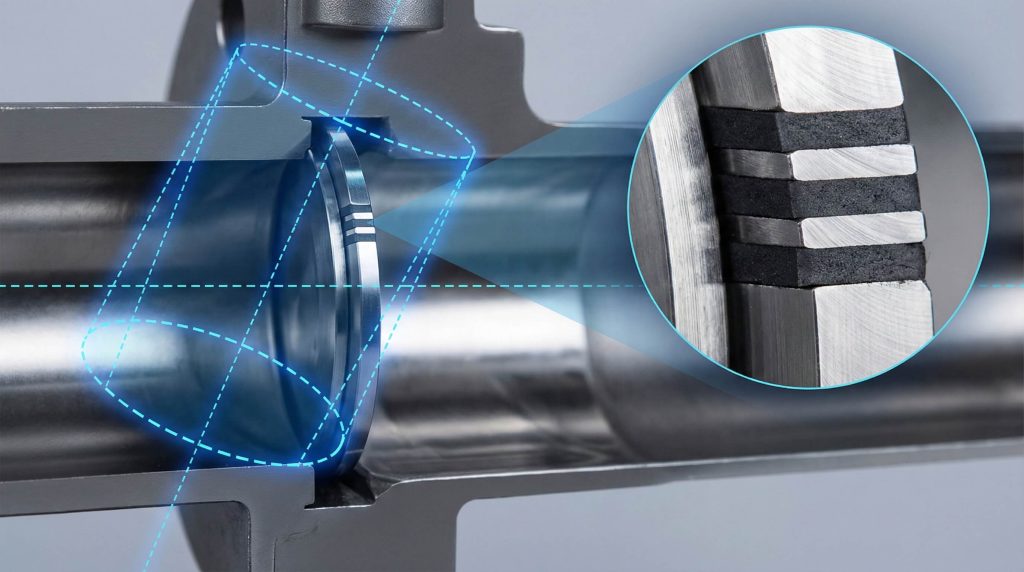
When you are dealing with extreme environments, managing butterfly valve pressure requires the advanced geometry of a triple offset valve (TOV). This design is often referred to as “frictionless” because the disc and seat only make contact at the final point of closure. It is the gold standard for high-pressure steam and high-temperature gas.
Beyond double offset: The third cone axis
The third offset is an inclined conical sealing surface that eliminates all rubbing throughout the 90-degree stroke. Why does this matter? Without rubbing, there is no mechanical wear on the seal, meaning the valve can perform for years without leaking. You essentially get the performance of a gate valve with the weight and space savings of a butterfly valve.
- Conical sealing provides a “wedge” effect for a tighter seal.
- Ideal for high-cycle applications where longevity is paramount.
- Smallest footprint for high-pressure Class 600 or Class 900 ratings.
Why is metal-to-metal sealing preferred for high-pressure steam?
Metal-to-metal seals are necessary because steam will quickly degrade or melt even the most robust elastomers. In a triple offset valve, a laminated metal-and-graphite seat provides the flexibility to seal against a hard metal disc. You achieve a “zero leakage” seal that can withstand the thermal expansion inherent in steam systems.
- Fire-safe by design (no soft parts to burn).
- Resistant to “wire-drawing” erosion from steam.
- Handles extreme thermal cycling without losing seat tension.
Key Takeaway: Triple offset designs eliminate friction entirely during travel, achieving zero-leakage performance in high-pressure scenarios.
| Feature | Double Offset | Triple Offset |
|---|---|---|
| Sealing Type | Resilient or High-Perf | Metal-to-Metal Laminated |
| Friction | Minimal | Virtually Zero |
| Max Pressure | ANSI Class 300 | ANSI Class 600/900 |
Triple offset valves represent the pinnacle of butterfly valve engineering, offering a “zero-leakage” solution for the most critical high-pressure services.
Which industries need butterfly valve pressure safety?
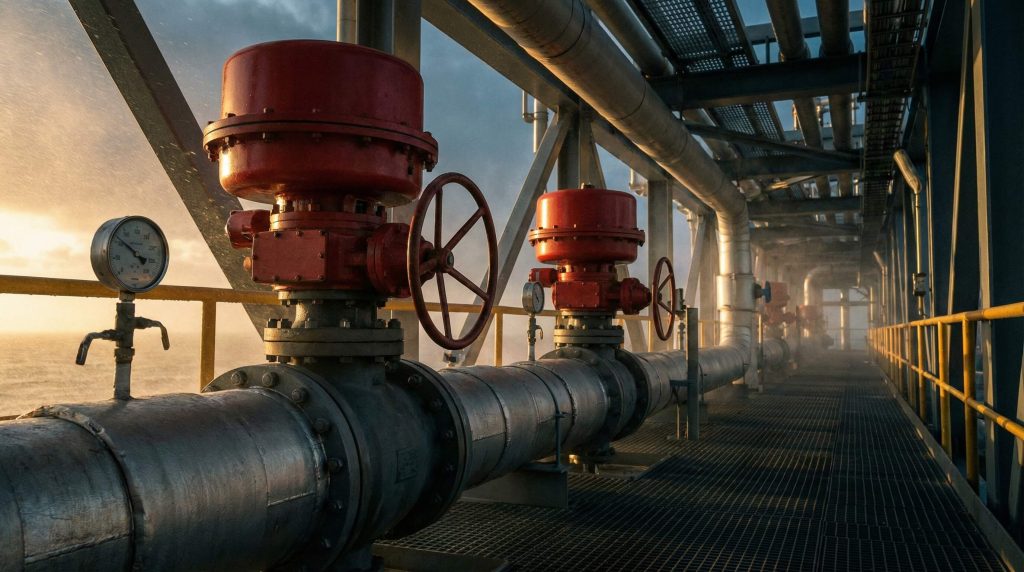
Many industrial sectors rely on high-performance butterfly valve pressure capabilities to ensure the safety of their personnel and the environment. You will find these valves in power plants, refineries, and chemical facilities where a single valve failure could lead to a massive disaster. Reliability isn’t just a goal; it’s a regulatory requirement.
Oil, Gas, and Chemical processing requirements
In these sectors, valves must handle volatile hydrocarbons and aggressive acids at high pressures. Think about this: a high-performance valve in a refinery must be fire-safe and resistant to sulfur-induced corrosion. The ability to shut down flow instantly under high pressure is the primary safety function of these valves.
- Used in upstream production and downstream refining.
- Crucial for flare systems and emergency shutdown (ESD).
- Must meet NACE MR0175 standards for sour gas service.
Are these valves compliant with FDA standards for food and beverage?
Yes, they can be, provided the materials are appropriately selected. For food and beverage, you need a high-performance valve that can handle the high pressure of Clean-In-Place (CIP) systems without contaminating the product. Stainless steel bodies and FDA-approved PTFE seats are the standard here.
- Handles high-pressure steam cleaning cycles.
- Polished internal surfaces prevent bacterial growth.
- Non-leaching seat materials ensure product purity.
Key Takeaway: From pharmaceutical production to power generation, high-performance valves are the standard for critical flow control.
| Industry | Primary Requirement | Common Valve Type |
|---|---|---|
| Oil & Gas | Fire safety / Pressure | Triple Offset Metal Seat |
| Chemical | Corrosion resistance | PTFE-Lined High-Perf |
| Food & Bev | Hygiene / CIP Pressure | Stainless Steel Double Offset |
The cross-industry adoption of high-performance valves proves their versatility in solving complex pressure and reliability challenges.
What ratings define butterfly valve pressure limits?
Navigating the various standards for butterfly valve pressure is essential for ensuring your hardware is legal and safe. You will encounter different naming conventions depending on whether you are following North American (ANSI) or European (DIN/EN) standards. Knowing how to translate these ratings is key to procuring the right equipment for your global projects.
Navigating PN10 to PN40 and ANSI Class ratings
Pressure ratings (PN) and Class ratings define the maximum pressure a valve can withstand at a specific temperature. For example, PN16 means the valve is rated for 16 bar, while ANSI Class 150 is roughly equivalent to PN20. You must always ensure that your valve’s rating exceeds the maximum possible pressure of your system.
- PN Ratings: PN10, PN16, PN25, PN40 (Pressure in Bar).
- ANSI Classes: Class 150, 300, 600 (Dimensionless rating).
- Conversion: Always check the specific material’s P-T chart for accuracy.
What are the differences between API 609 and EN 593 standards?
These standards dictate the design and testing of butterfly valves. API 609 (American Petroleum Institute) is widely used in the oil and gas industry, focusing on fire safety and high-pressure performance. EN 593 is the European equivalent, covering a broader range of industrial applications.
- API 609 Category B: Covers high-performance offset valves.
- EN 593: Specifies design requirements for all butterfly valve types.
- Testing: Both require rigorous pressure testing (API 598 or ISO 5208).
Key Takeaway: Adhering to international standards like API or DIN ensures that the valve meets specific safety and performance benchmarks.
| Standard | Region | Primary Focus |
|---|---|---|
| API 609 | USA/Global | Oil, Gas, High Pressure |
| EN 593 | Europe | Industrial General Use |
| ASME B16.34 | USA/Global | Pressure-Temperature Ratings |
Regulatory compliance is not just about paperwork; it is a guarantee that the valve has been engineered to withstand the pressures it claims to handle.
How does sealing tech hold butterfly valve pressure?
Advanced sealing technology is what allows a high-performance butterfly valve pressure barrier to remain intact over millions of cycles. You should understand that the seal is more than just a piece of rubber; it is a complex assembly of geometry and material science. Modern valves use multi-layered protection to prevent leaks even if the primary seal is damaged.
Soft seal vs. Hard seal: Finding the pressure limit
Which one do you need? Soft seals (PTFE/Elastomers) provide an excellent bubble-tight seal at lower to moderate pressures and temperatures. Hard seals (Metal/Stellite) are required for high-pressure, abrasive, or high-temperature media where a soft seal would be destroyed.
- Soft Seal: Zero leakage, lower torque, limited temperature.
- Hard Seal: High durability, wide temperature range, may have a small allowable leakage rate (Class IV or V).
- Hybrid (Laminated): Combines metal layers with graphite for zero-leakage in high heat.
How does blowout protection safeguard the valve stem?
In a high-pressure system, there is a risk that the internal pressure could eject the stem from the valve body if the internal retaining mechanism fails. This is known as a “blowout.” High-performance valves include integrated blowout-proof stems to ensure that even in a failure scenario, the stem remains safely inside the body.
- Internal shoulders prevent the stem from moving outward.
- Complies with API 609 and ASME B16.34 safety requirements.
- Protects operators during high-pressure cycles.
Key Takeaway: Advanced seat geometry and reinforced stem designs provide redundant layers of protection against catastrophic leaks.
| Sealing Type | Sealing Mechanism | Typical Leakage Class |
|---|---|---|
| Resilient | Compression/Interference | Class VI (Zero Leak) |
| Metal-to-Metal | Torque-seated / Wedge | Class IV or V |
| Laminated | Multi-layer Compression | Class VI (Zero Leak) |
Sealing reliability is the ultimate metric for valve performance, as it determines the safety and efficiency of the entire process loop.
Can maintenance improve butterfly valve pressure life?
To maximize the service life and maintain the butterfly valve pressure rating of your equipment, a proactive maintenance schedule is non-negotiable. You can significantly reduce the total cost of ownership by identifying wear patterns before they lead to a system-wide failure. A well-maintained valve can last for decades, even in high-cycle environments.
Routine maintenance for high-cycle applications
High-cycle applications, like those found in automated processing lines, put immense strain on the stem packing and seat. Why does this matter? If the packing leaks, you lose pressure and risk environmental contamination. Regularly checking the torque of the packing gland can prevent these issues before they start.
- Lubricate the actuator and stem according to the manual.
- Monitor for any unusual noise or vibration during operation.
- Keep a log of cycle counts to predict seat replacement needs.
How do you identify seat erosion before it causes failure?
You can identify potential failure by monitoring the torque required to close the valve. If the torque increases suddenly, it may indicate that debris is caught in the seat or that the seat has deformed. Similarly, a drop in torque might suggest that the seat material has eroded, allowing the disc to pass with less resistance.
- Perform annual pressure tests (hydrostatic or pneumatic).
- Use ultrasonic leak detection on critical valves.
- Inspect the disc edge for pitting or “wire-drawing” during shutdowns.
Key Takeaway: Proactive maintenance and regular pressure testing can reduce the total cost of ownership by up to 40%.
| Maintenance Task | Frequency | Objective |
|---|---|---|
| Visual Inspection | Monthly | Check for external leaks/corrosion |
| Packing Adjustment | Quarterly | Prevent stem leakage |
| Operational Test | Semi-Annually | Ensure smooth travel and seating |
Maintenance is an investment in reliability, ensuring that your high-performance valves continue to handle high-pressure loads safely and efficiently.
Conclusion
Engineering high-performance butterfly valves requires a delicate balance of geometric precision and material durability. RUITO is committed to engineering precision-grade valve solutions that exceed international safety standards. Our high-performance butterfly valves are designed to withstand the most rigorous industrial pressures, ensuring reliability where it matters most. By choosing the right offset design and material pairing, you can eliminate the downtime associated with seat failure and leakage. To find the perfect fit for your high-pressure infrastructure, contact us today for a technical consultation. For more information, you can visit Ruitoflow Home for our full range of industrial valve solutions.
FAQ
- Can I use a standard butterfly valve for high-pressure steam?
No, standard valves typically use elastomers that fail under high-pressure steam; a triple offset high-performance valve with a metal seat is required to withstand the heat and prevent seal melting. - How do I determine the best material for corrosive chemical processing?
Directly check the chemical compatibility of your media with 316L stainless steel and PTFE; for highly aggressive media, exotic alloys or duplex steels are generally the most effective choices. - How do I know if I need a double or triple offset valve?
Yes, you can usually decide based on your leakage and temperature requirements; double offset is suitable for most clean liquids and gases, while triple offset is necessary for high-temperature steam and applications requiring zero-leakage metal seats. - How do I determine the maximum working pressure of these valves?
Directly consult the P-T (Pressure-Temperature) charts provided by the manufacturer; the rating is determined by the body material’s tensile strength, the wall thickness, and the specific design standard like ANSI Class 300. - How do I identify if butterfly valve seats need to be replaced?
Yes, you can identify this through routine pressure testing or by monitoring for increased operating torque; while replacement cycles depend on usage, high-performance designs typically last 3-5 times longer than resilient-seated valves.