
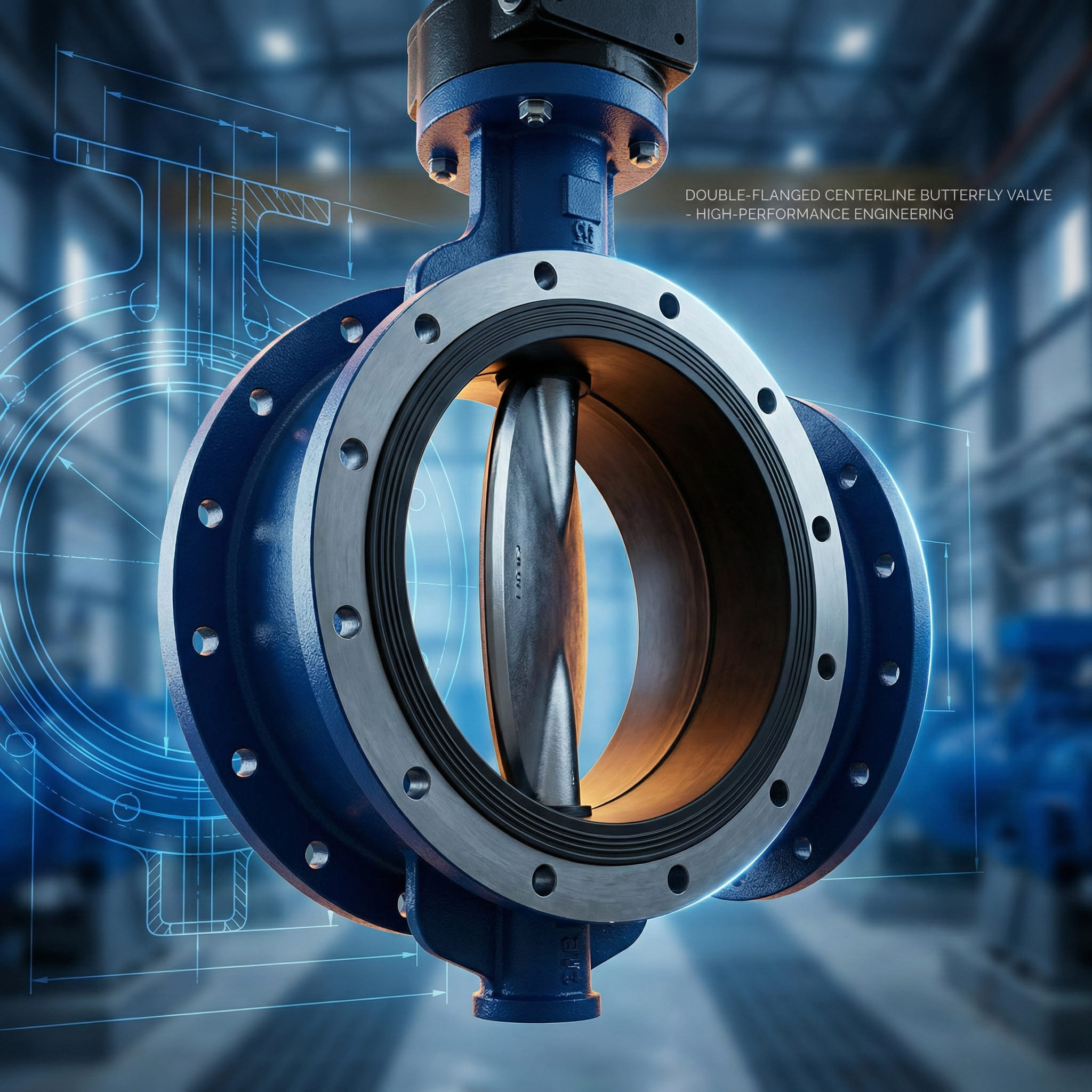
The structural features of this valve center on a concentric disc design and a robust flanged body that ensures stable alignment and leak-proof performance in high-flow pipelines. When you encounter a sudden seal failure in a critical cooling line, the resulting pressure drop can halt production for hours and cost thousands in lost revenue. You cannot afford the risks of substandard hardware that buckles under operational stress or thermal expansion. By integrating a double flanged center line butterfly valve into your system, you secure a reliable, high-performance solution that eliminates leakage and simplifies long-term maintenance.
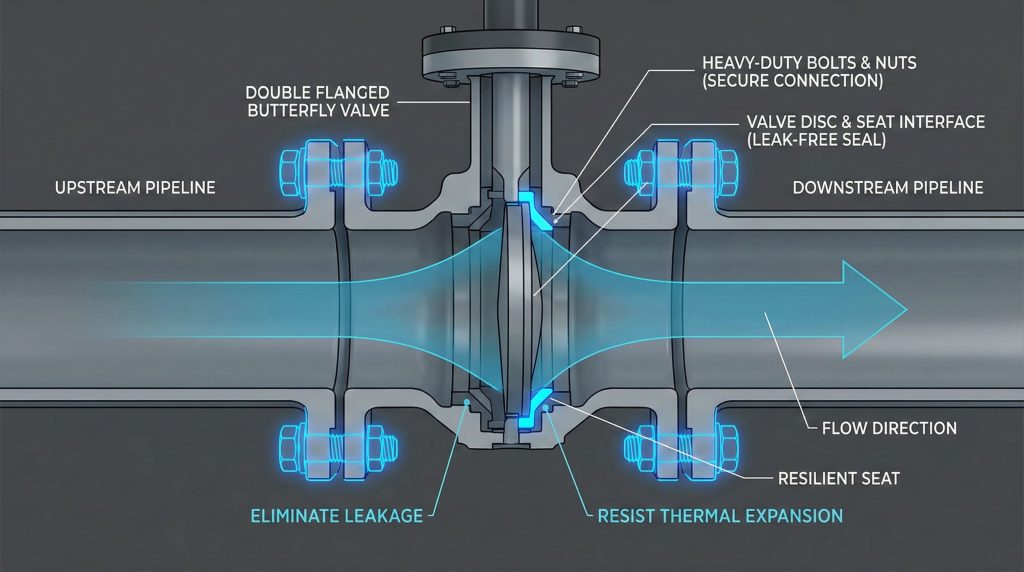
Why choose a double flanged center line butterfly valve?
You choose this valve when your application requires a secure, bolted connection that maintains structural integrity under significant pipe stress. The double flanged center line butterfly valve is specifically engineered to bridge the gap between lightweight wafer designs and heavy-duty industrial requirements.
Does it offer superior piping stability?
Think about it: a flanged connection provides independent bolting on both sides of the valve body. This design allows you to perform downstream maintenance without removing the valve from the upstream line.
- Enhanced structural rigidity for large diameter pipes.
- Easier alignment during the initial installation phase.
- Reduced risk of gasket slippage under high vibration.
The best part? This stability ensures that the valve remains perfectly centered within the flow path, preventing uneven seat wear.
Key Takeaway: Using a flanged body style increases the safety margin of your pipeline by providing a more permanent and vibration-resistant installation.
| Feature | Benefit |
|---|---|
| Double Flange Body | Provides independent piping connections and high structural strength. |
| Concentric Design | Ensures uniform pressure distribution across the sealing surface. |
This structural arrangement is the primary reason engineers prefer flanged models for high-stakes municipal and industrial water projects.
How does a double flanged center line butterfly valve work?
This valve works by rotating a circular disc 90 degrees around a central axis to either block or allow the passage of fluid. The double flanged center line butterfly valve utilizes a simple quarter-turn mechanism that makes it ideal for both manual and automated control systems.
What is the quarter-turn mechanism?
The operation is incredibly efficient because the disc only needs to move a short distance to achieve a full opening. This speed is critical for emergency shut-off scenarios where every second counts for safety.
- Rapid actuation reduces the time required to isolate sections.
- Low torque requirements allow for smaller, more cost-effective actuators.
- Minimal mechanical complexity leads to higher reliability over time.
But here’s the kicker: the central stem alignment ensures that the torque remains consistent throughout the entire opening and closing cycle.
Key Takeaway: The streamlined operation of the quarter-turn disc reduces energy consumption and wear on automation components.
| Component | Function |
|---|---|
| Shaft/Stem | Transmits rotational force from the handle or actuator to the disc. |
| Disc | Acts as the primary flow control element by rotating into the flow stream. |
The efficiency of this movement allows for precise flow regulation without the heavy mechanical overhead of multi-turn valves.
Is the double flanged center line butterfly valve concentric?
Yes, the valve is concentric because the stem axis and the disc center are perfectly aligned with the longitudinal center of the valve body. Unlike a standard gate valve, which lifts a wedge out of the flow, this design keeps the disc centered within the bore at all times.
Why does geometric symmetry matter?
The concentric geometry ensures that the disc makes contact with the seat simultaneously around the entire 360-degree circumference. This leads to a uniform seal that doesn’t rely on complex offsets to prevent leakage.
- Symmetrical flow patterns reduce turbulence near the seat.
- Equalized pressure distribution extends the lifespan of the rubber liner.
- Simplified manufacturing leads to higher precision in seat-to-disc fit.
It gets better: because the design is symmetrical, the valve can often handle flow from either direction without a loss in sealing efficiency.
Key Takeaway: Concentric alignment provides a balanced mechanical load, which translates to a more predictable and longer service life for your seals.
| Design Type | Symmetry Level |
|---|---|
| Concentric | High (Center-line alignment of all components). |
| Eccentric | Low (Offset stems for specialized high-pressure sealing). |
This geometric simplicity makes the concentric flanged valve the go-to choice for standard low-to-medium pressure industrial fluid systems.
What is the double flanged center line butterfly valve seat?
The seat is a resilient, replaceable liner that creates a tight seal by being compressed between the disc and the valve body. In a double flanged center line butterfly valve, the seat often features a reinforced backing to prevent deformation under high flow velocities.
How do resilient seats prevent leaks?
The seat material, usually an elastomer like EPDM or NBR, is designed to be slightly smaller than the disc’s diameter. This interference fit ensures that when the disc is closed, the rubber is squeezed to form a bubble-tight barrier.
- Self-cleaning action as the disc wipes across the seat surface.
- Absorption of small particulates to maintain a tight seal.
- Resistance to corrosion from a wide variety of industrial chemicals.
Make no mistake: the quality of the seat material is the single most important factor in determining the valve’s overall performance.
Key Takeaway: A high-quality resilient seat provides zero-leakage performance and protects the metal body from the corrosive effects of the media.
| Seat Material | Common Application |
|---|---|
| EPDM | Water treatment and general utility systems. |
| Viton (FKM) | High-temperature and chemical processing. |
The integration of the seat into the flanged body ensures that the liner remains securely in place even during high-velocity flow surges.
Where to use a double flanged center line butterfly valve?
These valves are primarily used in large-scale water distribution, HVAC systems, and power plant cooling circuits where flanged piping is standard. While you might consider a globe valve for small-scale throttling, the flanged butterfly is much more efficient for high-volume flow management.
Is it suitable for water treatment?
In water treatment plants, the double flanged center line butterfly valve is the industry standard for isolating filters and pump stations. Its compact face-to-face dimension saves valuable space in tight gallery layouts compared to other valve types.
- Used extensively in desalination and wastewater filtration.
- Ideal for fire protection systems requiring flanged connections.
- Common in irrigation networks and municipal pumping stations.
But here’s the kicker: the flanged design allows for safer operation in buried service or submerged environments where wafer valves might shift.
Key Takeaway: The versatility of the flanged design makes it the most reliable choice for infrastructure projects that demand long-term stability.
| Industry | Primary Use Case |
|---|---|
| Power Generation | Cooling water intake and condenser isolation. |
| Marine | Ballast systems and engine room cooling. |
Choosing the flanged version ensures your system meets the rigorous safety standards required for public and industrial utility infrastructure.
How is a double flanged center line butterfly valve sealed?
The sealing is achieved through a mechanical interference fit where the disc edge is pushed into the resilient seat liner. This double flanged center line butterfly valve utilizes the elastic properties of the seat to create a wide contact area that blocks fluid bypass.
What is the benefit of two-way sealing?
Because the disc is centered, the sealing force is applied equally regardless of which side the pressure is coming from. This bi-directional capability is essential for systems where flow direction might change or where backflow must be contained.
- Simplifies system design by removing the need for directional installation.
- Provides reliable shut-off during pump maintenance or system reversals.
- Maintains seal integrity under varying pressure differentials.
Think about it: a valve that seals in both directions gives you double the protection against unexpected system failures.
Key Takeaway: Bi-directional sealing eliminates installation errors and provides a more versatile solution for complex piping networks.
| Seal Type | Directionality |
|---|---|
| Interference | Bi-directional (Seals equally in both directions). |
| Pressure-Assisted | Often uni-directional (Requires flow to help seal). |
This interference-based sealing method is highly effective for fluids that do not contain heavy abrasives that could tear the elastomer.
What are double flanged center line butterfly valve stems?
The stems are the structural pillars that support the disc and transmit the force required to break the seal during opening. Unlike the internal components of a check valve, these stems are externally accessible for maintenance and actuator mounting.
How is stem blowout prevented?
Modern designs include “blowout-proof” stem retention features to ensure the shaft remains inside the valve even if the internal pressure spikes. This is a critical safety feature that protects operators and surrounding equipment during unforeseen pressure surges.
- High-strength stainless steel construction prevents stem twisting.
- Multiple O-rings or packing glands prevent external leakage at the stem.
- Precision machining ensures smooth rotation with minimal friction loss.
The best part? The through-stem design provides maximum support to the disc, preventing it from fluttering in high-velocity flow.
Key Takeaway: Robust stem design ensures that the valve remains operational under high torque and prevents hazardous external leaks.
| Stem Feature | Advantage |
|---|---|
| One-Piece Shaft | Higher strength and better disc alignment. |
| Blowout-Proof | Enhanced operator safety during high-pressure events. |
Investing in a valve with a high-quality stem assembly reduces the risk of mechanical failure and extends the time between service intervals.
Why is a double flanged center line butterfly valve simple?
The simplicity stems from its minimal part count and the lack of complex cavities where debris could accumulate. A double flanged center line butterfly valve is designed for straightforward assembly and disassembly, making it a favorite for maintenance crews.
Is maintenance truly easier?
Because there are no deep pockets or complex metal-to-metal seating surfaces, the valve is much less likely to clog or seize. When service is required, the resilient seat can often be replaced without specialized tools or factory rebuilding.
- Fewer moving parts mean fewer points of potential mechanical failure.
- Streamlined body shape reduces the overall weight of the piping system.
- Standardized flange dimensions ensure compatibility with existing hardware.
Think about it: a simpler valve means less training for your team and fewer spare parts to keep in stock.
Key Takeaway: Minimalist engineering lowers the total cost of ownership by reducing both initial purchase price and long-term maintenance labor.
| Factor | Butterfly Valve | Other Industrial Valves |
|---|---|---|
| Part Count | Low | High |
| Maintenance Difficulty | Simple | Complex |
This simplicity does not compromise performance; rather, it enhances reliability by removing unnecessary mechanical complications.
Does a double flanged center line butterfly valve wear out?
While very durable, the resilient seat will eventually experience wear due to the friction of the disc rubbing against it during every cycle. This wear profile is similar to the seat degradation found in a ball valve, though the butterfly valve’s seat is often easier to replace.
How do you extend the seat life?
The key to longevity is ensuring the disc is properly aligned and the media is free from sharp, abrasive solids. Regular cycling of the valve also prevents the elastomer from “setting” or sticking to the disc over long periods of inactivity.
- Proper lubrication of the stem prevents binding and uneven seat loads.
- Avoiding high-velocity throttling reduces “wire-drawing” erosion on the seat.
- Periodic inspections allow you to catch minor wear before it becomes a leak.
It gets better: selecting the right elastomer for your specific chemical media can double the expected lifespan of the valve.
Key Takeaway: Proactive maintenance and correct material selection are the best ways to ensure your valve lasts for decades.
| Wear Factor | Mitigation Strategy |
|---|---|
| Friction | Use high-polished disc edges and correct lubrication. |
| Chemical Attack | Choose compatible seat materials like Viton or EPDM. |
By monitoring these wear factors, you can schedule maintenance during planned shutdowns rather than reacting to emergency failures.
Can a double flanged center line butterfly valve resist heat?
Heat resistance is primarily limited by the temperature thresholds of the rubber seat material used in the design. While the metal body of a double flanged center line butterfly valve can handle extreme heat, the elastic seal will degrade if the temperature exceeds its rating.
What are the common thermal limits?
Most EPDM seats are rated for temperatures up to 120°C (248°F), which is sufficient for most hot water and steam-tracing applications. For higher temperatures, you must switch to specialized materials or move toward a metal-seated triple offset design.
- EPDM: Good for general hot water and low-pressure steam.
- Viton: Excellent for high-temperature chemicals and oils.
- Silicone: Used in food-grade or specialized high-heat environments.
But here’s the kicker: even at higher temperatures, the flanged body helps dissipate heat better than a thin wafer-style valve.
Key Takeaway: Understanding the thermal limits of your seat material prevents catastrophic seal melting and keeps your process running safely.
| Material | Max Temperature (°C) |
|---|---|
| NBR (Buna-N) | 80°C |
| PTFE (Teflon) | 180°C |
Selecting the correct thermal grade ensures that your valve maintains its sealing pressure even when the system reaches peak operating temperatures.
Conclusion
A high-performance double flanged center line butterfly valve solves the most common issues of pipeline instability and leakage. By combining the structural strength of a flanged body with the efficient sealing of a concentric disc, this valve provides a dependable solution for water, chemical, and utility systems. At Ruito, we specialize in engineering flow control solutions that reduce your downtime and enhance system safety through precision manufacturing. Our goal is to provide world-class valve technology that empowers global industries to operate with total confidence. To find the perfect valve for your specific application, please contact us today.
FAQs
Can I use this valve for high-pressure gas applications?
No, this valve is primarily designed for liquid media or low-pressure gas because the resilient seat may not provide the necessary seal integrity for high-pressure gaseous fluids.
What’s the best way to prevent seal wear?
The best way is to ensure the disc is fully opened or closed rather than used for constant throttling, which minimizes the time the disc edge spends rubbing against the seat.
How do I know if the seat needs replacement?
You will notice a gradual increase in downstream leakage when the valve is fully closed or an increase in the torque required to operate the handle.
Can I install this valve in any orientation?
Yes, you can install it horizontally or vertically, although horizontal stem orientation is often preferred for media containing heavy sediments to prevent buildup in the bottom bearing.
What’s the best material for sea water applications?
The best material is usually a combination of a Nylon-coated or Bronze disc and an EPDM seat to resist the corrosive effects of salt and marine growth.