
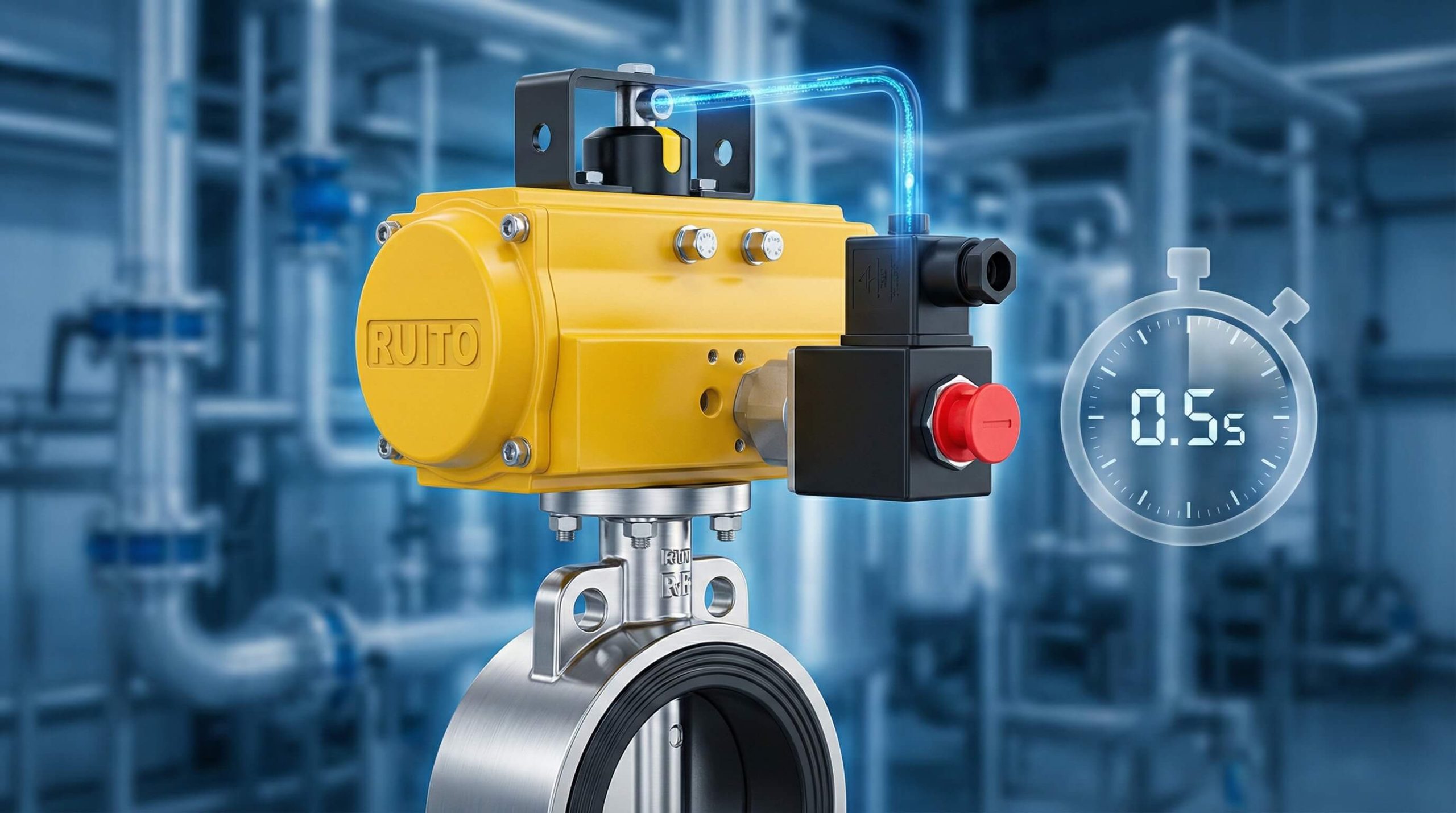
A pneumatic actuator operated butterfly valve with solenoid valve is an automated industrial tool that uses electromagnetic signals and compressed air to control the flow of media through a pipe. You often face significant challenges when manual valves fail to respond quickly enough to pressure changes or process demands in your facility. This inefficiency can lead to product waste or even dangerous system overloads. By installing a solenoid operated butterfly valve, you solve these issues with a high-speed, remote-controlled solution that ensures precision in every cycle.
1. What is a pneumatic actuator operated butterfly valve with solenoid valve?
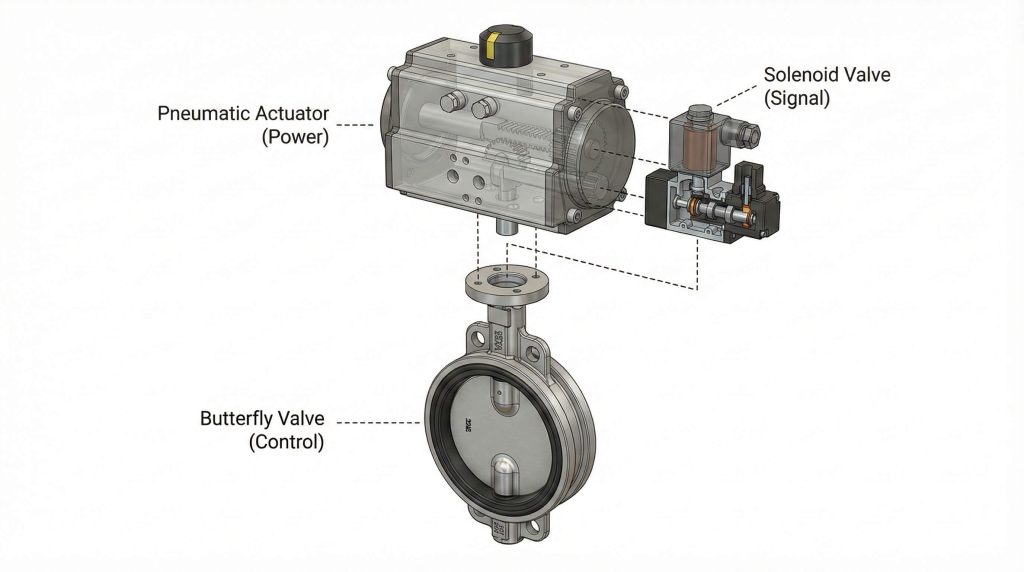
A solenoid operated butterfly valve is an integrated assembly designed for high-efficiency fluid regulation in automated pipelines. It combines a mechanical butterfly valve with a pneumatic actuator that is triggered by a solenoid valve receiving electrical commands.
You can use this system to eliminate the need for manual intervention in hard-to-reach or hazardous areas. RUITO ensures these units are built for high-cycle environments where reliability is non-negotiable.
Think about this:
- It translates electrical logic into mechanical motion.
- It provides rapid shut-off in under one second.
- It fits into existing PLC control architectures easily.
Defining the Assembly
The assembly consists of three core units: the valve body for media contact, the actuator for power, and the solenoid for signal routing. These components are typically mounted together using a NAMUR standard interface for compactness.
This configuration allows you to manage everything from simple water lines to complex chemical processing with a single signal. It is the most common choice for modern industrial automation.
| Component | Function | Advantage |
|---|---|---|
| Butterfly Valve | Media isolation/regulation | Low pressure drop |
| Pneumatic Actuator | Converts air to rotation | High torque output |
| Solenoid Valve | Directs compressed air | Electrical control |
Reliable automation starts with a clear understanding of how these three independent parts act as a single unit.
Key Takeaway: A solenoid operated butterfly valve is the essential bridge between your digital control system and physical fluid management.
2. How does a solenoid operated butterfly valve function in automated systems?
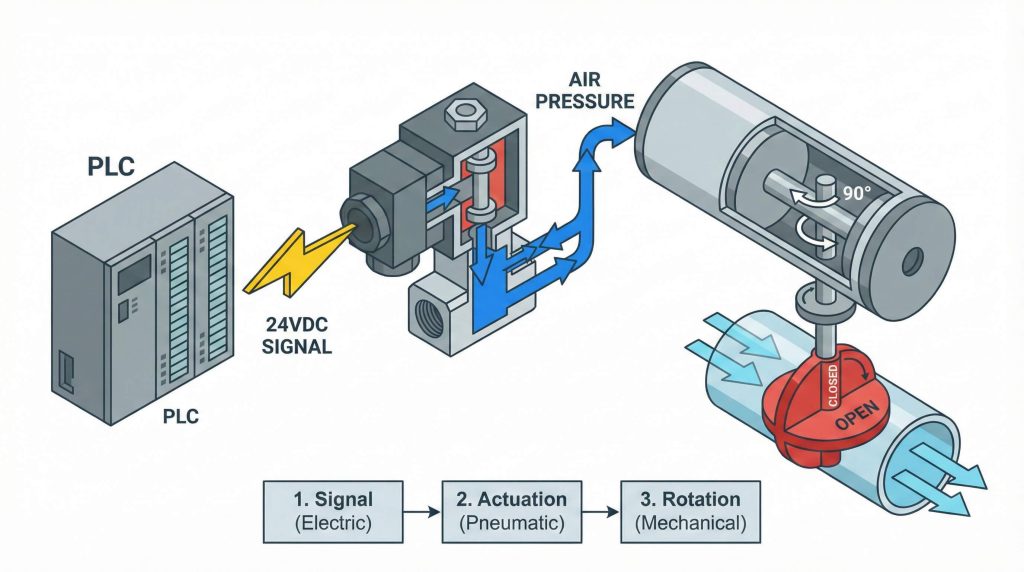
The solenoid operated butterfly valve functions by converting electrical energy into pneumatic force to rotate a valve disc. When your control system sends a voltage to the solenoid coil, it creates a magnetic field that shifts an internal spool.
This shifting directs compressed air into the actuator chamber, which then pushes a piston or rack-and-pinion to turn the valve stem 90 degrees. It is a seamless process that happens almost instantaneously.
Believe it or not:
- The solenoid acts as the “brain” of the operation.
- Air pressure provides the “muscle” for the movement.
- The disc provides the “seal” for the media.
The Operational Sequence
First, the solenoid valve receives a 24VDC or 220VAC signal from the PLC. Next, air is routed to the “open” port of the pneumatic actuator.
Finally, the actuator rotates the disc to allow flow, and the process reverses when the signal is removed. This sequence ensures that your flow control is always synchronized with your system data.
| Step | Trigger | Physical Result |
|---|---|---|
| Signal | Electrical Current | Solenoid shifts spool |
| Actuation | Air Pressure | Piston moves internally |
| Flow Change | 90° Rotation | Valve opens or closes |
System synchronization depends on the solenoid’s ability to react to electrical pulses with millisecond accuracy.
Key Takeaway: Speed and synchronization are the primary benefits of using air-powered actuators with solenoid triggers.
3. What are the technical components of a solenoid operated butterfly valve?
A solenoid operated butterfly valve is composed of several high-precision parts that must work in perfect alignment. The valve body typically features a disc made of stainless steel or ductile iron, which rotates within a resilient seat.
The pneumatic actuator sits atop the valve, housing the pistons and springs required for mechanical torque. The solenoid is mounted to the side of the actuator, acting as the gatekeeper for compressed air.
It gets better:
- Seats are available in EPDM, NBR, or PTFE.
- Actuators feature hard-anodized aluminum housings.
- Solenoids come with manual override buttons for testing.
Materials and Build Quality
The choice of materials determines how well your valve will withstand corrosive chemicals or extreme temperatures. RUITO uses SS316 for discs in aggressive environments to prevent premature wear.
Actuators are tested to millions of cycles to ensure that the internal rack-and-pinion does not fail under heavy use. This robust build minimizes your long-term maintenance costs.
| Part | Common Material | Industrial Benefit |
|---|---|---|
| Valve Disc | SS316 / SS304 | Corrosion resistance |
| Seat Liner | PTFE / EPDM | Tight sealing |
| Actuator Case | Aluminum Alloy | Lightweight strength |
Material compatibility is the most critical factor in preventing leaks and ensuring a long service life for your valves.
Key Takeaway: High-quality component selection ensures that the valve can handle both the external environment and the internal media.
4. Why should you prioritize a solenoid operated butterfly valve over manual options?
Choosing a solenoid operated butterfly valve over a manual hand-lever valve significantly improves your plant’s safety and efficiency. Manual operation is prone to human error and is often too slow for emergency scenarios.
Automation allows for precise, repeatable positioning that a human operator simply cannot match. You can also monitor the valve’s status in real-time using limit switches integrated into the assembly.
Here is the best part:
- You can control hundreds of valves from one room.
- Labor costs for manual adjustments are eliminated.
- Safety is enhanced with fail-safe return springs.
Efficiency and Safety Gains
Manual valves require physical strength and presence, which can be a liability in steam or chemical plants. An automated solenoid valve removes your workers from these dangerous zones.
Furthermore, automated valves can be programmed to close instantly if a sensor detects a leak or pressure drop. This proactive safety measure can save your facility from catastrophic failures.
| Feature | Manual Valve | Solenoid Operated Valve |
|---|---|---|
| Response Speed | Seconds/Minutes | Milliseconds |
| Risk Profile | High (Human error) | Low (Logic-driven) |
| Scalability | Difficult | Simple integration |
Transitioning from manual to automated control is the fastest way to modernize an aging industrial fluid system.
Key Takeaway: Automation via solenoid control is a strategic investment in both operational safety and long-term labor savings.
5. What actuator types are compatible with a solenoid operated butterfly valve?
There are two main types of pneumatic actuators used for a solenoid operated butterfly valve: double-acting and spring-return. Double-acting actuators require air pressure for both the opening and closing strokes.
Spring-return actuators use air to move in one direction and a set of internal springs to return to the fail-safe position. You must choose based on your specific safety requirements.
Consider this:
- Double-acting is best for standard on/off tasks.
- Spring-return is essential for emergency shut-offs.
- Both types mount easily to standard RUITO butterfly valves.
Double Acting vs. Spring Return
Double-acting actuators are generally more compact and cost-effective for everyday applications. They offer consistent torque in both directions but require a constant air supply for all movements.
Spring-return models are the “fail-safe” choice because they automatically close if you lose power or air pressure. This protects your equipment from damage during an unexpected utility failure.
| Actuator Type | Air Use | Fail-Safe Ability |
|---|---|---|
| Double Acting | Open and Close | None (Stays in place) |
| Spring Return | Open Only | Yes (Closes automatically) |
Selecting the right actuator type ensures your system behaves predictably even during a total power loss.
Key Takeaway: Match your actuator type to your fail-safe requirements to ensure maximum protection for your industrial assets.
6. Which solenoid configurations work with a solenoid operated butterfly valve?
The solenoid operated butterfly valve requires a specific solenoid configuration to match the actuator’s air requirements. Most industrial setups use either a 3-way or a 5-way solenoid valve.
A 5-way solenoid is necessary for double-acting actuators because it manages two separate air ports. A 3-way solenoid is simpler and is used for spring-return (single-acting) actuators.
Look at the facts:
- 5/2 way solenoids are the industry standard.
- Explosion-proof coils are available for hazardous zones.
- NAMUR mounting eliminates the need for external tubing.
Choosing the Right Solenoid
Voltage is another critical factor; you can choose from 12VDC, 24VDC, 110VAC, or 220VAC. Most modern PLC systems prefer 24VDC for safety and ease of integration.
You should also consider the environmental rating, such as IP65 or IP67, to ensure the solenoid survives in dusty or wet conditions. RUITO provides a variety of coils to match your local power standards.
| Solenoid Type | Best For | Mounting Style |
|---|---|---|
| 3/2 Way | Spring-return actuators | NAMUR or Inline |
| 5/2 Way | Double-acting actuators | NAMUR |
| 5/3 Way | Multi-position control | NAMUR |
The correct solenoid configuration is the key to preventing air leaks and ensuring rapid valve response.
Key Takeaway: Proper solenoid selection is just as important as the valve itself for maintaining system reliability.
7. What are the main applications for a solenoid operated butterfly valve?
A solenoid operated butterfly valve is versatile enough to be used across almost every industrial sector. In water treatment, they manage the flow of wastewater through filtration systems without manual intervention.
In the HVAC industry, these valves control the distribution of chilled water in massive commercial cooling towers. You will also find them in food and beverage plants for wash-down and mixing processes.
Think about this:
- They handle massive volumes of water efficiently.
- They are perfect for chemical dosing systems.
- They manage airflow in large ventilation ducts.
Critical Industry Use Cases
In the chemical industry, PTFE-lined butterfly valves are automated with solenoids to handle aggressive acids. This keeps operators safe by allowing control from a remote station.
Marine applications use these valves for ballast water management on ships, where space is tight and reliability is vital. Their compact design makes them ideal for engine room installations.
| Industry | Typical Fluid | Requirement |
|---|---|---|
| Water Treatment | Wastewater | High cycle life |
| Chemical | Corrosive Acids | Material integrity |
| Power Plant | Cooling Water | Rapid shut-off |
The adaptability of the butterfly design allows it to excel in both low-pressure water and high-pressure gas systems.
Key Takeaway: Whether handling water or chemicals, the automated butterfly valve is the most versatile tool in your fluid control kit.
8. How do you properly install a solenoid operated butterfly valve?
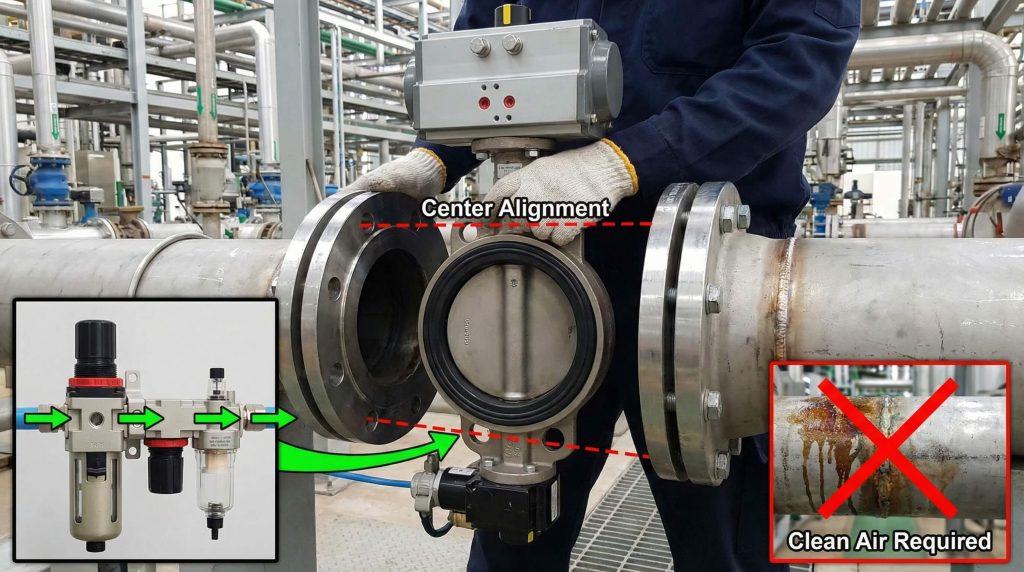
Installing a solenoid operated butterfly valve requires attention to both the piping and the air supply. You must ensure that the valve is centered between the flanges to prevent the disc from hitting the pipe wall.
The air supply should be clean, dry, and filtered to prevent debris from clogging the solenoid’s tiny internal ports. Using an FRL (Filter-Regulator-Lubricator) unit is highly recommended for every installation.
Keep in mind:
- Check flange alignment before tightening bolts.
- Use a stable air pressure (usually 5-7 bar).
- Ensure the electrical coil matches your control voltage.
Installation Best Practices
Before you finalize the install, cycle the valve manually using the override button on the solenoid. This confirms that the disc moves freely and that there are no mechanical obstructions in the pipe.
Always mount the solenoid in a way that allows for easy access to the electrical connections. This makes future troubleshooting or coil replacement much faster and safer for your technicians.
| Installation Step | Target | Common Mistake |
|---|---|---|
| Flange Alignment | Prevent disc damage | Uneven bolt torque |
| Air Filtration | Protect solenoid | Using wet/dirty air |
| Wiring | Signal integrity | Incorrect voltage supply |
A clean and precise installation is the best way to prevent premature failure of the actuator and solenoid.
Key Takeaway: Proper installation and clean air are the two biggest factors in extending the life of your automated valve.
9. What maintenance is required for a solenoid operated butterfly valve?
Maintaining your solenoid operated butterfly valve is relatively straightforward but must be done consistently. You should inspect the valve seat and disc for wear every six to twelve months, depending on the media.
The solenoid valve should be checked for air leaks around the exhaust ports, which often indicates a worn internal seal. Lubricating the actuator’s internal gears can also prevent friction and slow response times.
It gets better:
- NAMUR solenoids are easily replaced in minutes.
- Actuator seals can be swapped without removing the valve.
- Regular testing prevents the “stiction” of the valve seat.
Proactive Maintenance Routine
You should include a “cycle test” in your monthly maintenance schedule to ensure the valve hasn’t become stuck due to debris buildup. This is especially important for valves that remain open or closed for long periods.
Checking the electrical connections for corrosion is also vital, especially in outdoor or wash-down environments. A small amount of moisture in the terminal box can cause intermittent signal failures.
| Maintenance Task | Frequency | Goal |
|---|---|---|
| Visual Leak Check | Weekly | Identify seal issues |
| Cycle Testing | Monthly | Prevent disc sticking |
| Seal Replacement | 2-3 Years | Ensure zero leakage |
Consistency in maintenance prevents the small issues from turning into expensive, unplanned facility shutdowns.
Key Takeaway: A simple proactive maintenance schedule can double the operational lifespan of your automated valves.
10. Why choose RUITO for your next solenoid operated butterfly valve?
RUITO is a premier manufacturer of the solenoid operated butterfly valve, offering over 15 years of engineering expertise. We provide a complete solution, including the valve, actuator, and solenoid, all tested as a single unit.
Our products meet ISO 9001, CE, and WRAS standards, ensuring that you receive international-grade quality. We offer full traceability and documentation for every batch, which is critical for EPC and OEM projects.
Why RUITO:
- 100% pressure testing at 1.5x working pressure.
- 24-hour technical response for all inquiries.
- Fast delivery (5 days for stock, 25 for custom).
Our Commitment to Excellence
We understand that your project schedule is your top priority. RUITO’s manufacturing process is optimized to deliver high-quality valves with predictable lead times and zero defects.
From custom CAD drawings to on-site support, our engineers work with you to ensure the valves meet your exact performance specs. We don’t just sell parts; we provide fluid control reliability.
| Service Metric | RUITO Performance | Your Benefit |
|---|---|---|
| Quality Rate | 99.5% reliability | Minimal downtime |
| Tech Response | Under 24 hours | Faster project design |
| Testing | 100% verification | Safety guarantee |
Partnering with an expert manufacturer like RUITO de-risks your procurement and ensures your systems run flawlessly.
Key Takeaway: RUITO combines high-precision engineering with transparent documentation to provide the best value in automated valves.
Frequently Asked Questions
Can I manually open a solenoid operated butterfly valve if power fails?
Yes, most solenoids come with a manual override button. You can press or turn this button to shift the internal spool and operate the valve using the available air pressure without an electrical signal.
How do I choose between a wafer and a lug type for automation?
Wafer types are lighter and more cost-effective for standard pipelines. Lug types allow you to disconnect the downstream piping while the valve remains in place, making them better for maintenance-heavy sections.
What is the standard life expectancy of these valves?
A well-maintained RUITO assembly can last for over 1,000,000 cycles. The actual lifespan depends heavily on the cleanliness of the air supply and the corrosiveness of the media being handled.
Do I need a positioner or just a solenoid valve?
If you only need the valve to be fully open or fully closed, a solenoid is sufficient. If you need to control the flow at specific percentages (e.g., 50% open), you will need a pneumatic positioner.
What happens if the air supply is cut off?
If you use a spring-return actuator, the valve will automatically return to its fail-safe position (usually closed). If you use a double-acting actuator, the valve will typically stay in its last position.
Conclusion
The solenoid operated butterfly valve stands as a cornerstone of modern industrial efficiency, offering a level of control and safety that manual systems simply cannot achieve. By integrating high-quality pneumatic actuators and precision solenoids, you create a fluid control system that is responsive, reliable, and ready for the demands of 24/7 production.
Whether you are upgrading an existing plant or designing a new facility, RUITO is here to support you with expert advice and world-class manufacturing. If you are ready to enhance your operations with the latest in valve technology, contact us today for a technical consultation and a tailored quote for your project.