
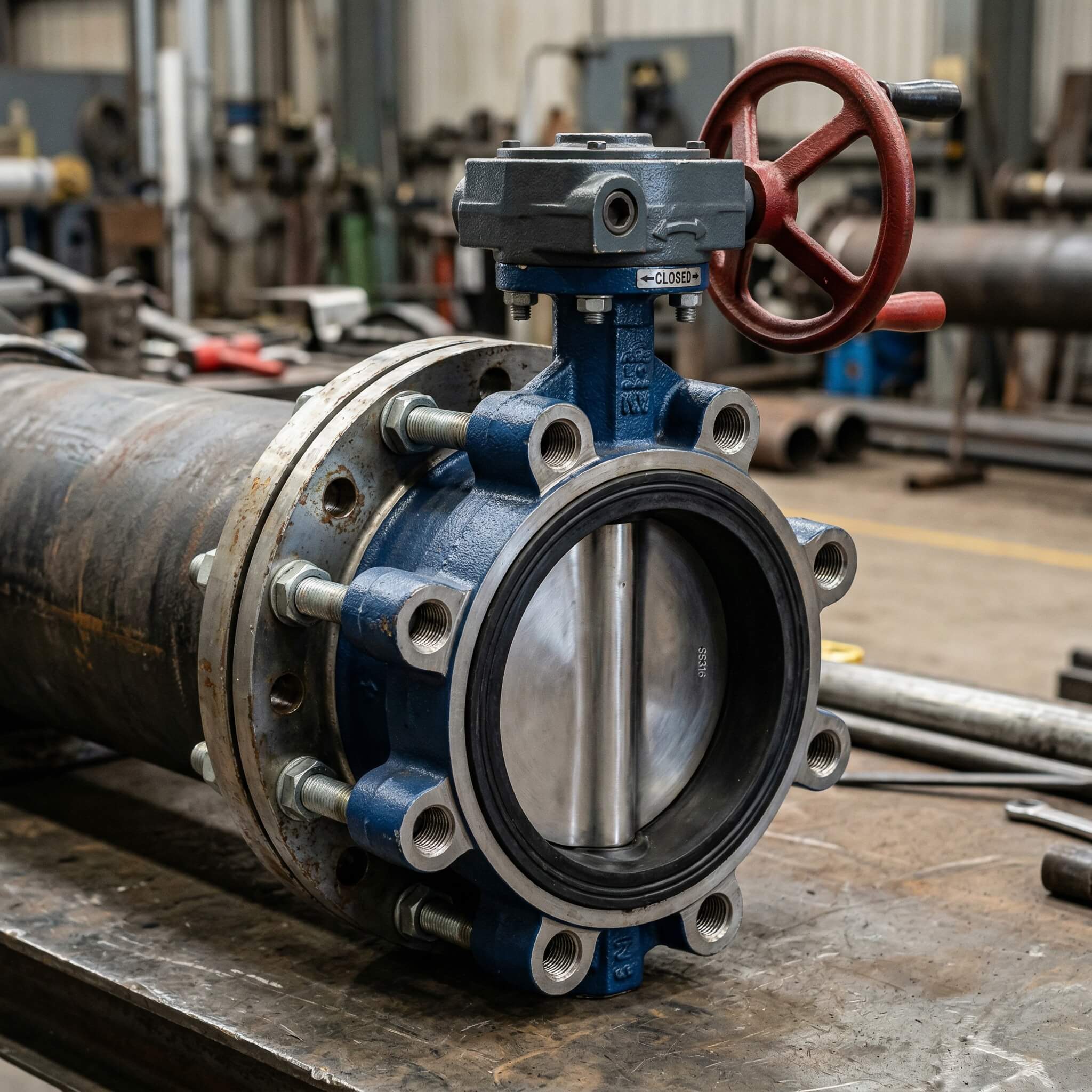
The primary difference between wafer and lug valves lies in their mounting method and their ability to facilitate independent downstream maintenance. Many industrial facilities experience catastrophic downtime when a simple pipe repair requires a complete system drainage because the installed valves cannot hold pressure from one side. This lack of isolation flexibility creates logistical nightmares and increases labor costs significantly. Utilizing a high-performance tapped lug butterfly valve solves this by providing threaded bolt holes that allow for secure, independent connection to each flange.
What is a tapped lug butterfly valve?
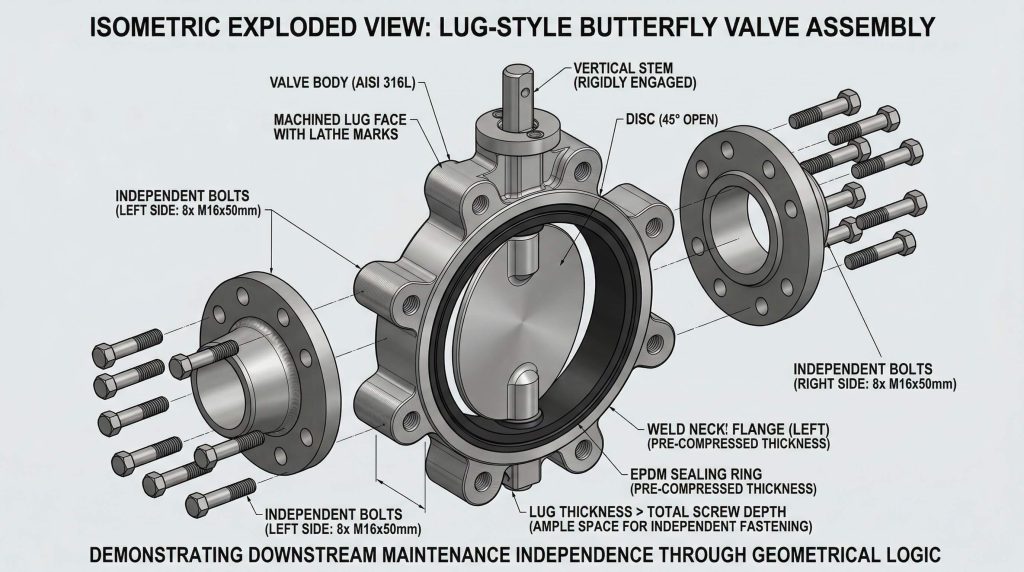
A tapped lug butterfly valve is a specialized fluid control component featuring threaded metal protrusions, or lugs, around its circumference. These threaded holes allow you to secure the valve to piping flanges using individual bolts for each side rather than long through-bolts.
Structural Body Components
You need to understand the physical makeup to appreciate its durability. The body of a tapped lug butterfly valve is typically cast from heavy-duty ductile iron or stainless steel to withstand significant mechanical stress.
- Integrated threaded lugs for flange alignment.
- Central rotating disc for flow regulation.
- Internal resilient seat for bubble-tight sealing.
Think about it:
The mechanical strength of this design is far superior to standard wafer types. This makes it an ideal choice for heavy industrial environments where vibration is common.
Key Takeaway
The lug design ensures that the valve remains a permanent part of the pipeline even when downstream sections are disconnected.
| Feature | Tapped Lug Specification |
|---|---|
| Connection Type | Threaded Lugs |
| Material Options | DI, CS, SS304/316L |
| Security | Independent Bolting |
This structural overview highlights why engineers prefer lugged bodies for critical infrastructure isolation.
How does a tapped lug butterfly valve operate?
A tapped lug butterfly valve operates through a quarter-turn mechanism where a disc rotates on a central axis to open or close the flow path. When you turn the handle or actuator 90 degrees, the disc moves from a position parallel to the flow to one that is perpendicular.
Quarter-Turn Mechanism Efficiency
Here is the deal:
The speed of operation is one of the biggest advantages you will find when using a tapped lug butterfly valve in your system. Unlike multi-turn gate valves, this unit allows for nearly instantaneous shut-off during emergencies.
- 0 to 90-degree rotation range.
- Low torque required for manual operation.
- Compatibility with electric and pneumatic actuators.
Believe it or not:
This efficient movement minimizes wear on the internal components over thousands of cycles. You gain both speed and longevity in a single package.
Key Takeaway
Quarter-turn operation provides rapid flow control and simplifies the automation process for complex industrial networks.
| Operational Metric | Performance Level |
|---|---|
| Speed | High (Quarter-turn) |
| Automation | Easy (ISO 5211 Pads) |
| Flow Profile | Linear/Equal Percentage |
The simplicity of this motion is the core reason for the valve’s widespread adoption in fluid management.
What defines a tapped lug butterfly valve design?
The defining characteristic of a tapped lug butterfly valve is the presence of threaded holes that match the bolt circle of the mating flanges. This design allows you to install bolts from both sides of the pipe without requiring a nut on the opposite end of the bolt.
Threaded Lug Functionality
It gets better:
Because the lugs are threaded, you can remove the piping on one side of the tapped lug butterfly valve while the other side remains under full system pressure. This is a massive advantage for maintenance crews who need to swap out pumps or filters without a total plant shutdown.
- Eliminates the need for long through-bolts.
- Provides a secure anchor point for the valve body.
- Supports dead-end service applications.
But that’s not all:
The precise machining of these lugs ensures that the valve is always perfectly centered within the pipeline. You won’t have to worry about disc interference or seal misalignment during the installation process.
Key Takeaway
Threaded lugs provide the unique mechanical capability of acting as a temporary pipe end, offering unmatched maintenance flexibility.
| Design Element | Benefit to User |
|---|---|
| Threaded Holes | No nuts required for installation |
| Lug Placement | Guaranteed flange alignment |
| Compact Profile | Saves space in tight corridors |
The integration of threads directly into the valve body transforms it into a structural component of the piping system.
Why use a wafer vs tapped lug butterfly valve?
Choosing between a wafer style and a tapped lug butterfly valve often comes down to a balance of initial cost versus long-term operational flexibility. While wafer valves are lighter and less expensive, they lack the independent bolting capability that makes the lug style so versatile.
Cost and Weight Considerations
Look:
A wafer valve is designed to be sandwiched between two flanges, meaning it relies on the compression of the entire assembly to stay in place. If you are working on a budget-sensitive project where frequent maintenance isn’t expected, a tapped lug butterfly valve might be considered an unnecessary premium.
- Wafer: Lower material cost and shipping weight.
- Lug: Higher initial investment for better utility.
- Wafer: Faster initial installation on long pipe runs.
Here is the kicker:
If you ever need to service a section of the pipe, the wafer valve will fall out as soon as you loosen the bolts. You must weigh the “cheap” upfront cost against the “expensive” downtime later.
Key Takeaway
Wafer valves are excellent for continuous lines, but lug valves are the essential choice for any point requiring system isolation.
| Factor | Wafer Choice | Lug Choice |
|---|---|---|
| Initial Price | Lowest | Moderate |
| Maintenance | Requires full shutdown | Supports sectional repair |
| Weight | Minimal | Heavy-duty |
Selecting the right type depends on your specific need for future-proofing the installation against service interruptions.
Can a tapped lug butterfly valve handle dead-ends?
Yes, a tapped lug butterfly valve is specifically engineered to handle dead-end service where the valve serves as the terminus of a pressurized line. This is possible because the bolts on the upstream side keep the valve body and seat securely pressed against the flange.
Dead-End Pressure Ratings
The truth is:
In a dead-end scenario, the tapped lug butterfly valve must withstand the full force of the media against the closed disc without the support of a downstream flange. Most high-quality lug valves are rated for this service, though the pressure rating may be slightly lower than in a standard installation.
- Securely handles one-sided pressure loads.
- Ideal for tank drainage or discharge points.
- Maintains seal integrity without downstream bracing.
But wait:
You should always check the manufacturer’s specifications to ensure the dead-end pressure rating meets your safety standards. It is often recommended to use a blind flange for long-term dead-end applications to provide an extra layer of protection.
Key Takeaway
The ability to serve as a dead-end is a critical safety feature that only lug-style valves can reliably provide in a pressurized system.
| Service Type | Compatibility | Pressure Note |
|---|---|---|
| Mid-line Service | Excellent | Full Rated Pressure |
| Dead-end Service | Yes | Check Specific Rating |
| Downstream Removal | Possible | Safety Flange Recommended |
This specific capability makes the lugged version a staple in municipal water and chemical storage facilities.
Is a tapped lug butterfly valve better for pressure?
A tapped lug butterfly valve generally offers better stability and sealing performance under high-pressure conditions than a wafer-style alternative. Because the body is bolted directly to the flanges, it is less susceptible to the shifting or “walking” that can occur with wafer valves during pressure surges.
Structural Integrity Under Load
Bottom line:
When the pressure in your line spikes, the lugs on a tapped lug butterfly valve absorb the mechanical energy and transfer it safely to the piping structure. This prevents the valve seat from deforming, which is the most common cause of leaks in high-pressure applications.
- Reinforced body prevents disc deflection.
- Threaded lugs maintain uniform gasket compression.
- Reduced risk of bypass leakage during surges.
Think about this:
In systems with frequent thermal expansion or heavy vibrations, the bolted connection keeps the valve perfectly aligned. You won’t find this level of structural security in a standard wafer design.
Key Takeaway
Lugged valves provide a more robust sealing environment, making them superior for high-pressure or high-vibration industrial sectors.
| Pressure Factor | Lug Performance | Wafer Performance |
|---|---|---|
| Surge Resistance | High | Moderate |
| Seal Uniformity | Excellent | Good |
| Structural Load | Distributed to Lugs | Applied to Bolts |
The added mass and bolting security of the lugged body act as a safeguard for your most critical flow lines.
How to install a tapped lug butterfly valve?
Installing a tapped lug butterfly valve is a straightforward process because the lugs act as a natural guide for the bolts, ensuring perfect flange alignment. You will need two sets of bolts—one for the upstream side and one for the downstream side—which are threaded directly into the valve body.
Bolting and Alignment Steps
Don’t forget:
Before you begin, you must verify that the thread pitch in the lugs matches your flange bolts (ANSI vs. DIN). A tapped lug butterfly valve with the wrong threads will be impossible to install and could damage your piping components.
- Clean flange faces and check gasket condition.
- Position the valve with the disc in the slightly open position.
- Thread bolts by hand into the lugs before tightening.
Now:
Once the bolts are hand-tight, use a torque wrench to tighten them in a star pattern. This ensures that the tapped lug butterfly valve applies even pressure to the seat, preventing leaks and ensuring a long service life.
Key Takeaway
The self-aligning nature of threaded lugs significantly reduces installation time and minimizes the risk of technician error.
| Step | Action | Tool Required |
|---|---|---|
| Preparation | Verify Thread Type | Manual/Database |
| Positioning | Center between Flanges | Hands |
| Securing | Star-pattern Torquing | Torque Wrench |
Proper installation is the most effective way to ensure the long-term reliability of your fluid control system.
Where is a tapped lug butterfly valve most useful?
The tapped lug butterfly valve is most useful in applications where system downtime must be minimized and safety is a top priority. You will find them most frequently in power plants, chemical processing facilities, and large-scale water treatment works where sectional isolation is required.
Heavy Industry Applications
In fact:
In the oil and gas sector, the ability to isolate a pressurized line for maintenance is not just a convenience—it is a safety requirement. A tapped lug butterfly valve allows technicians to work on downstream equipment while the upstream side remains safely contained.
- Water treatment plants for pump isolation.
- HVAC systems for large commercial chillers.
- Chemical plants handling aggressive media.
Look at this:
Even in food processing, these valves are preferred for their stability and ease of cleaning. You can remove a section of the wash-down line without affecting the rest of the production floor’s pressure.
Key Takeaway
Versatility across industries makes the lug-style valve a universal solution for modern engineering challenges.
| Industry | Primary Use Case | Preferred Feature |
|---|---|---|
| Oil & Gas | Safe Isolation | Pressure Retention |
| Municipal Water | Pump Stations | Dead-end Service |
| HVAC | Chiller Lines | Compact Strength |
This adaptability ensures that no matter your field, a lugged valve can likely meet your operational demands.
What seat fits a tapped lug butterfly valve best?
Choosing the right seat material for your tapped lug butterfly valve depends entirely on the temperature, pressure, and chemical composition of the fluid you are managing. Common options include EPDM for water, NBR for oils, and PTFE for highly corrosive chemicals.
Material Compatibility Guide
To be sure:
Using the wrong seat material in a tapped lug butterfly valve will lead to rapid degradation and valve failure. If you are pumping steam or hot water, EPDM is the industry standard due to its excellent heat resistance and resilience.
- EPDM: Best for water, steam, and alcohols.
- NBR: Ideal for petroleum-based oils and fuels.
- PTFE: Required for aggressive acids and solvents.
Wait, there is more:
For high-purity pharmaceutical or food applications, you may require a specialized white EPDM or PTFE seat that is FDA-approved. This ensures that the tapped lug butterfly valve does not contaminate the product passing through it.
Key Takeaway
Matching the seat material to the media is the single most important factor in extending the life of your valve.
| Seat Material | Temperature Range | Best Media |
|---|---|---|
| EPDM | -20°C to 120°C | Potable Water / HVAC |
| NBR (Buna-N) | -10°C to 80°C | Compressed Air / Oils |
| PTFE | -30°C to 200°C | Harsh Chemicals |
A well-selected seat ensures that your valve remains bubble-tight even after years of continuous operation.
How to select your tapped lug butterfly valve?
Selecting the correct tapped lug butterfly valve involves evaluating your system’s pipe size, pressure rating, and whether you require manual or automated control. You must also consider the environment where the valve will be placed, as coastal or corrosive areas may require stainless steel bodies rather than iron.
Critical Selection Checklist
Simply put:
You need to know your flange standard before you buy. If you order a tapped lug butterfly valve with metric threads for an ANSI (Imperial) piping system, you will face an expensive delay and a lot of frustration.
- Identify the pipe diameter (DN or Inches).
- Verify the flange standard (ANSI 150, PN16, etc.).
- Determine the required seat and disc materials.
The point is:
Always plan for the worst-case scenario. Choosing a tapped lug butterfly valve with a slightly higher pressure rating than you currently need can prevent a disaster if your system parameters change in the future.
Key Takeaway
A thorough pre-purchase evaluation ensures that the valve you install today will handle the demands of tomorrow.
| Selection Metric | User Action | Importance |
|---|---|---|
| Flange Spec | Match Thread/Bolt Pattern | Critical |
| Actuation | Choose Lever/Gear/Auto | Operational |
| Environment | Select Body Material | Longevity |
Taking the time to specify these details correctly will save you time, money, and headaches throughout the valve’s lifecycle.
Conclusion
Deciding between wafer and lug butterfly valves is a foundational step in building a reliable and maintainable piping system. While wafer styles offer a lightweight and economical solution for standard runs, the tapped lug butterfly valve stands out as the superior choice for isolation, dead-end service, and high-pressure environments. By understanding the mechanical advantages of threaded lugs and selecting the appropriate materials for your media, you can significantly reduce system downtime and enhance operational safety. Our team is committed to delivering precision-engineered fluid control solutions that meet the most rigorous international standards. To find the ideal valve configuration for your specific industrial project, contact us today for a comprehensive technical consultation.
Frequently Asked Questions
Can I install a wafer valve as a pipe end?
No, because wafer valves require the compression of two flanges to maintain their seal and structural integrity.
What’s the best way to identify the thread type on a tapped lug butterfly valve?
You should check the manufacturer’s identification plate or consult the original specification sheet to confirm if it uses UNC or Metric threads.
How do I know if I need a PTFE seat?
If your system handles highly corrosive chemicals or extreme temperatures above 120°C, a PTFE seat is usually the safest and most durable choice.
Can I replace a wafer valve with a lug valve?
Yes, you can typically replace a wafer valve with a lug valve of the same face-to-face dimension, provided you use the correct shorter bolts for the lugs.
What’s the best pressure rating for municipal water systems?
PN16 or ANSI 150 is the standard recommendation, as these ratings provide a sufficient safety margin for most municipal pumping and distribution networks.