
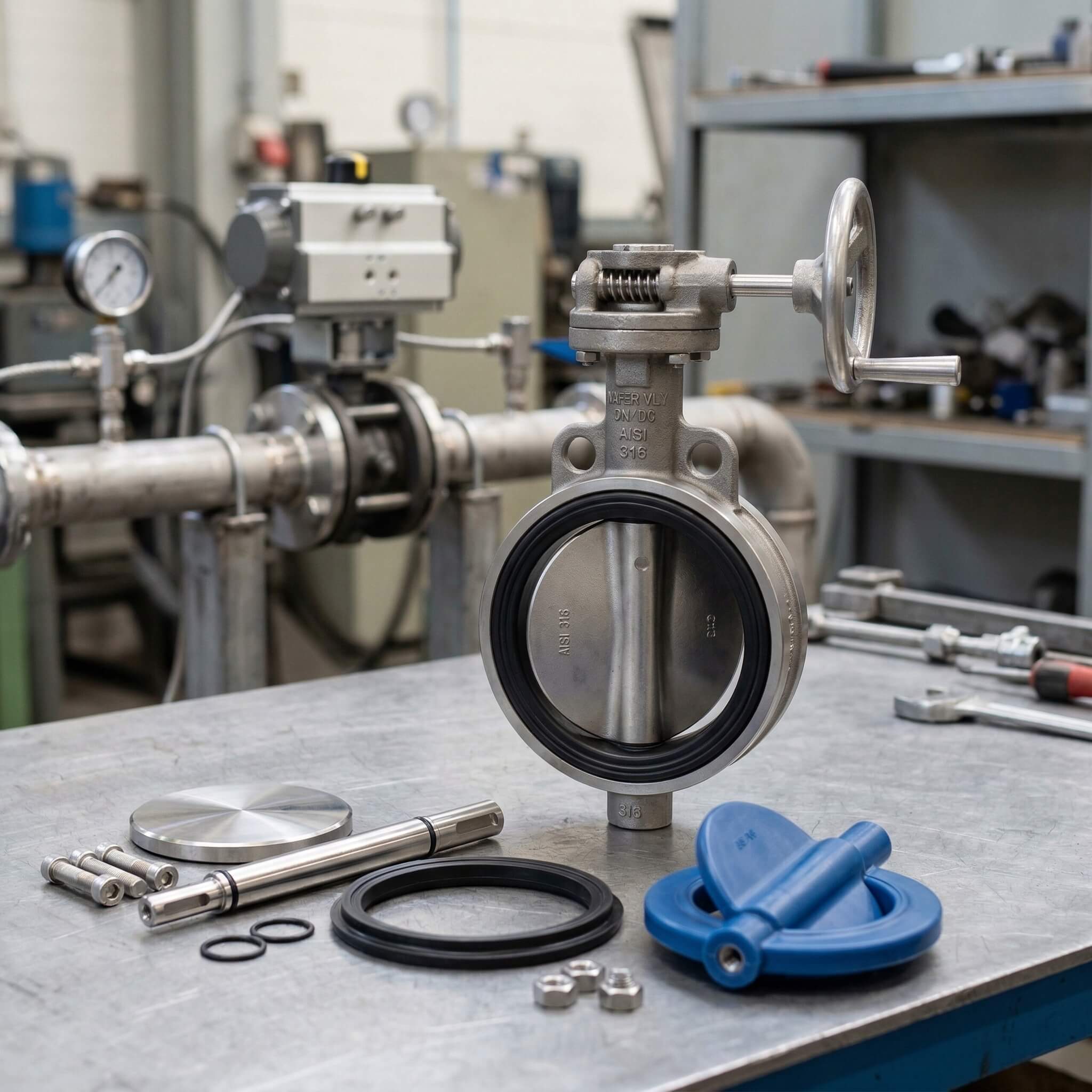
Butterfly valve components are the mechanical parts including the body, disc, stem, and seat that work together to regulate fluid flow in a piping system. Imagine your industrial project facing a sudden leak or a seized valve during a critical production phase. This pain often stems from poor material selection or a lack of understanding regarding the butterfly valve parts list. By mastering these internal names and their functions, you can optimize your fluid control systems for maximum reliability and safety.
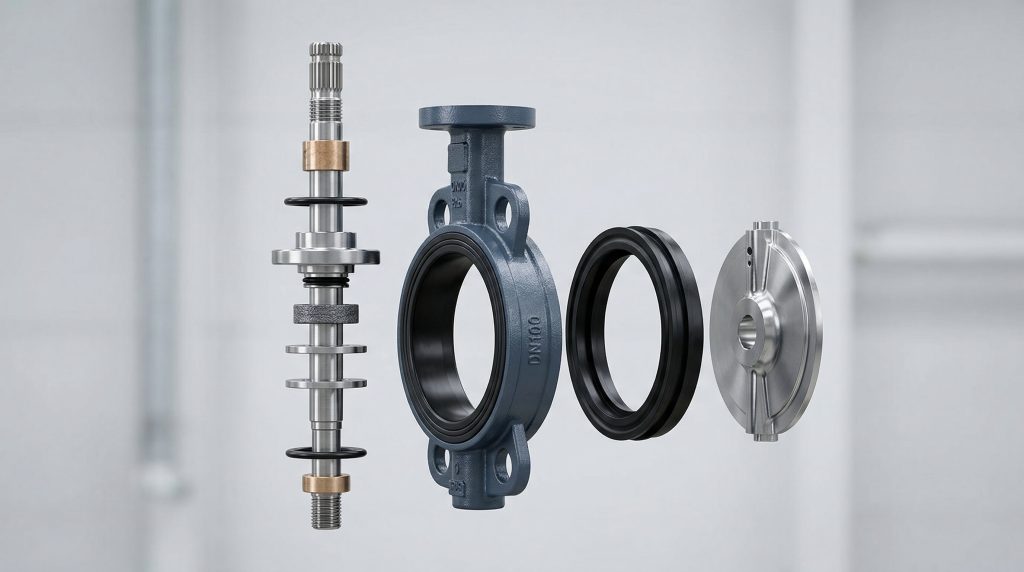
What is the primary butterfly valve parts list?
The primary butterfly valve parts list consists of four main components: the body, the disc, the stem, and the seat. These elements are designed to contain pressure and provide a physical barrier to stop or throttle flow. You must ensure each part is compatible with your specific media and pressure requirements.
Essential core components
You need to recognize that the core assembly relies on a rotating disc mechanism. Unlike a ball valve, the disc remains in the flow path, which influences pressure drop characteristics.
Look:
Here is why these parts are the foundation of every unit:
- Body: The outer shell that connects to the pipes.
- Disc: The closure element that rotates to block flow.
- Stem: The shaft that transmits torque to the disc.
- Seat: The internal lining that ensures a leak-tight seal.
Functional synergy in flow control
Every part on the list must work in perfect synchronization to prevent mechanical failure. The stem must turn the disc exactly 90 degrees to reach the fully closed or open position against the seat.
| Component | Primary Function | Critical Requirement |
|---|---|---|
| Body | Pressure containment | High structural integrity |
| Disc | Flow obstruction | Corrosion resistance |
| Stem | Torque transmission | High tensile strength |
| Seat | Sealing interface | Chemical compatibility |
The internal geometry of these parts dictates how well the valve performs under high-velocity flow conditions.
Key Takeaway: A complete understanding of the core four parts prevents procurement errors and ensures system longevity.
How does the body impact a butterfly valve parts list?
The body is the main structural component that holds everything together in your butterfly valve parts list. It acts as the pressure vessel and provides the connection points for your piping system. You must select a body design that fits your installation space and maintenance access needs.
Common body design variations
You will typically choose between wafer, lug, or flanged body styles depending on your application. Wafer bodies are lighter and more cost-effective for general service.
Think about it:
The choice between body types affects how you handle future repairs:
- Wafer: Sandwiched between flanges using long bolts.
- Lug: Features threaded inserts for independent bolting.
- Flanged: Uses integrated flanges for heavy-duty connections.
Body materials and pressure limits
Ductile iron is a standard choice for water systems, while carbon steel handles higher pressures. You must verify that the body material matches the pressure class of your pipeline to avoid catastrophic failure.
| Body Type | Installation Style | Best Application |
|---|---|---|
| Wafer | Thru-bolt sandwich | Space-constrained areas |
| Lug | Threaded bolt holes | Dead-end service tasks |
| Flanged | Double flange bolt | Large diameter systems |
Selecting the wrong body style can lead to difficulties during downstream piping removal or maintenance.
Key Takeaway: The body type determines the ease of installation and the ability to perform dead-end service safely.
Why is the disc vital in a butterfly valve parts list?
The disc is the active closure member that resides in the center of your butterfly valve parts list. It is functionally equivalent to the gate in a gate valve but operates with a quarter-turn motion. You should prioritize disc material quality as it faces the highest level of erosion and corrosion.
Disc geometry and flow efficiency
Designers often use eccentric or concentric disc placements to optimize performance. Concentric discs are simpler, while eccentric designs reduce the friction between the disc and seat during operation.
In fact:
The shape of the disc directly influences the flow coefficient (Cv) of your system:
- Thin Edge: Reduces turbulence and pressure loss.
- Symmetrical: Provides equal flow in either direction.
- Coated: Protects against abrasive slurries or chemicals.
Material selection for harsh media
Stainless steel discs (SS316) are the gold standard for resisting corrosion in chemical plants. For more aggressive environments, you might consider aluminum bronze or specialized polymer coatings.
| Disc Material | Common Use | Temperature Resistance |
|---|---|---|
| SS304/SS316 | Water & Chemicals | Excellent |
| Ductile Iron | Low-pressure water | Moderate |
| Nylon Coated | Abrasive slurries | Good (Low Temp) |
Matching the disc material to your process media is the most effective way to extend the life of the valve.
Key Takeaway: The disc is your primary line of defense against leaks; choose materials based on chemical and abrasive properties.
Does the stem matter for your butterfly valve parts list?
The stem is the critical link that connects your actuator to the disc in a butterfly valve parts list. It must be strong enough to handle the torque required to break the seal after long periods of closure. You should inspect the stem design to ensure it offers a blowout-proof safety feature.
One-piece versus split stem designs
You will encounter both one-piece (solid) and two-piece (split) stems in the market. One-piece stems are generally more robust for high-torque applications, while split stems offer a cleaner flow path.
Consider this:
The stem design impacts both performance and maintenance:
- Solid Stem: Maximum strength and torque handling.
- Split Stem: Improved flow capacity and reduced turbulence.
- Material: Often made of 410 or 17-4 PH stainless steel.
Stem sealing and friction control
Seals around the stem prevent the fluid from leaking out of the top of the valve. You should also look for high-quality bushings that reduce friction and prevent the stem from galling against the body.
| Stem Feature | Technical Benefit | Maintenance Impact |
|---|---|---|
| Blowout-proof | Safety under pressure | Critical for safety |
| ISO 5211 Pad | Easy automation | Simplifies upgrades |
| V-Ring Packing | Dynamic sealing | Prevents external leaks |
A sheared stem can leave your valve stuck in position, leading to expensive system-wide shutdowns.
Key Takeaway: The stem is the “spine” of the valve; ensure it is rated for the maximum torque of your actuator.
How do seats define a butterfly valve parts list?
The seat is the replaceable lining in your butterfly valve parts list that creates a leak-tight seal. It absorbs the impact of the disc and provides the necessary friction to stop the fluid. You must distinguish between resilient (soft) seats and metal seats based on your operating temperature.
Resilient seat material options
Most standard industrial valves use EPDM or NBR for water and oil services. These elastomers provide a bubble-tight shut-off that is difficult to achieve with harder materials.
Look:
Here is why seat material selection is so precise:
- EPDM: Best for hot water and dilute acids.
- NBR: Ideal for oils, fats, and petroleum products.
- Viton: Handles high temperatures and aggressive chemicals.
Metal seats for extreme conditions
When you deal with steam or high-heat processes, resilient seats will melt or deform. Metal seats utilize precision machining to create a seal that survives where rubber fails.
| Seat Material | Temp Range (°C) | Best For |
|---|---|---|
| EPDM | -20 to 120 | Potable Water |
| PTFE | -20 to 200 | Strong Acids |
| Metal | Up to 500+ | Steam / High Heat |
Chemical compatibility is the primary driver of seat failure; always check the chemical resistance charts.
Key Takeaway: The seat is the most frequently replaced part; choose a material that balances sealing performance with chemical life.
Are actuators on your butterfly valve parts list?
Actuators are the components that provide the force to operate the valves in your butterfly valve parts list. While the valve handles the fluid, the actuator handles the control logic of your system. You can choose between manual, pneumatic, or electric versions depending on your automation needs.
Manual versus automated control
For small valves (DN50 to DN150), a simple lever handle is usually sufficient for your needs. However, larger valves or remote installations require gearboxes or automated actuators to ensure safe operation.
Here is why:
Automation improves safety and process consistency:
- Levers: Quick on/off control for small sizes.
- Gearboxes: High torque for large diameters.
- Pneumatic: Fast, reliable automation using air.
Benefits of electric actuation
Electric actuators allow you to integrate the valve into a centralized PLC or SCADA system. They provide precise positioning, which is essential if you are using the valve for throttling rather than just on/off service.
| Actuator Type | Speed | Power Source |
|---|---|---|
| Manual Lever | Fast | Human Force |
| Gearbox | Slow | Mechanical Gain |
| Pneumatic | Fast | Compressed Air |
| Electric | Moderate | Electricity |
The choice of actuator depends on the frequency of operation and the availability of on-site power or air.
Key Takeaway: Actuators bridge the gap between mechanical hardware and digital process control systems.
What seals are in a butterfly valve parts list?
Seals and O-rings are the secondary barrier in your butterfly valve parts list. They work behind the scenes to protect the environment and the operator from hazardous leaks. You should treat these as critical items during any check valve or butterfly valve inspection.
Primary and secondary sealing logic
The primary seal is created by the disc and the seat interface. Secondary seals, such as O-rings located in the stem area, ensure that no media escapes if the primary seat is slightly bypassed.
In fact:
Proper sealing requires attention to small details:
- O-Rings: Prevent leakage along the stem.
- Gaskets: Seal the connection between the valve and the pipe.
- Bushings: Support the stem to maintain seal alignment.
Bearing and bushing importance
Bearings keep the stem centered and prevent the disc from scrubbing against the seat unevenly. Without high-quality bearings, your valve will require significantly more torque to operate and will wear out faster.
| Seal Type | Location | Purpose |
|---|---|---|
| Stem O-Ring | Upper/Lower Stem | Atmospheric sealing |
| Flange Gasket | Body Interface | Pipeline sealing |
| Packing Gland | Top of Stem | High-pressure backup |
Failure to replace an O-ring during maintenance can lead to small, persistent leaks that damage the actuator.
Key Takeaway: Small sealing components prevent environmental contamination and protect your expensive actuation hardware.
Is there a triple offset butterfly valve parts list?
Triple offset valves are a high-performance variant that includes unique items in their butterfly valve parts list. They are specifically designed for zero-leakage in critical high-pressure and high-temperature services. You will find these most often in oil refineries and power plants.
Understanding the three offsets
The “triple” refers to the geometric displacement of the stem and the sealing cone. These offsets allow the disc to rotate into the seat without friction, only making contact at the final degree of closure.
Think about it:
The complexity of the offsets provides massive benefits:
- Frictionless: Extends the life of the metal seat.
- Torque-Seated: Ensures a tighter seal as pressure increases.
- Cam-Action: Allows for bubble-tight metal-to-metal sealing.
High-performance parts materials
These valves often feature stellite-faced seats and stainless steel laminated discs. The parts list for a triple offset valve is much more specialized than a standard resilient-seated version.
| Feature | Design Difference | Benefit |
|---|---|---|
| Metal Seal | Laminated Layers | Fire-safe performance |
| Stellite Seat | Hard-facing | Erosion resistance |
| Eccentric Stem | Shifted Axis | Reduced torque needs |
While more expensive, these valves replace more traditional heavy-duty valves due to their compact size and superior sealing.
Key Takeaway: Triple offset designs are the ultimate solution for high-pressure systems where elastomer seals would fail.
Can you maintain a butterfly valve parts list easily?
Maintaining the components in your butterfly valve parts list is essential for reducing long-term operational costs. Proactive maintenance allows you to spot wear on the seat or stem before it leads to a total system failure. You should establish a regular inspection schedule based on your cycle counts and media type.
Inspection and replacement cycles
You should inspect the seat every 12 months for signs of hardening or cracking. In high-cycle applications, you might need to replace the seat and seals more frequently to maintain a perfect shut-off.
Look:
Here is why maintenance is your best investment:
- Cleaning: Removes debris that can tear the seat.
- Lubrication: Keeps the stem and bearings moving smoothly.
- Testing: Confirms the actuator is reaching the full 90-degree stop.
Identifying early failure signs
Increased operating torque is the most common early sign that the internal parts are failing. If your automated actuator is drawing more current or air, it is time to check for seat swelling or stem misalignment.
| Failure Sign | Probable Component | Action Needed |
|---|---|---|
| Visible Leak | Stem O-Rings | Replace Seals |
| Bypass Leak | Valve Seat | Replace Seat |
| Stuck Valve | Stem/Bushings | Lubricate/Repair |
A simple seat replacement can save you from having to purchase an entirely new valve assembly.
Key Takeaway: Routine maintenance of internal components is the most effective way to prevent unplanned production downtime.
How to select a quality butterfly valve parts list?
The quality of your butterfly valve parts list depends on the manufacturing standards and material traceability of the supplier. You should never compromise on the grade of the casting or the precision of the machining. You need to ensure the manufacturer follows global standards to guarantee performance.
Essential industry standards
You should verify that the valves comply with standards like API 609, DIN EN 593, or ISO 5208. These standards dictate everything from the wall thickness of the body to the pressure testing requirements for the seat.
In fact:
Standards provide the following assurances:
- Material Traceability: Confirms the chemical makeup of the steel.
- Test Certification: Proves the valve held pressure in the factory.
- Dimensional Accuracy: Ensures the valve fits your existing pipes.
Evaluating manufacturer credibility
A reliable manufacturer provides full documentation, including Material Test Reports (MTRs) for all pressure-retaining parts. This level of transparency is vital for EPC contractors and industrial engineers who must manage project risk.
| Requirement | Why It Matters | Verification Method |
|---|---|---|
| ISO 9001 | Quality management | Certificate review |
| 100% Hydro-test | Pressure safety | Test report check |
| MTC Traceability | Material integrity | Mill cert request |
Choosing a manufacturer with a proven track record in your specific industry reduces the likelihood of premature failure.
Key Takeaway: Quality starts with standardized manufacturing and ends with rigorous pressure testing of every single unit.
Frequently Asked Questions
Can I replace the seat without buying a new valve?
Yes. For most resilient-seated valves, the seat is a separate, replaceable component that can be swapped out once the valve is removed from the pipeline.
What’s the best material for a chemical-resistant disc?
Stainless steel 316L or PTFE-lined discs are typically the best judgment because they offer the broadest range of chemical resistance against aggressive acids.
Can I upgrade a manual valve to an automated one later?
Absolutely. As long as your valve has a standard ISO 5211 mounting pad, you can remove the handle and install a pneumatic or electric actuator at any time.
Why does my butterfly valve have higher torque in one direction?
This is usually due to seat swelling or an offset disc design where the pressure helps seal the valve in one direction but opposes it in the other.
How do I know if I need a triple offset valve?
If your application involves temperatures above 200°C or high-pressure steam where bubble-tight shut-off is mandatory, the triple offset design is the most reliable choice.
Conclusion
Your industrial success depends on the reliability of every item on your butterfly valve parts list. From the structural strength of the body to the precision sealing of the disc and seat, each component plays a vital role in keeping your operations running smoothly. Understanding these parts allows you to troubleshoot issues faster and make smarter procurement decisions. If you need assistance selecting the right components or want to optimize your fluid control system, contact us today for expert technical consultation. We solve your downtime and leakage problems with precision-engineered valves built for the world’s most demanding environments.