
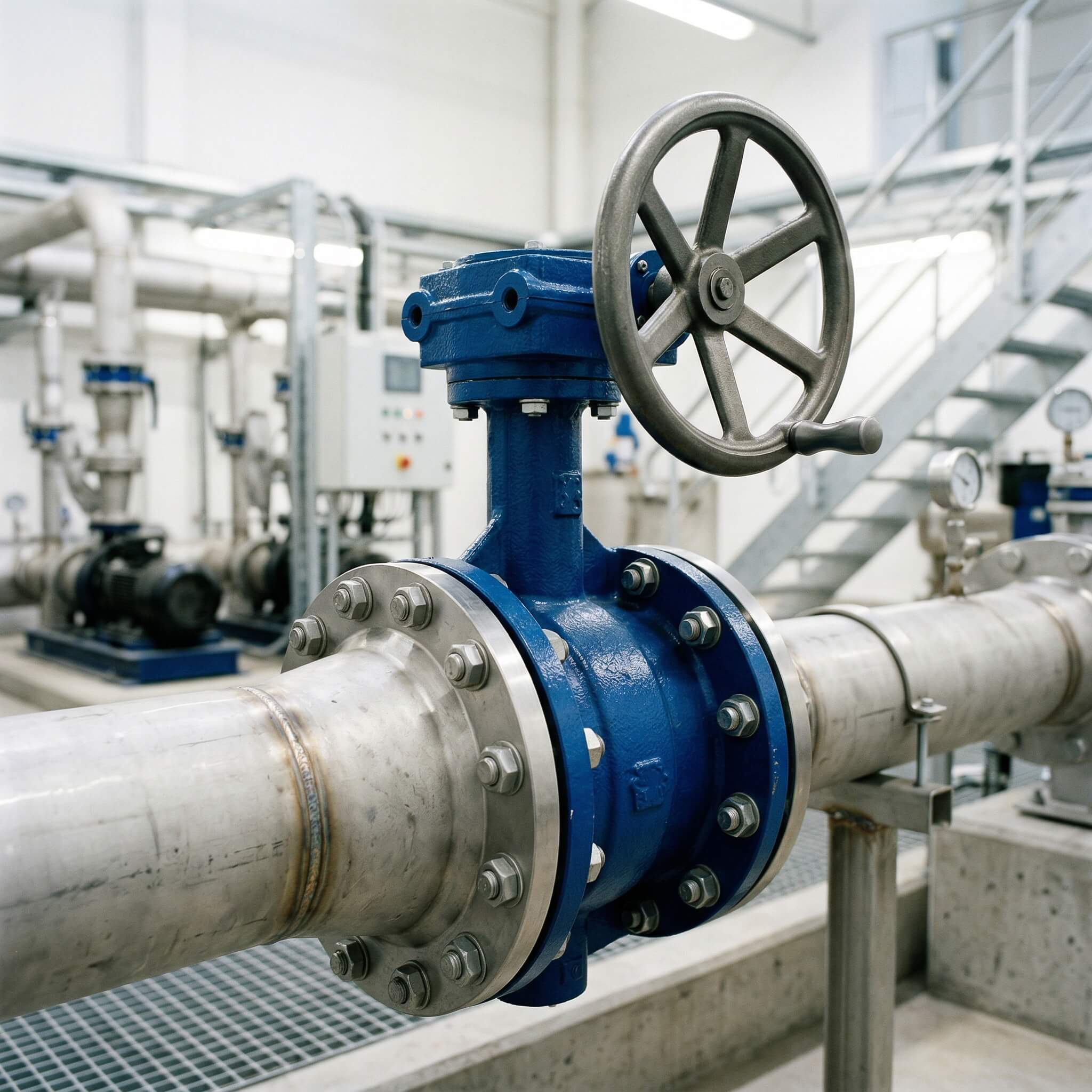
A butterfly valve is a quarter-turn rotational motion valve used to stop, regulate, and start the flow of various fluids. Inefficient flow control and bulky valve installations often lead you to experience increased maintenance costs and operational downtime in your industrial piping systems. Using the wrong valve type can cause significant pressure drops and leakage issues that complicate your daily operations. High-performance butterfly valve water solutions provide you with a compact, reliable, and cost-effective method for both precise throttling and secure flow isolation.
What is a butterfly valve water system component?
A butterfly valve water system component is a specialized flow control device that uses a rotating disc to manage the movement of liquid through a pipeline. You will find these components essential for systems requiring rapid shut-off and lightweight construction. Their design allows for efficient operation in large-diameter pipes where other valve types would be too heavy.
How does the quarter-turn mechanism work?
The mechanism operates by rotating the internal disc 90 degrees to move from a fully open to a fully closed position. When you turn the handle or actuator, the stem rotates the disc to either block the path or allow full flow.
Here is why:
- Speed: It allows for very fast opening and closing.
- Simplicity: Fewer moving parts mean less mechanical wear for you.
- Efficiency: The quarter-turn motion reduces operator fatigue during manual use.
What are the primary parts of the valve?
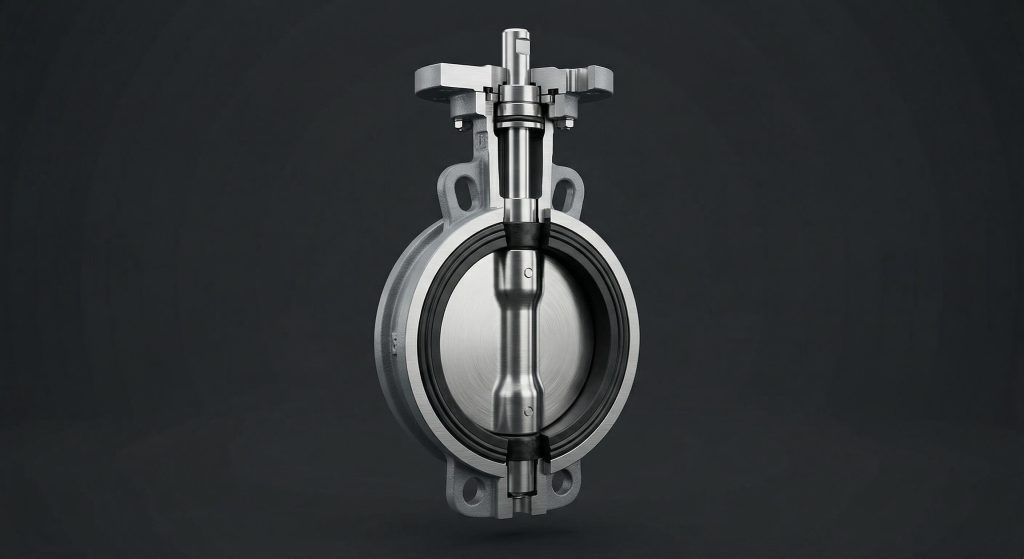
The primary parts include the valve body, a resilient seat, the rotating disc, and the supporting stem. These elements work together to ensure a bubble-tight seal when the valve is closed.
But that’s not all. You must also consider the actuator or handle that provides the necessary torque to move the disc.
| Component | Primary Material | Function |
|---|---|---|
| Valve Body | Ductile Iron/SS | Housing for internal parts |
| Disc | Stainless Steel | Obstruction for flow control |
| Seat | EPDM/Viton | Provides leak-proof sealing |
| Stem | 416 Stainless Steel | Transmits torque to the disc |
The integration of these durable materials ensures that your assembly can withstand the rigors of high-pressure liquid environments.
Key Takeaway: Understanding the structural components of your valve helps you identify wear points and select the right materials for long-term reliability.
Where is a butterfly valve water application common?
A butterfly valve water application is common in sectors ranging from municipal treatment plants to large-scale industrial cooling systems. You typically see these valves used where space is limited and high flow capacity is required. They are versatile enough to handle clean liquids as well as fluids with moderate suspended solids.
Is it suitable for municipal water supply?
Yes, these valves are standard in municipal networks due to their compact face-to-face dimensions and ease of automation. They allow you to manage high volumes of water with minimal pressure loss across the distribution network.
Here is why:
- Lower weight reduces pipe support requirements.
- Reliable sealing protects against treated water loss.
- Ease of maintenance keeps your utility costs down.
Can it handle industrial wastewater systems?
Butterfly valves are excellent for wastewater because their streamlined disc design resists clogging from debris. You can choose specialized seat materials to handle the chemical additives often found in industrial effluent.
But that’s not all.
| Application Type | Suitability | Key Benefit |
|---|---|---|
| Potable Water | High | Corrosion resistance |
| Wastewater | High | Minimal debris buildup |
| Cooling Towers | Very High | Large flow capacity |
The robust construction of these valves makes them a preferred choice for harsh environmental conditions in waste management.
Key Takeaway: Utilizing butterfly valves in diverse water applications optimizes your system’s footprint while maintaining high operational throughput.
What terms describe a butterfly valve water flow?
The terms used to describe butterfly valve water flow usually include “throttling,” “on-off service,” and “flow coefficient” (Cv). These descriptors help you understand how the valve interacts with the fluid dynamics of your piping system. Proper terminology ensures you communicate effectively with engineers and suppliers regarding your performance needs.
What does near linear flow regulation mean?
Near linear flow regulation means the flow rate increases or decreases in a consistent proportion to the angle of the disc opening. While not perfectly linear, it gives you predictable control over the volume of liquid passing through.
Here is why:
- Predictability: You can anticipate flow changes easily.
- Precision: It supports better system balancing.
- Safety: It prevents sudden pressure surges in your lines.
Why is flow isolation critical for maintenance?
Flow isolation allows you to completely shut off a section of the pipe so you can perform repairs without draining the entire system. This “bubble-tight” shut-off is vital for protecting your equipment and personnel during service intervals.
But that’s not all.
| Flow Term | Definition | Importance for You |
|---|---|---|
| Throttling | Modulating flow volume | Maintains system balance |
| Isolation | Complete shut-off | Ensures safe maintenance |
| Low Head Loss | Minimal pressure drop | Reduces pumping energy costs |
Effective flow management reduces the mechanical stress on your pumps and extends the life of your entire infrastructure.
Key Takeaway: Mastering flow terminology allows you to select valves that provide the exact level of control and isolation your system requires.
How to install a butterfly valve water line unit?
Installing a butterfly valve water line unit requires careful alignment of the valve disc and the surrounding pipe flanges to prevent seat damage. You must ensure the disc is slightly open during installation so it does not snag on the flange edges. Following a systematic approach prevents premature seal failure and ensures a leak-free connection.
How to prepare the pipe flanges correctly?
You must clean the flange faces and ensure they are parallel and properly spaced before inserting the valve. If the pipes are too close or misaligned, you risk crushing the valve seat or causing the disc to bind.
Here is why:
- Alignment: Prevents uneven stress on the valve body.
- Cleanliness: Removes debris that could damage the seals.
- Spacing: Ensures there is enough room for the valve width.
What is the proper bolt tightening sequence?
A star-pattern tightening sequence is essential to apply even pressure across the valve’s sealing surface. You should tighten the bolts in several stages, increasing the torque gradually until you reach the manufacturer’s specification.
But that’s not all.
| Installation Step | Action | Outcome for You |
|---|---|---|
| Disc Positioning | Set to slightly open | Prevents seat interference |
| Flange Check | Verify parallelism | Ensures uniform sealing |
| Bolt Torque | Use star pattern | Prevents body distortion |
Proper installation techniques eliminate common startup issues like localized leaks and operational jamming.
Key Takeaway: A precise installation process protects your investment and guarantees the long-term integrity of your pipeline’s flow control.
Why choose a butterfly valve water solution?
You should choose a butterfly valve water solution because it offers the best balance of performance, weight, and price for large-scale operations. Compared to heavy gate or globe valves, these units are much easier for you to install and maintain over time. They provide reliable service in both high-flow industrial settings and sensitive municipal environments.
Are they more cost-effective than gate valves?
Butterfly valves are generally more affordable, especially in larger sizes, because they use less metal in their construction. This lower material cost translates directly to a lower purchase price for your project budget.
Here is why:
- Lightweight: Reduces shipping and installation labor costs.
- Compact: Requires fewer supports and less space.
- Simple: Lower maintenance needs over the valve’s lifecycle.
How do they save space in tight piping layouts?
The “wafer” or “lug” design of these valves features a very short face-to-face dimension compared to traditional valves. This allows you to fit them into compact areas where other valves simply would not fit.
But that’s not all.
| Valve Type | Space Requirement | Relative Cost |
|---|---|---|
| Butterfly Valve | Minimal | Low to Medium |
| Gate Valve | High | High |
| Globe Valve | Medium | High |
Choosing a butterfly design allows you to design more efficient, compact systems without sacrificing flow capacity or reliability.
Key Takeaway: The economic and spatial advantages of butterfly valves make them the superior choice for modern, high-efficiency piping projects.
How to maintain a butterfly valve water assembly?
Maintaining a butterfly valve water assembly involves periodic inspection of the seat and regular cycling of the disc to prevent mineral buildup. You will find that a proactive maintenance schedule significantly reduces the risk of unexpected valve failure. Keeping the moving parts clean and the seals intact ensures the valve remains operational when you need it most.
Why is regular valve cycling important?
Regularly opening and closing the valve prevents “freezing” or sticking caused by scale accumulation from the liquid. If you leave a valve in one position for too long, you might find it impossible to operate during an emergency.
Here is why:
- Mobility: Keeps the stem and disc moving freely.
- Cleaning: Dislodges minor deposits on the seat.
- Inspection: Allows you to verify the actuator function.
When should the valve seat be replaced?
You should replace the seat if you notice visible cracking, hardening of the elastomer, or if the valve no longer provides a complete shut-off. Most modern valves feature field-replaceable seats, making it easy for you to restore performance.
But that’s not all.
| Maintenance Task | Frequency | Purpose |
|---|---|---|
| Visual Inspection | Every 6 months | Identify external leaks/corrosion |
| Manual Cycling | Quarterly | Prevent disc sticking |
| Seat Replacement | As needed | Restore bubble-tight sealing |
A consistent maintenance routine ensures your valves perform at peak efficiency and prevents costly system-wide shutdowns.
Key Takeaway: Simple, regular maintenance tasks are your best defense against the operational degradation of flow control components.
What defines a quality butterfly valve water product?
A quality butterfly valve water product is defined by its adherence to international manufacturing standards and the use of high-grade materials. You should look for valves that offer a combination of precision machining and durable elastomer sealing. Quality components ensure that your system remains leak-free and easy to operate even under high-pressure conditions.
Which international standards should apply?
Standards like API 609, AWWA C504, and ISO 5752 govern the design, pressure ratings, and dimensions of these valves. These certifications give you confidence that the valve will perform as specified in your technical requirements.
Here is why:
- Interchangeability: Standard dimensions fit your existing pipes.
- Reliability: Certified pressure ratings ensure safety.
- Consistency: Uniform quality across different production batches.
Why are material certifications necessary?
Material certifications (like MTRs) prove that the metals and elastomers used in the valve meet the chemical and physical properties required for your application. This is particularly important for you when dealing with corrosive water or drinking water systems.
But that’s not all.
| Quality Indicator | Standard/Cert | Benefit for You |
|---|---|---|
| Design Standard | API 609 | Guaranteed performance specs |
| Potable Water | NSF/ANSI 61 | Safe for drinking water |
| Leakage Class | MSS SP-67 | Confirmed shut-off integrity |
Investing in certified products reduces your long-term risk and ensures compliance with industry safety regulations.
Key Takeaway: Prioritizing certified quality over initial cost protects your system from the dangers of substandard manufacturing and material failure.
When to use a lug style butterfly valve water unit?
You should use a lug style butterfly valve water unit when you need the ability to disconnect one side of the piping while the other side remains under pressure. The lug design features threaded inserts that allow you to bolt the valve directly to each flange independently. This provides you with greater flexibility during system modifications or partial maintenance tasks.
What are the benefits of the lugged design?
The primary benefit is the secure mechanical connection it provides to each pipe flange without requiring a through-bolt. This makes the valve much easier for you to handle during installation in tight or elevated spaces.
Here is why:
- Stability: The valve is bolted to both flanges.
- Maintenance: Allows downstream pipe removal.
- Security: Reduces the risk of the valve shifting.
Is it suitable for dead-end service?
Yes, lug valves are specifically designed to handle dead-end service, where they act as the terminal point of a pressurized line. You can safely remove the downstream piping while the lug valve holds the full pressure from the upstream side.
But that’s not all.
| Design Feature | Lug Style | Wafer Style |
|---|---|---|
| Dead-End Service | Yes (rated) | No |
| Connection Type | Threaded Lugs | Through-Bolts |
| Installation Weight | Heavier | Lighter |
Using a lugged design gives you the operational freedom to service sections of your facility without a total system drain.
Key Takeaway: Lug style valves are the professional choice for systems requiring modular maintenance and the ability to isolate terminal line ends.
Can a butterfly valve water system handle throttling?
A butterfly valve water system can handle throttling effectively between the 30-degree and 80-degree disc positions. You will find that these valves are suitable for coarse flow regulation in cooling and distribution systems. However, you must avoid using them for precise throttling at very low angles to prevent seat erosion and cavitation.
How does it compare to globe valve control?
While globe valves offer superior precision for fine-tuning flow, butterfly valves provide a much higher flow capacity for their size. For you, this means a butterfly valve is better for high-volume systems that only require general modulation.
Here is why:
- Flow Capacity: Higher Cv values for large pipes.
- Cost: Much cheaper than large globe valves.
- Weight: Significantly lighter for the same pipe size.
What are the limits of disc positioning?
You should generally not operate a butterfly valve for long periods with the disc open less than 20 degrees. At these low angles, the high-velocity liquid can cause “wire drawing” or erosion of the valve seat.
But that’s not all.
| Throttling Angle | Performance Level | Recommendation |
|---|---|---|
| 0° – 20° | Poor | Avoid for long periods |
| 30° – 70° | Good | Optimal for regulation |
| 80° – 90° | Excellent | Best for full flow |
Managing the disc angle correctly allows you to control flow volumes while protecting the internal components from hydraulic damage.
Key Takeaway: Strategic use of the 30-70 degree range allows you to achieve effective flow regulation without compromising the valve’s lifespan.
How to select the right butterfly valve water size?
Selecting the right butterfly valve water size involves matching the valve’s flow coefficient (Cv) to your system’s required flow rate and pressure drop. You should not simply match the valve size to the pipe size, as this can lead to oversized valves that provide poor control. Taking the time to calculate your specific needs ensures your pumps operate efficiently and your flow stays stable.
Does pipe diameter affect the valve choice?
While pipe diameter provides a starting point, the actual velocity of the liquid is the more critical factor for you to consider. If the velocity is too high, you may need a specialized high-performance valve to handle the resulting turbulence.
Here is why:
- Velocity Limits: Excessive speed can cause cavitation.
- Pressure Drop: Smaller valves increase your energy costs.
- Control Range: Correct sizing improves throttling accuracy.
How to calculate the required flow coefficient?
You calculate the Cv by considering the flow rate in gallons per minute and the allowable pressure drop across the valve. This calculation helps you determine the smallest valve size that can handle your maximum flow without excessive resistance.
But that’s not all.
| Selection Factor | Impact on System | Your Goal |
|---|---|---|
| Flow Rate (GPM) | Throughput capacity | Meet process demand |
| Pressure Drop | Energy consumption | Minimize head loss |
| Liquid Velocity | Component wear | Stay under 15-20 fps |
Accurate sizing prevents the common issues of valve hunting, seat erosion, and unnecessary energy expenditure in your facility.
Key Takeaway: Sizing your valves based on hydraulic calculations rather than pipe diameter leads to a more efficient and controllable water system.
Conclusion
Choosing the right butterfly valve solves your most pressing challenges, from reducing installation footprint to minimizing maintenance-related downtime. By selecting high-quality, certified components and following proper installation guidelines, you can ensure your infrastructure remains efficient and reliable for years to come. Whether you need precise throttling or robust isolation, these valves provide a versatile solution for any industrial application. We invite you to contact us today to find the perfect flow control components for your specific requirements. Our vision is to empower global industries with precision-engineered flow solutions that maximize efficiency and sustainable performance.
FAQ
Can I use a butterfly valve for high-pressure steam applications?
No, standard resilient-seated valves are not designed for high-temperature steam. You should instead use triple-offset metal-seated butterfly valves specifically rated for steam service to ensure safety and longevity.
What’s the best material for a valve seat in a chlorine-treated system?
Viton or specialized EPDM is usually the best choice for treated water. These materials resist the oxidizing effects of chlorine better than standard rubber, preventing premature seal degradation.
Can I install a butterfly valve with the stem in a horizontal position?
Yes, it is actually recommended for systems with sediment to install the stem horizontally. This prevents debris from settling in the bottom stem bearing, which could cause the valve to jam over time.
What’s the most common cause of butterfly valve leakage?
Improper installation and flange misalignment are the most frequent causes of leaks. When the valve is not centered or the bolts are tightened unevenly, the seat can distort and fail to provide a tight seal.
Can I use a wafer-style valve for dead-end service?
No, you must never use a wafer-style valve for dead-end service. Wafer valves rely on the pressure from both flanges to stay secure; removing one side will cause the valve to fail and potentially cause a blowout.