
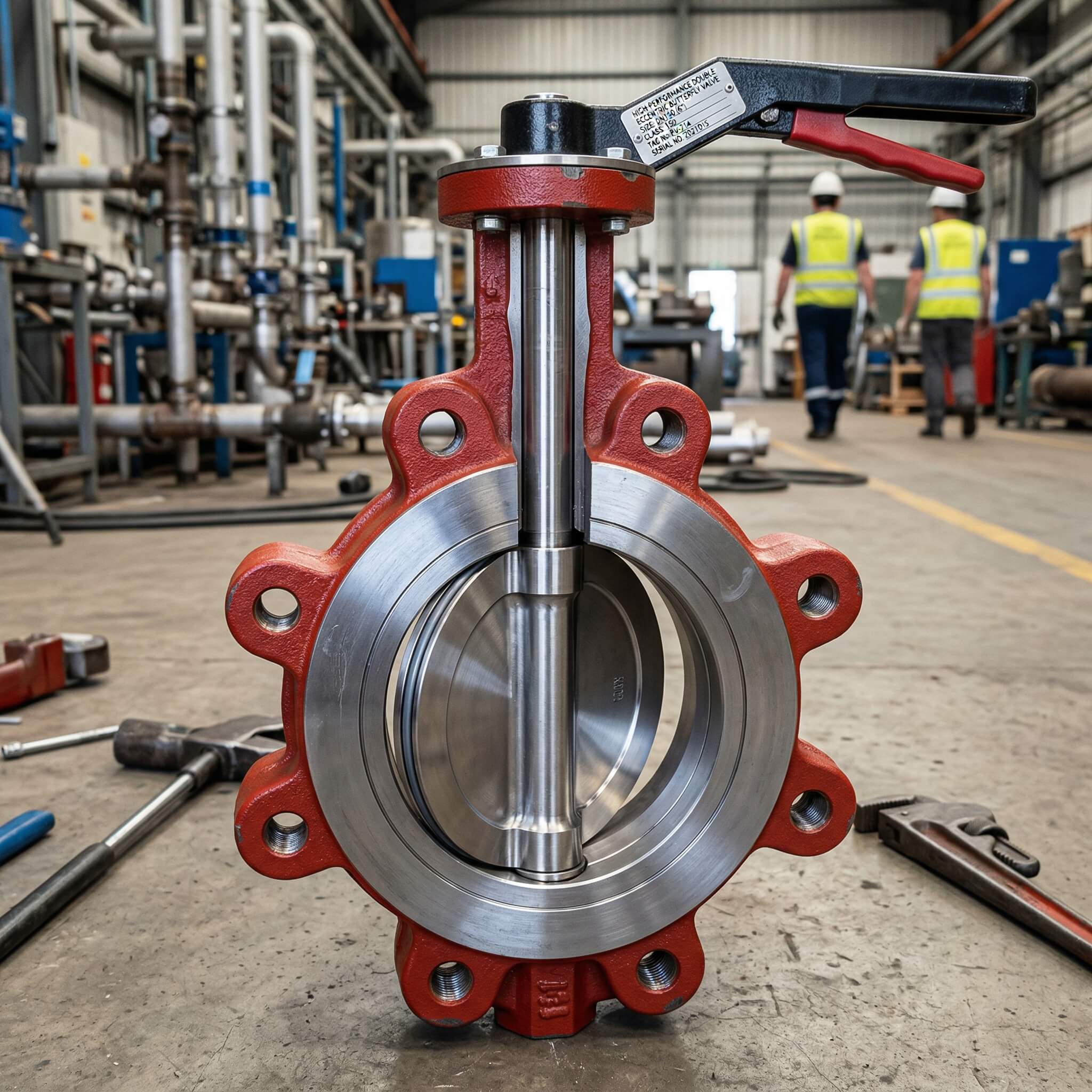
A double offset butterfly valve is a high-performance industrial valve where the stem is displaced from the center of the disc and the pipe, creating a cam-like action during operation. In critical piping systems, using standard concentric valves often leads to premature seal wear and catastrophic leakage under high pressure. These failures cause expensive unplanned downtime and safety risks for your facility’s personnel. By implementing a precision-engineered double offset butterfly valve design, you achieve bubble-tight sealing and significantly reduced friction.
What defines a double offset butterfly valve design?
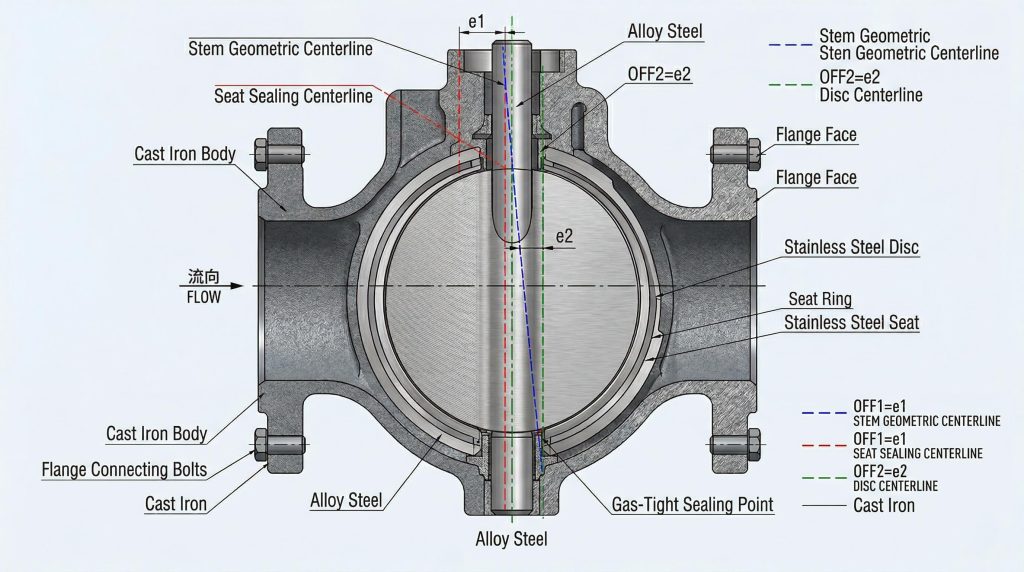
This specific double offset butterfly valve design is defined by two distinct displacements: the shaft is behind the seat centerline and slightly to one side of the pipe centerline. These offsets allow the disc to lift off the seat almost immediately upon opening.
What are the core components you need to know?
Do you know which parts make this valve “high performance”? You will find that the design relies on a robust body, a precision-machined disc, and a specialized seat assembly.
- Valve Body: Available in wafer, lug, or flanged types for varied piping.
- Disc and Stem: The disc is usually made of stainless steel for corrosion resistance.
- Seating Surface: Typically utilizes PTFE, RTFE, or metal-to-metal contact.
Here is the kicker:
Because the stem is not in the center, the disc moves in a cam-like motion. This ensures you get a tighter seal without the constant rubbing seen in cheaper alternatives.
Key Takeaway
The double offset geometry provides a high-cycle life by minimizing contact between the disc and the seat until the final moment of closure.
| Feature | Double Offset Specification |
|---|---|
| Stem Position | Offset from centerline and seat |
| Sealing Type | Cam-action eccentric |
| Cycle Life | High (100,000+ operations) |
This engineering configuration ensures that your industrial systems remain leak-free for longer periods compared to standard valves.
How does a double offset butterfly valve design work?
The operational logic of a double offset butterfly valve design centers on a camming motion that pulls the disc away from the seat during the first few degrees of rotation. This mechanism prevents the “dragging” effect that destroys soft seats in standard concentric valves.
How does the cam action benefit your system?
Have you ever wondered why these valves require less torque? You will notice that as you turn the actuator, the disc doesn’t rub against the seat for the entire 90-degree travel.
- Opening Phase: The disc lifts off the seat immediately, reducing friction.
- Closing Phase: The eccentric movement wedges the disc into the seat for a secure seal.
- Torque Reduction: Lower friction means you can use smaller, cheaper actuators.
Think about it:
Lower friction translates directly to less wear and tear on your internal seals. This means you won’t have to replace parts as often as you would with zero-offset designs.
Key Takeaway
The “camming” action of the disc ensures that sealing pressure is only applied during the final degrees of closure.
| Phase | Disc-to-Seat Contact | Torque Requirement |
|---|---|---|
| 0° (Closed) | Maximum Compression | High (Seating Torque) |
| 5° – 85° | Zero Contact | Very Low |
| 90° (Open) | Zero Contact | Minimal |
This operational efficiency makes it the preferred choice for automated control systems where speed and reliability are paramount.
Why use a double offset butterfly valve design?
Choosing a double offset butterfly valve design provides a middle-ground solution that offers high-pressure capabilities without the extreme cost of triple offset valves. You gain the ability to handle corrosive media and higher temperatures while maintaining a compact footprint.
Is the cost-to-performance ratio right for you?
Can you afford the downtime associated with low-quality utility valves? When you upgrade to a high-performance design, you are investing in a longer-lasting fluid control solution.
- Pressure Handling: Rated for ANSI Class 150, 300, and sometimes 600.
- Temperature Range: Handles superheated steam and cryogenic fluids with ease.
- Space Savings: Much lighter and more compact than gate or globe valves.
But wait, there’s more:
These valves are incredibly versatile across different industries. Whether you are dealing with oil or wastewater, the double eccentric geometry holds up where others fail.
Key Takeaway
The primary motivation for this design is achieving “bubble-tight” shutoff in applications that exceed the limits of soft-seated concentric valves.
| Benefit Category | Industrial Impact |
|---|---|
| Maintenance | Reduced seat replacement frequency |
| Automation | Lower torque allows for smaller actuators |
| Application | Suitable for steam, gas, and chemicals |
Investing in this design ensures you meet strict environmental regulations regarding fugitive emissions and leakage.
What materials suit a double offset butterfly valve design?
Selecting the right materials for your double offset butterfly valve design is essential for ensuring chemical compatibility and structural integrity. Most high-performance models utilize carbon steel or stainless steel bodies to withstand external stresses and internal pressure.
Which seating material should you choose?
Do you need a soft seat for gas or a metal seat for extreme heat? You must match the seat material to your specific media to prevent premature failure.
- PTFE/RTFE: Best for general chemicals and temperatures up to 200°C.
- Metal Seats: Required for high-pressure steam or fire-safe applications.
- Exotic Alloys: Hastelloy or Monel can be used for highly corrosive acids.
Make no mistake:
The material of the disc and shaft is just as important as the seat. If the shaft shears under high torque, your entire production line could come to a halt.
Key Takeaway
Material selection directly impacts the valve’s ability to maintain a seal under varying thermal and chemical conditions.
| Material Component | Common Options | Temperature Range |
|---|---|---|
| Body | WCB, CF8M, Ductile Iron | -29°C to 425°C |
| Seat | PTFE, Stellite, Inconel | -196°C to 600°C |
| Disc | SS316, 17-4PH | Application dependent |
Choosing high-grade stainless steel for the disc and shaft ensures that your valve remains operational even in saltwater or acidic environments.
What are the body styles for double offset butterfly valve design?
The double offset butterfly valve design typically comes in three body configurations: wafer, lug, and double flanged. Each style offers unique benefits depending on whether you need “end-of-line” service or the most compact installation possible.
Which body style fits your piping layout?
Are you planning to perform maintenance without shutting down the entire line? You will find that lug-style valves are superior for isolating sections of a system.
- Wafer Style: Lightest and cheapest; fits between two pipe flanges.
- Lug Style: Features threaded inserts; allows for downstream piping removal.
- Flanged Style: Used for very large diameters to ensure maximum stability.
The best part?
Wafer valves save a significant amount of space compared to traditional ball valves. If your facility has tight piping constraints, the wafer double offset is your best friend.
Key Takeaway
Your choice of body style should be dictated by your maintenance requirements and the physical space available in your plant.
| Body Type | End-of-Line Service | Installation Cost |
|---|---|---|
| Wafer | No | Lowest |
| Lug | Yes | Medium |
| Double Flange | Yes | Highest |
Selecting the correct body type ensures that your installation complies with international piping standards like ANSI B16.5 or DIN.
Is double offset butterfly valve design for high pressure?
A double offset butterfly valve design is specifically engineered to handle pressures far beyond what a standard rubber-lined valve can manage. While concentric valves struggle at 150 PSI, these high-performance variants often operate comfortably at 740 PSI or higher.
How do these valves handle pressure surges?
Will your valves hold up when the pumps kick in? You can trust this design because the shaft and disc are reinforced to prevent deformation under high differential pressure.
- ANSI Class 150: Standard for most municipal and HVAC water lines.
- ANSI Class 300: Common in petrochemical and steam applications.
- Shut-off Pressure: Capable of bi-directional sealing in many configurations.
Here is the deal:
The eccentric design actually uses the line pressure to help push the disc into the seat. This “pressure-assisted” sealing is what makes them so reliable in critical service.
Key Takeaway
The double offset design bridges the gap between low-pressure utility valves and high-pressure specialty equipment.
| Pressure Class | Max Working Pressure (Approx) | Common Application |
|---|---|---|
| Class 150 | 285 PSI | Water treatment |
| Class 300 | 740 PSI | Industrial steam |
| Class 600 | 1480 PSI | Specialized oil/gas |
This high-pressure capability ensures that you don’t have to worry about “blowouts” or internal bypass during peak operation.
How to actuate a double offset butterfly valve design?
You can actuate a double offset butterfly valve design using manual, pneumatic, electric, or hydraulic methods. Because of the reduced operating torque, you will find that the actuators required are often smaller and more cost-efficient than those used for check valves or gate valves.
Which actuator type is best for your facility?
Do you need fast-acting emergency shutoff or precise flow modulation? You will need to select an actuator that matches the cycle frequency of your process.
- Manual Gear: Best for valves that stay open or closed for long periods.
- Pneumatic: The industry standard for speed and fail-safe operations.
- Electric: Ideal for remote locations where compressed air is unavailable.
Let’s be honest:
Automation is where these valves truly shine. Their predictable torque curve makes it very easy for your control systems to maintain a specific flow rate without hunting.
Key Takeaway
Standardizing your actuation interfaces allows you to quickly swap out motors or cylinders without removing the valve from the pipe.
| Actuator Type | Speed of Operation | Best For |
|---|---|---|
| Pneumatic | Fast (1-3 seconds) | Safety shutoff |
| Electric | Moderate | Precise modulating control |
| Gear Op | Slow | Manual isolation |
Using the right actuation package ensures that your fluid control system responds instantly to your plant’s commands.
Where is double offset butterfly valve design applied?
You will see the double offset butterfly valve design in nearly every heavy industrial sector, from power generation to chemical refining. Their ability to handle “dirty” media like slurries or hydrocarbons makes them more versatile than many other valve types.
In which industries will you find these valves?
Are you working in a sector that requires high purity or high safety standards? You will find these valves protecting critical infrastructure globally.
- Power Plants: Handling high-pressure cooling water and steam lines.
- Oil & Gas: Used in refineries for isolating various fuel grades.
- Water Treatment: Managing large-scale filtration and desalination processes.
The kicker is this:
Because they can be made “fire-safe,” they are a mandatory requirement in many petrochemical facilities where flammable liquids are present.
Key Takeaway
The broad application range of this design stems from its ability to provide tight shutoff across diverse temperatures and pressures.
| Industry | Typical Media | Critical Requirement |
|---|---|---|
| Shipbuilding | Seawater / Fuel | Corrosion Resistance |
| HVAC | Chilled Water | Low Leakage |
| Chemical | Acids / Caustics | Sealing Integrity |
From the depths of a marine engine room to the top of a chemical reactor, these valves provide the reliability you demand.
How to maintain a double offset butterfly valve design?
Maintaining your double offset butterfly valve design is straightforward compared to gate valves, as the primary wear components are easily accessible. You should perform periodic inspections of the stem packing and seat surfaces to ensure optimal performance.
How do you extend the life of your valves?
Do you have a preventative maintenance schedule in place? You will find that simple lubrication and occasional packing adjustments can double the life of your equipment.
- Packing Adjustment: Tighten the gland followers if you see minor stem leaks.
- Seat Inspection: Check for debris that might have scarred the sealing surface.
- Actuator Check: Ensure the limit switches are stopping the disc at the right spot.
Let’s dive right in:
Most seat replacements can be done with basic hand tools. Unlike some other valve types, you don’t usually need to replace the entire disc assembly just because the seat is worn.
Key Takeaway
Regular maintenance of the high-performance double offset valve ensures that it remains “bubble-tight” for its entire 15-25 year design life.
| Maintenance Task | Frequency | Expected Outcome |
|---|---|---|
| Visual Leak Check | Monthly | Prevent major failures |
| Stem Lubrication | Bi-annually | Smooth operation |
| Seat Replacement | 5-10 Years | Restore zero-leakage |
Proactive care for your valves reduces the total cost of ownership and prevents the “PAS” scenarios mentioned earlier.
How does it compare to triple offset butterfly valve design?
The double offset butterfly valve design is often compared to the triple offset version, which features an additional elliptical seat geometry. While the triple offset is the “gold standard” for zero-leakage in extreme heat, the double offset is often the more economical and practical choice for 90% of industrial tasks.
Is the triple offset overkill for your project?
Do you really need to spend three times the budget for a feature you might not use? You will find that the double offset handles most steam and water applications perfectly.
- Friction Level: Triple offset has zero friction; double offset has friction only at the start/end.
- Cost Factor: Double offset is significantly more budget-friendly.
- Seat Life: Both offer high longevity compared to concentric types.
Here is the best part:
For most HVAC, water, and mid-range chemical processes, the double offset is actually the superior choice because it is easier to repair and faster to source.
Key Takeaway
Choose the double offset for high-performance needs where extreme cryogenic or 600°C+ temperatures are not present.
| Specification | Double Offset | Triple Offset |
|---|---|---|
| Sealing Motion | Cam Action | Non-rubbing Conical |
| Max Temp | Up to 400°C | Up to 800°C+ |
| Primary Market | General Industry / Power | Heavy Oil / Nuclear |
Understanding this comparison allows you to optimize your procurement budget without compromising on the safety of your facility.
Conclusion
By understanding the mechanics of the double offset butterfly valve design, you can eliminate the risks of leakage and downtime that plague standard concentric valves. The PAS scenario—where critical systems fail due to seal friction—is solved by the eccentric cam-action that lifts the disc away from the seat, ensuring longevity and safety. Our vision is to empower global industries with precision fluid control that never compromises on quality. To secure your project’s success and receive a custom engineering proposal, please contact us today.
FAQ
Can I use a double offset butterfly valve for high-pressure steam?
Yes. When equipped with a metal seat or high-grade PTFE, this design is excellent for saturated steam applications up to Class 300 ratings.
What is the best seat material for corrosive chemicals?
RTFE (Reinforced PTFE) is generally the best choice because it offers superior chemical resistance while remaining flexible enough to ensure a bubble-tight seal.
How do I know if my valve is double offset?
You can check by looking at the stem position; if the shaft does not pass directly through the center of the disc and is set behind the seat, it is a double offset design.
Can I install these valves in any orientation?
Yes. However, it is a best practice to install them with the stem horizontal in slurries or dirty media to prevent sediment from settling in the bottom bearing.
What is the typical lead time for custom designs?
Standard stocked models can ship in 5 days, while custom-engineered solutions tailored to your CAD specifications typically take 15 to 25 days.