
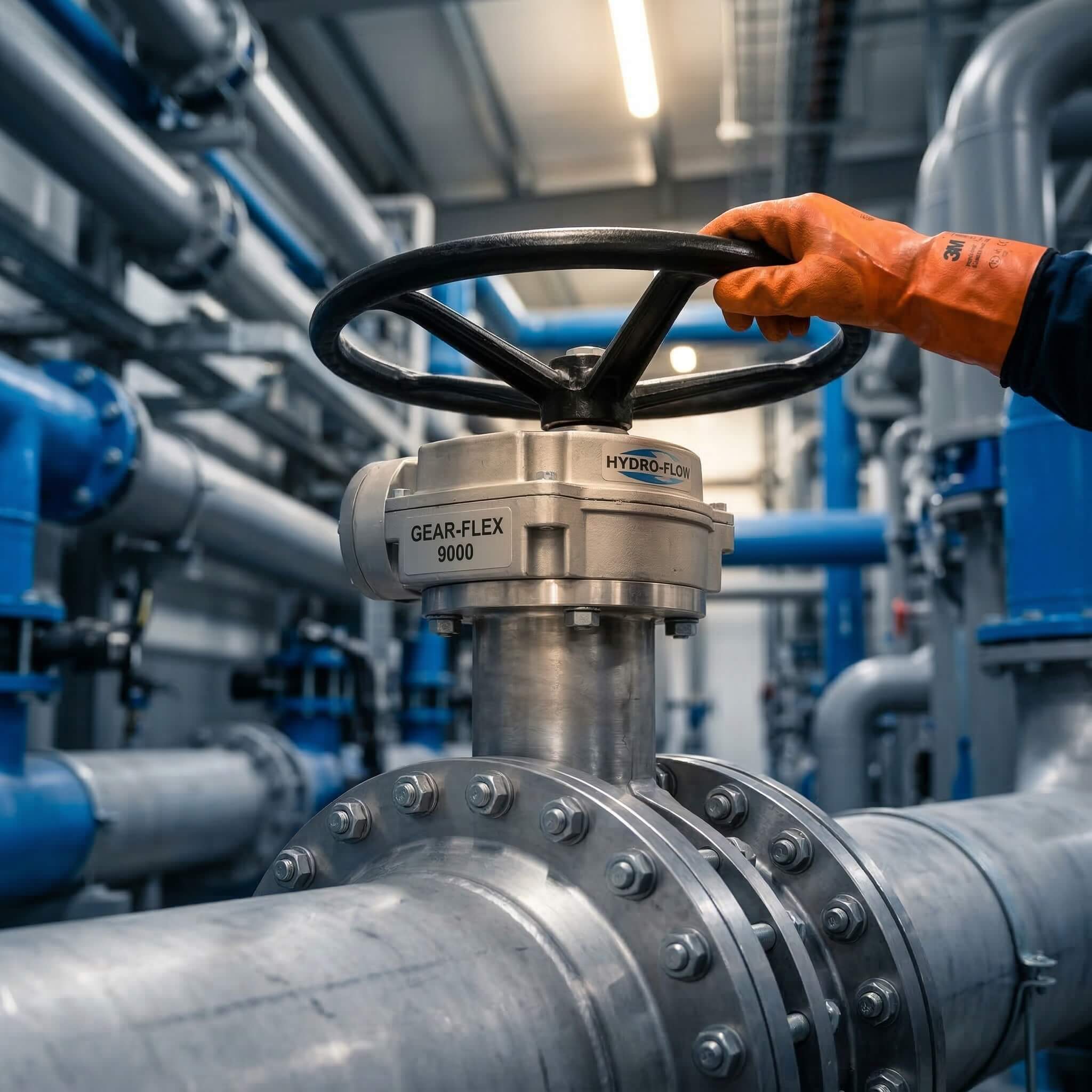
A gear operated butterfly valve is a specialized industrial valve that utilizes a gearbox to multiply manual input torque for the opening and closing of a pipeline. Manual operation of large-diameter valves or those under high differential pressure using standard levers is physically exhausting and often impossible for a single operator. Forcing a manual lever leads to rapid operator fatigue, inconsistent flow control, and the dangerous risk of “water hammer” shocks that can rupture pipes or damage expensive downstream equipment. Integrating a gear box butterfly valve solves these challenges by using torque multiplication to ensure smooth, precise, and safe operation in any industrial environment.
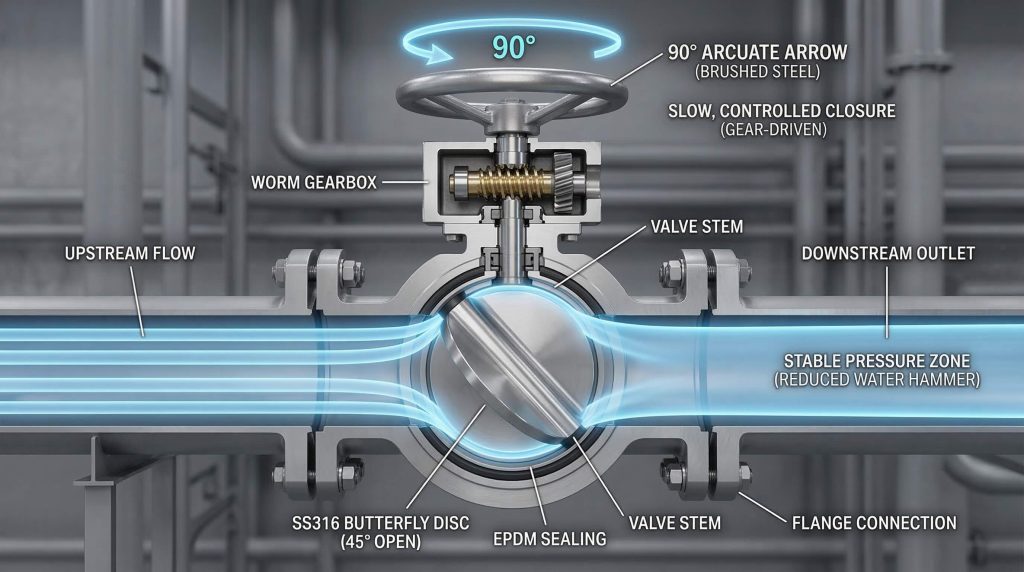
Why use a gear box butterfly valve?
You use this valve type primarily to manage high torque requirements in large-scale piping systems safely. Operating a gear box butterfly valve allows you to control massive fluid volumes without requiring the immense physical force typically needed for manual levers.
When is torque a major concern?
You might wonder: when does manual force become insufficient? Usually, once a valve exceeds DN250 in size or operates under significant pressure, a gearbox becomes mandatory for operation. This mechanical advantage ensures that you can modulate flow without risking operator injury or mechanical failure.
How does it prevent water hammer?
The best part? The gear reduction mechanism ensures a slow, controlled rotation of the disc. This gradual closure prevents the sudden pressure surges known as water hammer that frequently plague systems using fast-acting gate valves.
Key Takeaway: Gearboxes provide the necessary mechanical leverage to operate large valves safely while protecting the pipeline from pressure shocks.
| Benefit | Feature | Industrial Value |
|---|---|---|
| Torque Multiplier | Worm Gear Set | Reduces operator fatigue significantly |
| Safety | Slow Actuation | Prevents pipe-damaging water hammer |
| Control | Handwheel | Allows for finer flow adjustments |
This selection summary highlights why the gearbox is superior for heavy-duty industrial fluid control applications.
What parts are in a gear box butterfly valve?
The internal parts of this assembly include a worm gear, a worm, a protective housing, and a manual handwheel. A gear box butterfly valve functions as a cohesive unit where the input from the wheel is translated through a 90-degree turn to the valve stem.
What roles do the worm and gear play?
The worm and gear set is the heart of the transmission system. As you turn the handwheel, the worm rotates and moves the larger gear, which is directly coupled to the valve shaft. This setup provides high gear ratios that make opening the valve feel effortless.
Is the housing material important?
You must consider the environment when checking housing quality. Most housings are made of ductile iron or cast steel to protect internal gears from corrosion and physical impact.
Key Takeaway: The internal gear set determines the torque efficiency, while the housing ensures the assembly survives harsh industrial environments.
| Component | Common Material | Function |
|---|---|---|
| Handwheel | Carbon Steel / DI | User interface for input |
| Worm Gear | Bronze / Steel | Transfers torque to the stem |
| Housing | Ductile Iron | Protects internal parts from weather |
Understanding these components helps you identify high-quality valves that will require less maintenance over time.
How does a gear box butterfly valve work?
This valve works by using a quarter-turn rotational motion where the gearbox reduces the speed of rotation to increase the output force. When you operate a gear box butterfly valve, the handwheel drives a worm shaft that rotates the disc exactly 90 degrees to open or close the flow.
How does the ratio affect operation?
The gear ratio determines how many turns of the handwheel are needed to fully cycle the valve. While it takes longer to open than a lever, it gives you incredible power over high-pressure seats.
Does it stay in position?
One major advantage is the self-locking nature of the worm gear design. Unlike globe valves, once you set the position, the pressure of the fluid cannot easily force the gear to move backward.
Key Takeaway: The mechanical transmission ensures that the valve remains stable in its set position while providing immense closing force.
| Operating Feature | Mechanism | Result |
|---|---|---|
| Transmission | Worm Shaft | 90-degree rotational conversion |
| Stability | Self-Locking | Maintains position under pressure |
| Speed | Gear Reduction | Slow and steady movement |
The mechanical design of the gearbox is engineered to prioritize safety and stability over raw operating speed.
Is the gear box butterfly valve durable?
Yes, these valves are highly durable because the gearbox isolates the operating mechanism from the direct flow of the medium. A gear box butterfly valve can withstand thousands of cycles because the mechanical parts are protected within a lubricated casing.
Does it resist corrosion?
You should look for valves with high IP ratings, such as IP65 or IP67, for outdoor use. These ratings ensure that water and dust cannot penetrate the gearbox to cause rust.
What about high-cycle wear?
The best part? The use of bronze or treated steel for internal gears reduces friction during movement. This material choice ensures that the valve does not seize even after long periods of inactivity.
Key Takeaway: Protective housing and high-quality internal materials allow these valves to perform reliably in demanding outdoor or industrial settings.
| Durability Factor | Specification | Benefit |
|---|---|---|
| Enclosure | IP67 Rating | Protection against immersion/dust |
| Lubrication | High-Temp Grease | Reduces internal gear wear |
| Bearings | Sealed Design | Supports the stem under load |
A durable gearbox ensures that your initial investment pays off through a longer service life and fewer emergency repairs.
Where to install a gear box butterfly valve?
You should install this valve in locations where flow regulation is required for large pipes or where space for a long lever is unavailable. Placing a gear box butterfly valve in your system allows for more compact installations since the handwheel does not require the wide swing radius of a manual handle.
Is it suitable for high altitudes?
You might wonder: what if the valve is located high above the floor? In these cases, you can attach a chain wheel to the gearbox, allowing you to operate the valve safely from the ground.
How does it fit in tight spaces?
Because the handwheel is mounted on the side, it fits better in cramped boiler rooms or ship hulls. This makes it a more versatile choice than ball valves which often need more clearance for handle movement.
Key Takeaway: These valves are ideal for large pipelines and cramped industrial layouts where safety and space-saving are priorities.
| Location Type | Advantage | Installation Tip |
|---|---|---|
| Tight Corridors | Compact Footprint | Mount gearbox vertically to save side space |
| Overhead Pipes | Chain Wheel Access | Ensure chain length reaches operator level |
| High Pressure Lines | Torque Control | Install with the stem in a horizontal position |
Correct placement ensures that your operators can reach and control the valve without using ladders or specialized tools.
Is the gear box butterfly valve precise?
Yes, the high gear ratio allows for very fine adjustments of the internal disc position. Using a gear box butterfly valve gives you the ability to move the disc in increments of a single degree, which is impossible with a standard lever.
Can you use it for throttling?
The precision of the gearbox makes it an excellent choice for throttling flow. You can carefully dial in the exact flow rate needed for cooling or processing applications.
Is there a position indicator?
Most gearboxes come with a built-in dial or pointer on top. This allows you to see the exact percentage of the valve opening at a glance.
Key Takeaway: The mechanical reduction allows for surgical precision in flow control, making it suitable for balancing systems.
| Precision Feature | Accuracy Level | Operational Benefit |
|---|---|---|
| Pointer Dial | Visual | Instant opening status check |
| Worm Pitch | High | Prevents accidental disc shifting |
| Adjustment | Incremental | Fine-tuned flow regulation |
This level of precision ensures that your industrial processes remain consistent even under varying pressure conditions.
Can you automate a gear box butterfly valve?
You can easily automate these valves by replacing the handwheel with an electric or pneumatic actuator. Most modern gear box butterfly valve designs feature an ISO 5211 mounting pad that makes this transition seamless.
What is the ISO 5211 standard?
This is a global standard for the interface between valves and actuators. If your gearbox has this mounting pad, you can bolt on an actuator without needing custom brackets or modifications.
Can you still operate it manually?
The best part? Many automated setups include a manual override gearbox. This ensures you can still close the valve during a power failure or system emergency.
Key Takeaway: Standardization allows you to upgrade from manual to automated control as your plant requirements grow.
| Automation Step | Component | Result |
|---|---|---|
| Interface Check | ISO 5211 Pad | Ensures actuator compatibility |
| Sizing | Torque Data | Matches actuator power to valve needs |
| Backup | Manual Override | Maintains safety during power loss |
Actuator compatibility turns a simple manual valve into a critical part of an automated smart-flow system.
How to maintain a gear box butterfly valve?
Maintenance involves regular inspection of the internal grease and checking the integrity of the housing seals. A gear box butterfly valve requires very little work, but neglecting lubrication can lead to gear grinding and eventual failure.
Why is routine lubrication necessary?
You might wonder: how often should I add grease? In standard environments, checking the grease every six months is usually sufficient to prevent metal-on-metal wear.
How do I check for leaks?
You should inspect the stem seals and gearbox gaskets for signs of moisture. Just like maintaining check valves, preventing external contaminants from entering the mechanism is key to longevity.
Key Takeaway: Simple lubrication and visual inspections every six months can extend the life of your valve by decades.
| Maintenance Task | Frequency | Target Area |
|---|---|---|
| Greasing | Bi-Annually | Worm and Gear mesh |
| Visual Check | Monthly | Housing and Seal integrity |
| Cycle Test | Quarterly | Verify smooth handwheel movement |
Proactive maintenance prevents the “seizing” that often happens to valves that are left in one position for too long.
Why buy a gear box butterfly valve now?
You should invest in these valves now to upgrade your system’s safety and reduce the risk of infrastructure damage. Using a gear box butterfly valve provides an immediate ROI by lowering the physical strain on your maintenance crew and preventing costly pipeline repairs.
Does it lower labor costs?
Because one person can operate a large valve alone, you don’t need to send teams of two or three to manage a single station. This efficiency adds up to significant labor savings over time.
Is it a safety requirement?
In many jurisdictions, manual levers are restricted on large-diameter pipes for safety reasons. Upgrading now ensures you stay compliant with modern workplace safety standards.
Key Takeaway: The reduction in labor and increase in system safety make the gearbox an essential long-term investment.
| Investment Logic | Factor | Financial Impact |
|---|---|---|
| Labor Savings | Single Operator | Reduces man-hours for valve cycles |
| Asset Protection | No Water Hammer | Extends the life of the entire pipeline |
| Compliance | Safety Standards | Avoids potential fines or injury claims |
The initial cost of the gearbox is quickly offset by the operational efficiencies and safety benefits it brings to your facility.
Is the gear box butterfly valve efficient?
Yes, it is one of the most efficient manual valve designs due to its high torque-to-input ratio. Every turn of the handwheel on a gear box butterfly valve translates into controlled, powerful movement of the disc against high-pressure seats.
Is energy loss a factor?
Since this is a manual device, there is no electrical energy consumption. It provides a “green” and reliable solution for remote locations where power is not available.
How does it compare to other valves?
Unlike the long travel time of some gate valves, the 90-degree turn of a butterfly valve is relatively quick even with gear reduction.
Key Takeaway: Gear-operated butterfly valves provide the best balance of power, speed, and manual efficiency for industrial users.
| Efficiency Metric | Performance | Comparison |
|---|---|---|
| Energy Usage | Zero (Manual) | Better for remote/off-grid sites |
| Operating Time | Moderate | Faster than multi-turn gate valves |
| Force Required | Low | Requires 70% less effort than a lever |
The mechanical advantage of the gearbox ensures that your flow control is as efficient as possible without external power.
Conclusion
The gear operated butterfly valve remains the gold standard for large-scale industrial fluid control, offering an unmatched blend of safety, precision, and durability. By choosing the right gear ratio and ensuring regular maintenance, you can protect your infrastructure and your personnel from the risks associated with high-pressure flow. If you are ready to optimize your pipeline with precision-engineered solutions, please contact us to discuss your project specifications. We are dedicated to delivering precision-engineered valve solutions for global industries.
Frequently Asked Questions
Can I install a gear operator on a valve that currently has a handle?
Yes, most valves can be retrofitted if they have a standard mounting pad, though you must ensure the stem dimensions match the gearbox input.
How do I know if my gearbox needs more grease?
If you notice increased resistance when turning the handwheel or hear a grinding noise, it is time to disassemble the cover and apply fresh lubricant.
Can I use these valves for steam applications?
You can, provided you select a high-temperature seal material and a gearbox that is rated for the ambient heat of a steam line.
What is the best material for a gearbox in a chemical plant?
Stainless steel or epoxy-coated ductile iron is recommended to prevent the housing from being eaten away by corrosive vapors.
How many turns does it usually take to open the valve?
This depends on the gear ratio, but typical industrial gearboxes require between 10 and 30 full rotations of the handwheel for a 90-degree disc movement.