
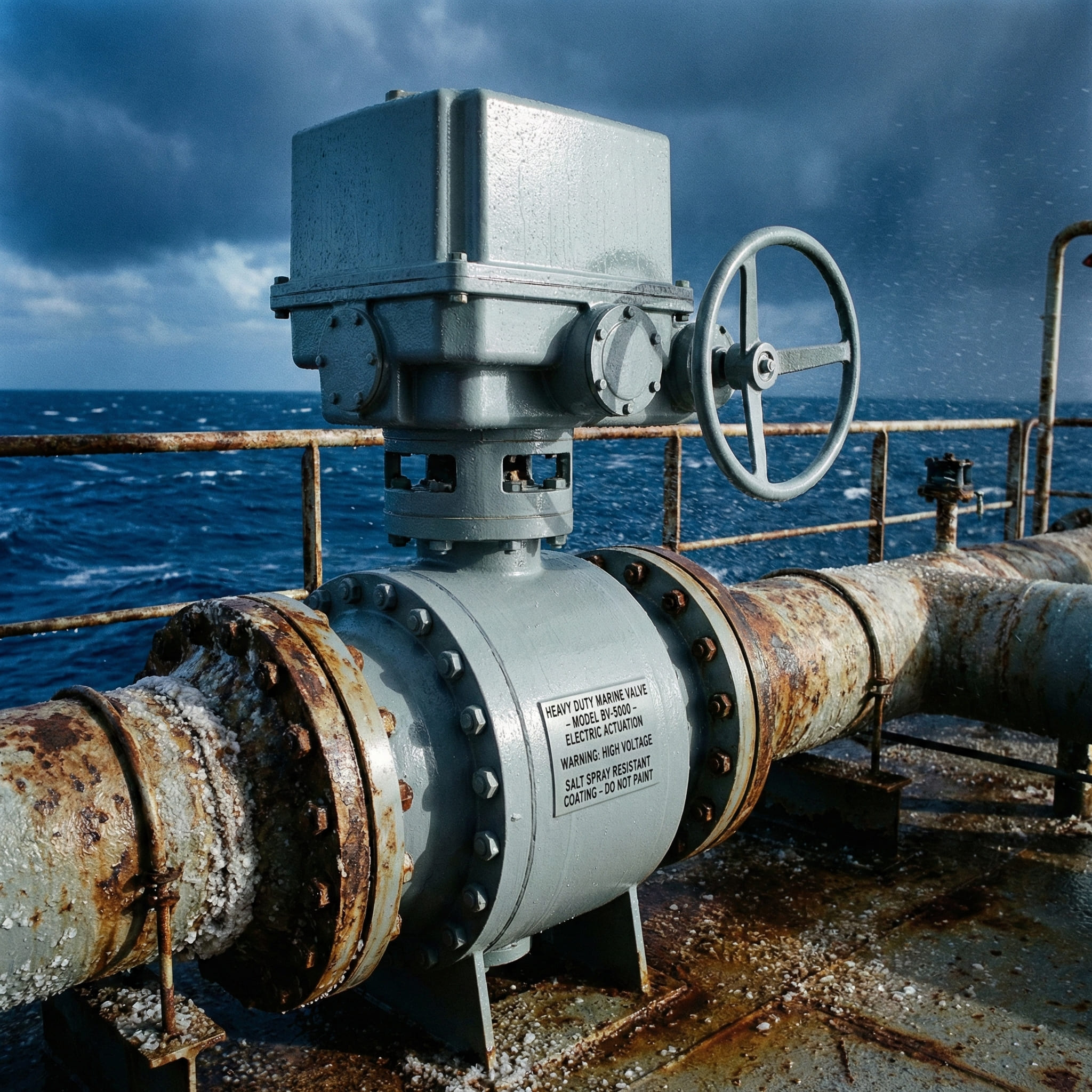
An electric butterfly valve works by using a motorized actuator to rotate a circular disc 90 degrees within a pipe, effectively starting or stopping fluid flow. Managing industrial pipelines manually can be a logistical nightmare, especially when you need to act fast to prevent overflow or system damage. These delays often lead to costly downtime or even environmental hazards on offshore rigs. The marine electric butterfly valve solves these issues by providing automated, high-torque control that you can manage from a central station.

What defines a marine electric butterfly valve?
A marine electric butterfly valve is an automated flow control device consisting of a valve body and an electric actuator designed for harsh, corrosive environments. This specific configuration allows you to manage large volumes of liquid or gas with minimal physical effort. The marine electric butterfly valve is essential for modern vessels where space is limited and automation is required.
Why choose automation over manual levers?
Automated systems allow you to control flow from a distance, which is much safer than manual operation in hazardous areas.
- Remote control capabilities.
- Reduced labor requirements.
- Higher precision in flow positioning.
Here is the kicker: you don’t have to worry about the physical strength of your crew to shut off high-pressure lines. Automated actuators handle the heavy lifting for you.
Key Takeaway: Automation enhances safety and efficiency by removing the need for physical proximity to the valve.
| Feature | Manual Butterfly Valve | Electric Butterfly Valve |
|---|---|---|
| Control | Local/Physical | Remote/Automated |
| Speed | Variable (Human) | Constant (Motorized) |
| Application | Small scale | Industrial/Marine |
Selecting an automated model ensures that your system can respond instantly to electronic safety triggers.
How does a marine electric butterfly valve operate?
It operates by receiving an electrical signal that triggers a motor to turn a gear train, which then rotates the valve stem and the attached disc. You will find that the marine electric butterfly valve is designed for rapid response in high-pressure seafaring conditions. This motorized movement ensures that the valve reaches a full seal or a full open state without physical effort.
Is the motorized rotation speed adjustable?
Most high-end actuators allow you to set the speed of the 90-degree turn to prevent water hammer.
- Controlled opening times.
- Protection for downstream piping.
- Programmable stroke limits.
Look: controlling the speed might seem small, but it prevents massive pressure spikes that could burst your pipes. You get total control over the fluid dynamics.
Key Takeaway: Controlled rotation protects the integrity of the entire piping network from sudden pressure changes.
| Operational Phase | Action | Outcome |
|---|---|---|
| Signal Input | Motor activates | Stem begins rotation |
| Mid-Stroke | Disc moves 45° | Throttling occurs |
| Completion | Limit switch trips | Full shutoff achieved |
Observing the stroke timing is the best way to calibrate your system for maximum safety.
What parts form a marine electric butterfly valve?
The assembly of a marine electric butterfly valve includes an electric motor, a gear reduction unit, a valve body, a stem, and a circular disc. Every component is engineered to withstand the vibration and salt spray typical of maritime operations. The marine electric butterfly valve relies on the synergy of these parts to maintain a tight seal under pressure.
What is the role of the gear reduction unit?
The gearbox multiplies the torque from the small motor so it can turn the large disc against fluid resistance.
- Torque multiplication.
- Precision movement control.
- Mechanical advantage for larger sizes.
But that’s not all; the gearbox also acts as a braking system. It holds the disc in position even when the motor is turned off.
Key Takeaway: The gearbox is the “muscle” that allows a small electrical input to control massive fluid forces.
| Component | Material | Primary Function |
|---|---|---|
| Body | Ductile Iron/Steel | Structural housing |
| Disc | 316 Stainless Steel | Flow obstruction |
| Stem | High-strength Alloy | Torque transmission |
High-quality materials in these components prevent premature failure in saltwater environments.
How does an actuator move a marine electric butterfly valve?
The actuator moves the valve by converting high-speed rotational energy from its electric motor into high-torque mechanical force through a reduction gearbox. You rely on this component to ensure the marine electric butterfly valve overcomes the friction of the seat during operation. Without this geared advantage, the motor would stall under the weight of heavy fluid pressure.
Can you use different voltage types?
Actuators are available in AC or DC configurations to match your ship’s or factory’s power grid.
- 24V DC for mobile systems.
- 110V/220V AC for plant power.
- Multi-phase options for high torque.
Think about it: having the right voltage match means you won’t need expensive converters. You can plug the actuator directly into your existing infrastructure.
Key Takeaway: Voltage versatility ensures that the valve can be integrated into any existing electrical environment.
| Actuator Type | Power Source | Best Use Case |
|---|---|---|
| On-Off | AC/DC | Simple isolation |
| Modulating | DC Control | Flow regulation |
| Spring Return | Emergency Battery | Fail-safe systems |
Matching the actuator torque to the valve’s break-away torque is the most critical step in sizing.
Why is disc design key for a marine electric butterfly valve?
The disc design is key because its shape and thickness determine the flow capacity and the amount of turbulence generated as fluid passes through. In a marine electric butterfly valve, a streamlined disc reduces the pressure drop when the valve is fully open. This efficiency helps you maintain system pressure while reducing the energy required by your pumps.
Why use a streamlined disc?
A streamlined profile minimizes drag, which reduces the wear and tear on the valve stem and seat.
- Optimized flow coefficient (Cv).
- Reduced cavitation risks.
- Lower operational torque.
The best part? A better disc design means you can use a smaller, less expensive actuator. You save money on both the hardware and the energy bills.
Key Takeaway: Efficient disc profiles lower long-term operational costs by reducing pump strain and actuator wear.
| Disc Type | Advantage | Disadvantage |
|---|---|---|
| Concentric | Cost-effective | High seat friction |
| Double Offset | Lower wear | More complex |
| Triple Offset | Zero leakage | High initial cost |
Evaluate the media velocity to determine if you need a high-performance offset disc design.
How to choose seats for a marine electric butterfly valve?
You choose seats based on the chemical compatibility and temperature range of the media passing through the marine electric butterfly valve at any given time. The seat must be resilient enough to deform slightly against the disc to create a bubble-tight seal. If you pick the wrong material, the sea’s salt or the pipe’s chemicals will quickly degrade the seal.
When is PTFE necessary?
PTFE is the standard for aggressive chemicals or high temperatures that would melt standard rubber.
- Chemical inertness.
- High-temperature resistance.
- Low friction coefficient.
In short: if you are dealing with anything other than clean water, you should verify the seat’s resistance. You don’t want to deal with a leak in the middle of the ocean.
Key Takeaway: Proper seat selection is the single most important factor in preventing internal valve leakage.
| Seat Material | Temp Range | Media Compatibility |
|---|---|---|
| EPDM | -20 to 120°C | Water, Glycol |
| NBR | -10 to 80°C | Oils, Fuels |
| PTFE | -30 to 200°C | Acids, Steam |
Always cross-reference your fluid’s chemical profile with the seat material’s resistance chart.
What actuators fit a marine electric butterfly valve?
The actuators that fit include quarter-turn electric units that can be classified as either weatherproof, explosion-proof, or submersible. You must ensure that the actuator for your marine electric butterfly valve has an IP67 or IP68 rating to survive the humid deck conditions. Choosing the wrong enclosure will lead to short circuits and total system failure.
What is a modulating actuator?
A modulating actuator allows you to stop the disc at any angle to regulate flow rather than just opening or closing it.
- Precise flow control.
- Integration with sensors.
- Digital position feedback.
Look: if your process requires a specific flow rate to maintain temperature, a modulating actuator is your best friend. It gives you the “fine-tuning” manual valves lack.
Key Takeaway: Selecting the correct actuator enclosure ensures the electronics survive the surrounding environment.
| Enclosure Rating | Protection Level | Best Environment |
|---|---|---|
| IP65 | Dust/Water Jets | Indoor Factory |
| IP67 | Temporary Immersion | Ship Decks |
| IP68 | Continuous Submersion | Ballast Tanks |
Check the local safety codes to see if you require an explosion-proof (Ex-rated) actuator housing.
How do signals control a marine electric butterfly valve?
Signals control the valve by providing the actuator with the instructions on when to move and where to stop. You can control a marine electric butterfly valve using simple “open/close” switches or advanced analog signals for throttling. Modern systems often use PLC (Programmable Logic Controller) integration to automate these signals based on real-time data.
Is digital feedback useful?
Feedback signals tell the control room the exact position of the disc so you can verify the valve actually moved.
- Confirmation of operation.
- Error detection.
- System-wide synchronization.
Think about it: if the motor fails, you need to know immediately. Digital feedback prevents you from assuming a valve is closed when it is actually stuck open.
Key Takeaway: Signal feedback creates a closed-loop system that drastically reduces the risk of undetected mechanical failures.
| Signal Type | Function | Complexity |
|---|---|---|
| Digital (On/Off) | Full Open/Close | Low |
| Analog (4-20mA) | Throttling/Positioning | Medium |
| Bus (Modbus/HART) | Data/Diagnostics | High |
Utilizing 4-20mA signals is the industry standard for achieving reliable proportional flow control.
How to maintain a marine electric butterfly valve?
Maintenance involves regular inspection of electrical terminals, lubrication of the gear train, and verification of seat integrity. You should regularly test the “break-away” torque of the marine electric butterfly valve to ensure the motor isn’t straining. Over time, debris can build up in the seat, which increases friction and leads to actuator burnout.
How often to inspect?
In a marine environment, a quarterly inspection is recommended to catch corrosion before it penetrates the motor housing.
- Check for moisture ingress.
- Verify cable tightness.
- Inspect the disc for erosion.
In short: an ounce of prevention is worth a pound of cure. You will save thousands by replacing a $50 seal instead of a $2,000 actuator.
Key Takeaway: Proactive maintenance schedules prevent the most common causes of electric valve failure.
| Maintenance Task | Frequency | Expected Benefit |
|---|---|---|
| Visual Check | Monthly | Identify leaks early |
| Gear Lubrication | Annually | Reduce motor strain |
| Seal Replacement | Every 2 Years | Maintain bubble-tightness |
Keep a log of motor current draw to identify rising friction levels before a mechanical failure occurs.
When to install a marine electric butterfly valve?
You should install this valve when you need reliable, remote-controlled flow management in compact or hard-to-reach areas of a ship. The marine electric butterfly valve is perfect for ballast systems, cooling water lines, and fuel transfer where speed and precision are required. Because they are lighter than other valve types, they don’t add unnecessary weight to your vessel’s piping.
Is it suitable for offshore use?
Yes, provided you choose a model with marine-grade coatings and stainless steel internals to resist salt corrosion.
- Compact footprint.
- High weight-to-performance ratio.
- Excellent for low-pressure utilities.
But that’s not all; these valves are also much easier to install in existing lines. You can swap out a manual valve for an electric one with very few modifications.
Key Takeaway: The butterfly design offers the best combination of weight, size, and automation for marine applications.
| Criteria | Butterfly Valve | Gate Valve |
|---|---|---|
| Space Needed | Minimal | Extensive |
| Installation | Easy/Wafer | Difficult/Large |
| Weight | Low | High |
Analyze your space constraints to determine if a wafer-style or lug-style body is best for your flange.
Frequently Asked Questions
Can I manually move the valve if the power goes out?
Yes, most electric actuators come with a manual override handwheel or a wrench nut. You can use this to manually position the valve during a total electrical failure.
What’s the best way to prevent the motor from overheating?
Check the duty cycle rating of your actuator before installation. If you plan to move the valve constantly, you need a 100% duty cycle motor to prevent thermal shutdown.
How do I know if the seat is failing?
Internal leakage is the most common sign, which you can detect by monitoring pressure changes downstream. You might also notice the actuator drawing more current as it tries to crush debris in a worn seat.
Can I use these valves for steam applications?
Generally no, unless you use specialized high-temperature metal-seated models. Standard elastomer-seated butterfly valves will melt under the intense heat of industrial steam.
What is the difference between Wafer and Lug bodies?
Wafer bodies are sandwiched between two flanges, while Lug bodies have threaded holes that allow you to bolt them directly to a single flange. Lug styles are better for end-of-line service.
Conclusion
Transitioning to automated flow control is a strategic move that addresses the risks of manual delays, operational inconsistencies, and personnel safety. By integrating a high-performance valve system, you solve the critical challenges of remote management and long-term durability in harsh conditions. We provide precision-engineered solutions that ensure your industrial systems remain efficient, reliable, and compliant with international standards. Our mission is to empower global industries with fluid control technology that minimizes downtime and maximizes operational life. To discover the right specifications for your project, contact us today for a technical consultation.