
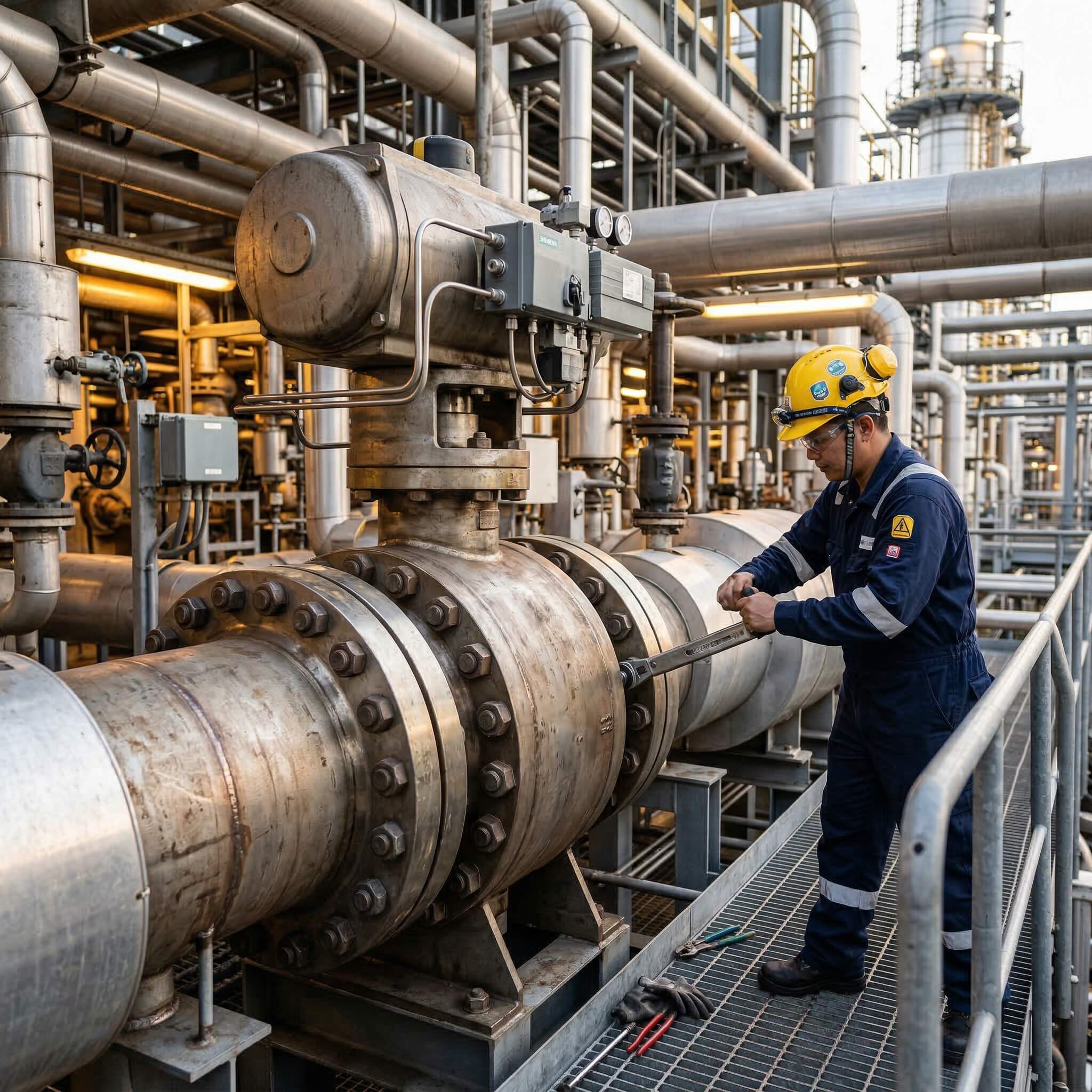
A triple offset butterfly valve works by utilizing three distinct geometric offsets that create a cam-like action, allowing the disc to seal against the seat with zero friction until the final point of closure. In high-pressure industrial environments, you often face the nightmare of traditional valves failing due to seat wear and constant leakage. This failure leads to expensive downtime and safety risks that threaten your operational bottom line. The triple offset butterfly valve design solves these issues by providing a metal-to-metal seal that remains “bubble-tight” even in the most severe service conditions.
What defines a triple offset butterfly valve design?
A triple offset butterfly valve design is a high-performance valve geometry that eliminates the rubbing between the seat and seal ring. By moving the shaft and the sealing surface away from the center, you achieve a “wedging” effect that ensures bi-directional zero leakage. This makes it an ideal choice for isolation in your critical steam and oil applications.
Identifying the core components
Here is the deal:
- The valve body provides the primary pressure boundary for your system.
- A disc rotates 90 degrees to control or stop the fluid flow.
- The stem connects the external actuator to the internal disc.
- The seal ring creates the actual barrier against leakage at high pressure.
You must understand that each of these parts is precision-machined. This allows for the complex movement required for a friction-free seal.
How the three offsets interact
Look at the details:
- Offset 1 places the shaft behind the sealing face of the seat.
- Offset 2 moves the shaft center-line off the pipe center-line.
- Offset 3 creates a conical geometry in the sealing contact area.
Key Takeaway: The combination of these three offsets transforms a simple rotary valve into a high-integrity isolation tool.
| Component | Function in the Design |
|---|---|
| Eccentric Shaft | Minimizes seat contact during rotation |
| Conical Disc | Enables the torque-seated wedging action |
| Laminated Seal | Provides flexibility for zero-leakage shut-off |
The interaction between these geometric shifts ensures that your valve remains durable over thousands of cycles.
Why use a triple offset butterfly valve design?
You should choose a triple offset butterfly valve design because it offers a lightweight, compact alternative to heavy gate and globe valves. Unlike concentric designs, this technology prevents the friction-based degradation of the sealing surface. This leads to a significantly longer lifespan and lower maintenance costs for your facility.
Enhancing plant safety standards
Think about it:
- Metal seats provide inherent fire-safe properties for hazardous zones.
- Zero-leakage performance prevents the escape of dangerous fluids.
- Fast quarter-turn operation enables quick emergency shut-downs.
- Compact footprints reduce the risk of structural pipe failure.
You can rely on these valves to protect your personnel from fugitive emissions. This design is built for high-risk environments.
Reducing total cost of ownership
The best part:
- Low torque requirements allow for smaller, cheaper actuators.
- Frictionless operation extends the interval between seal replacements.
- Simplified designs mean you spend less on spare parts inventory.
- Rugged construction resists erosion in high-velocity steam.
Key Takeaway: Switching to this design lowers your long-term expenses by decreasing both energy consumption and repair frequency.
| Benefit | Operational Impact |
|---|---|
| Weight Reduction | Lowers installation and support costs |
| Zero Friction | Eliminates seat wear and extends life |
| Bi-directional Seal | Simplifies system design and piping layout |
Lowering the mechanical stress on the sealing components directly translates to a more reliable production schedule for you.
How does the first offset impact the triple offset butterfly valve design?
The first offset in a triple offset butterfly valve design positions the shaft behind the plane of the sealing surface. This placement allows for a continuous, 360-degree seal around the entire circumference of the disc. In standard valves, the shaft often interrupts the seat, creating potential leak paths that you want to avoid.
Eliminating stem leak paths
Check this out:
- The seal remains unbroken by the rotating shaft during operation.
- Stem packing is isolated from the primary flow path.
- Uniform pressure is applied to the seat during final closure.
- Wear is reduced because the seal doesn’t rub against the shaft.
You will notice that this offset is the foundation for maintaining pressure integrity. It keeps your process media exactly where it belongs.
Improving fluid flow dynamics
Specifically:
- A clear flow path reduces turbulence near the seat.
- The pressure drop is minimized across the valve body.
- Stability is improved during high-velocity gas flows.
- Cavitation risks are lowered due to the streamlined disc.
Key Takeaway: The first offset removes the interference between the stem and the seal to ensure a solid contact point.
| Feature | Technical Benefit |
|---|---|
| Rear-Positioned Shaft | Enables an uninterrupted sealing ring |
| Isolated Stem | Protects packing from direct media contact |
By isolating the shaft from the sealing plane, the valve effectively removes the primary source of common butterfly valve leaks.
How does the second offset improve a triple offset butterfly valve design?
The second offset improves the triple offset butterfly valve design by shifting the center-line of the shaft away from the center-line of the flow path. This creates an eccentric movement that causes the disc to lift away from the seat almost immediately upon opening. By reducing the contact time, you prevent the seal from dragging against the seat during the stroke.
Reducing the required operational torque
It gets better:
- The disc releases from the seat within degrees of rotation.
- Mechanical resistance is lowered during the travel stroke.
- Actuators can be sized for movement rather than breakout friction.
- Operation becomes smoother under high differential pressures.
You save money on automation by using smaller actuators. These units require less pneumatic or electric power to move the disc.
Extending the life of sealing surfaces
In fact:
- Seat rubbing is eliminated throughout 99% of the stroke.
- Seal rings do not suffer from deformation during travel.
- The valve remains easy to operate even after long idle periods.
- Metal fatigue is minimized due to the cam-action release.
Key Takeaway: The second offset introduces the camming action necessary to prevent premature wear on the metal seat.
| Benefit | Practical Result |
|---|---|
| Cam Action | Immediate seal release upon rotation |
| Lower Friction | Increases the number of cycles before maintenance |
Minimizing the contact time between internal parts is your secret to maintaining a “bubble-tight” seal over several years.
How does the third offset refine a triple offset butterfly valve design?
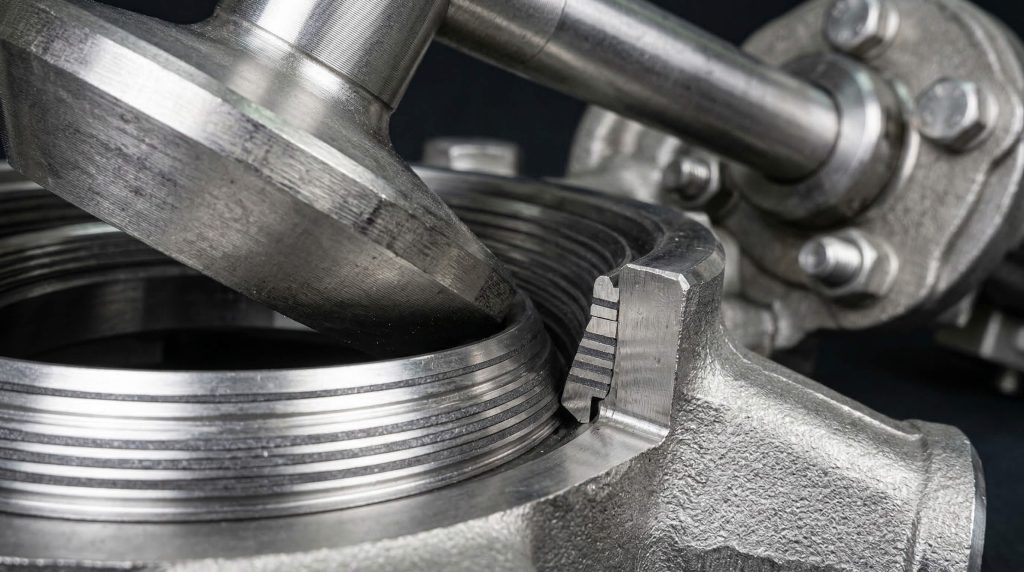
The third offset refines the triple offset butterfly valve design by changing the geometry of the seat into an inclined cone. This cone shape ensures that the disc only contacts the seat at the final point of closure, creating a “plug-in-socket” effect. This mechanical wedging is what allows for a metal-to-metal seal that remains effective under high pressure.
Creating a frictionless wedging action
Here is the deal:
- The seat and seal ring act as a conical pair.
- Friction is mathematically eliminated from the travel path.
- The sealing force is generated by the actuator torque.
- The seal remains tight regardless of the flow direction.
You can achieve a tighter seal simply by increasing the torque applied at the end of the stroke. This provides flexibility for various pressures.
Managing thermal expansion challenges
Understand this:
- The conical design compensates for material expansion in heat.
- Metal seats do not soften or melt like polymer seals.
- The seal ring retains its elasticity in cryogenic temperatures.
- Sealing integrity is maintained during rapid temperature cycles.
Key Takeaway: The third offset provides the unique conical geometry required for a truly frictionless, torque-seated metal seal.
| Geometry | Sealing Method | Result |
|---|---|---|
| Inclined Cone | Mechanical Wedging | Zero friction and high-pressure shut-off |
The transition from interference sealing to torque-based sealing is what separates this design from lower-performance butterfly valves.
Is zero-leakage common in triple offset butterfly valve design?
Zero-leakage is the defining performance standard for the triple offset butterfly valve design in your industrial applications. While standard butterfly valves rely on soft rubbers that fail under stress, the triple offset uses a robust metal-to-metal interface. This ensures that you get a “bubble-tight” shut-off that meets the most stringent international testing standards.
Comparing seat materials and integrity
Make no mistake:
- Laminated metal seals provide a “spring” effect for tight closure.
- Stellite hard-facing resists abrasion from sand and scale.
- Metal seats are inherently fire-safe for oil and gas use.
- Precision machining ensures a perfect fit across the cone.
You will find that these valves perform reliably where soft-seated valves would traditionally melt or tear. This is critical for high-temp steam.
Meeting global testing certifications
Actually:
- These valves meet API 598 and ISO 5208 standards.
- Zero-leakage is achieved in both flow directions.
- Performance is maintained across extreme temperature cycles.
- Fugitive emissions are strictly controlled to meet EPA rules.
Key Takeaway: Advanced geometry allows hard metal materials to seal more effectively than soft elastomers in severe environments.
| Standard | Leakage Class | Typical Application |
|---|---|---|
| API 598 | Zero Leakage | High-pressure gas and liquid isolation |
Rigorous adherence to zero-leakage standards ensures that your facility remains compliant with all environmental and safety regulations.
When do you specify a triple offset butterfly valve design?
You should specify a triple offset butterfly valve design for any system involving high-pressure hydrocarbons or cryogenic fluids. These valves are specifically engineered to handle the thermal shocks and abrasive media that would destroy standard equipment. If you require bi-directional shut-off in a compact space, this is the most reliable choice.
Selecting for extreme temperature ranges
Consider these sectors:
- Steam distribution systems in your power generation plants.
- Cryogenic storage and transport for LNG facilities.
- Hydrocarbon processing in high-temperature refineries.
- Molten salt or thermal oil loops in solar power.
You must choose a valve that won’t seize when the temperature fluctuates during plant startup. The metal-to-metal seat is your best defense.
Applications with abrasive or corrosive media
Don’t forget:
- Desalination plants handling high-pressure abrasive brine.
- Chemical processing involving corrosive acid flows.
- Offshore platforms facing salt spray and abrasive sand.
- Slurry lines in mining operations where wear is high.
Key Takeaway: The triple offset design is the professional choice when safety, durability, and zero-leakage are non-negotiable.
| Condition | Valve Requirement | Why Triple Offset? |
|---|---|---|
| High Heat | Metal-to-metal seats | Prevents melting and seal failure |
| High Pressure | Torque-seated wedging | Ensures a tight seal under load |
Matching the valve design to your specific system conditions prevents unexpected failures and expensive emergency repairs.
How does pressure affect triple offset butterfly valve design?
Pressure acts as a friend to the triple offset butterfly valve design because higher system pressure can actually assist in the sealing process. As the disc is pushed into the seat, the mechanical wedging force increases, ensuring that the seal remains tight even as conditions become more severe. This characteristic is why you find them in Class 600 and Class 900 services.
Maintaining bi-directional sealing integrity
Think about it:
- The torque-seated mechanism works regardless of flow direction.
- Upstream pressure pushes the disc harder into the seat.
- Downstream pressure is offset by the mechanical wedge force.
- Seal rings self-adjust to maintain contact under load.
You can rely on these valves for cross-over lines where the pressure could come from either side. They provide consistent performance every time.
Resisting high differential pressure shocks
Here is the deal:
- The heavy-duty stem resists bending under high loads.
- Hard-faced seats prevent erosion from high-pressure jets.
- Disc geometry prevents flutter during high-pressure opening.
- The torque seating compensates for body deformation.
Key Takeaway: This design thrives under high pressure by using the system’s own force to reinforce the metal-to-metal seal.
| Factor | Sealing Impact | Operational Result |
|---|---|---|
| Differential Pressure | Enhances seat contact | Tighter shut-off at high loads |
| Mechanical Torque | Overcomes seat resistance | Consistent operation in all states |
Understanding how pressure interacts with the conical seat allows you to specify these valves for your most demanding high-load loops.
What materials are in a triple offset butterfly valve design?
The materials used in a triple offset butterfly valve design must be high-strength and corrosion-resistant to withstand torque-seating. You will typically find bodies made from cast carbon steel or various grades of stainless steel. For the most demanding environments, manufacturers apply specialized hard-coatings to the seat surfaces to prevent galling and erosion.
Choosing the right body alloys
Basically:
- WCB carbon steel is standard for general industrial use.
- CF8M stainless steel handles most corrosive chemicals.
- Duplex alloys provide superior strength for marine service.
- Monel or Inconel is used for extremely sour gas.
You need to match the metallurgy to your specific fluid to prevent pitting. Choosing the right alloy is your first step toward longevity.
Advanced seal and trim materials
Furthermore:
- Laminated rings use graphite for flexibility and heat resistance.
- Stellite hard-facing protects the seat from high-velocity steam.
- Hardened stems prevent binding in high-torque applications.
- Nitrided surfaces increase the wear resistance of moving parts.
Key Takeaway: High-quality metallurgy is essential to maintain the precision geometry of the three offsets over many years.
| Valve Part | Common Material | Advantage |
|---|---|---|
| Seal Ring | 316SS + Graphite | Combines flexibility with heat resistance |
| Seat Surface | Stellite Overlay | Resists wear and prevents metal galling |
Investing in high-grade materials at the start prevents the premature failure of critical internal components in your system.
Is maintenance simple for a triple offset butterfly valve design?
Maintenance for a triple offset butterfly valve design is simpler than traditional valves because the frictionless movement prevents common seat damage. You do not have to worry about the frequent “tearing” of soft seals that typically causes leaks. Most modern designs also allow for field-replaceable components, meaning you can service the valve without removing the body.
Routine inspection and service steps
Keep this in mind:
- Monitor stem packing for any signs of fugitive emissions.
- Verify actuator torque settings to ensure full closure.
- Inspect the laminated seal ring during scheduled turnarounds.
- Lubricate the actuator and stem according to the manual.
You will spend significantly less time on repairs compared to maintaining a standard gate or globe valve. This keeps your plant running longer.
Utilizing field-replaceable technology
Surprisingly:
- Seat rings can be changed using common hand tools.
- In-line repairs reduce your system downtime by hours.
- No specialized grinding or machining is required for maintenance.
- Parts are standardized for quick replacement from your stock.
Key Takeaway: Lower maintenance needs and easy field repairs lead to a much lower total cost of ownership for you.
| Maintenance Task | Frequency | Benefit |
|---|---|---|
| Packing Adjustment | Annual | Prevents external leaks and emissions |
| Seal Inspection | 3-5 Years | Ensures continued zero-leakage performance |
Designing for maintenance access ensures that your team can keep the plant running at peak efficiency with minimal effort.
Frequently Asked Questions
- Can I use a triple offset butterfly valve for precision throttling?
- Yes, the frictionless design and high-strength stem make it excellent for both isolation and precision control applications.
- What’s the best material for a valve in a high-temperature steam system?
- Stainless steel bodies with Stellite-faced seats are the best choice to handle the extreme thermal expansion and erosion.
- How do I know if I need a triple offset instead of a double offset valve?
- If your application involves temperatures over 200°C or requires 100% zero leakage in high-pressure gas, the triple offset is necessary.
- Can I replace the internal seals without taking the valve out of the line?
- Yes, most modern triple offset designs feature field-replaceable seat rings and seals that can be serviced while the body stays in-line.
- What’s the best way to automate a triple offset butterfly valve?
- Pneumatic or electric quarter-turn actuators are the best choice due to the low and consistent torque required for these valves.
Conclusion
The triple offset butterfly valve stands as the most reliable technology for managing critical fluid isolation and control in your facility. By eliminating friction and utilizing a robust metal-to-metal wedging mechanism, it solves the leakage and maintenance problems that plague traditional plant operations. Our team is dedicated to providing high-performance flow control solutions that enhance safety and maximize your operational efficiency. We believe in a future where zero-leakage is the standard for every critical system. To optimize your system and reduce long-term costs, contact us today.