
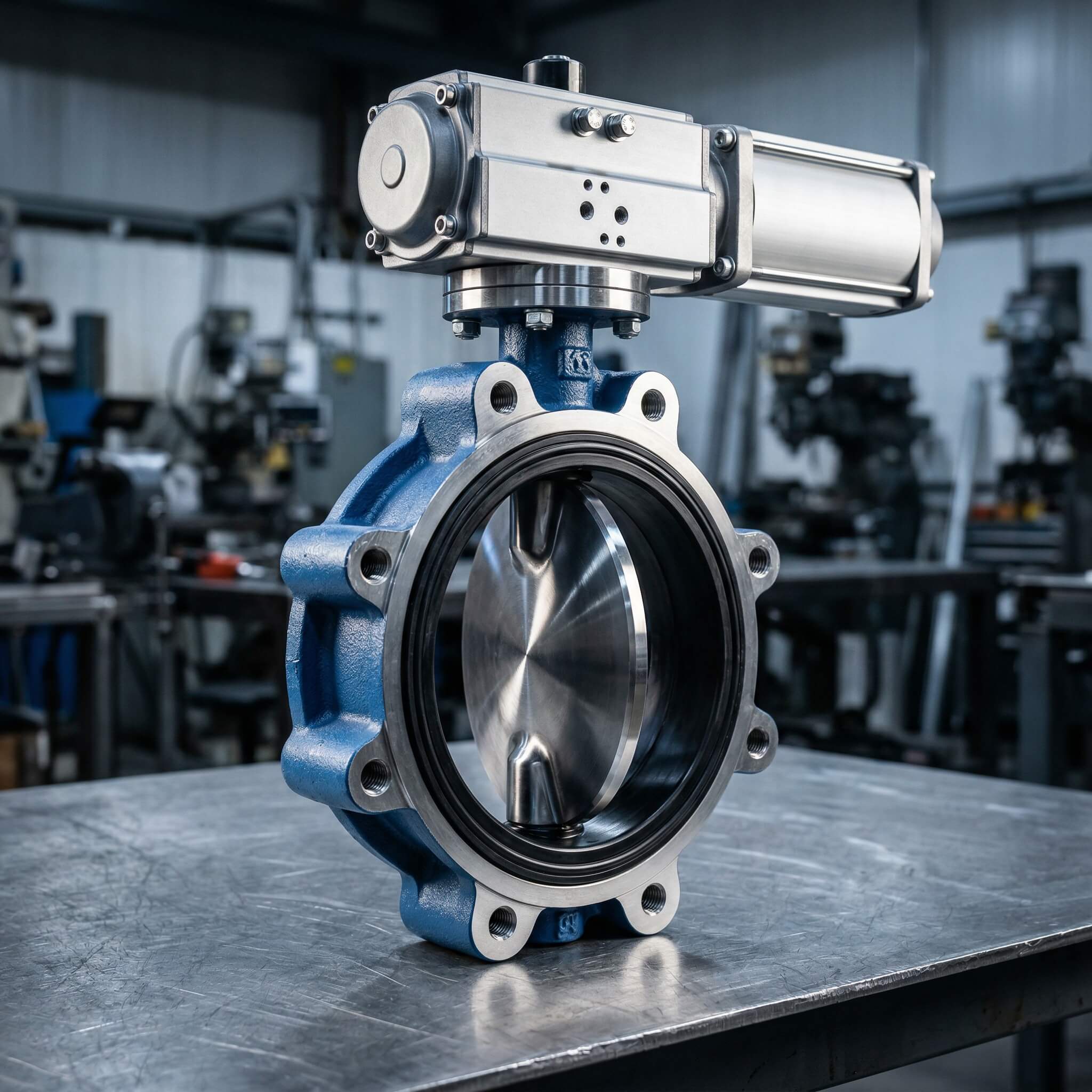
Choosing between these two designs depends entirely on whether you require end-of-line service or a lightweight, lower-cost connection for your piping system. You might feel overwhelmed by the technical specifications and flange requirements of different industrial setups. If you select the wrong wafer pattern butterfly valve for a pressurized line, you risk catastrophic leaks during downstream maintenance. This guide provides a definitive analysis to help you secure your fluid control systems with the correct components.
What defines a wafer pattern butterfly valve?
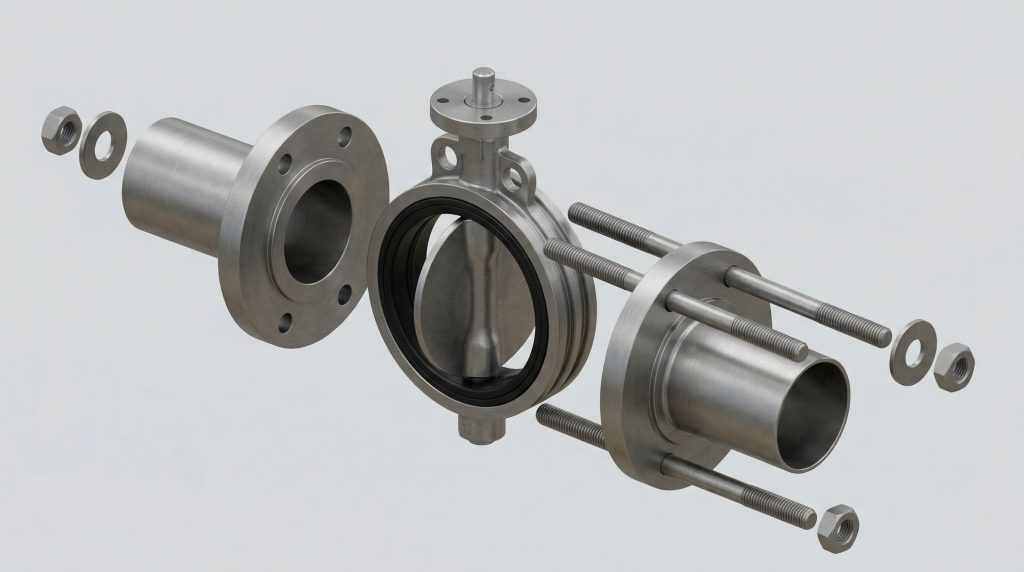
A wafer pattern butterfly valve is a lightweight flow control device designed to be “sandwiched” between two pipe flanges. You install it using long bolts that pass through both flanges and the valve body. This design relies on the clamping force of the surrounding piping to maintain a bubble-tight seal.
How does the body design work?
Does the slim profile of the valve body offer structural advantages for your system? The body is remarkably thin and takes up very little face-to-face space in your pipeline. Because it lacks threaded holes, it serves as a universal fit for many different flange standards.
Here is the deal:
You save significantly on weight and material costs compared to bulkier valve types.
- Prevents gasket protrusion into the flow stream.
- Ensures even compression across the seat.
- Simplifies the bolt-up process for technicians.
- Reduces the overall footprint of the piping assembly.
Key Takeaway
The wafer design is the most compact and economical option for general flow isolation between two fixed points.
| Feature | Specification |
|---|---|
| Body Style | Slim, non-threaded |
| Connection | Sandwich between flanges |
| Weight | Lightweight and compact |
Why choose a wafer pattern butterfly valve?
You should choose a wafer pattern butterfly valve when you need a cost-effective solution for bi-directional flow in your facility. Since the valve body contains less metal than a lug-style counterpart, the initial purchase price is significantly lower. This is particularly beneficial when you are managing large-diameter piping systems with strict budget constraints.
Does it save installation time?
Can the reduced weight of this valve improve the efficiency of your maintenance crew? While it requires careful alignment, the reduced weight makes it easier for your crew to handle manually. You do not have to worry about matching specific bolt hole threads on the valve body itself.
Think about this:
Lighter valves mean less stress on your piping supports and hangers over time.
- Compatible with various ANSI and DIN flanges.
- Lower torque requirements for smaller sizes.
- Available in various elastomer seat options.
- Faster shipping due to reduced material weight.
Key Takeaway
The primary motivation for selecting this pattern is the balance of high performance and low material cost.
| Benefit | Impact |
|---|---|
| Lower Cost | Reduced project CAPEX |
| Weight | Easier manual handling |
| Versatility | Lower inventory needs |
How to install a wafer pattern butterfly valve?
To install a wafer pattern butterfly valve, you must ensure the upstream and downstream flanges are perfectly aligned and spaced. You place the valve between the flanges and then insert the long studs through the entire assembly. You must tighten the nuts in a star pattern to ensure the elastomer seat compresses evenly against the flange faces.
What is the most common mistake?
Are you aware that the disc position during installation determines the longevity of your valve seat? Many technicians forget to partially open the disc before tightening the bolts. If the disc is fully closed, the flange pressure can pinch the seat, causing high torque or permanent damage.
The best part?
Correct installation ensures a zero-leakage seal for thousands of cycles.
- Clean flange faces thoroughly before insertion.
- Check disc clearance within the pipe internal diameter.
- Lubricate bolts to ensure accurate torque application.
- Use a cross-over tightening sequence for even pressure.
Key Takeaway
Precision alignment and proper bolt tensioning are the secrets to a long-lasting wafer valve installation.
| Step | Action |
|---|---|
| Preparation | Clean and align flanges |
| Position | Disc slightly open (10%) |
| Securing | Tighten in star pattern |
Is a wafer pattern butterfly valve for end-of-line?
You cannot use a wafer pattern butterfly valve for end-of-line service because it relies on pressure from both sides to stay in place. If you remove the downstream piping for maintenance, the bolts lose tension, and the valve body will be pushed out of the line. This creates a dangerous situation where you cannot safely isolate pressurized media from the open end.
Why is this a safety risk?
Do you understand the mechanical limitations that prevent this valve from being used at a pipe’s terminus? Without the clamping force of the second flange, the valve body has nothing to hold it against the remaining flange. You risk a total system blowout if you attempt this configuration in a live system.
Look at it this way:
Safety should always dictate your valve selection over initial cost savings.
- Not suitable for pump discharge without downstream piping.
- Unsafe for tank isolation if the tank needs cleaning.
- Prohibited by most industrial safety codes for dead-end service.
- Requires a companion flange if used at the end of a line.
Key Takeaway
Wafer valves are strictly for “in-line” applications where they are supported by piping on both sides.
| Application | Suitability |
|---|---|
| In-Line Service | Excellent |
| End-of-Line | Prohibited |
| Maintenance | Requires system shutdown |
What materials suit a wafer pattern butterfly valve?
A wafer pattern butterfly valve is typically manufactured from durable materials like ductile iron, carbon steel, or stainless steel. You select the body material based on your external environment and the seat material based on the fluid properties. For corrosive chemicals, you would likely choose a stainless steel disc paired with a specialized PTFE liner.
Why is ductile iron popular?
Have you considered why ductile iron is the standard choice for most municipal water systems? It offers a great balance of strength and impact resistance for your infrastructure. You get the durability of steel at a price point much closer to traditional cast iron.
Here is the secret:
The right material combination can extend your valve life by decades.
- EPDM seats for steam and water applications.
- Viton seats for high-temperature chemical media.
- Stainless steel discs for corrosive or abrasive fluids.
- Nylon-coated discs for salt water resistance.
Key Takeaway
Material selection is the most important factor in preventing premature valve failure and corrosion.
| Component | Common Materials |
|---|---|
| Body | Ductile Iron, SS316 |
| Disc | SS304, Bronze, DI |
| Seat | EPDM, PTFE, NBR |
How does a wafer pattern butterfly valve seal?
The seal in a wafer pattern butterfly valve is achieved through interference between the disc edge and the resilient seat. As you rotate the disc into the closed position, it deforms the elastomer slightly to create a tight barrier. The pressure of the media actually helps press the seat against the disc to enhance the sealing performance.
Is the seal bi-directional?
Can you rely on this valve to stop flow regardless of which direction the pressure originates from? Most modern designs allow you to seal against pressure coming from either direction. This makes the valve very versatile for your complex piping layouts and reversible flow systems.
The bottom line:
You get a bubble-tight shutoff even in low-pressure applications.
- Avoid abrasive slurries with standard resilient seats.
- Check for “compression set” in old elastomers periodically.
- Monitor for chemical swelling of the seat material.
- Ensure the disc edge remains smooth and polished.
Key Takeaway
The resilient seat design provides a reliable, low-torque seal that is easy to maintain and replace.
| Sealing Type | Mechanism |
|---|---|
| Primary Seal | Disc-to-Seat interference |
| Secondary Seal | Flange-to-Seat compression |
| Directionality | Bi-directional capability |
Can a wafer pattern butterfly valve use actuators?
Yes, you can easily mount pneumatic, electric, or hydraulic actuators to a wafer pattern butterfly valve. Most of these valves feature an ISO 5211 mounting pad on the top of the valve stem. This allows you to automate your flow control without needing custom brackets or expensive modifications to the valve body.
Is pneumatic or electric better?
Which actuation method provides the best response time for your specific industrial process? Pneumatic actuators are faster and better for high-cycle applications in your industrial plants. You would choose electric actuators when you need precise modulating control or if you lack a compressed air source.
Believe it or not:
Automation can reduce your labor costs and improve system response times significantly.
- ISO 5211 pads simplify the mounting process.
- Limit switches provide remote position feedback to your control room.
- Manual overrides are essential for safety during power failures.
- Declutchable gearboxes allow manual operation when needed.
Key Takeaway
Standardized mounting interfaces make the wafer design a prime candidate for modern automated systems.
| Actuation Type | Best Use Case |
|---|---|
| Manual | Infrequent operation |
| Pneumatic | High speed and frequency |
| Electric | Precise modulating control |
Wafer pattern butterfly valve vs. lug: differences?
The main difference between a wafer pattern butterfly valve and a lug-style valve is the way they attach to your piping. A lug-style valve has threaded inserts (lugs) around its perimeter, allowing you to bolt each flange to the valve independently. This structural difference means the lug-style can handle end-of-line service while the wafer style is strictly for in-line use.
Which one is more expensive?
Are you aware of the cost delta between these two common butterfly valve patterns? Lug-style valves are heavier and require more machining for the threaded holes. You will generally pay 10% to 20% more for a lug-style valve of the same size and material specification.
You need to know:
The extra cost for lug-style is an investment in system flexibility and safety.
- Lug: Supports downstream maintenance without system drainage.
- Wafer: Lower profile and significantly lighter weight.
- Lug: Easier to install in tight spots where long studs won’t fit.
- Wafer: Fewer components and lower material waste.
Key Takeaway
While they look similar, the lug-style offers mechanical advantages for maintenance that the wafer style lacks.
| Comparison | Wafer Pattern | Lug-Style |
|---|---|---|
| Body Holes | Smooth/Centering | Threaded Lugs |
| Dead-End | Not Recommended | Fully Capable |
| Material Vol | Lower/Slim | Higher/Robust |
Where is a wafer pattern butterfly valve applied?
You find a wafer pattern butterfly valve most frequently in water treatment, HVAC, and fire protection systems. It is the go-to choice for large-scale utility lines where cost and weight are your major decision factors. You will also see them used extensively in chemical processing plants where bi-directional flow is a common requirement.
Is it suitable for high-pressure?
Can the wafer design handle the extreme pressures found in your heavy industrial processes? They are typically rated for PN10, PN16, or ANSI 150 systems. If you are working with extremely high-pressure steam, you might need a high-performance double-offset design instead of a standard wafer.
Here is the truth:
For 90% of general utility applications, the wafer design is perfectly sufficient.
- HVAC chilled water loops for building cooling.
- Municipal irrigation systems for agricultural use.
- Cooling tower bypass lines in power plants.
- Low-pressure air handling systems.
Key Takeaway
The wafer valve is the “workhorse” of the industrial world, handling diverse media across many sectors.
| Industry | Typical Use |
|---|---|
| HVAC | Chilled and Hot Water |
| Water Treatment | Isolation and Throttling |
| Food & Bev | Utility Washdown Lines |
Is a wafer pattern butterfly valve cost-effective?
A wafer pattern butterfly valve is widely considered the most cost-effective valve for your large-diameter pipe installations. Compared to a gate valve or a ball valve of the same size, the wafer butterfly is significantly cheaper and takes up much less space. You save money not just on the valve itself, but also on the shipping and structural supports required.
What about long-term costs?
Will the maintenance requirements of this valve impact your long-term operational budget? Maintenance is relatively simple because you only have one moving part and a replaceable seat. You can often refurbish these valves in the field without the need for specialized or expensive tools.
The best part?
A well-maintained wafer valve can last as long as more expensive alternatives.
- Low initial purchase price for budget management.
- Minimal space requirements in tight mechanical rooms.
- High flow efficiency leads to lower pump energy costs.
- Reduced shipping costs due to lower material weight.
Key Takeaway
From procurement to operation, the wafer design offers the lowest total cost of ownership for most systems.
| Cost Factor | Performance |
|---|---|
| Purchase Price | Lowest in class |
| Installation | Moderate to Fast |
| Operation | Highly energy efficient |
Frequently Asked Questions
Can I use a wafer valve for end-of-line service?
No, you should never do this because the wafer design relies on the clamping force of two flanges to remain secure. Without the downstream flange, the valve will fail and leak under pressure, posing a significant safety risk.
What’s the best way to prevent seat damage during installation?
The best way is to keep the disc slightly open, approximately 10%, when tightening the flange bolts. This prevents the seat from being pinched between the disc edge and the flange face, which causes high torque.
Can I use a wafer pattern butterfly valve for throttling?
Yes, you can use it for basic throttling, but it is most effective between 30 and 70 degrees of opening. Operating it too close to the seat can cause cavitation or uneven wear on the elastomer.
What’s the best material for a saltwater environment?
The best choice is an aluminum-bronze or stainless steel disc paired with an EPDM or NBR seat. These materials offer the best resistance to the corrosive nature of salt and brackish water.
How do I know if the seat is replaceable on my valve?
Most resilient-seated wafer valves are designed with replaceable seats that can be swapped once they wear out. You can verify this by checking if the seat is bonded to the body or if it can be pulled out manually.
Conclusion
Navigating the choice between wafer and lug-style valves is a matter of balancing your budget, safety protocols, and maintenance requirements. While the wafer pattern offers unmatched weight and cost savings, the lug-style provides the necessary security for end-of-line services. By matching your valve selection to the specific mechanical needs of your pipeline, you ensure long-term reliability and minimize system downtime.
Our team at RUITO specializes in providing high-reliability, precision-engineered valves that meet international standards like ISO, CE, and DNV. We deliver traceable, documentation-ready solutions that simplify your procurement process and protect your critical infrastructure. Whether you need standard utility valves or custom-engineered components, we are here to support your mission-critical fluid control needs. If you have questions about which design fits your specific project, please contact us today for a technical consultation.