
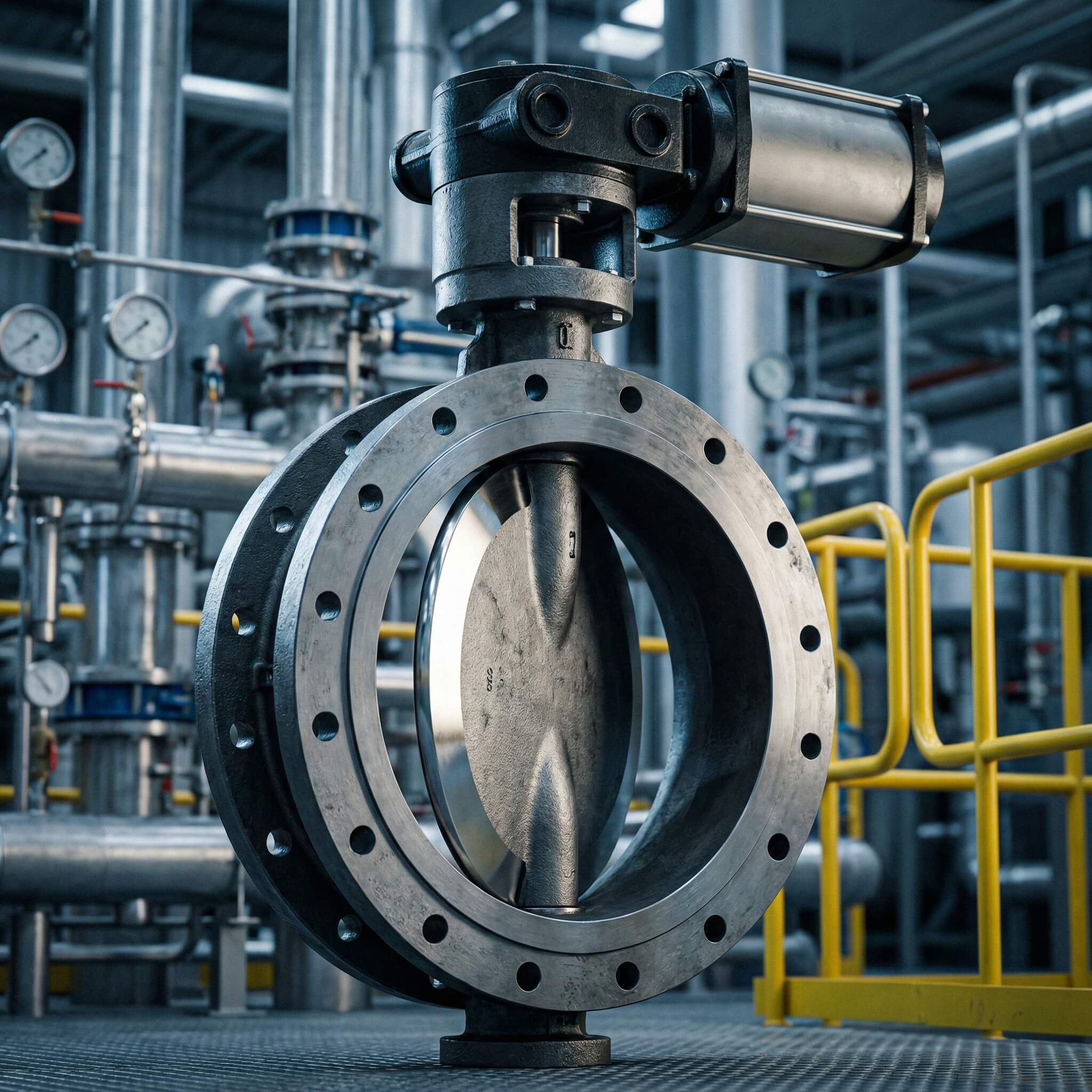
The anatomy of a high-performance double offset butterfly valve consists of a body, disc, stem, and seat engineered with two specific eccentric offsets to reduce wear and ensure bubble-tight shutoff. Industrial facilities often suffer from valve failures due to high-pressure steam or corrosive chemicals. These leaks cause expensive downtime and jeopardize worker safety. The butterfly valve structure found in double offset designs solves these issues by minimizing friction and providing the reliable sealing you need.
Why study the high-tech butterfly valve structure?
Studying this specific butterfly valve structure is essential because it represents the pinnacle of rotary valve engineering for critical process control. Understanding these components helps you select equipment that meets API 609 and ASME B16.34 standards for high-pressure environments. You can optimize your plant’s performance by identifying how these precision-machined parts interact.
Compliance with API and ASME Standards
Professional engineering relies on strict adherence to global safety and performance benchmarks. Here is why:
- API 609 dictates the thickness and testing requirements for high-performance models.
- ASME B16.34 ensures the pressure-temperature ratings are safe for your specific application.
- API 598 provides the testing protocols for bubble-tight sealing verification.
| Standard | Focus Area | Engineering Benefit |
|---|---|---|
| API 609 | Valve Design | Standardized wall thickness and safety |
| ASME B16.34 | Pressure/Temp | Accurate rating for industrial safety |
This engineering framework ensures that every component is built to survive the most demanding thermal and mechanical stresses.
Key Takeaway
Rigorous design standards provide the structural foundation for high-performance reliability in extreme industrial settings.
How does the body impact the butterfly valve structure?
The body acts as the primary pressure vessel and foundational frame for the butterfly valve structure, ensuring internal parts remain aligned under load. It must be rigid enough to resist deformation during high-torque actuation. Most high-performance bodies are precision-cast from Carbon Steel or Stainless Steel.
Economy of the Wafer Body Design
The wafer body is designed to be lightweight and compact for your pipeline. Think about this:
- It fits snugly between two pipe flanges using long through-bolts.
- Material costs are lower due to the thinner profile.
- Installation is faster and requires less physical space in tight skids.
Flexibility of the Lug Body Pattern
The lug style offers superior versatility for maintenance and safety isolation. But that is not all:
- Threaded bolt holes allow you to bolt the valve directly to each flange.
- It facilitates “dead-end service” for downstream maintenance.
- Safety is improved as the valve remains secure even if one pipe side is removed.
| Body Type | Mounting Style | Primary Advantage |
|---|---|---|
| Wafer | Sandwiched between flanges | Low weight and cost-efficiency |
| Lug | Bolted to each flange | Safety in dead-end service |
Selecting the correct body type ensures your piping system remains flexible for future maintenance needs and repairs.
Key Takeaway
While wafer bodies save on initial costs, lug bodies provide the essential safety features required for isolated system maintenance.
What role does the disc play in butterfly valve structure?
The disc is the dynamic flow control element within the butterfly valve structure that regulates or stops the media. In high-performance designs, the disc is hydrodynamically profiled to reduce turbulence. Its spherical edge is polished to a mirror finish to protect the seat during closure.
Fluid Dynamics and Efficiency
High-performance discs are shaped to optimize the flow coefficient and reduce pressure drop. Here is why:
- The streamlined profile prevents the “vortex effect” common in standard discs.
- Vibration is minimized, which protects your surrounding instrumentation.
- Flow control becomes more linear and predictable across the 90-degree turn.
Durability Through Material Science
The disc must withstand abrasive media and high velocities without eroding. Believe it or not:
- 316 Stainless Steel is the standard for corrosion resistance in these valves.
- Hard-chrome plating on the edge prevents galling against the seat.
- Stellite overlays are available for your most abrasive slurry applications.
| Disc Feature | Material Choice | Performance Impact |
|---|---|---|
| Edge Finish | Polished/Plated | Extends seat life and reduces torque |
| Base Material | CF8M (316 SS) | Resists chemical attack and oxidation |
The interaction between the disc edge and seat determines the overall cycle life of your valve assembly.
Key Takeaway
Precision-machined discs are vital for maintaining low-torque operation and preventing premature seat degradation in high-cycle services.
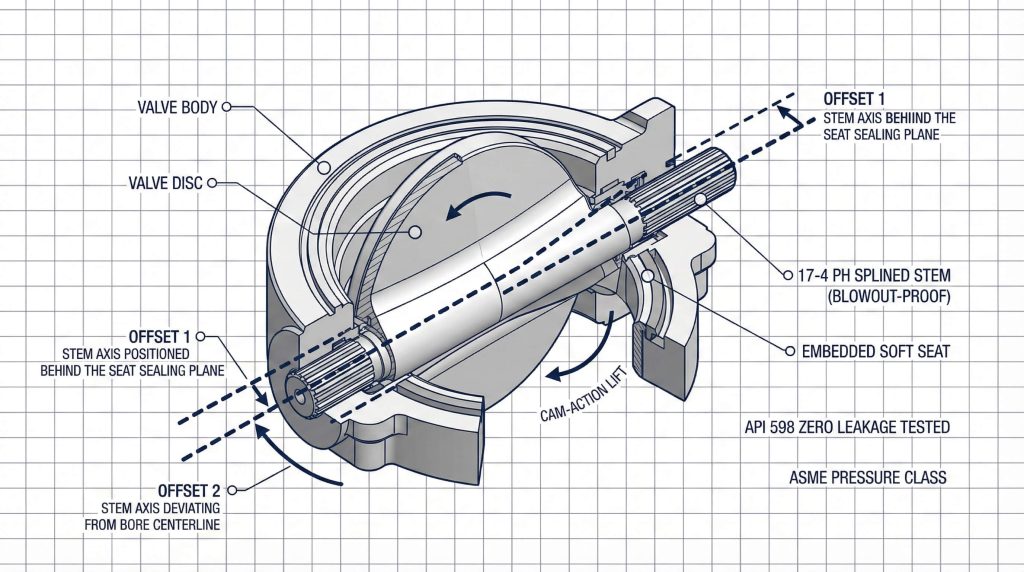
How do offsets redefine the butterfly valve structure?
The use of dual eccentricities redefines the butterfly valve structure by creating a unique “camming” motion during rotation. This geometry allows the disc to move away from the seat without rubbing. You benefit from significantly lower operating torque compared to concentric valves.
Mechanical Advantage of First Offset
The first offset positions the shaft axis behind the centerline of the seat seal. Think about this:
- It enables a continuous 360-degree sealing surface without breaks.
- Shaft penetration through the seat is eliminated, preventing common leak paths.
- Seal integrity is maintained even at higher pressure differentials.
Cam Action from the Second Offset
The second offset places the shaft eccentric to the centerline of the valve bore. It gets better:
- The disc lifts off the seat within the first few degrees of opening.
- Friction is virtually eliminated throughout the rest of the 90-degree travel.
- Your actuators can be smaller and more cost-effective due to reduced drag.
| Offset Type | Position | Operational Result |
|---|---|---|
| First | Behind seal plane | Eliminates seat-shaft leak paths |
| Second | Off-center of bore | Creates quick-release cam action |
This double-eccentric geometry is the secret behind the million-cycle lifespan of high-performance valve systems.
Key Takeaway
Dual offsets prevent the disc from dragging against the seat, which preserves seal integrity and lowers power requirements.
Which seat suits your specific butterfly valve structure?
Seat selection is the most critical decision for your butterfly valve structure to ensure a long-term, leak-free seal. High-performance valves offer materials ranging from soft polymers to hardened metals. You must match the seat material to your process temperature and chemical compatibility.
Reliability of Resilient Soft Seats
Soft seats are ideal for providing a “bubble-tight” shutoff in standard chemical services. Here is why:
- Reinforced PTFE (RTFE) handles temperatures up to 450°F with ease.
- Pressure-assisted designs use the media to tighten the seal automatically.
- Bi-directional shutoff is standard for most high-performance soft-seated models.
Safety of Metal and Fire-Safe Seats
Metal seats are required when your process exceeds the limits of polymers. But that is not all:
- Inconel seats can withstand extreme heat up to 1000°F and beyond.
- Fire-safe designs combine a primary soft seal with a secondary metal backup.
- These seats meet API 607 standards for safety in flammable environments.
| Seat Material | Max Temp | Sealing Performance |
|---|---|---|
| RTFE | 450°F | Class VI (Zero Leakage) |
| Inconel | 1000°F | Class IV or V (High Durability) |
The right seat material ensures your valve maintains its sealing class even after thousands of thermal cycles.
Key Takeaway
Choosing between resilient and metal seats depends on your specific balance of sealing tightness and temperature requirements.
How is the stem secured in a butterfly valve structure?
The stem is the structural bridge that transmits torque from your actuator to the disc within the butterfly valve structure. High-performance stems are built for high-torque applications and safety compliance. They are typically made from high-strength 17-4 PH Stainless Steel.
Ensuring Blow-out Proof Security
Safety is paramount in high-pressure systems where a stem failure could be catastrophic. Here is why:
- Internal retention shoulders prevent the stem from being ejected under pressure.
- This design meets strict API safety requirements for industrial environments.
- You are protected from dangerous “projectile” failures during internal malfunctions.
Precision of Splined Connections
Modern valves use splined connections to link the disc and stem efficiently. It gets better:
- A splined shaft provides more contact area than traditional pins.
- Torque transfer is smoother and eliminates the risk of pin shearing.
- Maintenance is simplified because there are no pins to drill out during rebuilds.
| Stem Feature | Design Benefit | Value to Operator |
|---|---|---|
| Blow-out Proof | Internal Retainer | Maximum personnel and plant safety |
| Spline Drive | High Surface Area | Reliable torque in high-pressure lines |
A robust stem design ensures that the valve responds accurately to actuator commands without mechanical slop.
Key Takeaway
Splined, blow-out proof stems offer the highest levels of safety and operational precision for modern automated facilities.
Do bearings improve the overall butterfly valve structure?
Bearings are the internal supports that maintain the alignment of the butterfly valve structure during rotation. They sit at the top and bottom of the valve body to absorb radial loads. You will notice smoother operation and less wear when high-quality bearings are used.
Friction Reduction in Extreme Heat
Heavy-duty bushings prevent the stem from seizing or galling against the body. Think about this:
- PTFE-coated stainless steel bearings provide a low-friction surface.
- Graphite-reinforced bearings are used for your high-temperature steam lines.
- Lower friction means your pneumatic actuators will consume less compressed air.
Alignment for Long-Term Sealing
Precise radial support prevents the stem from “bowing” under high pressure. But that is not all:
- Bearings keep the disc perfectly centered within the seat cavity.
- Uneven seat wear is eliminated by maintaining strict axial alignment.
- Your valve’s service life is extended by preventing internal component interference.
| Bearing Material | Environment | Key Benefit |
|---|---|---|
| PTFE/Composite | Corrosive/Standard | Lowest friction for easy turning |
| Graphite/Bronze | High Temperature | Resists seizing in thermal extremes |
Rigid bearing support is the foundation of a reliable, high-cycle rotary valve that requires minimal intervention.
Key Takeaway
High-performance bearings reduce breakaway torque and ensure the disc seals perfectly every time the valve closes.
How does packing protect the butterfly valve structure?
Stem packing is the primary environmental barrier in your butterfly valve structure, preventing fugitive emissions from escaping into the atmosphere. As regulations become stricter, the packing design has become more advanced. You must ensure the packing gland is correctly loaded to prevent leaks.
Sealing Against Fugitive Emissions
Modern packing sets are designed to meet international emission standards like ISO 15848-1. Here is why:
- “Cup and cone” shapes ensure the packing expands toward the stem and wall.
- Multi-layered PTFE or graphite rings provide a redundant sealing barrier.
- Fugitive emissions are kept at nearly undetectable levels for your facility.
Benefits of Live-Loading Systems
Live-loading uses spring tension to maintain constant pressure on the packing set. It gets better:
- Belleville washers compensate for the natural compression set of the packing.
- Manual adjustments are rarely needed, even in high-cycle applications.
- Leakage risks are minimized during rapid temperature fluctuations or “thermal shock.”
| Packing Design | Loading Style | Long-term Benefit |
|---|---|---|
| PTFE Cup & Cone | Self-Energized | Directional sealing against the stem |
| Live-Loaded | Spring-Loaded | Reduced maintenance and zero leakage |
A well-designed packing system protects your personnel and helps your facility stay compliant with environmental laws.
Key Takeaway
Live-loaded packing systems are the industrial standard for controlling fugitive emissions and reducing routine maintenance costs.
What sets the high performance butterfly valve structure apart?
The high performance butterfly valve structure is distinguished by its ability to handle pressures and temperatures that destroy standard valves. While general-purpose valves are limited to low-pressure water, these models thrive in steam and chemical lines. You get a much higher return on investment through durability.
Shifts in Industrial Pressure Ratings
High-performance models are built for ANSI Class 300 and 600 applications. Think about this:
- Standard concentric valves often fail above 200 PSI due to seal deformation.
- Double offset designs maintain bi-directional shutoff at much higher pressures.
- This allows you to use butterfly valves where you previously needed heavy gate valves.
Long-Term Lifecycle Value and ROI
The total cost of ownership is significantly lower for high-performance equipment. But that is not all:
- Seat life is often five to ten times longer than concentric designs.
- Downtime is reduced because the valve requires fewer repairs and adjustments.
- Energy savings are realized through lower torque and efficient flow paths.
| Feature | General Service Valve | High Performance Valve |
|---|---|---|
| Max Pressure | Low (Class 150) | High (Class 300/600) |
| Operational Life | Limited (Seat wear) | Extended (Cam action) |
The specialized structure of these valves makes them the most cost-effective solution for critical industrial process loops.
Key Takeaway
Investing in high-performance geometry pays for itself through reduced plant downtime and superior pressure-handling capabilities.
How to maintain the integrity of butterfly valve structure?
Maintaining the butterfly valve structure is surprisingly simple due to its modular, field-repairable design. You don’t need to scrap the entire valve when a wear component fails. Most high-performance models allow for rapid seat replacement without removing the disc.
Simplified Field Seat Replacement
The seat is typically held in place by a floating retainer ring for easy access. Here is why:
- You can replace the seat by simply removing the retainer bolts.
- There is no need to disassemble the entire stem and disc assembly.
- Maintenance teams can return the valve to service in a fraction of the time.
Use of Predictive Maintenance Tools
Monitoring your valve’s performance can prevent catastrophic failures before they happen. It gets better:
- Torque monitoring can signal when a seat is beginning to wear or foul.
- Acoustic leak detection helps you identify internal bypass without a shutdown.
- Regular visual inspections of the packing gland prevent external emission leaks.
| Maintenance Item | Tool Required | Objective |
|---|---|---|
| Seat Condition | Torque Sensor | Detect friction or sealing issues |
| Packing Gland | Visual / Sniffer | Prevent fugitive emission leaks |
Proactive maintenance of the offset geometry ensures that your valves perform reliably for decades of continuous operation.
Key Takeaway
The field-repairable design of double offset valves significantly lowers your long-term maintenance labor and spare parts budget.
Frequently Asked Questions
Can I use a double offset valve for bidirectional flow?
Absolutely, because the high-performance seat is designed for bi-directional shutoff. However, you should follow the “preferred flow direction” arrow for the absolute tightest seal under full pressure.
What is the best material for high-temperature steam?
Metal seats are definitely the best choice for steam applications over 450°F. Flexible Inconel seats provide the durability needed to survive thermal expansion and contraction cycles.
Can high-performance valves be used for throttling?
Yes, they are excellent for both isolation and throttling service. The offset design reduces the “flutter” and cavitation risks that affect standard butterfly valves at partial openings.
What is the best way to prevent stem leaks?
Live-loaded PTFE packing is the gold standard for preventing stem leaks. It maintains constant pressure on the seal, ensuring you meet fugitive emission standards without constant adjustment.
Can I replace the seat without removing the valve from the line?
No, you generally must remove the valve from the pipeline to access the retainer ring. However, once it is on the bench, you do not need to pull the stem or disc to swap the seat.
Conclusion
The anatomy of a high-performance double offset butterfly valve is a masterclass in reducing mechanical friction while maximizing sealing integrity. By addressing the common problems of seat wear and high operating torque, these valves offer a robust solution for your most challenging industrial processes. From the cam-action of the dual offsets to the safety of blow-out proof stems, every component is designed for long-term reliability. We are committed to providing the highest quality flow control solutions for your facility’s safety and efficiency. To find the perfect configuration for your next project, please contact us today.