

Using butterfly valves for control is a highly effective strategy for modern industrial systems, provided you select the correct disk geometry and sizing for your specific application. You can certainly use these valves for modulating service, as long as you account for the inherent flow characteristics of a butterfly valve to ensure system stability.
Many engineers face the frustration of process oscillations where a valve seemingly refuses to settle on a set point, especially at low flow rates. This “limit cycling” agitates the entire control loop, leading to premature wear on actuators, inconsistent product quality, and significantly higher utility costs. By understanding how the flow characteristics of a butterfly valve change across its travel, you can implement a solution that offers the economy of a quarter-turn valve with the precision typically reserved for a globe valve.
What are the flow characteristics of a butterfly valve?
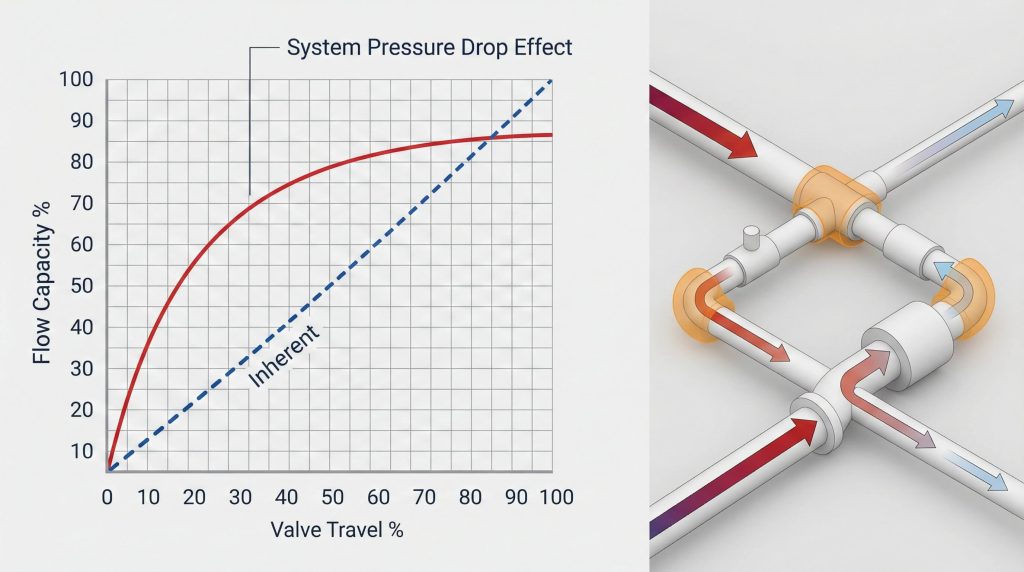
The flow characteristics of a butterfly valve define the relationship between the degree of disk opening and the percentage of maximum flow passing through the device. In their standard configuration, these valves typically exhibit an “inherent” linear characteristic when measured under a constant pressure drop.
How does inherent behavior differ from installed?
Inherent characteristics are determined in a laboratory setting with constant pressure, but the installed performance often shifts significantly once integrated into your piping. As the valve closes, the pressure drop across it typically increases, which can distort a linear inherent curve into a “quick-opening” installed behavior.
Here is the deal:
- Inherent Flow: Measured at a constant pressure differential.
- Installed Flow: The actual performance within your specific process piping.
- Pressure Loss: Energy consumed by the valve versus the rest of the system.
- Gain: The ratio of change in output flow to change in input signal.
Key Takeaway: Distinguishing between inherent and installed behavior is the first step toward achieving stable process control.
| Metric Type | Definition | Common Behavior |
|---|---|---|
| Inherent | Performance at constant $\Delta P$ | Linear |
| Installed | Performance in actual piping | Quick-Opening |
| Control Range | Effective modulation window | 25% to 50% Travel |
Understanding these profiles helps you predict how your system will react during startup and normal operation.
Why do flow characteristics of a butterfly valve matter?
You need to prioritize the flow characteristics of a butterfly valve because they determine the “gain” of your control loop, which is essential for maintaining a steady process. If the gain is too high at low travel, your system will overshoot the set point; if it is too low at high travel, the response becomes sluggish.
Why is gain stability critical for your system?
Stable gain ensures that a 10% change in the control signal results in a predictable and proportional change in the actual flow rate. When the gain deviates too far from a 1:1 ratio, the controller struggles to calculate the correct output, leading to instability.
Think about it.
- High Gain: Small valve movements cause massive flow changes.
- Low Gain: Large valve movements cause almost no flow change.
- Linear Gain: A consistent response across the entire operating range.
Key Takeaway: Managing valve gain through proper characteristic selection prevents the “hunting” behavior that damages equipment.
| Control State | Gain Value | Process Impact |
|---|---|---|
| Optimal | 0.5 to 2.0 | Stable and responsive |
| Sensitive | > 2.0 | Overshoot and oscillation |
| Sluggish | < 0.5 | Delayed set-point recovery |
Properly matched characteristics ensure your PID controllers don’t have to work overtime to compensate for valve nonlinearity.
Does gain affect flow characteristics of a butterfly valve?
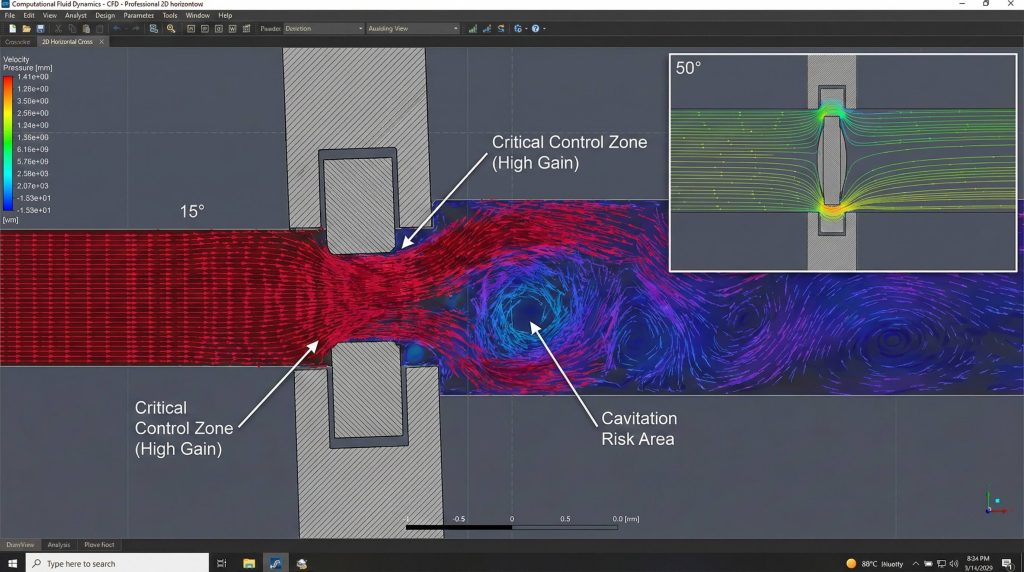
Gain is the mathematical derivative of the flow characteristics of a butterfly valve, representing how sensitive the flow rate is to changes in the disk position. When you look at a standard butterfly valve, you will notice that the gain is extremely high when the valve is just beginning to open.
What happens at low versus high travel angles?
At low travel angles (under 25%), a tiny movement of the disk creates a disproportionately large opening for the fluid, leading to high gain. Conversely, near the fully open position, the disk is parallel to the flow, meaning further rotation provides very little additional flow capacity.
Let’s dive in:
- Standard butterfly valves are most effective between 25% and 50% travel.
- Below 25% travel, you risk “limit cycling” and set-point overshoot.
- Above 70% travel, the valve becomes unresponsive to control signals.
- Effective gain management requires a specialized disk design for wider rangeability.
Key Takeaway: Standard butterfly valves have a limited “sweet spot” for control, necessitating careful sizing.
| Travel Position | Sensitivity | Control Quality |
|---|---|---|
| 0% – 20% | Very High | Poor (Oscillatory) |
| 25% – 50% | Moderate | Good (Stable) |
| 70% – 90% | Very Low | Poor (Sluggish) |
Operating outside the stable gain region often forces operators to switch to manual control, which compromises safety and efficiency.
How do flow characteristics of a butterfly valve impact cost?
The flow characteristics of a butterfly valve allow you to use a smaller, lighter, and more affordable valve compared to a bulky gate valve or globe design. Because butterfly valves are typically line-size, they eliminate the need for expensive pipe reducers that are often required for other valve styles.
Why is a compact design often more economical?
Compact valves use less metal and require less structural bracing, which reduces both the initial purchase price and the total installation labor. Furthermore, the high flow capacity (Cv) of a butterfly valve means you can often achieve the desired flow with a smaller envelope size.
You might be wondering:
- Reduced Weight: Lowers the cost of pipe supports and hangers.
- Face-to-Face: Shorter dimensions save valuable plant floor space.
- Actuation: Lower torque requirements allow for smaller, cheaper actuators.
- Maintenance: Easier disassembly reduces downtime and labor costs.
Key Takeaway: Choosing a butterfly valve for control can significantly lower CAPEX if the flow profile fits your process.
| Cost Factor | Butterfly Valve | Alternative Styles |
|---|---|---|
| Purchase Price | Low to Medium | High |
| Installation | Minimal Reducers | Frequent Reducers |
| Maintenance | Simple / Fast | Complex / Slow |
By leveraging the high capacity of these valves, you can design leaner systems without sacrificing basic control functionality.
What defines the flow characteristics of a butterfly valve?
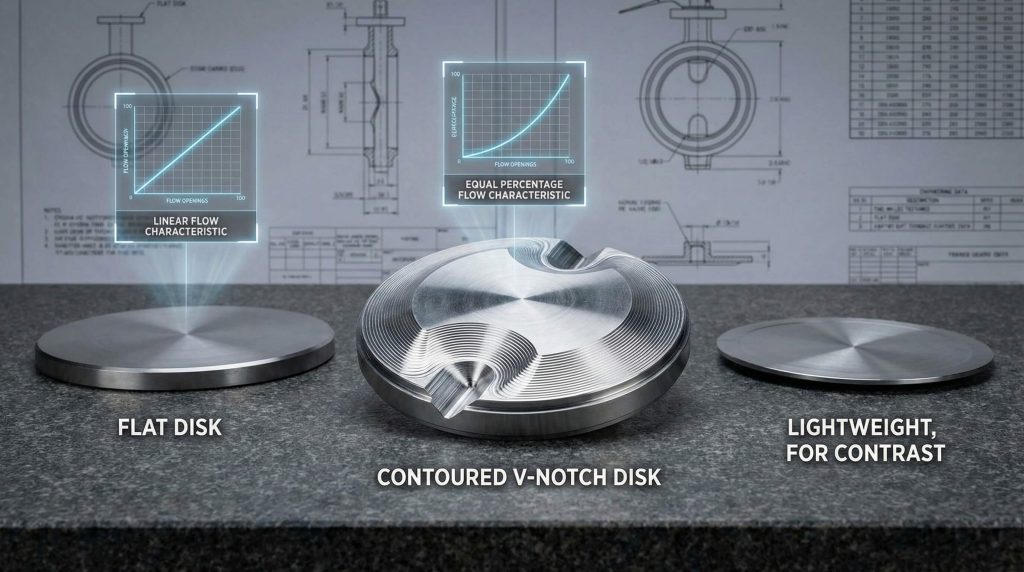
The physical shape and thickness of the disk are what primarily define the flow characteristics of a butterfly valve. As the disk rotates, the varying area of the “curtain” through which fluid passes creates a specific flow-to-travel relationship.
What are the three main characteristic types?
In the valve industry, the three primary inherent characteristics are quick-opening, linear, and equal percentage. While standard butterfly valves are naturally linear, they can be modified with specialized disk shapes to mimic the equal percentage curve found in a ball valve.
The best part?
- Linear: Flow is directly proportional to the valve travel.
- Equal Percentage: Each increment of travel produces an equal percentage change in flow.
- Quick-Opening: Large flow changes occur at very small travel increments.
- Custom Trim: Engineered disks can reshape the inherent curve to suit specific loops.
Key Takeaway: Disk geometry is the “software” of the valve, dictating its performance logic in the pipeline.
| Characteristic Type | Best Application | Flow Sensitivity |
|---|---|---|
| Linear | Constant Pressure Drop | Consistent |
| Equal Percentage | Variable Pressure Drop | Logarithmic |
| Quick-Opening | On/Off Service | Sudden |
Choosing the right inherent characteristic is vital to ensuring that the installed gain remains within the acceptable 0.5 to 2.0 range.
Are flow characteristics of a butterfly valve linear?
Standard inherent flow characteristics of a butterfly valve are generally linear, meaning the flow increases at a steady rate as the disk opens. However, you must be cautious because a linear inherent curve often performs like a quick-opening valve once it is installed in a high-resistance system.
Why do standard discs struggle with control?
Standard discs have a symmetric profile that creates high turbulence and rapid flow changes at the leading edges during initial opening. This makes it difficult to control fine flow rates, often necessitating a transition to more specialized designs if the process is sensitive.
Here is the deal:
- Linear disks work well in loops with low pressure drops.
- They struggle when the valve must handle a large portion of the system’s total pressure drop.
- High-gain at low travel is an inherent weakness of the flat-disk design.
- Many engineers use a check valve in tandem to manage backflow risks in these systems.
Key Takeaway: A “linear” valve rarely stays linear once you put it into a real-world piping network.
| Valve Feature | Impact on Linearity | Result |
|---|---|---|
| Symmetric Disk | High gain at 0-15° | Non-linear control |
| Pipe Reducers | Increases pressure drop | Distorted curve |
| Thick Disk | Reduces max flow | Lower Cv |
If your process requires precision across a wide range of flow rates, a standard linear butterfly valve may not be sufficient.
Can trim change flow characteristics of a butterfly valve?
You can absolutely modify the flow characteristics of a butterfly valve by utilizing specialized trim or disk designs, such as equal percentage disks. These engineered disks are designed to provide better control in situations where a standard butterfly valve would be too sensitive or too sluggish.
How does an equal percentage disk help?
Equal percentage disks are shaped to restrict flow more effectively at low angles, shifting the usable control range toward the middle of the travel. This allows the valve to behave more like a globe valve, offering stable control even when the source water temperature or system pressure fluctuates.
Think about it.
- Precision: Allows for stable control as low as 15% travel.
- Rangeability: Extends the effective control window up to 70% travel.
- Retrofitting: You can often upgrade the disk without changing the entire valve body.
- Versatility: Perfect for secondary loops or packaged plants with limited space.
Key Takeaway: Specialized disk trims provide the rangeability of high-end control valves at a fraction of the cost.
| Feature | Standard Disk | Equal Percentage Disk |
|---|---|---|
| Control Range | 25% to 50% | 15% to 70% |
| Low Flow | Unstable | Stable |
| Cost | Lowest | Medium |
This technology is a game-changer for plant managers who need to improve control without re-engineering their entire piping layout.
How do flow characteristics of a butterfly valve affect range?
The flow characteristics of a butterfly valve determine its “controllable rangeability,” which is the ratio of maximum to minimum controllable flow. Standard designs often have limited rangeability because they lose control effectiveness at both the very low and very high ends of their travel.
What is the typical controllable travel range?
For a standard butterfly valve, you can expect a reliable control range between 25% and 50% of the total travel. Operating outside this narrow window typically results in process variability that can exceed the tolerances of sensitive chemical or pharmaceutical applications.
Let’s dive in:
- Standard Range: 25% to 50% (Very limited for complex loops).
- High-Performance Range: 15% to 70% (Comparable to globe valves).
- Scaling: Poor rangeability leads to “oversized” valves for low-flow conditions.
- Safety: Consult our blog for detailed sizing charts to avoid rangeability traps.
Key Takeaway: Understanding rangeability limits prevents you from selecting a valve that cannot handle your system’s minimum flow requirements.
| Valve Style | Rangeability Ratio | Control Travel % |
|---|---|---|
| Standard Butterfly | 10:1 to 20:1 | 25% – 50% |
| High-Performance | 30:1 to 50:1 | 15% – 70% |
| Globe Valve | 50:1+ | 10% – 90% |
Maximizing the controllable travel range reduces the risk of having to put your system into manual mode during low-demand periods.
Do flow characteristics of a butterfly valve cause cycling?
Inherent flow characteristics of a butterfly valve can indeed cause limit cycling if the valve is oversized or if the gain at low travel is too high. Limit cycling occurs when the controller sends a signal to move, and the resulting change in flow is so large that the controller immediately tries to reverse the action.
What are the risks of limit cycling in a loop?
Limit cycling causes constant oscillation of the process variable, which creates excessive wear on the valve stem packing, seals, and actuator components. In industries like photographic film or chemical production, even a half-degree temperature fluctuation caused by cycling can result in massive amounts of wasted scrap material.
You might be wondering:
- Is the valve too large? Line-size valves are often oversized for control.
- Is the gain too high? Check the flow profile at the current operating point.
- Can the actuator keep up? Slop or hysteresis in the linkage exacerbates cycling.
- Should I switch to automatic? Only if the valve is operating in its stable range.
Key Takeaway: Limit cycling is a symptom of poor valve-to-process matching, usually rooted in the valve’s flow profile.
| Problem | Cause | Consequence |
|---|---|---|
| Limit Cycling | High Gain at low travel | Equipment wear / Scrap |
| Overshooting | Non-linear response | Process instability |
| Sluggishness | Low Gain at high travel | Slow recovery |
Addressing these issues often requires switching to a valve with an equal percentage characteristic to flatten the gain curve.
When are flow characteristics of a butterfly valve ideal?
The flow characteristics of a butterfly valve are ideal when your application requires high flow capacity, low pressure drop, and the process control is not extremely tight. They are the preferred choice for secondary loops, water treatment facilities, and HVAC systems where installation space is at a premium.
How do you select the best valve for your needs?
To select the best valve, you must analyze your system’s minimum, normal, and maximum flow rates against the valve’s Cv curve. If your normal operating point falls between 30% and 60% open, a standard butterfly valve will likely provide excellent service at a very competitive price point.
The best part?
- Efficiency: Low obstruction means lower pumping costs over the valve’s life.
- Versatility: Available in various materials like stainless steel and ductile iron.
- Simplicity: Fewer moving parts mean higher reliability in the field.
- Compliance: Certified designs for marine, oil, and water industries are readily available.
Key Takeaway: When sized correctly, butterfly valves offer an unbeatable balance of performance and economy.
| Scenario | Recommended Valve | Reason |
|---|---|---|
| High Precision | Equal Percentage Butterfly | Stable Gain |
| General Utility | Standard Butterfly | Cost / Space |
| High Pressure | High-Performance Butterfly | Seal Integrity |
By matching the valve’s flow profile to your system’s resistance curve, you can achieve world-class control without the “globe valve price tag.”
Conclusion
Achieving precise process control doesn’t always require the most expensive equipment; it requires the most intelligent application of valve technology. By understanding the flow characteristics of a butterfly valve, you can solve instability issues, reduce installation costs, and improve your facility’s overall efficiency. At RUITO, we are committed to providing precision-engineered fluid control solutions that meet the rigorous demands of global industrial projects. We invite you to explore our technical resources or contact us today to find the perfect valve for your next critical application.
FAQ
What is the most common flow characteristic for a butterfly valve?
Standard butterfly valves typically have an inherent linear flow characteristic, though this often changes to a quick-opening profile once the valve is installed in a system with significant pipe resistance.
Can I use a butterfly valve for throttling?
Yes, you can use butterfly valves for throttling, but it is recommended to operate them between 20 and 70 degrees of opening to avoid the high-gain and low-gain regions at the travel extremes.
What is the “gain” of a control valve?
Gain is the ratio of the change in output (flow rate) to the change in input (control signal). A stable control valve should ideally have an installed gain between 0.5 and 2.0 across its operating range.
How does an equal percentage disk improve control?
An equal percentage disk reshapes the flow curve so that small movements at low travel produce smaller changes in flow, effectively lowering the gain and preventing process oscillations or “limit cycling.”
When should I replace a butterfly valve with a globe valve?
You should consider a globe valve only if your process requires extremely high rangeability (beyond 50:1) or if the butterfly valve cannot provide a stable enough gain profile even with specialized control disks.