
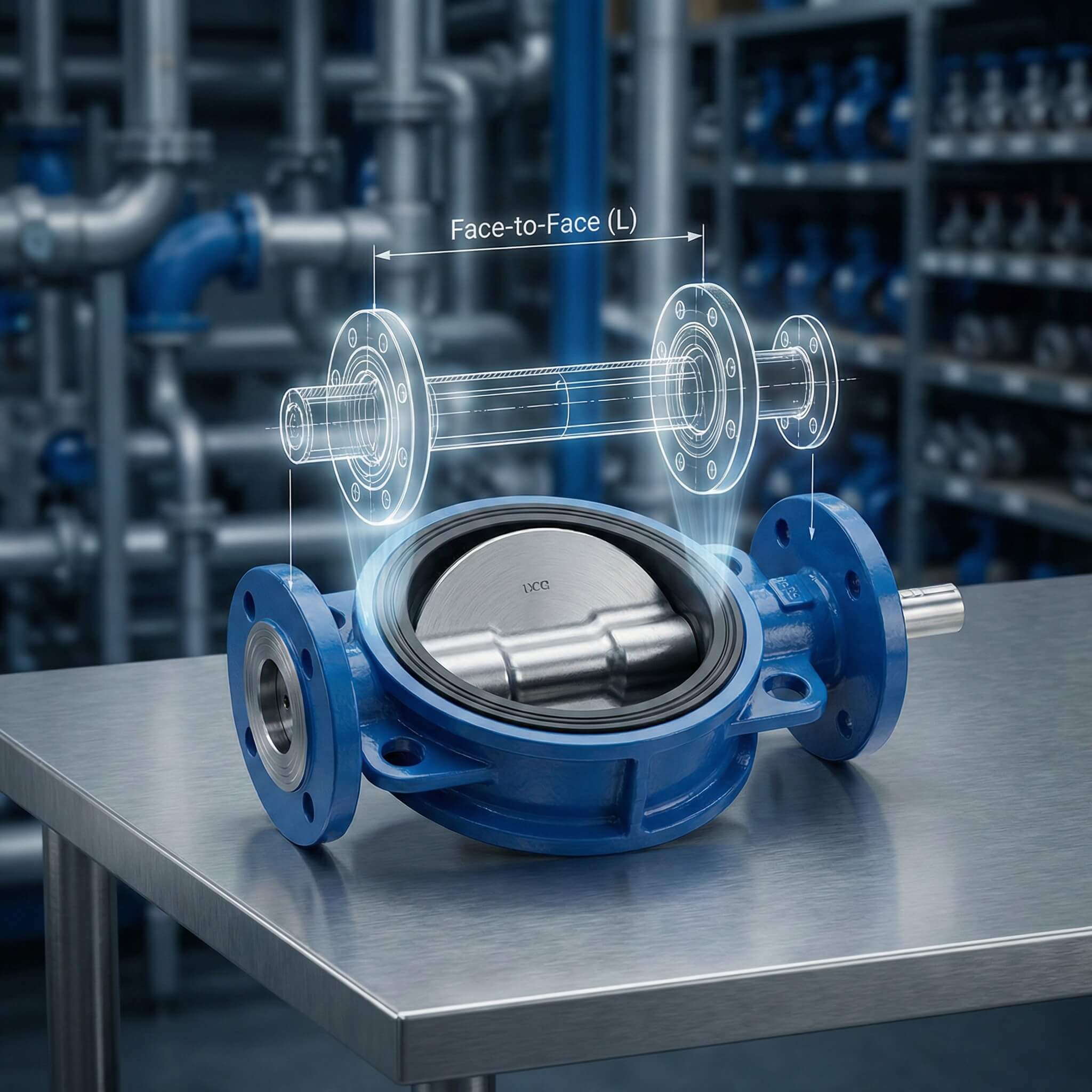
Butterfly valve dimensions are the technical specifications, including nominal diameter and the butterfly valve face to face length, that determine how a valve fits into a piping system. Improperly sized valves lead to leaks, pressure drops, and complete system failure, which can be catastrophic for your operations. Replacing an incorrectly sized valve is costly, time-consuming, and risks significant downtime in critical industrial processes. This guide provides the technical clarity needed to master dimensions and ensure a perfect fit every time.
Why Do Butterfly Valve Dimensions Matter for System Performance?
Proper dimensions ensure that the valve integrates seamlessly with the piping, maintaining the required flow rate and pressure levels without causing mechanical stress. Accuracy in the butterfly valve face to face measurement is critical for maintaining seal integrity during installation.
Why does this matter?
Poorly sized valves create unnecessary turbulence and friction. This leads to energy loss and premature component wear across the entire fluid network.
How do dimensions impact flow rate and pressure?
A valve that is too small for the pipe increases fluid friction and results in significant pressure drops. Conversely, an oversized valve can lead to cavitation and poor control during throttling operations.
Why is flange compatibility essential?
Matching the valve flange dimensions to the pipe flange prevents leak paths and ensures structural stability. If the dimensions do not align, the bolts may not distribute pressure evenly across the seal.
- Standardized bolt hole patterns.
- Flange face diameter matching.
- Gasket surface alignment.
- Consistent pressure ratings between components.
How does sizing affect valve longevity?
Correctly sized valves experience less mechanical strain on the seals and internal components. This reduces the frequency of maintenance and extends the overall service life of the hardware.
Key Takeaway: Dimensional accuracy is the foundation of seal integrity and long-term operational efficiency in any industrial application.
| Dimension Factor | Performance Impact |
|---|---|
| Bore Diameter | Determines flow capacity and Cv |
| Face-to-Face | Ensures physical fit and seal compression |
| Flange Pattern | Guarantees leak-free connection |
Careful attention to these factors prevents mechanical failure and optimizes energy consumption within the system.
What Is the Standard Butterfly Valve Face to Face Dimension?
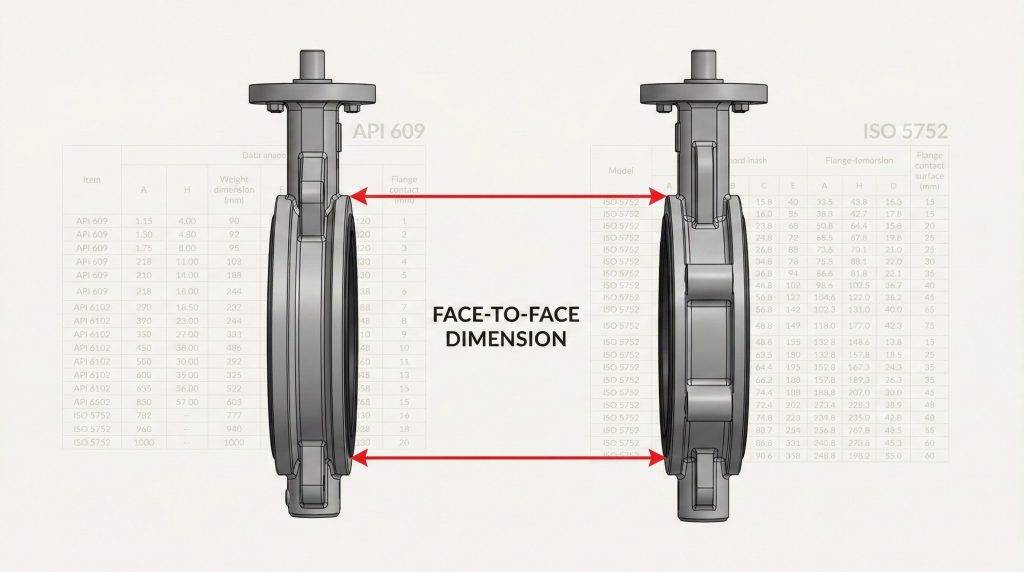
The standard dimension refers to the longitudinal distance between the two gasket-bearing surfaces of the valve body. This butterfly valve face to face metric is governed by international standards like API 609 and ISO 5752 to ensure interchangeability.
Here’s the deal:
Without these standards, engineers would be forced to modify piping every time a valve needed replacement. Standardized lengths allow for “drop-in” replacements from different manufacturers.
Is there a difference between wafer and lug face-to-face?
Wafer valves feature a slim profile designed to be sandwiched between two pipe flanges. Lug valves have a slightly more robust body with threaded inserts, but they often share the same face-to-face dimensions for a given size.
What are the common industry standards for these lengths?
Most manufacturers adhere to ASME B16.10 or API 609 for their dimensional specifications. These standards categorize valves by their pressure class and nominal pipe size.
- API 609 Category A (Concentric).
- API 609 Category B (High Performance).
- ISO 5752 Series 20.
- ASME B16.10 Table 4.
Key Takeaway: The butterfly valve face to face dimension is a standardized metric that dictates the longitudinal space a valve occupies in a pipeline.
| Standard | Typical Application |
|---|---|
| API 609 | General oil, gas, and chemical use |
| ISO 5752 | International water and utility systems |
| ASME B16.10 | North American industrial piping |
Adherence to these global standards ensures that parts remain interchangeable across various geographical regions and industries.
How Do Different Butterfly Valve Types Affect Sizing?
The architecture of the valve, whether it is a concentric, double-offset, or triple-offset design, dictates its overall width and weight. High-performance models often require a larger butterfly valve face to face footprint to accommodate specialized sealing mechanisms.
But there’s more.
The complexity of the internal geometry changes the physical envelope required for the valve to function. You must account for disc swing clearance in your installation planning.
How do wafer and lug valve dimensions compare?
Standard wafer and lug valves typically cover sizes from 2″ to 24″ in common inventories. While their thickness is similar, the lug version includes extra material for the mounting holes.
- Wafer: Lightweight, uses through-bolts.
- Lug: Heavier, allows for dead-end service.
- Both: Share similar face-to-face standards.
What are the dimensions of high-performance offset valves?
Double and triple offset valves have more robust bodies to house the offset shafts and camming action seats. These designs often have longer face-to-face measurements compared to simple rubber-lined valves.
How do plastic and stainless steel valve sizes differ?
Plastic valves are usually limited to smaller ranges, typically 1″ to 12″, due to material strength constraints. Stainless steel options can reach massive diameters and require thicker walls for high-pressure integrity.
Key Takeaway: Valve architecture—from simple concentric to complex triple offset—directly determines the required installation envelope.
| Valve Type | Size Range | Typical Face-to-Face |
|---|---|---|
| Concentric | 2″ to 48″+ | Slim / Narrow |
| Triple Offset | 3″ to 80″+ | Wide / Standardized |
| Plastic (PVC) | 1″ to 12″ | Variable / Proprietary |
The specific design of the valve must be matched to the spatial constraints of the existing piping layout.
What Are the Typical Dimensions for Class 150 Wafer Valves?
Class 150 wafer valves generally follow a slim-profile design with face-to-face lengths ranging from approximately 43mm for 2-inch sizes to 114mm for 12-inch sizes. Standardizing the butterfly valve face to face for Class 150 ensures these components are compatible with standard ANSI flanges.
Think about this:
Class 150 is the most common pressure rating for utility and industrial water systems. Having a clear understanding of these specific dimensions simplifies the procurement process for your facility.
What is the face-to-face range for 2″ to 12″ valves?
For a standard 2-inch Class 150 valve, the width is usually around 1.75 inches. As you move up to a 12-inch valve, that width increases to approximately 3.12 inches to 5 inches depending on the standard.
How does the pressure rating influence disc thickness?
Higher pressure ratings require a thicker disc to prevent deformation under load. This increased thickness must be accounted for to ensure the disc does not strike the pipe wall when opening.
- Increased material mass for 300+ PSI.
- Reinforced disc edges.
- Larger shaft diameters.
- Wider seat contact areas.
Key Takeaway: Class 150 specifications provide a reliable baseline for the most common industrial butterfly valve face to face requirements.
| NPS (Inches) | Face-to-Face (mm) | Approx Weight (kg) |
|---|---|---|
| 4″ | 52 | 6 |
| 8″ | 60 | 14 |
| 12″ | 78 | 35 |
Standardized Class 150 dimensions allow for predictable system design and easier inventory management for maintenance teams.
Which Specific Measurements Are Critical for Valve Identification?
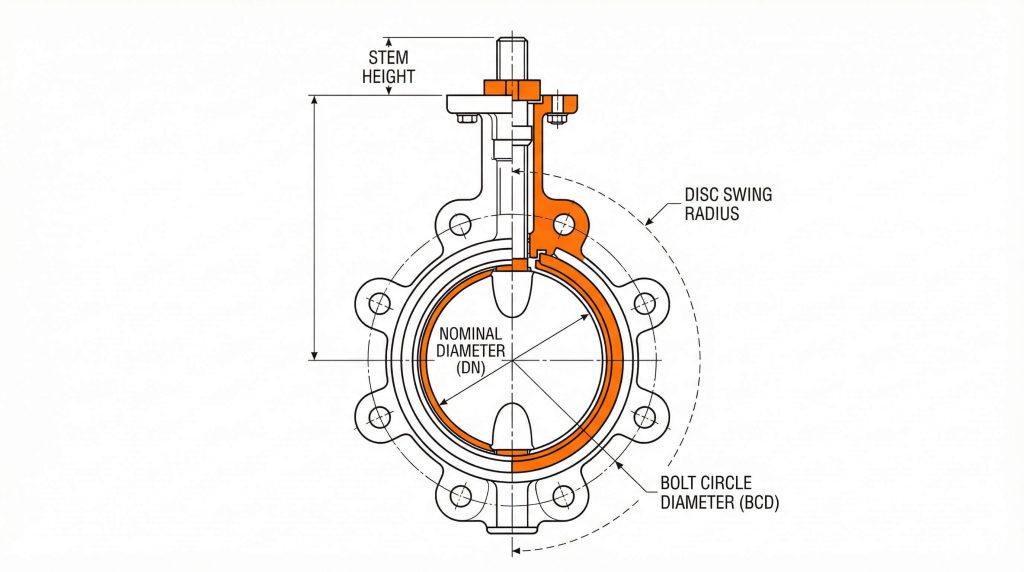
Critical measurements include the nominal pipe size (NPS), the outside diameter of the flange, and the specific butterfly valve face to face length. Identifying these parameters correctly prevents procurement errors and ensures the valve can handle the intended flow velocity.
Look closer:
It is not enough to simply know the pipe size. You must verify the internal bore and the clearance needed for the disc to rotate fully without obstruction.
What is the importance of Nominal Diameter (NPS)?
NPS corresponds to the internal bore of the pipe and dictates the overall flow capacity. If the valve’s internal diameter is significantly smaller than the pipe, it will act as a permanent restriction.
How do you calculate disc and seat dimensions?
The disc must be slightly smaller than the pipe bore to allow for a full 90-degree rotation. The seat dimension must provide enough surface area to create a bubble-tight seal against the disc edge.
- Disc protrusion depth.
- Seat compression margin.
- Internal bore diameter.
- Sealing surface width.
Why does stem length matter in deep installations?
Extended stems are necessary for pipes that are buried or heavily insulated. Without the proper stem length, the actuator or handle will be inaccessible for operation.
Key Takeaway: Beyond face-to-face, parameters like NPS, disc clearance, and stem length are vital for functional compatibility.
| Critical Metric | Verification Method | Importance |
|---|---|---|
| NPS | Visual/Tape | Flow alignment |
| Bore ID | Caliper | Obstruction check |
| Stem Height | Ruler | Actuation access |
Ensuring all secondary dimensions are verified prevents mechanical interference during the final stages of installation.
What Tools Ensure an Accurate Butterfly Valve Face to Face Measurement?
Precise measurement requires industrial-grade tools such as Vernier calipers, micrometers, and standard measuring tapes for larger dimensions. Using these tools allows you to verify that the butterfly valve face to face distance matches the manufacturer’s specification sheet exactly.
It gets better:
Using the right tools reduces the margin of error to sub-millimeter levels. This precision is what separates a leak-free installation from a costly repair job.
When should you use a Vernier caliper?
Calipers are ideal for measuring the internal bore diameter and the thickness of the valve stem. They provide the accuracy needed for tight tolerances in high-pressure applications.
Is a standard measuring tape sufficient?
For larger valves and measuring the distance between flange bolt holes, a high-quality tape measure is perfectly acceptable. It is the most practical tool for field verifications where extreme precision isn’t required.
- Measuring center-to-center hole distance.
- Checking overall body height.
- Verifying pipe outer diameter.
- Measuring large face-to-face gaps.
What is the role of a micrometer in valve inspection?
Micrometers are used during the quality control phase to measure the seat thickness and seal depth. They ensure that the elastomer components meet the exact design specifications for compression.
Key Takeaway: Utilizing precision tools like calipers and micrometers is essential to verify a butterfly valve face to face measurement against manufacturer specs.
| Tool | Accuracy Level | Best Use Case |
|---|---|---|
| Vernier Caliper | High (0.02mm) | Bore and stem checks |
| Micrometer | Very High (0.01mm) | Seal/Seat thickness |
| Measuring Tape | Moderate (1.0mm) | Overall length/BCD |
Using the correct instrument for each dimension ensures that every component meets the rigorous demands of industrial service.
What Is the Correct Procedure for Measuring Valve Dimensions?
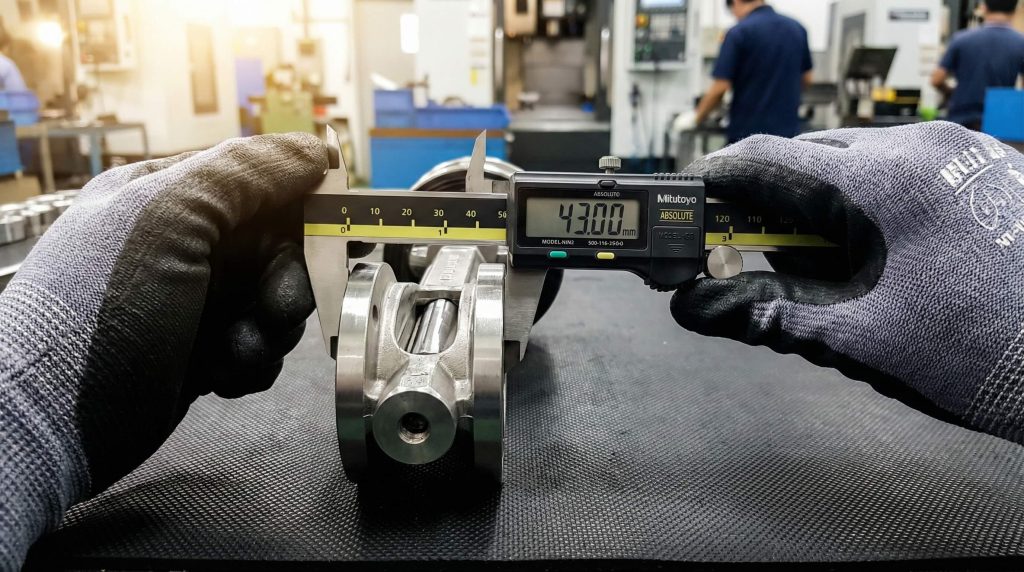
The correct procedure involves cleaning the valve surfaces, measuring the internal bore diameter, and then determining the butterfly valve face to face length between the mounting surfaces. Following a standardized sequence ensures that environmental debris does not compromise the accuracy of your readings.
Follow these steps:
Always perform measurements on a clean, flat surface. Any grit or old gasket material left on the valve faces will result in an incorrect reading.
How do you prepare the valve for measurement?
Remove all protective caps and clean the sealing faces with an appropriate solvent. Ensure the disc is in the fully closed position to prevent damage to the seating surfaces during the process.
What are the steps to measure the bore and stem?
Measure the bore at its widest point using your calipers. For the stem, measure from the top of the valve body to the very tip of the drive shaft to ensure actuator compatibility.
- Measure bore diameter.
- Measure stem diameter and height.
- Record face-to-face width.
- Check disc protrusion at 90 degrees.
How do you verify the bolt circle diameter (BCD)?
Measure the distance from the center of one bolt hole to the center of the hole directly opposite. This measurement must match your flange standard (e.g., ANSI or DIN) perfectly for the bolts to pass through.
Key Takeaway: A systematic measurement approach—cleaning, bore check, and BCD verification—prevents installation errors.
| Step | Action | Objective |
|---|---|---|
| 1 | Surface Cleaning | Remove debris/corrosion |
| 2 | Width Check | Confirm Face-to-Face |
| 3 | Hole Alignment | Verify BCD for Flanges |
Following this procedure guarantees that the data you collect is reliable for procurement and engineering calculations.
How Do Material Choices Influence Overall Valve Dimensions?
Material properties dictate the wall thickness and mass required for structural integrity, which directly impacts the exterior dimensions of the valve body. While the butterfly valve face to face length remains standard, a stainless steel valve will typically have thicker body walls than a PVC equivalent.
Surprisingly:
The choice of material affects more than just weight. Different alloys and polymers have different thermal expansion rates that must be considered for high-temperature service.
Why are stainless steel valves heavier and thicker?
Stainless steel and other high-pressure alloys are designed to withstand extreme stresses and corrosive environments. This requires a denser construction and thicker body walls to maintain a safe pressure boundary.
How do sealing materials like PTFE affect the seat dimension?
The thickness of the seat liner contributes to the internal diameter of the valve. Materials like PTFE are less compressible than EPDM, which may require a slightly different internal geometry for the disc.
- EPDM: Highly compressible, standard width.
- PTFE: Rigid, requires precise machining.
- Viton: High-temp resilience, varied thickness.
- Metal-to-Metal: Requires extreme precision.
Does temperature expansion change valve dimensions?
In high-heat applications, the metal body will expand. Engineers must account for these dimensional shifts when setting the initial gap in the piping to prevent the valve from being crushed.
Key Takeaway: Material selection is not just about chemistry; it dictates the physical thickness and butterfly valve face to face stability of the unit.
| Material | Relative Weight | Expansion Rate |
|---|---|---|
| Ductile Iron | Medium | Low |
| Stainless Steel | High | Moderate |
| CPVC / PVC | Low | High |
Understanding how materials behave under stress allows you to choose a valve that maintains its dimensions throughout its operating life.
How Do You Select the Right Butterfly Valve Face to Face for Your Application?
Selection requires matching the valve’s nominal size to your piping and ensuring the butterfly valve face to face dimension fits the existing gap in your pipeline. You must also account for flow coefficients (Cv) to prevent the valve from restricting system throughput unnecessarily.
Keep this in mind:
A valve that fits the pipe but has the wrong flow characteristics will cause system-wide inefficiency. Always balance physical dimensions with hydraulic requirements.
How do you match the valve to existing pipe size?
The nominal diameter of the valve must always match the nominal diameter of the pipe. Forcing a smaller valve into a larger pipe using reducers can cause turbulence and increased pumping costs.
What role do flow requirements (Cv) play in sizing?
The Cv value represents the volume of water that will flow through the valve with a 1 PSI pressure drop. Ensure the valve dimensions allow for a high enough Cv to meet your process needs without over-pressurizing the pump.
- Calculate required flow volume.
- Check Cv at 60 and 90 degrees open.
- Review pressure drop curves.
- Select bore size accordingly.
Why must you consult manufacturer catalogs?
Manufacturer catalogs provide the most accurate data for specific models. While international standards provide a framework, individual brand designs may have slight variations in handle clearance or actuator mounting.
Key Takeaway: Selecting the correct size requires a balance of pipe diameter, flow requirements, and strict adherence to technical catalogs.
| Selection Factor | Priority | Source of Data |
|---|---|---|
| NPS | High | Pipe Specs |
| Face-to-Face | Critical | Standards/Catalog |
| Flow Coefficient | High | Technical Data Sheet |
By cross-referencing field conditions with manufacturer data, you ensure a successful and efficient installation.
What Quality Standards Govern Butterfly Valve Dimensional Accuracy?
Dimensional accuracy is governed by international standards such as API 609, ASME B16.10, and ISO 5752. These regulations ensure that the butterfly valve face to face distance is uniform across different manufacturers, facilitating easy replacement and global interchangeability.
In other words:
Standards are the “language” that allow engineers from different companies to work together. They provide the assurance that a part ordered today will fit a system built twenty years ago.
Which ISO and API standards are most relevant?
API 609 is the primary standard for the oil and gas industry, while ISO 5752 is widely used in European water and utility sectors. Both define the allowable tolerances for every critical dimension.
How does compliance ensure global interchangeability?
When a manufacturer certifies a valve to API 609, it means the face-to-face and flange patterns are fixed. This allows you to swap a damaged valve with a new one from any certified brand without modifying the piping.
- ASME B16.10 (Face-to-Face).
- API 609 (Design and Dimensions).
- ISO 5752 (Series Standards).
- MSS SP-67 (Butterfly Valve Standards).
Key Takeaway: Global standards like API 609 ensure that the butterfly valve face to face distance remains consistent across different brands, simplifying maintenance.
| Standard | Scope | Region |
|---|---|---|
| API 609 | Industrial Design | Global |
| ASME B16.10 | Lengths/Widths | North America |
| ISO 5752 | Flanged Valves | International |
Strict adherence to these quality frameworks is the only way to guarantee the safety and reliability of modern industrial infrastructure.
Frequently Asked Questions
Does the butterfly valve diameter always match the pipe diameter?
Yes, for optimal performance, the nominal size of the valve should match the nominal diameter of the pipe to prevent flow restrictions and turbulence.
How do I measure the face-to-face length if the valve is already installed?
No, you cannot measure it accurately while installed; you must refer to the identification plate on the valve body or the original manufacturer’s submittal drawings.
What happens if I install a valve with the wrong face-to-face dimension?
Major leaks will occur because the flanges will not be able to compress the gasket properly, or the piping will be physically stressed trying to close the gap.
Are metric and imperial butterfly valve dimensions interchangeable?
No, while they may seem close, the bolt patterns and face-to-face lengths often vary slightly between DIN and ANSI standards, making them incompatible.
How does the pressure class change the valve’s physical size?
Heavier and thicker construction is required for higher pressure classes (like Class 300), which often results in a wider face-to-face and a larger flange diameter.
Conclusion
Mastering butterfly valve dimensions is a critical skill for any piping professional or facility manager. Precision in face-to-face measurements, material selection, and adherence to international standards like API 609 is the only way to ensure the safety and longevity of industrial systems. We believe that technical excellence in component selection is the cornerstone of sustainable industrial progress. For expert assistance in selecting the right high-performance components for your next project, please contact us today.