
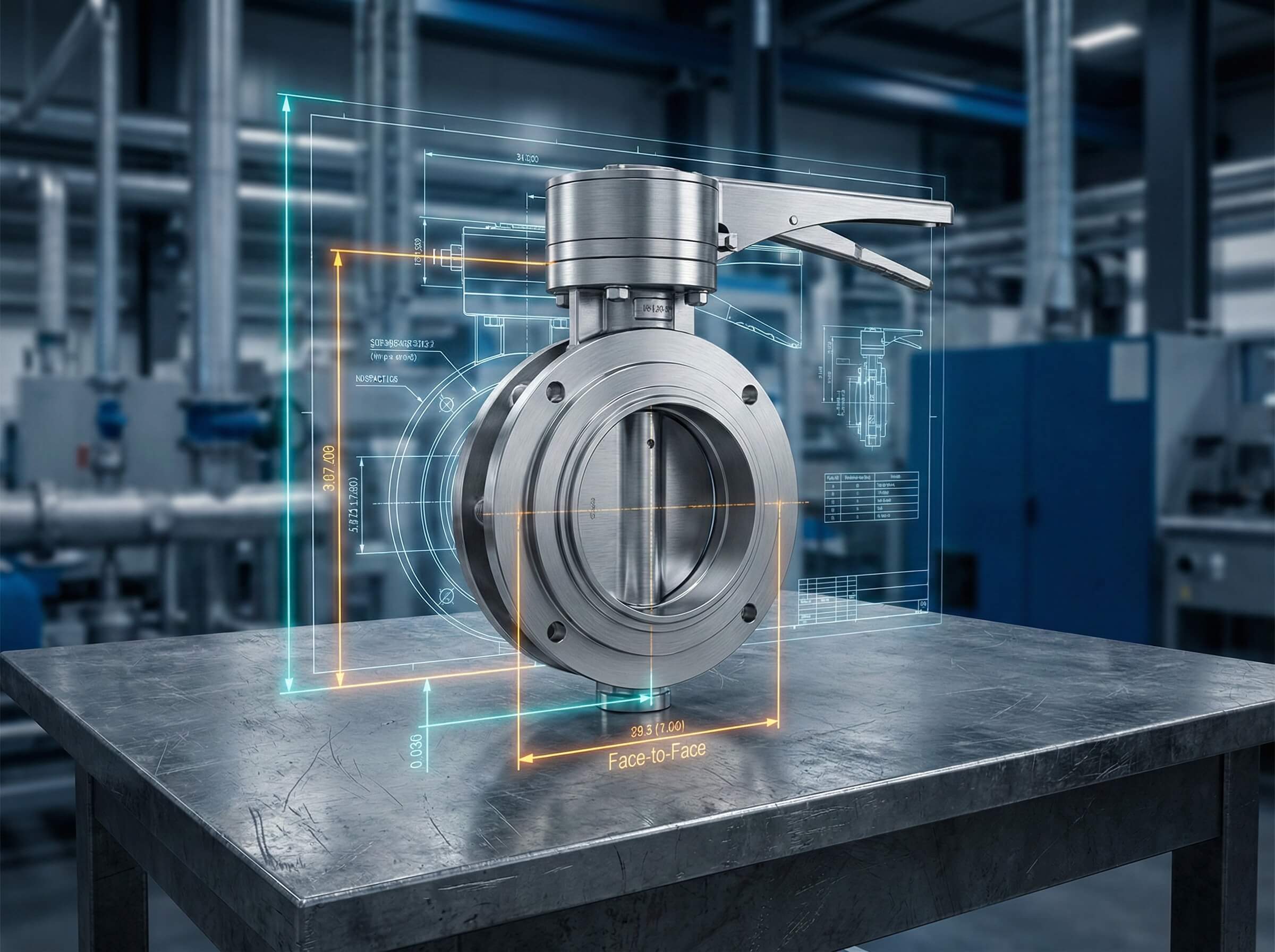
Butterfly valve dimensions define the physical envelope and flange compatibility required for seamless pipeline integration. When you select the wrong size, you face catastrophic leaks and unexpected mechanical failures during commissioning. Imagine the massive cost of a full system shutdown just because a single flange didn’t line up with the existing pipe. Fortunately, mastering butterfly valve standard dimensions ensures your project remains on schedule and within budget. Explore our butterfly valve options to find the perfect fit for your industrial application.
Why are butterfly valve standard dimensions critical?
Butterfly valve standard dimensions ensure that the valve fits precisely between pipe flanges without causing mechanical interference. These measurements dictate how the valve interacts with the fluid flow and the surrounding infrastructure.
Does sizing affect flow performance?
Look: incorrect dimensions lead to inefficient flow control and erratic pressure drops. If a valve is undersized, the resulting friction creates excessive wear on internal components.
- Flow Rate Control: Size directly influences the volume of fluid handled.
- Pressure Management: Larger diameters are required for high-pressure ratings.
- Seal Integrity: Precision sizing prevents leakage at the seat interface.
Think about it: a perfectly sized valve maintains the intended velocity of your media while minimizing energy consumption. Proper dimensions also prevent cavitation, which can destroy your valve internals over time.
How does size impact maintenance?
Here is the deal: properly sized valves last significantly longer because they experience less mechanical strain. You can browse our standard solutions to see how precision engineering reduces long-term operational costs.
- Vibration Reduction: Correct fits eliminate loose connections that cause noise.
- Part Availability: Standard sizes make finding replacement seals much easier.
- Ease of Access: Proper dimensions ensure there is enough room for technicians to work.
By adhering to industry standards, you reduce the risk of custom-part lead times during emergencies. This proactive approach keeps your facility running at peak efficiency.
Key Takeaway: Correct dimensions optimize flow rates and extend the valve’s operational lifespan by reducing mechanical friction.
| Dimension Factor | Impact on System | Recommended Action |
|---|---|---|
| Under-sized | High pressure drop | Check Cv requirements |
| Over-sized | Poor throttling | Match nominal pipe size |
| Misaligned | Joint leakage | Verify flange standards |
Analysis: Matching the valve envelope to the piping system is the first step in preventing premature hardware failure.
What are butterfly valve standard dimensions for types?
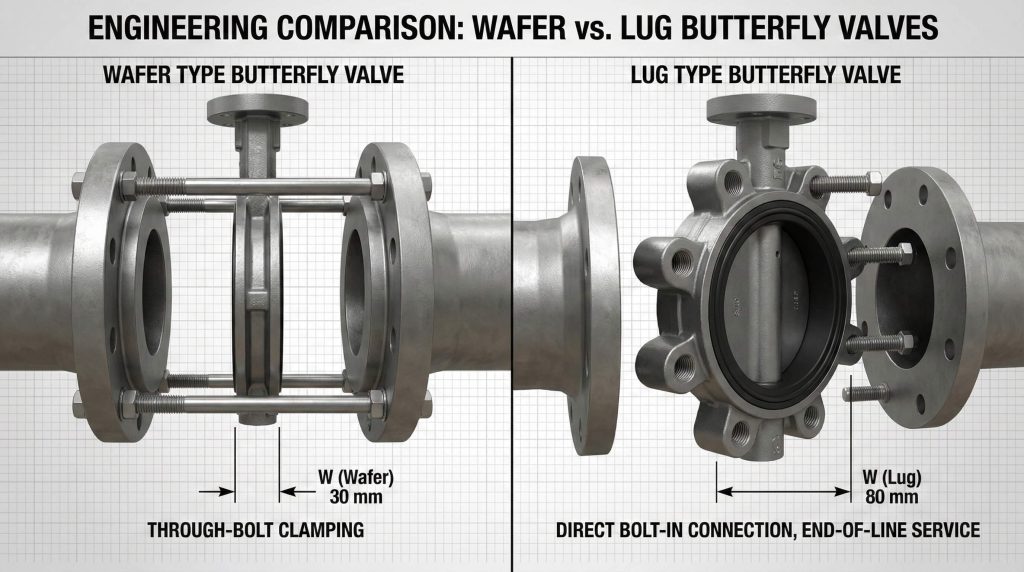
The body style of a valve dictates its physical footprint between pipe flanges. When you compare different body styles, you will notice that butterfly valve standard dimensions fluctuate based on the connection type.
Are wafer and lug sizes different?
Believe it or not: the external shape of a wafer valve is significantly more compact than its lug counterpart. Wafer types are designed to be sandwiched between flanges, whereas lug types feature threaded holes.
- Wafer Type: Installed between two flanges using long through-bolts.
- Lug Type: Features protruding “lugs” that allow for independent bolting.
- Space Savings: Wafer bodies are generally thinner and lighter.
The best part? Lug valves allow you to disconnect downstream piping while keeping the valve in place under pressure. This flexibility is essential for systems that require frequent maintenance.
Do offset designs change measurements?
Specifically: high-performance offset valves often have deeper bodies to accommodate complex sealing geometries. This extra space is necessary to ensure the disc clears the seat without interference.
- Double Offset: Moves the stem away from the center of the disc.
- Triple Offset: Incorporates a cam-like action for bubble-tight sealing.
- Width Impact: These designs often require a wider face-to-face dimension.
In other words, you must account for the increased physical depth when upgrading from a resilient-seated valve to a high-performance offset model. This ensures the new valve doesn’t interfere with existing pipe supports.
Key Takeaway: Body style selection determines the “Face-to-Face” dimension and the specific bolting hardware required for installation.
| Valve Type | Standard Diameter | Typical Thickness |
|---|---|---|
| Wafer | 2″ to 24″ | 1.75″ to 4.5″ |
| Lug | 2″ to 24″ | 1.75″ to 5.0″ |
| Flanged | 4″ to 72″ | 5.0″ to 15.0″ |
Analysis: Industrial operators must distinguish between wafer and lug footprints to ensure the piping gap is correctly calculated.
Where is the butterfly valve standard dimensions chart?
Standardization charts help engineers quickly identify the physical properties of valves for procurement and system design. These butterfly valve standard dimensions act as a universal language for manufacturers and contractors.
Is there a Class 150 chart?
Think about it: Class 150 charts are the most common reference for commercial and light industrial applications. These charts provide the exact height, width, and weight of each valve size.
- Small Bore (2″-6″): Standardized for HVAC and light industrial use.
- Medium Bore (8″-12″): Used in water treatment and chemical lines.
- Large Bore (14″+): Common in power generation and municipal water.
The best part? Using a standardized chart allows you to swap valves from different manufacturers without modifying your existing pipes. It provides the confidence that the replacement will fit perfectly.
How do bore sizes vary?
Here is the deal: the internal bore diameter must match your pipe schedule to avoid turbulence. If the bore is too small, you create a bottleneck that reduces system performance.
- Internal Clearance: The disc must rotate freely within the bore.
- Standard Schedules: Most charts align with Schedule 40 or 80 pipe.
- Flow Efficiency: A matched bore ensures a smooth transition for the media.
Look: even a small discrepancy in bore size can lead to premature erosion of the valve seat. Always verify the internal diameter before finalizing your purchase order.
Key Takeaway: Dimension charts provide a reliable reference for verifying that a valve will physically fit into a pre-designed piping manifold.
| Nominal Size (NPS) | Face-to-Face (in) | Outside Diameter (in) |
|---|---|---|
| 4″ | 2.06 | 6.88 |
| 8″ | 2.38 | 11.00 |
| 12″ | 3.06 | 16.00 |
Analysis: Utilizing a standardized chart eliminates guesswork and ensures compatibility across different component manufacturers.
What defines the butterfly valve standard dimensions?
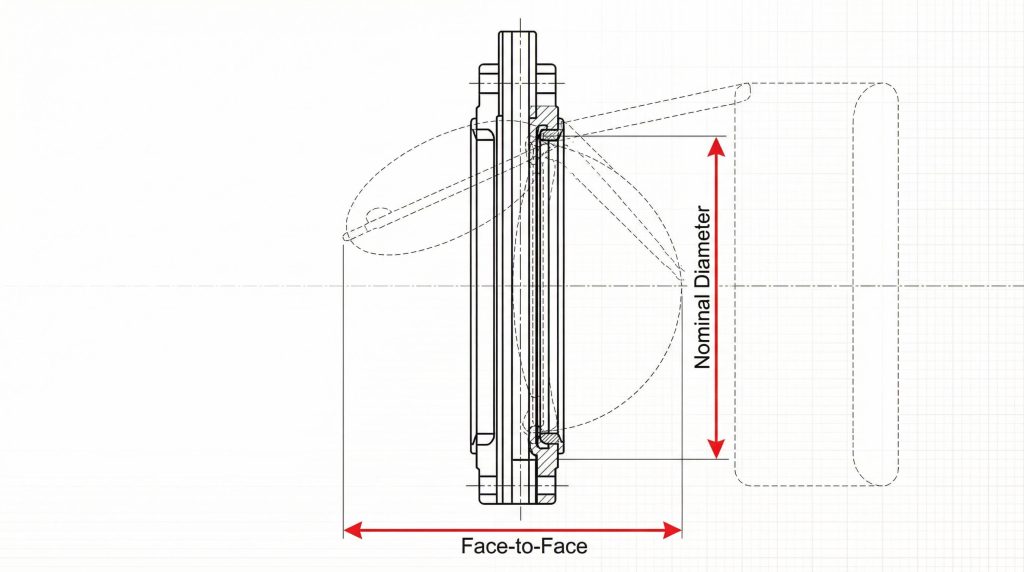
The core metrics of butterfly valve standard dimensions include the face-to-face length and the nominal bore. These two values determine if the valve will physically fit the gap in your pipeline.
What is the face-to-face metric?
In other words: the face-to-face dimension is the total distance between the two sealing surfaces of the valve body. This is arguably the most critical measurement for replacement projects.
- Standardization: Usually follows ASME or ISO 5752 standards.
- Installation Gap: This must match the distance between pipe flanges exactly.
- Gasket Allowance: Remember to account for gasket thickness in your calculations.
Believe it or not: being off by just a few millimeters can make it impossible to tighten the flange bolts. Always double-check this measurement against the manufacturer’s spec sheet.
How is nominal diameter defined?
Specifically: nominal diameter refers to the internal bore size, which should generally correspond to the pipe’s internal diameter. This ensures that the disc can rotate freely without hitting the pipe wall.
- Pipe Correlation: A 6-inch valve is designed for a 6-inch pipe.
- Disc Path: The diameter must accommodate the swing radius of the disc.
- Tolerance: Manufacturers provide a small margin to ensure no metal-on-metal contact.
Look: the nominal size is a label, but the actual measurement might vary slightly based on the pressure class. You should always consult the technical drawing for precise internal measurements.
Key Takeaway: Face-to-face and nominal diameter are the primary metrics used to define a valve’s physical compatibility with a pipeline.
| Metric | Measurement Point | Purpose |
|---|---|---|
| Face-to-Face | Inlet to Outlet | Pipeline spacing |
| Stem Length | Body to Tip | Actuator mounting |
| Bolt Circle | Center of Holes | Flange alignment |
Analysis: Focusing on these three primary metrics prevents 90% of common installation errors in industrial fluid systems.
How to measure butterfly valve standard dimensions?
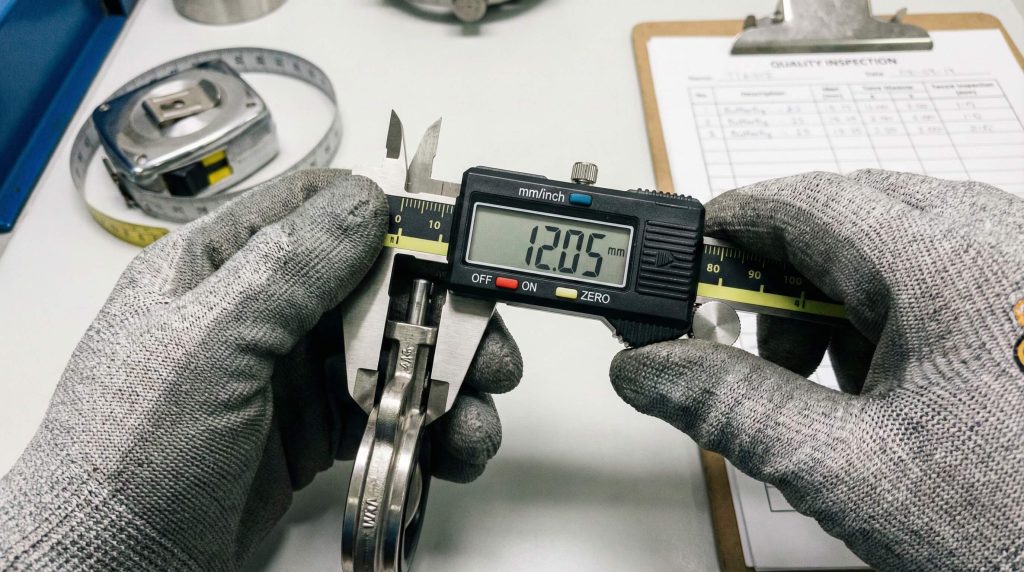
Precision is key when measuring hardware that must hold back thousands of pounds of pressure. Accurate butterfly valve standard dimensions can only be obtained through a systematic measurement process.
Which tools provide accuracy?
The best part? You don’t need highly expensive equipment to get a reliable reading. Simple tools can provide highly accurate data if used correctly.
- Vernier Calipers: Best for measuring stem diameter and small bore sizes.
- Measuring Tape: Suitable for large face-to-face and flange OD checks.
- Micrometers: Used for checking disc thickness and seat tolerances.
Here is the deal: using the wrong tool can lead to rounding errors that jeopardize the seal. Always ensure your tools are calibrated before starting the measurement.
How to check the stem?
Specifically: the stem dimensions dictate what kind of actuator or handle you can mount on the valve. Measuring the “flat” or “square” of the stem is essential for automation.
- Stem Height: Measured from the top of the body to the shaft tip.
- Shaft Diameter: Checked with calipers for precision.
- Keyway Size: Ensures the actuator coupling fits snugly.
Look: an incorrectly measured stem will lead to a loose actuator, causing poor control and potential safety hazards. Take your time to measure both the length and the width of the stem top.
Key Takeaway: Selecting the appropriate measuring tool is the only way to ensure the recorded data meets industrial tolerance standards.
| Tool | Precision Level | Best Use Case |
|---|---|---|
| Caliper | High (0.01mm) | Stem & Disc Bore |
| Tape Measure | Moderate (1.0mm) | Face-to-Face Length |
| Micrometer | Ultra-High (0.001mm) | Seat Tolerance |
Analysis: Professional measurement protocols require high-precision tools to verify that hardware meets its original design specifications.
Which codes govern butterfly valve standard dimensions?
International regulatory bodies define butterfly valve standard dimensions to ensure parts from different vendors are compatible. Compliance with these codes is mandatory for safety and insurance purposes.
Are ASME and API required?
In other words: ASME and API are the gold standard for North American industrial projects. These standards ensure that a valve purchased today will fit a system built thirty years ago.
- ASME B16.34: Covers pressure and temperature ratings for valve bodies.
- API 609: The primary standard for butterfly valve design and dimensions.
- Face-to-Face Rules: API 609 Category A and B define specific lengths.
Think about it: without these standards, every project would require custom-engineered valves, driving up costs significantly. They provide a baseline for quality and interchangeability.
Do ISO standards matter?
The best part? ISO standards provide a global framework that allows international trade in the valve industry. ISO 5752 is particularly important for defining the envelope dimensions of the valve.
- ISO 5752: Covers face-to-face and end-to-end dimensions globally.
- PN Ratings: Used in Europe and Asia to define pressure classes.
- Metric Uniformity: Ensures consistency across different measurement systems.
Here is the deal: if you are working on a project with international components, you must verify if the dimensions follow Imperial or Metric standards. Mixing the two without adapters is a recipe for disaster.
Key Takeaway: Compliance with global standards like ASME and API is mandatory for ensuring hardware interchangeability in international projects.
| Standard Code | Region | Focus Area |
|---|---|---|
| API 609 | Global | Design & Dimensions |
| DIN 3202 | Europe | Face-to-Face Length |
| JIS B2032 | Japan | Industrial Standards |
Analysis: Adhering to recognized global codes is the only way to guarantee that replacement parts will integrate into an existing system.
Do materials impact butterfly valve standard dimensions?
While the nominal size remains constant, the material choice can influence the thickness and weight of the valve. Different butterfly valve standard dimensions may apply when switching from metal to plastic.
Does metal choice affect walls?
Look: materials like stainless steel or exotic alloys often allow for thinner walls while maintaining high pressure ratings. This can lead to a more compact external profile compared to cast iron.
- Cast Iron: Generally requires thicker walls for safety.
- Stainless Steel: Offers high strength with a more compact profile.
- Ductile Iron: Provides a balance between weight and durability.
In other words, a stainless steel valve might be lighter and easier to install than a cast iron version of the same size. Always check the external clearance if your piping is in a tight space.
Are plastic dimensions different?
Believe it or not: plastic valves, such as PVC or CPVC, often have thicker flanges to compensate for the lower material strength. This means you may need longer bolts for installation.
- Flange Thickness: Often 1.5x thicker than metal counterparts.
- Weight Savings: Plastic valves are much lighter, reducing pipe support needs.
- Thermal Expansion: Plastic dimensions change more significantly with temperature.
The best part? Plastic valves are immune to corrosion, but you must account for their unique physical dimensions during the design phase. Never assume a plastic valve will use the same bolt kit as a metal one.
Key Takeaway: Material selection dictates the physical weight and wall thickness, which can slightly alter the external dimensions of the valve.
| Material | Wall Density | Weight Impact |
|---|---|---|
| Ductile Iron | High | Heavy |
| Stainless Steel | Medium | Moderate |
| CPVC / Plastic | Low | Lightweight |
Analysis: Engineers must account for the physical weight and thickness variations that occur when switching between metal and plastic valves.
How to select using butterfly valve standard dimensions?
Your procurement process relies on butterfly valve standard dimensions to match existing pipe schedules. Choosing the right valve is a matter of verifying technical data against your physical requirements.
How to match your pipe?
Think about it: the easiest way to select a valve is to identify the Nominal Pipe Size (NPS) of your system. You can then match this to the corresponding row in a dimension chart.
- Internal Diameter: Ensure the valve bore doesn’t restrict flow.
- External Clearance: Check if the valve body hits nearby obstacles.
- Flange Standard: Match ANSI, DIN, or JIS patterns.
Specifically: you should also verify the “lay length” of the existing valve if you are performing a replacement. This ensures the new unit fits into the same gap without piping modifications.
What about pressure ratings?
Look: the pressure rating, such as Class 150 or 300, determines the thickness of the valve flanges. A higher pressure rating usually means a thicker, heavier valve.
- Safety Margin: Always choose a rating that exceeds your peak pressure.
- Bolt Hole Pattern: Higher classes have more or larger bolt holes.
- Material Strength: High-pressure valves use forged or heavy-cast bodies.
Here is the deal: attempting to bolt a Class 150 valve to a Class 300 flange is impossible because the bolt circles won’t align. Always verify the pressure class before ordering.
Key Takeaway: Selecting a valve based on pipe size and pressure rating ensures a leak-free connection and optimal fluid dynamics.
| Selection Step | Data Required | Result |
|---|---|---|
| Pipe Match | NPS / DN | Correct Bore |
| Standard Check | ASME / DIN | Flange Fit |
| Rating Check | Class 150/300 | Safety Compliance |
Analysis: Selection is a process of elimination where pipe size, pressure, and standard compliance lead to the final product choice.
How to verify butterfly valve standard dimensions?
Manufacturing isn’t perfect, so verifying that a new valve falls within allowed tolerances is critical. Even minor deviations in butterfly valve standard dimensions can cause installation headaches.
What are tolerance checks?
In other words: a tolerance check confirms that the valve was manufactured to the specific measurements promised by the factory. Small errors in the casting process can lead to big problems.
- Flange Parallelism: Check that both faces are perfectly parallel.
- Bolt Hole Alignment: Ensure the holes match the pattern of the pipe flange.
- Disc Clearance: Verify the disc does not protrude beyond the body when closed.
Believe it or not: a flange that is out of parallel by just 0.5mm can cause a persistent leak that no amount of tightening will fix. Always perform a visual and physical inspection upon delivery.
How to align bolt holes?
Specifically: the bolt holes must be perfectly centered to allow the fasteners to pass through both the pipe flange and the valve lugs. Any misalignment will put shear stress on the bolts.
- Centerline Check: Use a template to verify hole spacing.
- Rotation Check: Ensure the holes aren’t rotated out of position.
- Hole Diameter: Check that the bolts have enough clearance to pass through.
The best part? Identifying a misalignment before the valve is lifted into position saves hours of wasted labor. It is much easier to exchange a valve on the ground than one high up in a pipe rack.
Key Takeaway: Final verification of tolerances is the last line of defense against installation failures and operational leaks.
| Verification Test | Method | Pass Criteria |
|---|---|---|
| Parallelism | Feeler Gauge | < 0.5mm deviation |
| Hole Pattern | Template Match | 100% alignment |
| Seat Compression | Visual / Hydro | Zero visible gap |
Analysis: Rigorous post-manufacturing checks ensure that every valve delivered to the site is ready for immediate, problem-free installation.
Why track changes in butterfly valve standard dimensions?
Engineers must monitor butterfly valve standard dimensions as new high-pressure alloys and smart technologies enter the market. Staying updated prevents your system designs from becoming obsolete.
Will smart valves change sizes?
Look: as actuators become more compact and integrated, the overall “installed height” of the valve assembly is decreasing. This allows for tighter piping configurations in modern facilities.
- Integrated Sensors: Measuring points are now built into the body.
- Compact Actuators: Smaller footprints allow for easier mounting.
- Weight Reduction: Advanced designs use less material for the same strength.
Here is the deal: while the face-to-face dimension remains standard, the “overhead clearance” needed for the valve is constantly evolving. Modern designs allow for more equipment in less space.
Do digital twins help?
Specifically: using 3D models and digital twins allows you to simulate the installation before a single piece of metal is cast. This ensures that butterfly valve standard dimensions are perfectly accounted for in the virtual world.
- Clash Detection: Identify if the disc will hit a nearby pipe elbow.
- Weight Loading: Calculate the stress on pipe supports accurately.
- Maintenance Access: Ensure there is enough room for a wrench to turn.
The best part? Digital verification virtually eliminates the risk of receiving a valve that doesn’t fit the space. It is the ultimate tool for complex, multi-million dollar infrastructure projects.
Key Takeaway: Emerging technologies are refining how we use and verify dimensions, leading to more compact and efficient system layouts.
| Future Trend | Impact | Benefit |
|---|---|---|
| Digital Twins | Virtual Fitting | Zero Installation Errors |
| Smart Actuators | Lower Height | Space Optimization |
| Advanced Alloys | Thinner Walls | Reduced Weight |
Analysis: The evolution of valve dimensions is trending toward higher precision and smaller footprints without sacrificing flow capacity.
Conclusion
Understanding the complexities of butterfly valve standard dimensions is essential for any successful piping project. From measuring face-to-face lengths to verifying global standard compliance, every detail contributes to the safety and efficiency of your fluid control system. At Ruitoflow, we are committed to providing precision-engineered valves that meet the most rigorous international standards. Our vision is to empower industrial operators with the data and hardware they need to build reliable, leak-free infrastructure for the future. Don’t leave your system’s reliability to chance. Contact us today to discuss your specific requirements and let our experts provide a custom-tailored solution for your next project.
Frequently Asked Questions
Does the valve diameter always match the pipe diameter?
Not always, though they are usually labeled with the same nominal size. While the nominal size should match the pipe, the actual internal bore of the valve might be slightly different to ensure the disc can rotate without hitting the pipe walls.
How is a butterfly valve bore measured?
The bore is measured using a caliper or micrometer while the valve is in the fully open position. You should measure across the widest part of the internal opening to determine the true flow capacity of the unit.
What’s the best way to find a face-to-face dimension?
The most reliable method is to consult the manufacturer’s technical data sheet or the API 609 standard chart. These documents provide the standardized length required for your specific pressure class and body style.
Can I use a wafer valve in a lug valve application?
Generally no, because the installation methods and bolting requirements are entirely different. A lug valve is required for end-of-line service, whereas a wafer valve must be clamped between two flanges to maintain its position.
Do temperature changes affect the physical valve size?
Yes, extreme temperatures cause thermal expansion or contraction of the valve body. High-quality valves are designed with specific tolerances to account for these changes, ensuring the seal remains effective throughout the operating range.