

To operate and actuate a butterfly valve, you must rotate the internal disc exactly 90 degrees using a dedicated mechanical or automated interface. Managing high-pressure fluid systems with imprecise manual adjustments often leads to significant energy loss and unexpected piping failures. These fluctuations in flow velocity can degrade valve seats and result in expensive operational downtime for your facility. By implementing a high-precision butterfly valve operator, you ensure the long-term reliability and safety of your industrial infrastructure.
What is a butterfly valve operator?
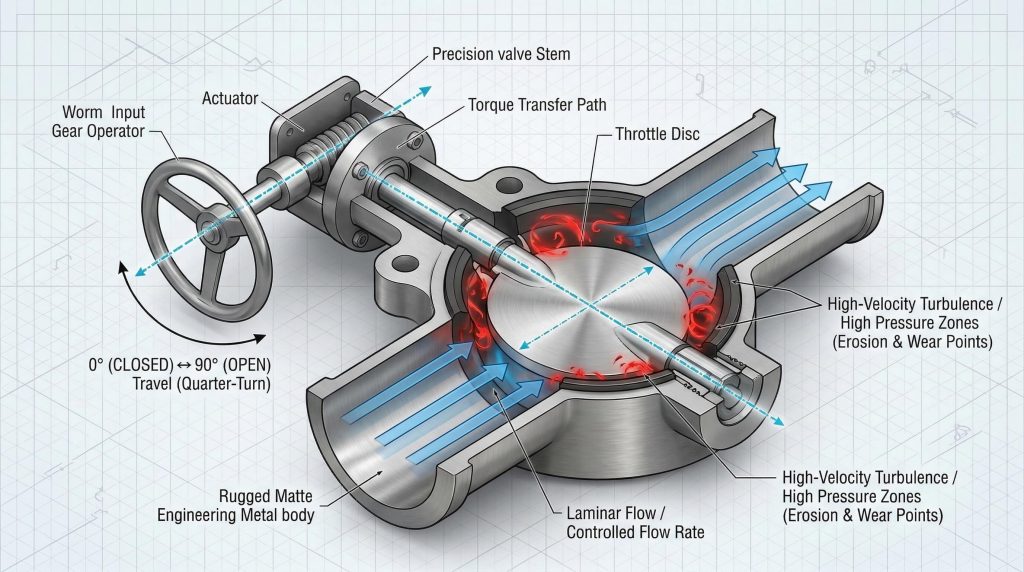
A butterfly valve operator is the external component—ranging from manual levers to complex actuators—that generates the torque required to position the valve’s internal disc.
What components make up the operator?
The typical assembly includes the handle or actuator housing, the drive stem, and the mounting flange that secures it to the valve body.
Look:
- Hand levers provide instant manual control for smaller lines.
- Gear boxes provide mechanical advantage for high-torque needs.
- Automated actuators allow for remote PLC integration.
- Stem extensions facilitate buried or hard-to-reach service.
The best part?
These components are designed for 90-degree travel, ensuring a simple and repeatable interface for your team.
Key Takeaway: The operator acts as the interface between the user’s command and the physical movement of the fluid control disc.
| Component | Primary Function | Common Material |
|---|---|---|
| Handle/Lever | Manual torque application | Ductile Iron / Steel |
| Actuator | Automated force generation | Aluminum / Stainless |
| Stem | Torque transmission to disc | SS304 / SS316L |
Analyzing these components reveals that material selection directly impacts the operator’s durability in corrosive environments.
How do you use a butterfly valve operator?
You use a butterfly valve operator by rotating the handle or activating the power source to move the disc from a fully closed position to a 90-degree fully open state.
Can you operate it in 90-degree turns?
Yes, because butterfly valves are quarter-turn devices, you only need a 90-degree motion to transition from zero flow to maximum capacity.
Here is the deal:
- Parallel handle alignment indicates the valve is 100% open.
- Perpendicular handle alignment indicates the valve is fully closed.
- Locking notches allow you to hold specific throttling angles.
Why does this matter?
The speed of a quarter-turn operation is significantly faster than using a gate valve which requires multiple full turns.
Key Takeaway: Efficient 90-degree actuation reduces labor intensity and accelerates emergency shut-off response times.
| Handle Position | Flow Status | Disc Alignment |
|---|---|---|
| Parallel | Fully Open | 0° (Aligned with Flow) |
| 45 Degrees | Throttled | 45° (Intermediate) |
| Perpendicular | Fully Closed | 90° (Sealed) |
This simple visual feedback loop allows operators to verify flow status instantly from a distance.
Which butterfly valve operator handles manual tasks?
The most common butterfly valve operator for manual tasks is either a hand lever for small diameters or a worm gear operator for larger sizes.
Are hand levers best for small pipes?
Hand levers are the ideal choice for valves under DN150 (6 inches) because they offer rapid response and cost-effective simplicity.
But wait, there is more:
- They include a spring-loaded trigger to lock the position.
- You get immediate tactile feedback of the disc position.
- They require no electricity or compressed air to function.
Why?
Manual levers are perfect for low-frequency operations where speed and budget are your primary concerns.
When is a gear operator necessary?
A gear operator becomes necessary when the line pressure or valve size creates more torque than a human can safely apply with a simple lever.
Check this out:
- Large diameter valves (typically DN200 and above).
- High-pressure applications exceeding PN25 ratings.
- Systems requiring very gradual flow modulation.
The best part?
Worm gear operators are self-locking, meaning the disc will not move even if pressure surges hit the valve.
Key Takeaway: Selecting between a lever and a gear operator depends entirely on the torque requirements of your specific application.
| Manual Type | Typical Size Range | Key Advantage |
|---|---|---|
| Hand Lever | DN50 – DN150 | Operational Speed |
| Gear Box | DN200 – DN1200 | High Torque Control |
| Handwheel | Custom | Precision Tuning |
Choosing the correct manual interface prevents operator fatigue and ensures the valve remains seated under pressure.
When should you automate a butterfly valve operator?
You should automate a butterfly valve operator when your process requires frequent cycling, remote monitoring, or integration into a centralized SCADA system.
Is electric actuation better for high cycles?
Electric actuators are often the superior choice for high-cycle applications where you need precise positioning feedback and consistent speed.
Look:
- Integrated limit switches report status to your control room.
- Modulating motors allow you to control flow with 1% accuracy.
- They eliminate the need for expensive air piping networks.
But that’s not all:
Automation allows you to manage thousands of valves simultaneously, similar to managing a high-performance ball valve array.
Key Takeaway: Actuator automation removes human error and allows for data-driven process optimization across your plant.
| Feature | Manual Operation | Automated Actuation |
|---|---|---|
| Cycle Speed | Variable/Manual | Constant/Programmed |
| Remote Access | Not Available | Fully Integrated |
| Initial Cost | Low | Moderate to High |
Integrating automation significantly reduces long-term labor costs by centralizing system management.
How does a butterfly valve operator prevent leaks?
A high-quality butterfly valve operator prevents leaks by ensuring the disc is perfectly centered and firmly compressed against the resilient seat in the closed position.
Does the seat interaction matter?
The seat interaction is the most critical factor in achieving a bubble-tight seal, making the operator’s travel stops vital for success.
Here is the deal:
- Over-torquing the operator can permanently deform the seat.
- Under-torquing results in “weeping” or low-level bypass leaks.
- Properly set travel stops ensure the disc stops at exactly 90 degrees.
Why?
Without a calibrated operator, even a reliable check valve cannot prevent backflow if your main isolation valve is seeping.
Key Takeaway: Correct operator calibration is the final step in guaranteeing a zero-leakage, bubble-tight shutoff.
| Seat Material | Sealing Property | Typical Leakage Class |
|---|---|---|
| EPDM/NBR | Resilient / Flexible | API 598 Class VI |
| PTFE | Chemical Resistant | Zero Leakage |
| Metal-to-Metal | High Temperature | Class IV or V |
A precisely adjusted operator extends the life of the seat by preventing unnecessary abrasive wear during closure.
Is a pneumatic butterfly valve operator efficient?
A pneumatic butterfly valve operator is highly efficient for plant environments where compressed air is available and rapid fail-safe action is a safety requirement.
How fast does air pressure actuate the valve?
Pneumatic operators can transition a disc from open to closed in less than one second, providing critical protection for your piping.
Consider this:
- Rack and pinion designs provide high torque in a compact size.
- Spring-return models offer “fail-closed” safety during power loss.
- They are inherently spark-free for hazardous environments.
The best part?
Maintenance is simplified because pneumatic systems rely on standard seals and clean air rather than complex electronics.
Key Takeaway: Pneumatic actuation is the industry standard for high-speed, safety-critical industrial applications.
| Air Supply | Torque Range | Safety Feature |
|---|---|---|
| 4-8 Bar | 50 Nm – 15,000 Nm | Spring Return |
| Double Acting | Constant Torque | Stay-Put Logic |
The speed of pneumatic systems makes them indispensable for emergency shutdown (ESD) scenarios.
Where is a butterfly valve operator most effective?
The butterfly valve operator is most effective in large-scale municipal and industrial systems where space is limited and weight must be kept to a minimum.
Is it suitable for water treatment?
Yes, water treatment facilities rely on these operators for large pipelines because they provide the best weight-to-torque ratio on the market.
Look:
- Corrosion-resistant coatings protect the operator in damp galleries.
- WRAS-approved materials ensure the safety of potable water.
- Compact footprints fit into tight subterranean valve vaults.
Why does this matter?
Compared to a traditional globe valve, the butterfly design offers a much higher flow coefficient (Cv) for the same installation size.
Can it handle abrasive mining slurries?
Heavy-duty operators paired with hardened discs can manage mining slurries, provided the operator can overcome the friction of thickened media.
Here is the deal:
- High-torque gearboxes are required to break “sticking” discs.
- Reinforced mounting pads prevent vibration-related fatigue.
- Replaceable liners allow you to service the valve without replacing the operator.
Key Takeaway: The versatility of the operator determines whether the valve can handle clean water or abrasive industrial waste.
| Industry | Valve Size | Recommended Operator |
|---|---|---|
| Municipal Water | DN400 – DN2000 | Electric / Large Gear |
| HVAC Systems | DN50 – DN250 | Lever / Pneumatic |
| Mining Slurry | DN100 – DN600 | High-Torque Pneumatic |
Matching the operator to the specific industry environment ensures a much lower total cost of ownership.
Can a butterfly valve operator control gas flow?
A butterfly valve operator can control gas flow by acting as a high-precision damper, allowing you to modulate volumetric flow in exhaust or air-handling systems.
Does it work like a damper for air?
In HVAC and industrial furnace applications, you can use the operator to hold intermediate positions that maintain specific pressure levels.
The best part?
- You get infinite positioning between 0° and 90°.
- Minimal pressure drop occurs when the disc is fully open.
- Specialized actuators prevent “chatter” in high-velocity streams.
Why?
Precision operators ensure that turbulent gas flow doesn’t cause the disc to vibrate or drift from its set point.
Key Takeaway: The ability to hold stable intermediate positions makes the operator an excellent choice for air and gas modulation.
| Gas Type | Temperature | Sealing Requirement |
|---|---|---|
| Ambient Air | -10 to 80°C | Resilient Seal |
| Hot Flue Gas | up to 250°C | Metal-to-Metal |
| Compressed Gas | Variable | High Pressure Seal |
Precision modulation prevents energy waste by ensuring only the necessary amount of gas passes through the system.
How do you maintain a butterfly valve operator?
To maintain a butterfly valve operator, you must regularly lubricate the moving gears and inspect the stem connection for any signs of corrosion or mechanical play.
Should you inspect the stem and handle?
Inspection of the stem and handle is vital to ensure that your input torque is actually reaching the disc without loss.
Check for:
- Loose mounting bolts between the operator and the valve.
- Corrosion on the handle or the gear housing exterior.
- Hardened or leaking grease within the gearbox assembly.
Look:
Performing simple preventative maintenance every six months can extend your valve’s operational life by over 40%.
Key Takeaway: A regular maintenance schedule prevents mechanical seizing and ensures your safety systems are always ready to act.
| Task | Frequency | Objective |
|---|---|---|
| Grease Gears | Bi-Annually | Reduce Internal Friction |
| Bolt Tightening | Annually | Prevent Actuator Shift |
| Cycle Testing | Monthly | Prevent Disc Seizing |
Proactive maintenance is significantly cheaper than reacting to a seized valve during a critical process failure.
Why choose a specific butterfly valve operator?
Choosing a specific butterfly valve operator should be based on its compliance with international standards and its ability to withstand your facility’s unique environmental stresses.
Are ISO-certified operators more reliable?
ISO-certified operators undergo rigorous cycle testing and torque validation, ensuring they will perform consistently throughout their 25-year design life.
Why does this matter?
Verified reliability in the field results in:
- Reduced risk of environmental leaks or safety violations.
- Full compliance with international audits and insurance requirements.
- Predictable performance during extreme temperature fluctuations.
The best part?
Choosing a manufacturer that performs 100% hydrostatic testing at 1.5x working pressure guarantees your system is ready for the most demanding duties.
Key Takeaway: Global certification is your blueprint for quality, ensuring every operator meets a recognized baseline of excellence.
| Certification | Focus Area | Industry Application |
|---|---|---|
| ISO 9001 | Quality Management | General Industrial |
| CE / PED | Pressure Safety | High-Pressure Steam |
| DNV | Marine Performance | Offshore / Shipping |
Investing in certified equipment protects your personnel and your bottom line from the consequences of component failure.
Conclusion
Mastering how to operate and actuate a butterfly valve requires a deep understanding of the mechanical link between your control system and the fluid media. Whether you rely on manual levers for small-scale isolation or high-torque pneumatic actuators for safety-critical speed, your choice of butterfly valve operator dictates the efficiency of your entire piping network. At RUITO, our vision is to provide precision-engineered fluid control solutions that empower global industries with 99.5% reliability and ISO-certified manufacturing excellence. To optimize your facility’s flow management or request a detailed technical consultation, please contact us today.
FAQ
Can I use a butterfly valve for high-pressure steam?
Yes, but you must select a triple-offset design with a metal seat and a high-torque operator to account for thermal expansion and extreme pressures.
What’s the best way to prevent cavitation in a butterfly valve?
The best way is to avoid operating the valve at angles below 15 degrees for long periods; a precision operator helps you maintain the correct throttled position to minimize turbulence.
Can I upgrade my manual valve to an automated actuator?
Yes, most modern butterfly valves feature ISO 5211 mounting pads, which allow you to easily replace a hand lever with an electric or pneumatic actuator while the valve remains in the line.
Can I install the operator in a vertical orientation?
While you can install it vertically, it is recommended to keep the stem horizontal in slurry applications to prevent sediment from settling in the lower bearing.
Can I get an operator for a 2000mm diameter valve?
Yes, for large-scale municipal applications, we provide heavy-duty worm gear operators or large-bore hydraulic cylinders capable of generating the massive torque required for DN2000 actuation.