
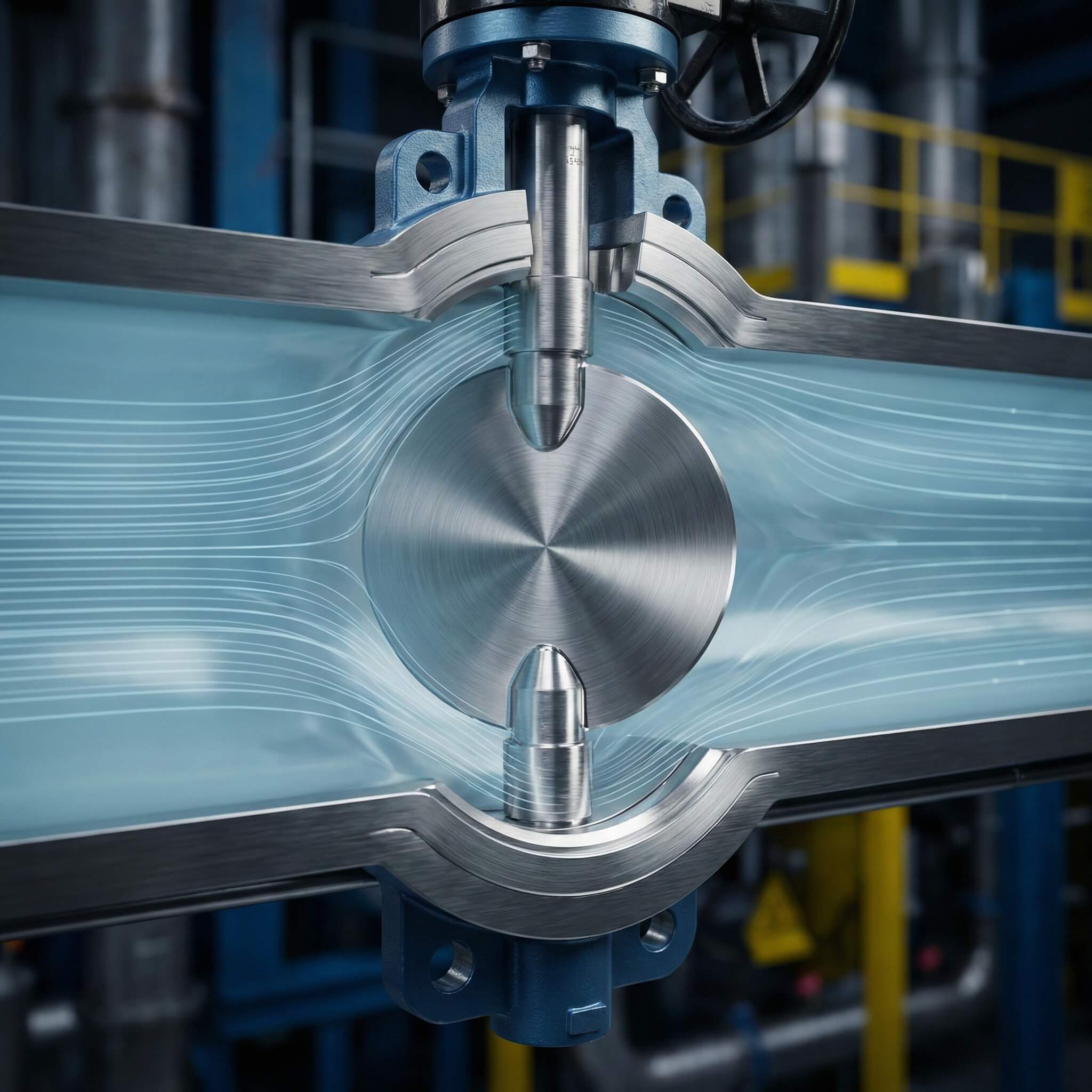
Selecting the right butterfly valve disc is the single most important factor in ensuring the efficiency, safety, and longevity of your industrial fluid system. Imagine installing a high-cost valve only to have the seat fail within weeks because the disc geometry was poorly matched to your pressure requirements. You face unexpected downtime, expensive replacement costs, and potential safety hazards for your maintenance crew. By understanding the nuances of butterfly valve disc design, you can optimize flow control and drastically reduce the total cost of ownership for your infrastructure.
Why is butterfly valve disc design critical for performance?
The butterfly valve disc design serves as the primary gate for fluid flow, directly influencing sealing reliability, pressure loss, and the amount of torque required for operation. When you choose the right design, you ensure that the valve can handle the specific velocity and chemistry of the media without premature erosion.
Precision in Sealing
The geometry of the disc determines how it interfaces with the valve seat to prevent leaks. In many industrial applications, a tight seal is non-negotiable for system safety.
Here is the truth:
- Proper disc edges reduce seat deformation.
- Profiled discs offer smoother engagement.
- Uniform thickness prevents stress points.
Impact on Maintenance
A well-engineered disc reduces the friction generated during every open and close cycle. This directly extends the life of both the seat and the actuator.
The result?
- Fewer part replacements.
- Lower labor costs.
- Higher system uptime.
Key Takeaway: Optimizing the disc design is the most effective way to balance initial procurement costs with long-term operational reliability.
| Feature | Impact on Performance | Long-term Benefit |
|---|---|---|
| Disc Edge Finish | Reduces Seat Wear | Lower Maintenance |
| Profile Thinness | Decreases Pressure Drop | Energy Efficiency |
| Alignment Accuracy | Prevents Leakage | System Safety |
Analysis: High-quality disc finishing and alignment are foundational to preventing common failure modes like seat tearing or stem binding.
How does a concentric butterfly valve disc design work?
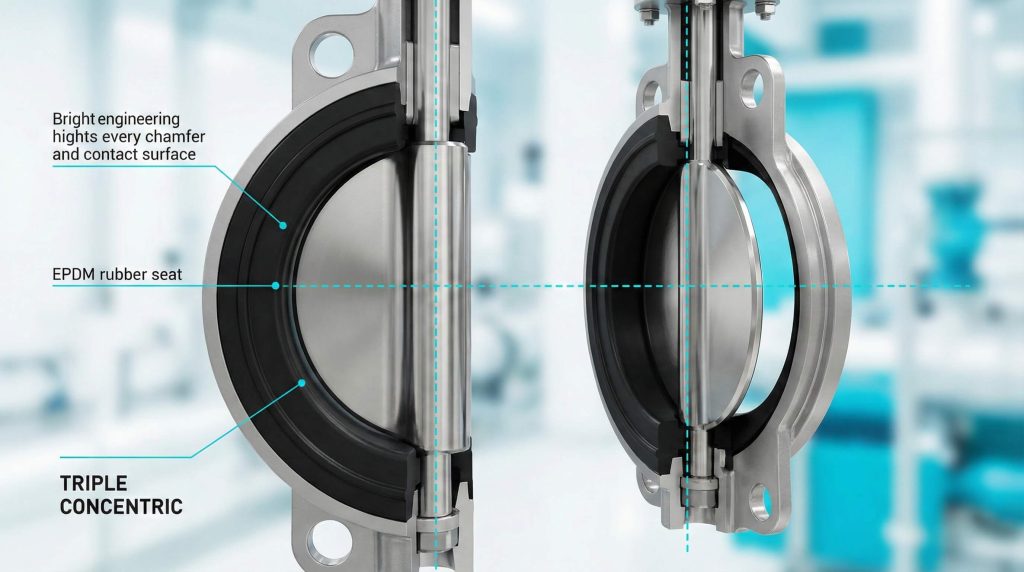
A concentric butterfly valve disc design features a center shaft that passes through the centerline of both the disc and the valve body. This symmetrical arrangement allows for simple, cost-effective operation in low-pressure systems.
Simplified Flow Path
In this design, the disc stays in contact with the rubber or PTFE seat throughout its entire 90-degree rotation. You will typically find these in water treatment and HVAC applications where bubble-tight shutoff is required at lower pressures.
Think about it:
- The design is easy to manufacture.
- It provides bi-directional sealing.
- Maintenance is relatively straightforward.
Key Takeaway: Concentric designs are ideal for general-purpose applications where cost-efficiency and soft-seated sealing are the priorities.
| Component | Function | Advantage |
|---|---|---|
| Center Shaft | Rotational Axis | Balanced Operation |
| Soft Seat | Compression Seal | Bubble-Tight Closure |
| Symmetrical Disc | Uniform Flow | Simple Installation |
Analysis: While highly effective for low-pressure utilities, the constant contact between the disc and seat limits the cycle life compared to offset designs.
What is a double-offset butterfly valve disc design?
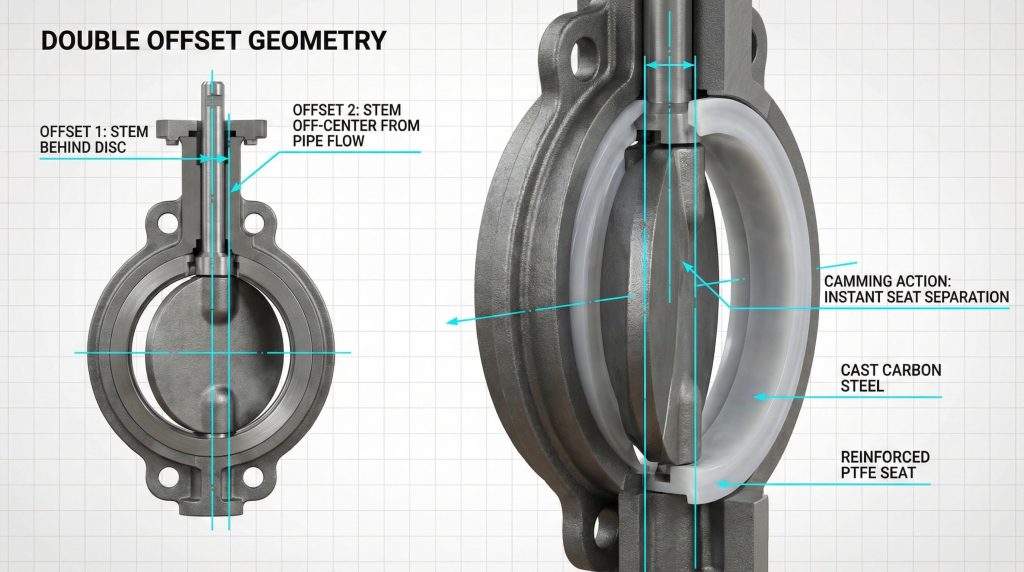
The double-offset butterfly valve disc design uses two separate offsets to lift the disc off the seat almost immediately upon opening. This design, often used alongside check valve solutions, significantly reduces friction and wear on the sealing surfaces.
High-Performance Characteristics
The first offset is the shaft located behind the disc centerline, while the second offset shifts the shaft to one side of the pipe centerline. You gain the ability to use metal seats for higher temperature and pressure environments.
But that’s not all:
- Reduced operating torque requirements.
- Extended seat life in high-cycle use.
- Capability for fire-safe designs.
Key Takeaway: Double-offset designs bridge the gap between simple water valves and heavy-duty industrial process valves.
| Offset Type | Engineering Goal | Practical Result |
|---|---|---|
| Primary Offset | Seat Clearance | Reduced Friction |
| Secondary Offset | Camming Action | Better Sealing |
| Metal Seat Option | Heat Resistance | High-Temp Capability |
Analysis: By minimizing contact during the opening stroke, double-offset designs allow for tighter sealing without sacrificing the longevity of the valve internals.
When should you use a triple-offset butterfly valve disc design?
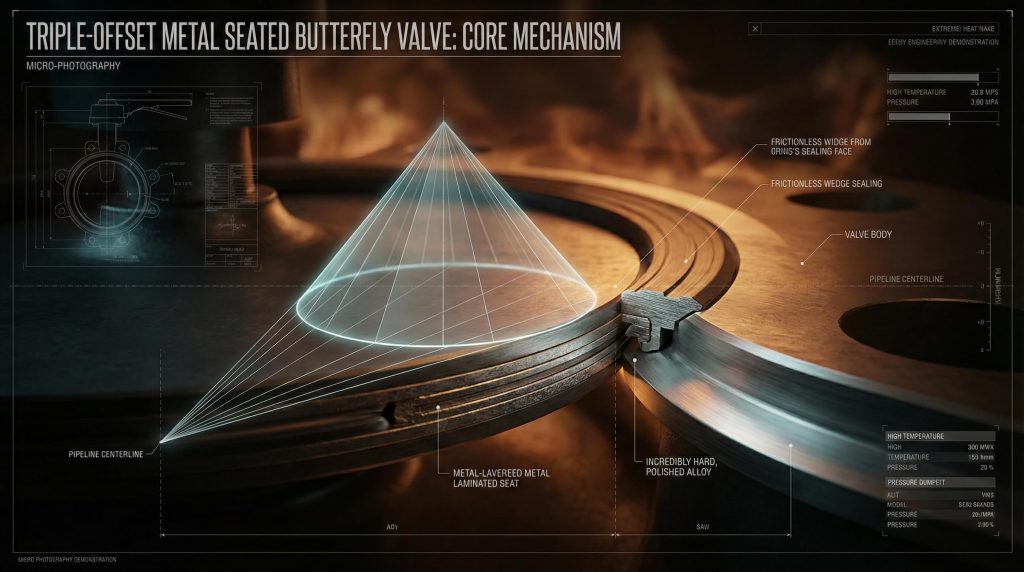
You should utilize a triple-offset butterfly valve disc design when your system demands zero-leakage performance under extreme temperatures or highly corrosive conditions. The third offset introduces a conical sealing surface that creates a “wedging” effect rather than relying on friction-based interference.
Zero-Leakage Performance
This design is the gold standard for critical industries like oil and gas or power generation. The disc makes contact with the seat only at the final point of closure, effectively eliminating wear during the travel stroke.
Believe it or not:
- It handles pressures up to Class 600.
- It survives temperatures over 400°C.
- It provides a true metal-to-metal seal.
Key Takeaway: Triple-offset valves are essential for hazardous media where environmental compliance and total shutoff are mandatory.
| Feature | Industry Standard | Benefit |
|---|---|---|
| Conical Sealing | Frictionless | Zero Leakage |
| Torque-Seated | Camming Action | Consistent Seal |
| Exotic Alloys | Corrosion Resistance | Long Service Life |
Analysis: The complexity of the triple-offset geometry provides the highest level of reliability for the most demanding industrial fluid control tasks.
Which materials suit your butterfly valve disc design?
Choosing the right material for your industrial gate valves or butterfly valve disc design is a balancing act between chemical compatibility, mechanical strength, and budget. Common choices range from ductile iron for utility water to Super Duplex stainless steel for aggressive chemical processing.
Metal and Alloy Options
Stainless steel 316 is the industry standard for general corrosion resistance, but exotic alloys like Monel or Titanium may be necessary for seawater applications. You must match the disc material to the specific pH and chloride levels of your process fluid.
Here is why:
- Ductile iron is cost-effective for water.
- CF8M (Cast 316) handles many chemicals.
- Aluminum bronze resists marine growth.
Protective Coatings
For highly corrosive acids or ultrapure water, a PTFE-coated disc might be the best solution. These coatings provide near-universal chemical resistance while maintaining a smooth, non-stick surface.
The result?
- Improved flow coefficients.
- Reduced chemical attack.
- Enhanced seat compatibility.
Key Takeaway: Material selection is as critical as geometry; always verify chemical compatibility charts before finalizing your specification.
| Material | Application | Main Benefit |
|---|---|---|
| Ductile Iron | HVAC / Water | Low Cost |
| SS316 (CF8M) | Food / Chemical | Corrosion Resistance |
| Duplex SS | Oil / Seawater | High Strength |
Analysis: Selecting a disc material that matches the pipe metallurgy prevents galvanic corrosion and ensures the valve lasts as long as the system.
How does butterfly valve disc design impact flow control?
The butterfly valve disc design directly affects the flow characteristic, which determines how the volume of fluid changes relative to the disc’s angle of opening. For precise regulation, you need a disc profile that offers a predictable relationship between position and flow.
Flow Characteristics
Most standard butterfly valves exhibit an “equal percentage” or modified linear characteristic. If your application requires throttling, you must ensure the disc shape does not cause turbulence or cavitation at low opening angles.
Check this out:
- Profiled discs improve low-flow control.
- Thinner discs allow for higher Cv values.
- Disc thickness affects the maximum flow area.
Key Takeaway: For modulating service, a high-performance disc design is necessary to avoid the hunting or instability common with basic designs.
| Opening Angle | Flow Behavior | Application Suitability |
|---|---|---|
| 0° – 30° | Minimal Flow | Not Recommended for Throttling |
| 30° – 70° | Linear Growth | Ideal Control Range |
| 70° – 90° | Maximum Flow | Full Open Service |
Analysis: Effective flow control is achieved by operating within the disc’s linear range, typically between 30 and 70 degrees of travel.
Does butterfly valve disc design affect operating torque?
Yes, the butterfly valve disc design is the primary variable in calculating the torque required to open or close the valve. High friction between the disc and seat increases the demand on your actuators, potentially requiring larger and more expensive units.
Torque Variables
In a concentric design, the disc is always rubbing against the seat, which creates a higher “breakaway” torque. In contrast, offset designs lift away quickly, significantly reducing the force needed to move the disc.
Here is the breakdown:
- Dynamic torque varies with flow velocity.
- Seating torque depends on seat material.
- Bearing friction is influenced by shaft design.
Key Takeaway: Selecting an offset disc design can save you thousands of dollars by allowing for smaller, more efficient pneumatic or electric actuators.
| Design Type | Torque Profile | Actuator Requirement |
|---|---|---|
| Concentric | High / Constant | Larger Actuators |
| Double Offset | Lower / Variable | Medium Actuators |
| Triple Offset | Lowest / Seated | Compact Actuators |
Analysis: Reducing operating torque through smart disc design not only lowers hardware costs but also reduces energy consumption over the valve’s life.
Can butterfly valve disc design reduce pressure drop?
A streamlined butterfly valve disc design minimizes the obstruction in the pipeline, which helps maintain system pressure and reduces pumping energy costs. When the valve is fully open, the thinness and shape of the disc dictate how much resistance the fluid encounters.
Optimizing Fluid Dynamics
Engineers use Computational Fluid Dynamics (CFD) to create disc shapes that allow fluid to wrap around the component with minimal turbulence. You will find that high-performance valves often feature thinner, more aerodynamic discs.
The secret?
- Reduced wake behind the disc.
- Minimized internal turbulence.
- Increased Flow Coefficient (Cv).
Key Takeaway: Energy efficiency starts with low-resistance valve internals; a streamlined disc can significantly lower your long-term utility bills.
| Factor | Effect on Pressure | Energy Outcome |
|---|---|---|
| Thicker Disc | High Resistance | Higher Pumping Costs |
| Streamlined Edge | Low Turbulence | Stable Pressure |
| Large Port Area | High Flow | Optimal Efficiency |
Analysis: Even small improvements in disc aerodynamics can lead to substantial energy savings in high-volume municipal or industrial pumping stations.
Why does butterfly valve disc design matter for high-cycle use?
In automated systems like those using a balancing valve, the butterfly valve disc design must withstand thousands of cycles without degrading the seal. High-cycle applications put immense stress on the point where the disc meets the seat, making friction reduction essential.
Durability and Fatigue
Offset designs are the preferred choice for high-cycle service because they minimize the “scrubbing” action that destroys soft seats. If you are running an automated process that cycles every few minutes, a concentric disc will likely fail prematurely.
Look at these facts:
- Offsets prevent seat “flat-spotting.”
- Hardened disc edges resist erosion.
- Polished surfaces reduce seal friction.
Key Takeaway: For automation and high-frequency switching, invest in an offset disc to avoid constant maintenance and seal replacements.
| Cycle Frequency | Recommended Design | Expected Life |
|---|---|---|
| Low (Manual) | Concentric | 5,000 – 10,000 Cycles |
| Medium (Auto) | Double Offset | 50,000+ Cycles |
| High (Process) | Triple Offset | 100,000+ Cycles |
Analysis: Matching the disc’s mechanical design to the expected cycle count is the most reliable way to prevent unplanned process interruptions.
How do you choose the right butterfly valve disc design?
Choosing the right butterfly valve disc design requires a comprehensive analysis of your fluid type, operating pressure, temperature, and required flow characteristics. You must start by identifying the most critical performance metric for your specific project.
Selection Checklist
Begin by evaluating if you need a soft seat for bubble-tight shutoff or a metal seat for extreme conditions. Then, consider whether the valve will be used for simple on/off service or precise flow modulation.
Follow these steps:
- Identify the media (corrosive, abrasive, or clean).
- Determine the maximum system pressure.
- Calculate the required Flow Coefficient (Cv).
- Select a design (Concentric, Double, or Triple Offset).
Key Takeaway: There is no “one-size-fits-all” valve; the best choice is always the one that balances technical requirements with your budget.
| Priority | Recommended Design | Material Focus |
|---|---|---|
| Budget / Water | Concentric | Ductile Iron |
| Performance / Steam | Double Offset | Stainless Steel |
| Safety / Chemicals | Triple Offset | Exotic Alloys |
Analysis: A systematic approach to selection ensures that you don’t over-engineer simple systems or under-spec critical high-pressure lines.
Conclusion
Understanding the intricacies of butterfly valve disc design is essential for any professional managing industrial fluid systems. From the cost-effective simplicity of concentric designs to the high-performance reliability of triple-offset geometry, the disc is the heart of your flow control strategy. By selecting the correct materials and structural designs, you eliminate the risks of premature failure, excessive torque, and costly pressure drops.
At RUITO, we are committed to providing precision-engineered valve solutions that meet the most demanding global standards. Our vision is to empower industrial operations with fluid control technology that is both high-performing and cost-effective. Whether you are dealing with municipal water treatment or complex chemical processing, our team is ready to help you optimize your infrastructure. To receive a technical consultation or a custom quote for your next project, contact us today.
Frequently Asked Questions
Can I use a concentric disc for steam applications?
Generally no, because the soft seats used in concentric designs cannot withstand the high temperatures and pressures of steam. You should opt for a double or triple offset design with metal seats for any steam service to ensure safety and longevity.
What’s the best disc material for seawater?
Aluminum bronze or Duplex stainless steel are usually the best choices. These materials offer superior resistance to chloride-induced corrosion and biofouling compared to standard stainless steels like 304 or 316.
How do I know if my disc is cavitating?
You will often hear a sound similar to gravel moving through the pipe, accompanied by vibration. Cavitation occurs when the pressure drops too low across the disc, and it can quickly erode even the strongest metal surfaces.
Can I replace just the disc if it gets damaged?
Yes, but it is often more cost-effective to replace the entire valve or the disc-seat-stem assembly as a set. This ensures that the sealing surfaces are perfectly matched and prevents future leaks caused by misaligned components.
What’s the best way to reduce operating torque?
Switching to an offset disc design is the most effective mechanical way to lower torque. Additionally, ensuring the disc edges are highly polished and using low-friction seat materials like PTFE can further reduce the force required for operation.