
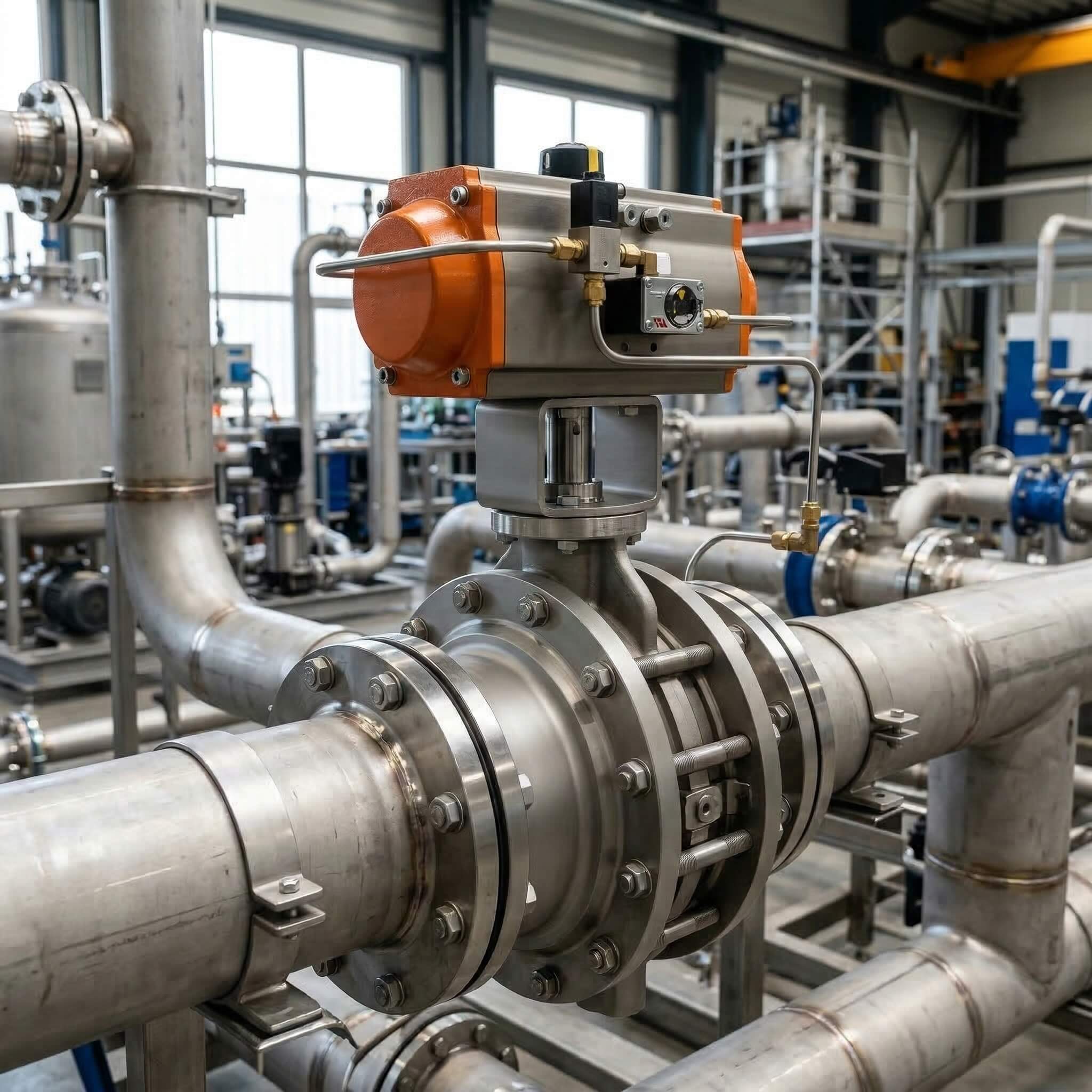
The flow coefficient (Cv) represents the volume of water in US gallons per minute that will flow through a valve with a pressure drop of 1 PSI. Choosing a valve based solely on pipe size rather than flow capacity is a common error that leads to significant system inefficiency. If you ignore specific hydraulic requirements, you risk installing a component that either restricts flow or causes excessive mechanical wear. An incorrectly sized cv butterfly valve can cause severe pressure drops, energy waste, and destructive cavitation that destroys your piping infrastructure. Understanding the Flow Coefficient allows you to select a valve that matches your system’s hydraulic reality, ensuring long-term stability and optimal performance.
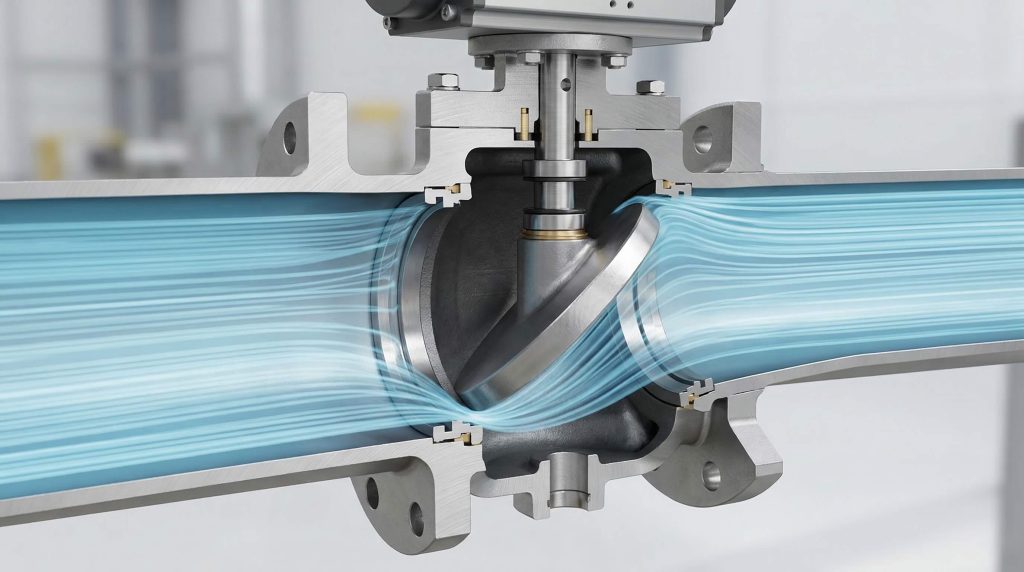
What is the flow coefficient of a cv butterfly valve?
The flow coefficient is a standardized rating used to measure a valve’s capacity for allowing fluid flow under a specific pressure differential. This measurement is the industry standard for comparing the efficiency of different valve designs and sizes across global markets.
In technical terms, the cv butterfly valve value represents the GPM of 60°F water that results in exactly a 1 PSI drop across the valve. You use this number as a constant to calculate flow rates for various liquids and gases within your specific piping configuration.
How does the industry define Cv value?
The industry defines Cv as the primary benchmark for hydraulic capacity. It ensures that engineers can predict system behavior before installation begins.
- Fluid Medium: Standardized to water at 60°F.
- Pressure Differential: Fixed at a 1 PSI drop.
- Measurement Unit: US Gallons Per Minute (GPM).
Why is Cv considered a universal constant?
Because Cv is calculated under controlled laboratory conditions, it provides a reliable baseline for every manufacturer. You can use it to compare a 4-inch valve from one brand against another with total confidence.
Here is the deal:
While the pipe size might be the same, the internal disc profile and shaft thickness vary significantly between brands. These physical variations directly impact the final Cv rating of the assembly.
Key Takeaway: The Cv value is the most critical technical specification for ensuring that your selected valve can handle the intended volume without causing energy-wasting pressure losses.
| Valve Parameter | Standard Metric | US Standard |
|---|---|---|
| Temperature | 15.5 °C | 60 °F |
| Pressure Drop | 0.069 bar | 1 PSI |
| Flow Unit | Liters/Min | US GPM |
The data above illustrates how international standards reconcile with the US-based Cv measurement system to maintain global consistency.
Why does the cv butterfly valve value matter for sizing?
Proper Cv selection ensures the valve operates within its optimal throttling range, preventing system instability and premature seal failure. When specifying a cv butterfly valve, sizing precision is the difference between system harmony and mechanical failure.
If you select a valve that is too small, the resulting high velocity can erode the internal components. Conversely, an oversized valve will operate nearly closed, leading to “hunting” in control loops and rapid seat degradation.
Can incorrect sizing damage your system?
Installing an incorrectly sized valve often leads to severe vibrations and noise throughout the facility. You will find that the actuators struggle to maintain a stable position when the flow forces are misaligned with the valve’s capacity.
- Undersizing: High pressure drop and potential choked flow.
- Oversizing: Poor control resolution and seat wire-drawing.
- Cavitation: Vapor bubble formation that pits the metal surfaces.
Is the “Sweet Spot” achievable for every project?
You should aim for the valve to operate between 30 and 70 degrees of opening during normal service. This range provides the most linear response and protects the disc from high-velocity edge wear.
Key Takeaway: Correct sizing keeps the valve in its intended performance envelope, significantly extending the service life of both the seat and the pneumatic or electric actuator.
| Opening Angle | Performance State | Risk Level |
|---|---|---|
| 0° – 20° | High Velocity | High |
| 30° – 70° | Stable Control | Low |
| 80° – 90° | Maximum Flow | Medium |
Operating within the 30° to 70° range ensures the best balance between flow control accuracy and mechanical longevity.
How do you calculate the cv butterfly valve flow rate?
Calculation involves the standard liquid flow formula where Cv equals the flow rate multiplied by the square root of the specific gravity over the pressure drop. You must understand the fluid properties to determine the correct cv butterfly valve requirements for your specific piping network.
For most water-based applications, the specific gravity is approximately 1.0, simplifying the math significantly. However, you must always account for temperature-induced density changes if you are working with hot water or glycol mixes.
What formula is used for liquid flow?
The primary formula used by engineers is $Cv = Q \sqrt{SG / \Delta P}$, where Q is the flow rate in GPM. This equation allows you to solve for the required Cv based on your target pressure drop.
- Q: Flow rate in US Gallons per minute.
- SG: Specific Gravity of the fluid (Water = 1).
- ΔP: Pressure drop across the valve in PSI.
How do pressure drop and gravity interact?
Think about it: As the fluid becomes heavier (higher SG), it requires more force to move through the same orifice. You will need a higher Cv rating to maintain the same flow rate as the fluid density increases.
Key Takeaway: Accurate calculations depend entirely on providing precise input data for flow rate and the maximum allowable pressure drop in the system.
| Fluid Type | Specific Gravity | Typical Temperature |
|---|---|---|
| Fresh Water | 1.00 | 60 °F |
| Sea Water | 1.03 | 60 °F |
| Diesel Fuel | 0.85 | 60 °F |
This table shows that even minor changes in fluid density require a recalculation of the required flow coefficient to avoid system errors.
What factors change a cv butterfly valve rating?
Disc geometry, seat material, and the internal body profile significantly influence the resistance encountered by the flowing medium. Advanced control systems, such as an cv butterfly valve, rely on stable Cv ratings to maintain automation accuracy.
You will find that a thin, streamlined disc provides much higher Cv values than a thick, heavy-duty disc. The transition between the valve body and the seat liner also plays a major role in creating or reducing turbulence.
Does the disc angle impact flow?
The relationship between opening angle and flow is non-linear, meaning a small change in position can lead to a massive change in volume. As the disc rotates toward 90 degrees, the projected area increases, allowing more fluid to pass with less resistance.
- Lined Valves: Thicker liners slightly reduce the internal diameter.
- Disc Shape: Double or triple offset discs have unique flow profiles.
- Shaft Design: Splined or pinned shafts can cause minor turbulence.
How do different liner materials affect Cv?
Softer elastomers like EPDM might deform slightly under high pressure, potentially altering the flow path. You must consider how seat compression affects the clear opening of the valve when it is in the fully open position.
Key Takeaway: Component precision and internal geometry define the final flow performance and determine how the valve will react to control signals.
| Component | Design Feature | Impact on Cv |
|---|---|---|
| Disc | Streamlined Edge | Increases Cv |
| Seat | Thick Vulcanized | Decreases Cv |
| Shaft | Two-Piece Design | Increases Cv |
Optimizing these design elements allows manufacturers to provide higher flow capacities within the same nominal pipe size.
Where is the cv butterfly valve data table found?
Manufacturers provide standardized tables listing the Cv values at various opening angles from fully closed to 90 degrees open. You should consult a specific cv butterfly valve chart to compare performance between different sizes and models during the design phase.
These tables are the foundation of process engineering, allowing you to map out the expected flow at every stage of operation. Without this data, you are essentially guessing the performance of your automated system.
Do standard sizes follow a linear progression?
You will notice that Cv increases exponentially as the pipe diameter grows. A 12-inch valve does not simply have double the capacity of a 6-inch valve; it actually handles several times the volume due to the increased cross-sectional area.
- Small Bore (2″-4″): Moderate Cv for utility lines.
- Medium Bore (6″-12″): High Cv for main distribution.
- Large Bore (14″+): Massive Cv for municipal and industrial intake.
Why do manufacturers provide data for every 10 degrees?
Providing data at 10-degree increments allows you to program control valves with precision. This granularity is essential for tuning PID loops in modern industrial plants where flow stability is paramount.
Key Takeaway: Data tables are essential tools for comparing competing designs and ensuring your selected valve meets the hydraulic demands of the project.
| Valve Size (Inch) | Cv (30° Open) | Cv (60° Open) | Cv (90° Open) |
|---|---|---|---|
| 2″ | 12 | 64 | 135 |
| 4″ | 36 | 230 | 600 |
| 6″ | 95 | 605 | 1,579 |
| 12″ | 495 | 3,162 | 8,250 |
This table clearly shows that the flow capacity does not scale linearly with size, emphasizing the need for professional data charts.
How to select a cv butterfly valve for gas systems?
Gas selection requires modified formulas that account for compressibility, temperature, and inlet pressure to prevent choked flow conditions. For complex gas applications, a high-performance cv butterfly valve offers the necessary flow precision.
When working with air, steam, or natural gas, you cannot use the simple liquid formula because gases change volume based on pressure. You must calculate the “critical pressure drop” to ensure the gas does not reach sonic velocity at the valve throat.
Is the calculation different for compressible fluids?
Yes, the formula must incorporate variables for inlet pressure ($P1$) and the absolute temperature ($T$) of the gas. You also need to verify that the pressure drop does not exceed half of the absolute inlet pressure.
- P1: Absolute inlet pressure in PSIA.
- T: Absolute temperature in Rankine.
- G: Specific gravity of the gas (Air = 1).
How do you avoid sonic velocity in gas lines?
The bottom line? If the pressure drop is too high, the gas will reach “choked flow” where no further increase in flow is possible regardless of the downstream pressure. You must select a valve with a high enough Cv to keep the pressure drop within safe, sub-sonic limits.
Key Takeaway: Compressible fluids require specialized engineering calculations to account for expansion and ensure the valve remains controllable.
| Gas Parameter | Measurement Detail | Importance |
|---|---|---|
| Inlet Pressure | Absolute PSIA | Determines Density |
| Temperature | Rankine Scale | Affects Expansion |
| Flow Rate | SCFH | Standard Volume |
Using standard cubic feet per hour (SCFH) allows engineers to standardize gas flow measurements across varying pressure environments.
Can a cv butterfly valve prevent cavitation issues?
Selecting a valve with an appropriately high Cv keeps fluid velocity within safe limits, preventing the vapor bubble formation that causes damage. By maintaining a low pressure drop across the cv butterfly valve, you protect your system from internal erosion.
Cavitation occurs when the local pressure drops below the fluid’s vapor pressure, causing bubbles to form and then collapse violently. These implosions can eat through stainless steel discs in a matter of weeks if the valve is improperly sized.
What is the relationship between Cv and velocity?
Higher Cv values generally mean lower internal restriction and lower velocity for a given flow rate. You can reduce the risk of cavitation by choosing a larger valve or one with a more efficient internal design.
- Vapor Pressure: The point where liquids turn to gas.
- Recovery Factor: How well the valve restores pressure downstream.
- Inlet Pressure: Higher inlet pressure can suppress bubble formation.
How do you recognize cavitation in the field?
Think about it: Cavitation sounds like gravel or stones passing through the pipe. If you hear this distinctive noise, your valve is likely experiencing a pressure drop that is too high for its current Cv rating.
Key Takeaway: Correct sizing is your first line of defense against cavitation, ensuring your system remains quiet and free from mechanical pitting.
| Condition | Pressure Drop | Risk Level |
|---|---|---|
| Normal Flow | < 10% of P1 | Very Low |
| High Differential | > 50% of P1 | Very High |
| Choked Flow | Max Velocity | Critical |
Monitoring the ratio between inlet pressure and pressure drop is the most effective way to predict and prevent cavitation damage.
Which cv butterfly valve works best for high pressure?
Triple offset and high-performance designs are preferred for high-pressure service because they maintain integrity while providing predictable Cv ratings. High-pressure environments often require a robust cv butterfly valve paired with a powerful rack and pinion actuator.
In these applications, the disc must withstand significant force while still allowing for precise modulation. You will find that high-performance valves use advanced seal geometries that do not interfere with the flow path as much as standard concentric designs.
Are triple offset designs more efficient?
They offer tighter sealing and more consistent flow control at higher differentials compared to rubber-lined valves. The “offset” geometry allows the disc to move away from the seat instantly, reducing friction and improving the Cv at low angles.
- Concentric: Best for low pressure and water service.
- Double Offset: Ideal for high-cycle chemical processing.
- Triple Offset: The standard for high-pressure steam and oil.
Can seat materials handle high-pressure Cv loads?
Metal-to-metal seats in triple offset valves provide the durability needed for high-velocity flows associated with high pressure drops. You can rely on these designs to maintain their Cv characteristics even after thousands of cycles.
Key Takeaway: Design architecture dictates high-pressure Cv stability and determines how well the valve will perform under extreme mechanical loads.
| Valve Design | Pressure Rating | Primary Benefit |
|---|---|---|
| Concentric | PN10 – PN16 | Cost-Effective |
| Double Offset | PN25 – PN40 | High Cycle Life |
| Triple Offset | PN64 – PN100 | Zero Leakage |
Choosing the right design ensures that the Cv rating remains stable even when the valve is subjected to industrial-scale pressures.
How does opening angle affect a cv butterfly valve?
The flow characteristic of a butterfly valve is typically an “Equal Percentage” curve, meaning flow increases progressively as the valve opens. Understanding how a cv butterfly valve responds at 30, 60, and 90 degrees is critical for proper control loop tuning.
You will notice that the most significant change in Cv occurs during the middle of the stroke. This behavior allows for very fine control when the valve is nearly closed, while still providing high volume when fully open.
Is flow control accurate at low angles?
Throttling below 20 degrees is generally discouraged due to instability and potential seat damage from high-velocity “jetting.” At these low angles, the disc acts more like an obstruction than a control element, leading to unpredictable flow patterns.
- 0-20°: Use for shut-off only, not for control.
- 30-70°: The “linear” part of the control curve.
- 80-90°: Used for high-volume bypass or full-flow states.
What is the “Equal Percentage” benefit?
Here is the deal: This characteristic allows for consistent control sensitivity across the entire operating range. You get the same percentage change in flow for every degree of movement, making the system much easier for an automated controller to manage.
Key Takeaway: Control accuracy is highest between 30 and 70 degrees, where the Cv curve is the most predictable and mechanical stresses are minimized.
| Opening Angle | Cv % of Max | Control Quality |
|---|---|---|
| 30° | 15% – 20% | High |
| 60° | 60% – 70% | High |
| 90° | 100% | Low (On/Off) |
This distribution shows why engineers target the mid-range of the stroke for critical modulation tasks in process industries.
Who provides technical cv butterfly valve support?
Specialized manufacturers like RUITO offer comprehensive technical data, including CFD simulations and 3D modeling, to support your engineering requirements. If you need assistance with complex flow simulations, contact our team for a cv butterfly valve technical consultation.
You can request custom Cv charts for non-standard fluids or unique installation scenarios. Our engineering team uses advanced software to predict how your valve will perform before it even leaves the factory floor.
Can you request custom flow simulations?
We provide detailed reports for non-standard media, such as slurries or highly viscous chemicals, where standard Cv tables might not apply. These simulations give you the data needed to secure project approval from EPC contractors and end-users.
- 3D CAD Models: For interface and interference checks.
- FEA Analysis: To verify structural integrity under pressure.
- CFD Reports: For precise flow and turbulence prediction.
How do certificates support your technical data?
Every valve we ship comes with a complete documentation package, including pressure test reports and material certificates. This traceability ensures that the Cv data we provide is backed by physical verification and ISO-certified manufacturing processes.
Key Takeaway: Partnering with an expert manufacturer ensures that your system design is supported by verified data and long-term mechanical reliability.
| Support Service | Delivery Time | Value to Engineer |
|---|---|---|
| Tech Consultation | 24 Hours | Rapid Sizing |
| 3D Modeling | 48 Hours | Integration Check |
| CFD Simulation | On Request | Performance Proof |
By leveraging these professional services, you eliminate the risks associated with improper valve selection and system design errors.
Frequently Asked Questions
Can I use the same Cv for different brands?
No, because internal disc thickness and seat geometry vary by manufacturer, affecting the actual flow capacity.
What’s the best opening angle for throttling?
The 30 to 70-degree range is best, as it offers the most stable control and prevents high-velocity erosion.
Can I calculate Cv for steam systems?
Yes, but you must use specialized gas formulas that account for the compressibility and density of steam.
What happens if the Cv is too high for my system?
Your valve will operate nearly closed, leading to poor control resolution, “hunting,” and rapid seat wear.
How do I find the Cv for a non-standard valve?
You should request a custom CFD simulation or a specific data sheet from the manufacturer for that model.
Conclusion
Mastering the Cv value is the foundation of efficient system design and long-term mechanical reliability. By selecting the correct cv butterfly valve, you ensure that your pumps operate efficiently, your pipes remain free from cavitation, and your energy costs stay low. Our precision-engineered valves are designed to meet the most demanding US and European standards, delivering consistent performance in critical applications ranging from water treatment to chemical processing. For specific sizing charts or customized engineering files for your next project, please contact us to speak with a fluid control specialist today. RUITO is dedicated to providing high-reliability, data-backed valve solutions that empower engineers to build better, more efficient industrial systems.