
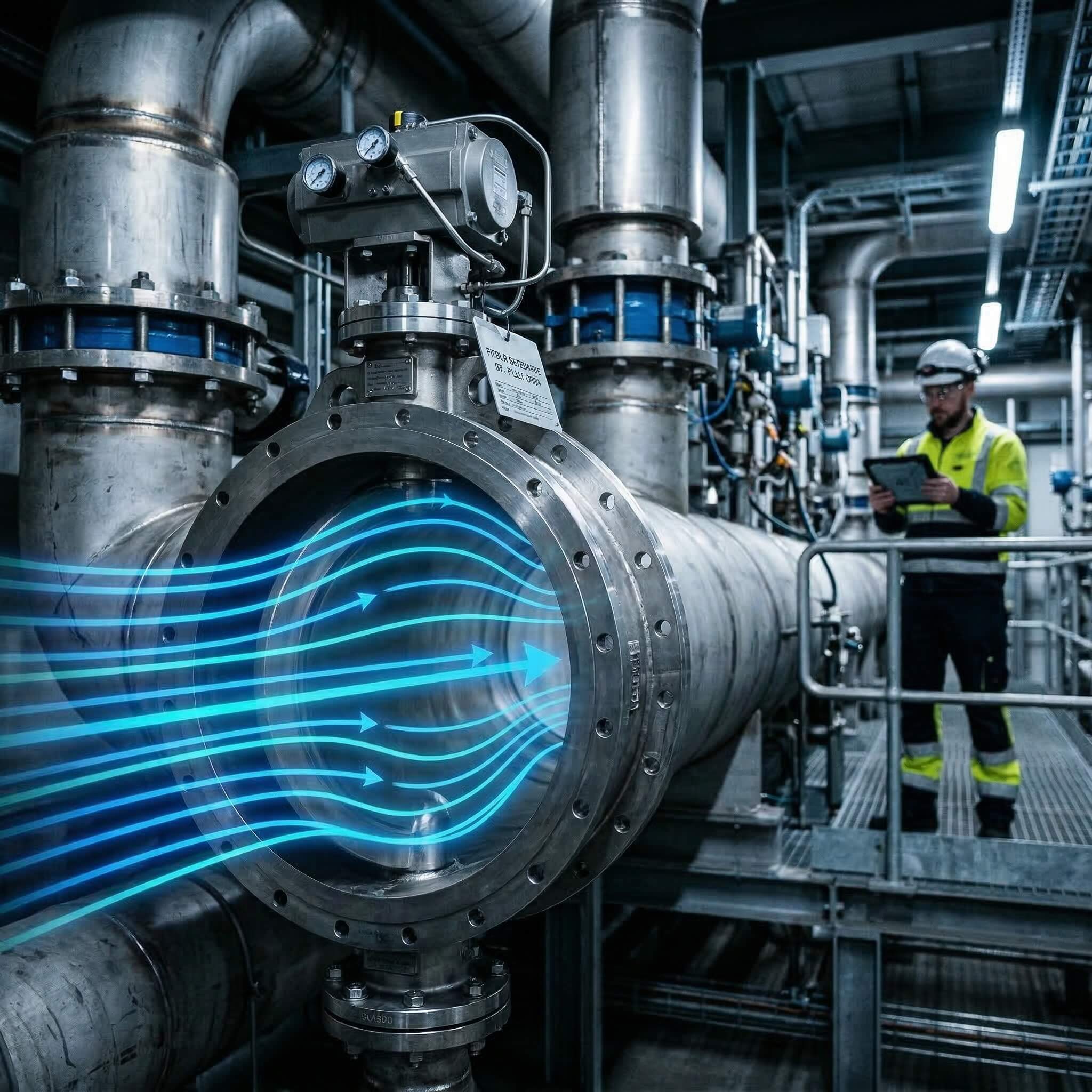
Effective management of butterfly valves requires a deep understanding of how torque, head loss, and cavitation interact to influence system performance. You likely face the frustration of high energy costs or sudden equipment failure caused by improper valve sizing or selection. If these variables are ignored, your actuators will burn out prematurely and your piping will suffer from the silent, destructive forces of internal erosion. By mastering the relationship between fluid dynamics and mechanical resistance, you can secure a long-lasting, efficient flow control system. This technical guide explores the critical impact of butterfly valve head loss and mechanical stress on your industrial operations.
What is the role of torque in butterfly valve operation?
Torque is the mechanical force required to rotate the valve disc against friction and hydrodynamic pressure. High butterfly valve head loss often correlates with high torque requirements, especially when the disc is partially open. Understanding this requirement is essential for selecting the correct actuator to ensure reliable opening and closing cycles.
Static vs. Dynamic Torque Requirements
You must distinguish between the force needed to break the seal and the force needed to move the disc during flow. Static torque is typically highest during the initial opening phase.
- Breakaway torque overcomes seat friction.
- Running torque maintains movement through the stroke.
- Seating torque ensures a leak-proof closure.
But that’s not all. You also have to consider how fluid velocity pushes against the disc surface.
Components of Total Operating Torque
Total torque is a combination of seat friction, bearing friction, and dynamic fluid forces. When you ignore these variables, you risk actuator stall or mechanical breakage.
- Stem friction is constant across the movement.
- Hydrodynamic torque varies with the disc angle.
- Seat interference provides the necessary sealing pressure.
Here is the kicker: dynamic torque can actually pull a valve open or shut depending on the flow direction.
Key Takeaway: Proper torque calculation prevents actuator failure and ensures that your valve remains controllable under all operating pressures.
| Torque Type | Primary Cause | Operational Impact |
|---|---|---|
| Static | Seat Friction | Impacts Actuator Sizing |
| Dynamic | Fluid Velocity | Affects Control Stability |
Analysis: Static torque determines the initial power needed, while dynamic torque dictates the stability of the disc during flow modulation.
How does head loss affect system efficiency?
Head loss represents the energy dissipated as heat and noise due to the resistance of the valve body and disc. A high level of butterfly valve head loss forces your pumps to work harder, directly increasing your monthly electricity expenditure. Minimizing this loss is the most effective way to optimize the total cost of ownership for your piping network.
Energy Dissipation in Piping Systems
You lose pressure whenever the fluid is forced to change direction or velocity around the disc. This turbulence consumes energy that could otherwise be used for transport.
- High velocity leads to exponential loss increases.
- Turbulent eddies create localized heat.
- Vibration from energy loss wears down supports.
Think about this: even a small reduction in resistance can save thousands in annual energy costs.
Can we calculate the Resistance Coefficient?
You can quantify efficiency by using the resistance coefficient ($\zeta$), which relates the pressure drop to the fluid’s kinetic energy. This value helps you compare different valve designs objectively.
- Geometric factors determine the base resistance.
- Surface roughness affects the skin friction.
- Disc thickness influences the flow path obstruction.
The best part? Modern high-performance valves are designed with streamlined discs to keep this coefficient as low as possible.
Key Takeaway: Reducing head loss is a direct path to lowering pump energy consumption and extending the operational life of your entire system.
| Opening Degree | Resistance Level | Efficiency Rating |
|---|---|---|
| 100% (Open) | Minimum | High |
| 30% (Throttled) | Severe | Low |
Analysis: Operating a valve at small opening angles drastically increases energy dissipation and reduces overall system efficiency.
Why does cavitation occur in butterfly valves?
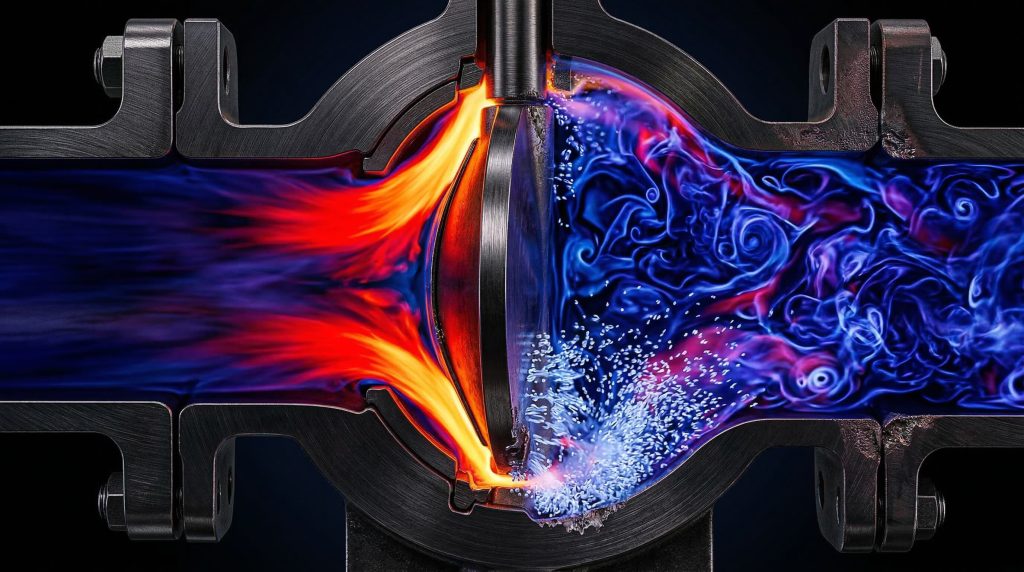
Cavitation occurs when the local pressure in the valve drops below the vapor pressure of the liquid, forming bubbles that eventually collapse with immense force. Excessive butterfly valve head loss at high velocities often signals the onset of this destructive phenomenon. If you do not manage these pressure drops, the resulting implosions will pit your metal surfaces and cause catastrophic leaks.
The Physics of Local Pressure Drops
You see cavitation most often at the trailing edge of the disc where the flow is fastest. As the fluid accelerates through the narrow gap, the pressure plummeting causes vapor to form.
- High differential pressure increases bubble formation.
- Low downstream pressure prevents bubble recovery.
- Liquid temperature changes the vapor pressure threshold.
But wait, there’s more. The noise you hear isn’t just water moving; it’s the sound of thousands of tiny explosions.
What is the Critical Cavitation Index?
You should use the cavitation index ($\sigma$) to predict whether your specific application is at risk. This dimensionless number allows you to stay within safe operating margins.
- Index values below the limit indicate high risk.
- Fluid density affects the intensity of collapse.
- System geometry can worsen or alleviate the drop.
Believe it or not, many engineers ignore this index until they see physical damage on the valve seat.
Key Takeaway: Monitoring the cavitation index is the only way to prevent the silent destruction of your internal valve components and seals.
| Cavitation Stage | Physical Sign | Risk Level |
|---|---|---|
| Incipient | Light Hissing | Low |
| Choked | Loud Roar | Extreme |
Analysis: Moving from incipient to choked cavitation marks the transition from minor noise to severe mechanical damage.
How do disc positions impact flow resistance?
The angle of the disc is the primary variable controlling flow rate and the resulting butterfly valve head loss. When you adjust the valve for throttling, the change in flow area creates a significant bottleneck. This transition from a fully open to a partially closed state completely alters the hydraulic profile of your pipeline.
Full Open vs. Partially Throttled Flow
You get the best performance when the disc is parallel to the flow, as it offers the least obstruction. However, throttling requires the disc to tilt, which increases the projected area and friction.
- 90 degrees provides the maximum flow capacity.
- Mid-range angles create high-velocity jets.
- Small angles cause the highest pressure drops.
Here is the bottom line: butterfly valves are excellent for on-off service but require careful sizing for throttling tasks.
Turbulent Flow Patterns and Eddy Currents
You will notice that as the disc tilts, the flow becomes separated, creating stagnant zones and swirling eddies. These patterns are the primary drivers of energy loss and mechanical vibration.
- Separation zones reduce the effective flow area.
- Eddies consume kinetic energy uselessly.
- Vortex shedding can cause the stem to vibrate.
It gets better: selecting a contoured disc design can help smooth out these turbulent zones even at mid-range angles.
Key Takeaway: Disc positioning is a trade-off between flow control and energy efficiency that requires precise engineering to balance.
| Disc Angle | Flow Pattern | Loss Intensity |
|---|---|---|
| 0° – 30° | High Turbulence | High |
| 60° – 90° | Near-Laminar | Low |
Analysis: Flow resistance decreases non-linearly as the disc moves toward the fully open position.
What factors influence dynamic torque variations?
Dynamic torque changes constantly based on the fluid velocity and the angle of the disc within the flow stream. Fluctuations in butterfly valve head loss can lead to unpredictable torque spikes that strain your actuation systems. You must account for these variations to prevent the valve from “hunting” or failing to reach its set position during high-flow conditions.
Hydrodynamic Forces on the Disc
You experience hydrodynamic torque because the pressure distribution on the upstream side of the disc is uneven compared to the downstream side. This imbalance creates a twisting moment on the valve stem.
- Fluid density increases the force exerted.
- Disc shape determines the center of pressure.
- Asymmetry in the flow path causes torque spikes.
You might be wondering: does flow direction matter? Absolutely, as it changes which side of the disc receives the most impact.
Fluid Velocity and Torque Correlation
You will see that as fluid velocity increases, the dynamic torque increases by the square of that velocity. This means that doubling your flow rate can quadruple the stress on your valve stem.
- High-velocity systems require heavy-duty stems.
- Liquid media generate more torque than gases.
- Surge pressures can cause momentary torque overloads.
The truth is, many actuators are undersized because they only account for seating friction, not these dynamic forces.
Key Takeaway: Dynamic torque is a product of fluid physics that must be calculated at peak flow rates to ensure system reliability.
| Velocity Change | Torque Impact | Component Stress |
|---|---|---|
| 1x Velocity | Baseline | Normal |
| 2x Velocity | 4x Increase | High |
Analysis: The exponential relationship between velocity and torque makes high-speed flow control particularly challenging for standard actuators.
How can we predict pressure drops across valves?
Predicting pressure drops allows you to ensure that downstream equipment receives the necessary flow at the required pressure. High butterfly valve head loss can starve your system if not predicted during the design phase. By using established mathematical models, you can accurately simulate how a valve will perform before it is ever installed.
Applying Bernoulli’s Principle to Valve Sizing
You can use the principle of energy conservation to understand how pressure is converted into velocity as fluid passes the disc. This change in state is the fundamental cause of the pressure drop you measure.
- Velocity increases at the “vena contracta” or narrowest point.
- Pressure must drop to maintain the energy balance.
- Partial pressure recovery occurs after the valve.
Check this out: the amount of pressure that doesn’t recover is what we define as the permanent head loss.
Impact of Inlet and Outlet Geometry
You should look at the piping immediately before and after the valve, as elbows or reducers can worsen the pressure drop. Disturbed flow entering the valve increases turbulence and inefficiency.
- Straight pipe runs stabilize the flow profile.
- Reducers increase local velocity and losses.
- Improper alignment creates extra mechanical drag.
The best part? Using a valve with the same bore as your pipe minimizes these geometric losses significantly.
Key Takeaway: Accurate pressure drop prediction requires looking at both the internal valve design and the surrounding piping configuration.
| Design Feature | Pressure Recovery | Overall Loss |
|---|---|---|
| Streamlined Disc | High | Low |
| Thick Profile Disc | Low | High |
Analysis: Disc geometry plays a decisive role in determining how much pressure is permanently lost to the system.
What are the signs of cavitation damage?
Detecting cavitation early is vital to preventing expensive downtime and safety hazards in your plant. Often, the increase in butterfly valve head loss is accompanied by distinct acoustic and physical symptoms that you can identify. If you ignore these signs, the internal surfaces of your valves will soon resemble a moonscape of craters and pits.
Noise and Vibration Identification
You will hear a sound often described as “pumping gravel” or “marbles in the pipe” when cavitation is present. This is caused by the shockwaves of collapsing vapor bubbles hitting the valve body.
- High-frequency noise indicates bubble collapse.
- Vibration can loosen bolts and flanges.
- Steady-state noise levels usually exceed 85 decibels.
But wait, there’s more. These vibrations can cause fatigue failure in sensitive instrumentation located near the valve.
Pitting and Surface Erosion Analysis
You can confirm cavitation damage by inspecting the disc and seat for a characteristic “sandblasted” appearance. Unlike chemical corrosion, this damage is purely mechanical and can happen very quickly.
- Deep pits appear on the low-pressure side.
- Seal materials can be shredded or torn.
- Surface roughness increases, further raising head loss.
Here is the kicker: even stainless steel can be eaten away in a matter of weeks under severe cavitation.
Key Takeaway: Acoustic monitoring and regular visual inspections are your best defenses against the irreversible damage caused by cavitation.
| Symptom | Cause | Severity |
|---|---|---|
| Gravel Noise | Bubble Implosions | Critical |
| Surface Pitting | Mechanical Impact | High |
Analysis: Physical damage is usually preceded by high-intensity noise, allowing for proactive maintenance before total failure occurs.
How does seat material influence seating torque?
The material used for the valve seat determines the amount of friction the actuator must overcome to achieve a bubble-tight seal. While seat friction contributes to butterfly valve head loss only slightly, it is the primary driver of your required seating torque. Choosing the wrong material can lead to a valve that is either too difficult to move or prone to leaking.
Resilient vs. Metal Seat Friction
You will find that resilient seats, like EPDM or NBR, offer excellent sealing but have a higher friction coefficient. Metal seats are more durable in high-heat scenarios but require much higher torque to deform the metal for a seal.
- Soft seats deform easily to stop leaks.
- Metal-to-metal contact requires high precision.
- Friction increases as the valve ages and dries.
Think about this: a PTFE lining can reduce friction significantly while maintaining high chemical resistance.
Thermal Expansion Effects on Torque
You must account for the fact that materials expand at different rates as the temperature of the media changes. This expansion can “squeeze” the disc, causing a sudden and dramatic increase in torque.
- High temperatures swell rubber seals.
- Metal discs expand faster than some body linings.
- Cold starts can cause the seat to become brittle.
The best part? Modern valves are designed with “offsets” to reduce the time the disc stays in contact with the seat.
Key Takeaway: Selecting the right seat material involves balancing the need for a tight seal with the torque limits of your actuator.
| Seat Material | Sealing Ability | Torque Level |
|---|---|---|
| EPDM/Rubber | Excellent | Moderate |
| Stainless Steel | Good | High |
Analysis: Resilient seats provide better sealing at lower costs but may limit the valve’s temperature range and life cycle.
Why is flow coefficient ($C_v$) critical for sizing?
The flow coefficient ($C_v$) is a standardized measure that tells you how much water can flow through a valve with a one-psi pressure drop. A low $C_v$ indicates a restrictive design with high butterfly valve head loss. You must use this value during the procurement stage to ensure the valve fits the hydraulic capacity of your system.
Defining Flow Capacity Standards
You should realize that $C_v$ allows for an apples-to-apples comparison between different manufacturers. It represents the efficiency of the internal flow path under standardized conditions.
- Higher $C_v$ means less resistance.
- $C_v$ changes based on the disc angle.
- It helps in calculating the exact pressure drop.
Believe it or not, an oversized valve with a massive $C_v$ can be just as problematic as an undersized one.
Using $C_v$ to Optimize Valve Selection
You can use the $C_v$ value to ensure your valve operates in its “sweet spot”—usually between 30 and 70 degrees open. Operating in this range provides the best control while minimizing wear.
- Avoid selecting valves where the required flow is at 90% open.
- Ensure the minimum flow doesn’t occur at 10% open.
- Match the valve $C_v$ to the pump’s performance curve.
Here is the kicker: a valve that is too large will “hunt” and vibrate because even a tiny movement causes a huge change in flow.
Key Takeaway: The flow coefficient is the most important technical metric for ensuring your valve is sized correctly for your specific flow requirements.
| Valve Size | $C_v$ at 90° | $C_v$ at 30° |
|---|---|---|
| 4-Inch | ~400 | ~40 |
| 8-Inch | ~1,600 | ~160 |
Analysis: The flow capacity of a butterfly valve drops by approximately 90% when moving from fully open to a 30-degree position.
How can we mitigate cavitation and head loss?
Mitigation strategies focus on either changing the valve design or altering the system conditions to keep the fluid within safe parameters. Reducing butterfly valve head loss through smart design is often the most cost-effective long-term solution. By applying these engineering principles, you can eliminate the root causes of failure rather than just treating the symptoms.
Implementing Anti-Cavitation Trims
You can install specialized disc designs that break up the flow into many smaller streams. This increases the pressure recovery and prevents the large-scale bubble collapse that causes damage.
- Perforated discs reduce noise levels.
- Multi-stage pressure drops prevent vapor formation.
- Hardened coatings protect the base metal.
It gets better: these trims can often be retrofitted into existing valve bodies to save on replacement costs.
Strategic Valve Placement Guidelines
You should avoid placing valves directly after pumps or elbows where the flow is naturally turbulent. Giving the fluid time to stabilize before it hits the valve disc can significantly reduce losses.
- Install valves 5-10 pipe diameters from obstructions.
- Ensure the downstream pipe is straight for 3-5 diameters.
- Use eccentric designs for abrasive or slurry media.
Think about this: sometimes moving a valve just two feet down the line can double its operational lifespan.
Key Takeaway: Effective mitigation combines high-performance valve technology with intelligent system layout and placement.
| Strategy | Primary Benefit | Implementation Cost |
|---|---|---|
| Anti-Cav Trim | Prevents Damage | Moderate |
| Proper Spacing | Reduces Turbulence | Low |
Analysis: While anti-cavitation hardware is effective, correct system layout is the most cost-efficient way to reduce hydraulic stress.
Conclusion
Understanding the complex relationship between torque, head loss, and cavitation is the only way to ensure your industrial fluid systems remain reliable and cost-effective. Throughout this analysis, we have solved the common problems of actuator burnout and internal erosion by providing actionable sizing data and mitigation strategies. At RUITO, our vision is to empower global industries with precision-engineered valve solutions that eliminate technical risk and maximize operational uptime. We are committed to providing the documentation and expertise needed to de-risk your procurement process and protect your infrastructure. To optimize your next project with high-performance hardware, contact us today for a comprehensive technical consultation.
Frequently Asked Questions
Can I use a standard butterfly valve for high-pressure throttling?
No, it is not recommended. Standard valves face extreme cavitation and high torque loads when partially open at high pressures, leading to rapid seal failure and pitting.
What’s the best way to reduce head loss in my system?
Select a high-performance, streamlined disc design. Ensuring the valve is correctly sized to operate at a 60-80 degree opening angle also significantly minimizes energy dissipation.
Can I predict cavitation by noise alone?
Yes, to a certain extent. The distinct “gravel pumping” sound is a reliable indicator that cavitation is occurring, but technical indices like $\sigma$ provide a more accurate mathematical prediction.
What is the best seat material for high-cycle applications?
Reinforced PTFE or specialized elastomers are best. These materials offer a balance of low friction to reduce seating torque and high durability for frequent operation.
Can I install a butterfly valve in any orientation?
Generally yes, but horizontal stems are preferred. Placing the stem horizontally prevents sediment from settling in the bottom bearing, which reduces wear and maintains stable torque.