
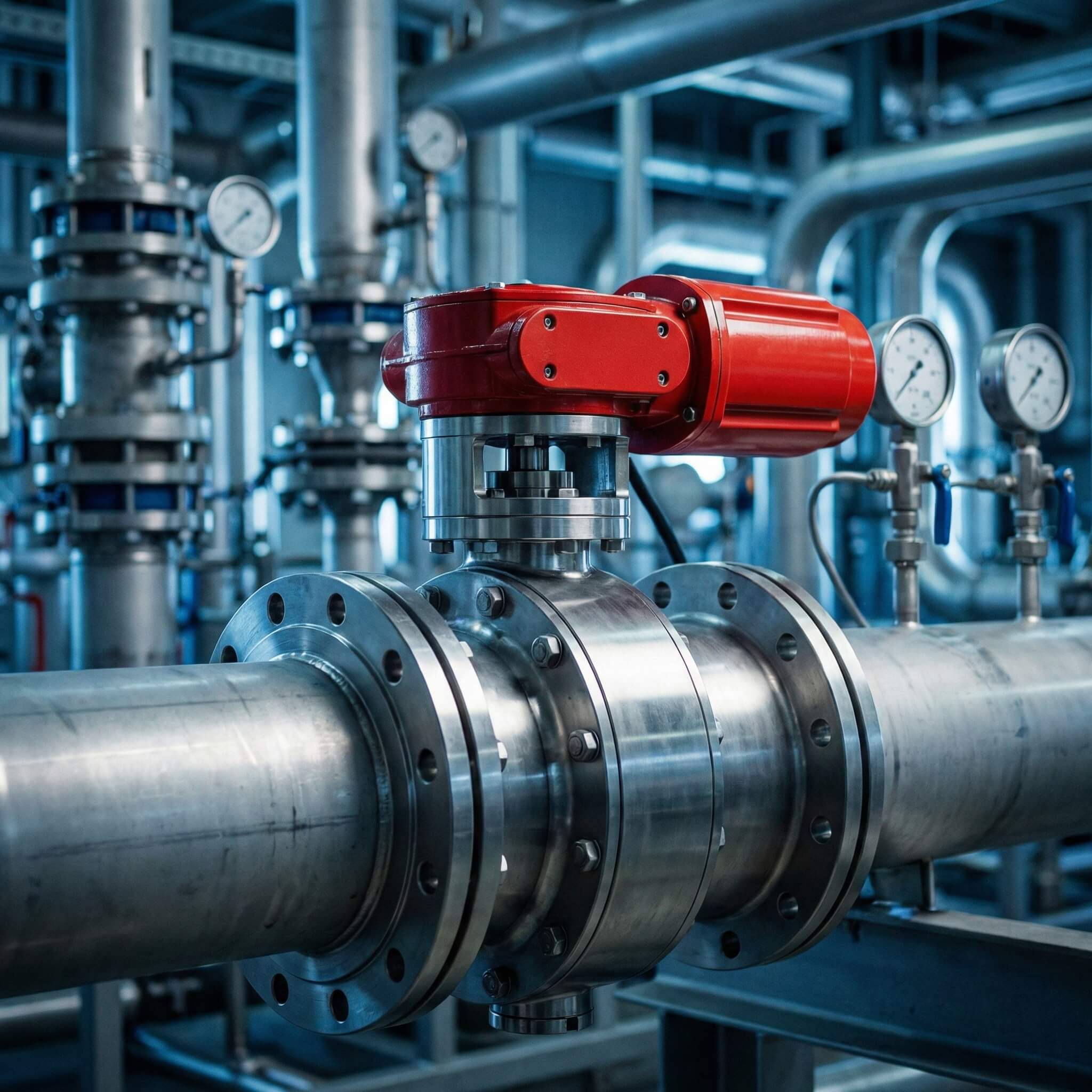
Many industrial plant managers and procurement officers struggle with recurring system downtime and hazardous emissions caused by valve seal degradation. These failures often stem from selecting a valve geometry that cannot withstand the specific pressure or temperature demands of the application, leading to expensive emergency repairs. By integrating a high-precision zero leakage butterfly valve into your infrastructure, you can eliminate bypass leakage and significantly extend the operational lifecycle of your fluid control systems.
1. Why is the design of a zero leakage butterfly valve critical for industrial fluid control?
The structural integrity of a zero leakage butterfly valve determines whether a process remains profitable or becomes a maintenance liability. In high-stakes environments like petrochemical processing or power generation, even a minor seal failure can lead to catastrophic pressure loss. Engineers must prioritize offset geometry to ensure the valve provides a bubble-tight shut-off under varying load conditions.
Defining the Offset Geometry
The term “offset” refers to the specific distance between the centerline of the valve stem and the centerline of the valve disc. These intentional misalignments are engineered to create a camming action during the opening and closing cycles. This movement profile reduces the friction that typically destroys soft seats in standard valve configurations.
The Evolution of Sealing Standards
Modern industrial standards have shifted from simple flow modulation to demanding absolute containment of hazardous media. While older designs allowed for “acceptable” leakage rates, the latest precision-engineered valves meet API 598 and ISO 5208 requirements for zero leakage. This evolution ensures that system integrators can maintain environmental compliance while maximizing flow efficiency.
Think about this:
- Centerline Alignment: Determines the fundamental torque required for operation.
- Disc Profile: Affects the Cv (flow coefficient) and pressure drop across the line.
- Seating Surface: Conical or flat geometries dictate the longevity of the seal.
| Feature | Zero Offset | Double Offset | Triple Offset |
|---|---|---|---|
| Primary Goal | General Flow Control | High-Performance Sealing | Zero Leakage/Severe Service |
| Seat Friction | High (Continuous) | Medium (Reduced) | Low (Frictionless) |
| Media Type | Water/Air | Chemicals/Steam | High-Temp/High-Pressure |
The geometric offset is the primary factor in determining the mechanical wear rate and sealing efficiency of the valve over thousands of cycles.
2. How does a concentric design define a zero offset zero leakage butterfly valve?
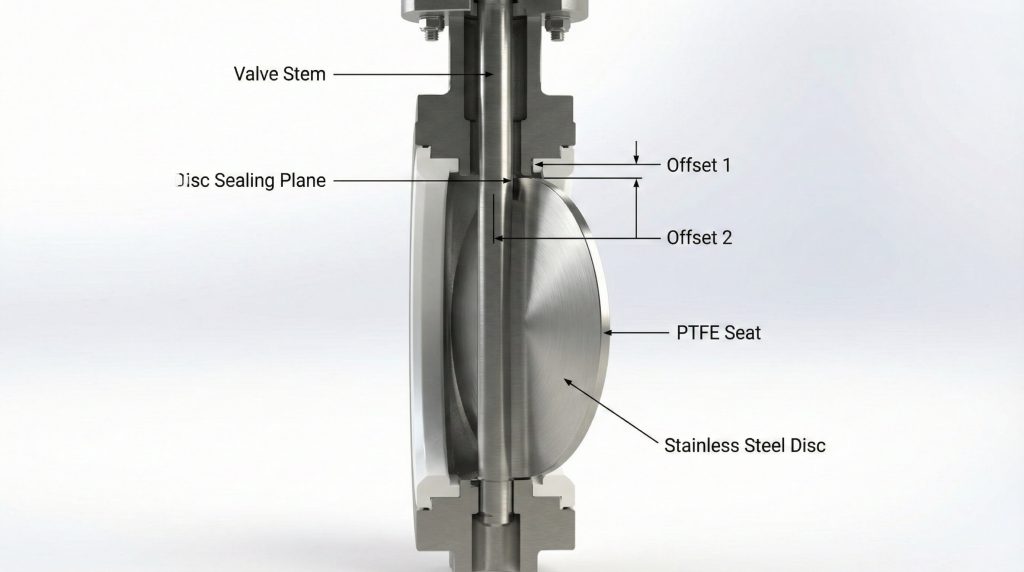
A zero offset zero leakage butterfly valve is characterized by a concentric design where the stem and disc are perfectly centered within the valve body. This configuration is the most common for low-pressure applications where simplicity and cost-effectiveness are the top priorities. Because the disc remains in contact with the seat throughout the entire 90-degree rotation, it relies on interference to create a seal.
Resilient Seated Performance
In zero offset designs, the valve typically utilizes elastomer seats made of materials like EPDM, NBR, or PTFE. The disc presses into the soft seat material to block flow, which works exceptionally well for water and low-temperature fluids. However, the constant rubbing between the disc and the seat means these valves have a finite lifespan in high-cycle automation.
Common Industrial Use Cases
These valves are the standard choice for HVAC systems, municipal water treatment, and fire protection services. They provide reliable service where pressure ratings stay within PN10 to PN16 limits and temperatures do not exceed the limits of the elastomer. For basic utility lines, the zero offset provides the most economical path to functional fluid management.
Here is the kicker:
- Symmetric Disc: Ensures equal flow characteristics in both directions.
- 360-Degree Contact: The seal is maintained through the entire stroke.
- Low Complexity: Easier to maintain and replace parts in the field.
| Component | Material Options | Max Pressure | Max Temperature |
|---|---|---|---|
| Disc | Ductile Iron/SS304 | PN16 | 120°C (EPDM) |
| Seat | EPDM/NBR/PTFE | PN16 | 80°C (NBR) |
| Stem | SS410/SS420 | PN16 | 200°C (PTFE) |
While zero offset valves are highly efficient for water-based utilities, they are not suitable for high-pressure steam or abrasive chemical slurries.
3. What makes the double offset zero leakage butterfly valve a high-performance choice?
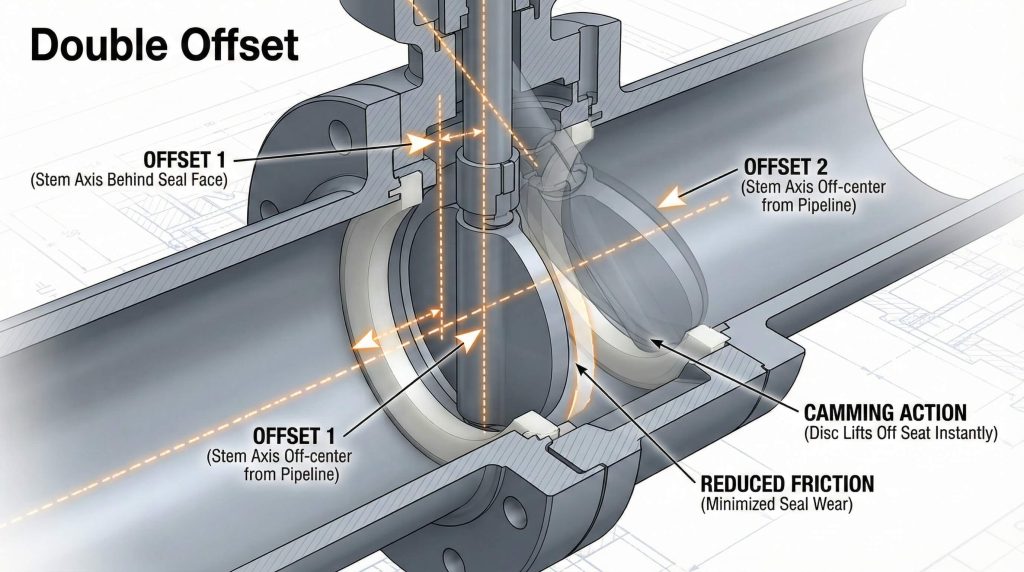
The double offset zero leakage butterfly valve is frequently referred to as a “high-performance” valve because of its eccentric design. This version incorporates two distinct offsets: the stem is positioned behind the disc and slightly to one side of the centerline. This configuration allows the disc to “lift” away from the seat almost immediately upon opening.
The High-Performance Camming Action
By moving the stem off-center, the disc follows an elliptical path rather than a circular one during operation. This reduces the friction between the seat and the disc during the first 10 degrees of opening and the last 10 degrees of closing. Consequently, the valve experiences significantly less seat wear, allowing it to maintain a Class VI shut-off for much longer.
Pressure and Durability Benefits
Double offset valves are capable of handling much higher pressures, often reaching ratings up to PN40 or ANSI Class 300. They are ideally suited for chemical processing and power plant applications where soft seats are still preferred but durability is non-negotiable. The reduced operating torque also allows for the use of smaller, more efficient actuators.
But that’s not all:
- Eccentric Stem: Minimizes seat deformation during high-cycle service.
- Soft and Fire-Safe Seats: Available in PTFE or metal-backed configurations.
- Extended Lifecycle: Reduces the frequency of unscheduled maintenance shutdowns.
| Specification | Standard Configuration | Benefit |
|---|---|---|
| Pressure Rating | PN25 – PN40 | Handles industrial surge loads |
| Seal Rating | Class VI | Near-zero leakage in soft seats |
| Typical Size | DN50 – DN1200 | Versatile for most piping systems |
The double offset design effectively bridges the performance gap between basic utility valves and specialized severe-service hardware.
4. In what ways does the geometry of a triple offset zero leakage butterfly valve eliminate friction?
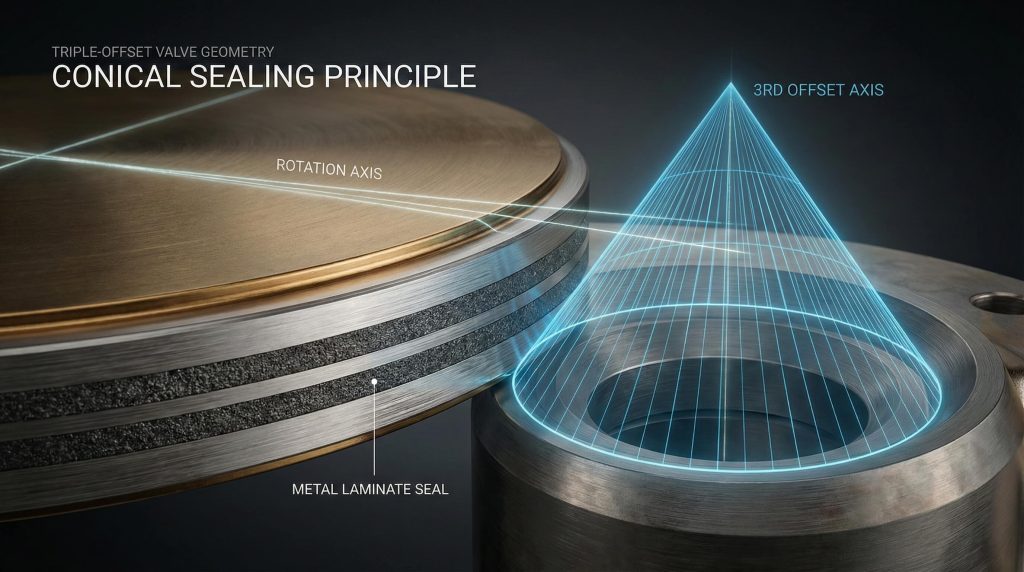
A triple offset zero leakage butterfly valve represents the pinnacle of valve engineering, designed to eliminate seat friction entirely. The third offset is a unique geometric change where the seating surface itself is machined into a conical shape. This creates a “wedging” effect, meaning the disc only makes contact with the seat at the final point of closure.
Conical Sealing and Zero Leakage
Because the seat is a cone-shaped section rather than a flat or rounded surface, the disc travels without any rubbing until the valve is fully shut. This frictionless operation is what allows the valve to achieve a true bubble-tight, zero-leakage seal according to API 598 standards. It is the preferred solution for hazardous media where any bypass could lead to safety violations.
Metal-to-Metal Sealing Reliability
Unlike zero and double offset valves, triple offset versions typically utilize metal-to-metal seating or laminated stainless steel/graphite seals. This makes them inherently fire-safe and capable of withstanding extreme temperatures that would melt elastomer or PTFE seats. They are often constructed with Stellite overlays on the seating surfaces for maximum hardness.
You might be wondering:
- Offset 1: Stem positioned behind the centerline of the disc.
- Offset 2: Stem positioned to the side of the disc centerline.
- Offset 3: Seat and disc contact axis is an inclined cone (tapered).
| Feature | Triple Offset Detail | Industrial Impact |
|---|---|---|
| Contact Type | Non-rubbing / Wedging | Eliminates seat wear and tearing |
| Seal Material | SS316 + Graphite / Stellite | Operates in 500°C+ environments |
| Tightness | API 598 Zero Leak | Prevents fugitive emissions |
The triple offset geometry transforms the butterfly valve into a robust alternative to gate and globe valves in critical high-pressure lines.
5. Which pressure and temperature ratings apply to each zero leakage butterfly valve type?
Selecting the correct zero leakage butterfly valve requires a deep understanding of the working envelope for each offset type. Pressure and temperature limits are dictated by both the mechanical geometry of the valve and the materials used for the seals. Using a zero offset valve in a high-temperature steam line will result in immediate seat failure and potential system damage.
Thermal Limits of Sealing Materials
Zero offset valves are generally limited to 120°C because they rely on EPDM or NBR seats. Double offset valves can push these limits to 200°C when using reinforced PTFE seats. Triple offset valves, however, are the only option for extreme heat, often operating reliably at 500°C and above due to their metal-seated construction.
Pressure Surge Resilience
High-pressure systems generate significant force against the valve disc, which can cause “seat blowout” in inferior designs. Triple offset valves are engineered to handle pressures exceeding 1500 PSI (ANSI Class 600 or higher). Their wedging action ensures that higher line pressure actually forces the disc tighter into the seat, enhancing the seal during surges.
Simply put:
- Low Pressure: Zero offset (PN10/PN16) for non-critical utilities.
- Medium Pressure: Double offset (PN25/PN40) for process water and chemicals.
- High Pressure: Triple offset (Class 600+) for steam and oil/gas.
| Valve Type | Max PSI | Max Temp | Sealing Class |
|---|---|---|---|
| Zero Offset | 150 – 230 | 120°C | Resilient Tight |
| Double Offset | 740 | 200°C | Class VI |
| Triple Offset | 1500+ | 500°C+ | API 598 Zero Leak |
Temperature and pressure ratings are the most critical factors when matching a valve to its specific industrial duty cycle.
6. Why should you select a triple offset zero leakage butterfly valve for corrosive media?
A triple offset zero leakage butterfly valve is the standard choice for aggressive chemical environments and offshore applications. Because these valves do not rely on soft elastomers, they can be manufactured from exotic alloys like Duplex stainless steel or Monel. The lack of seat friction ensures that the protective oxide layers on these metals remain intact.
Handling Abrasive and Corrosive Slurries
In chemical processing, media often contains abrasive particles that can tear or pit soft seats during the opening stroke. The “no-rub” action of the triple offset design means that the disc moves away from the seat instantly, preventing particles from being trapped and dragged. This significantly reduces the rate of erosive wear in mining and mineral processing.
Marine and Offshore Applications
Saltwater environments are notoriously brutal on industrial hardware, causing rapid pitting and galvanic corrosion. DNV-certified triple offset valves are engineered with superior corrosion resistance for use on offshore platforms and FPSO vessels. Their compact, lightweight design provides a major advantage over heavier gate valves in space-constrained marine modules.
It gets better:
- Alloy Flexibility: Can be cast in SS316L, Bronze, or Carbon Steel.
- Erosion Resistance: Hard-faced seats prevent damage from high-velocity flow.
- Chemical Compatibility: Metal seats are impervious to most organic solvents.
| Industry | Media Type | Preferred Offset |
|---|---|---|
| Oil & Gas | Hydrocarbons / Sour Gas | Triple Offset |
| Marine | Saltwater / Ballast | Triple Offset / Double Offset |
| Mining | Abrasive Slurries | Triple Offset |
For any application involving corrosive or abrasive media, the elimination of mechanical friction is the most effective way to prevent premature valve failure.
7. How does seating material vary between different zero leakage butterfly valve offsets?
The material science behind a zero leakage butterfly valve is just as important as its mechanical geometry. Seating materials must be selected based on their chemical compatibility, thermal expansion coefficients, and required sealing tightness. A mismatch here can lead to either a valve that is too stiff to operate or one that leaks under minimal pressure.
Elastomers and Soft Seats
Zero offset and many double offset valves utilize soft seats to achieve a tight seal at lower costs. EPDM is excellent for water and HVAC, while NBR is preferred for oils and fats. PTFE (Teflon) offers superior chemical resistance and is often used in double offset valves for aggressive but relatively cool fluids.
Laminate and Solid Metal Seats
Triple offset valves utilize advanced laminate seats consisting of alternating layers of stainless steel and graphite. This combination provides the flexibility needed to conform to the disc’s edge while maintaining the strength of metal. For extreme temperatures or high-velocity steam, solid metal seats with Stellite 6 overlays are used to ensure maximum hardness.
Let’s dive deeper:
- Soft Seats: Best for bubble-tight sealing at low temperatures.
- Laminated Seats: Provide a balance of flexibility and heat resistance.
- Metal Seats: Essential for fire-safe ratings and high-pressure steam.
| Seat Material | Common Offset | Key Advantage |
|---|---|---|
| EPDM | Zero Offset | Low cost / High flexibility |
| PTFE | Double Offset | Chemical resistance |
| SS316/Graphite | Triple Offset | High temperature / Fire-safe |
Material selection must always be balanced against the mechanical movement of the disc to ensure long-term sealing integrity.
8. What are the maintenance requirements for a high-cycle zero leakage butterfly valve?
A high-performance zero leakage butterfly valve requires a structured maintenance regimen to ensure consistent operation in automated systems. While eccentric designs reduce wear, they still require periodic inspections to check for stem seal integrity and seat condition. Proper maintenance prevents minor issues from escalating into unplanned facility shutdowns.
Seat Replacement Protocols
Maintenance complexity varies significantly between the different offset types. Zero offset valves often allow for quick on-site replacement of the resilient seat, which is essentially a rubber liner. In contrast, triple offset metal seats are precision-ground and may require factory-level calibration to ensure the conical geometry remains perfectly aligned.
Packing Gland and Stem Seal Integrity
The stem seal is the most frequent point of failure in high-cycle valves, often leading to “fugitive emissions.” Modern zero leakage valves utilize adjustable packing glands or O-ring systems to prevent media from escaping along the stem. For hazardous service, maintenance teams must verify the torque on the packing bolts to ensure the seal remains compressed.
The bottom line?
- Visual Checks: Inspect the disc edges for pitting or erosion.
- Cycle Testing: Ensure the actuator moves smoothly without sticking.
- Seal Inspection: Check for leakage around the stem or through the pipe.
| Task | Frequency | Focus Area |
|---|---|---|
| Visual Inspection | Quarterly | Disc and Body exterior |
| Torque Check | Bi-Annually | Actuator and Packing |
| Seat Test | Annually | Internal leakage (Bubble test) |
While triple offset valves have a higher initial price, their drastically lower wear rates lead to much longer intervals between major maintenance overhauls.
9. How does torque demand change across each zero leakage butterfly valve configuration?
Torque is the amount of rotational force required to open or close a zero leakage butterfly valve. This metric is critical because it determines the size and cost of the actuator (electric or pneumatic) required for automation. Offset geometry plays a massive role in reducing the “break-to-open” torque needed to crack the seal.
Actuator Sizing and Efficiency
Zero offset valves have the highest torque demand relative to their size because the disc must overcome the friction of the entire seat circumference. Triple offset valves, however, allow for significantly smaller actuators. Since the disc only touches the seat at the very end of the stroke, the motor or piston doesn’t have to fight friction during the majority of the travel.
Dynamic Torque in High-Flow Scenarios
In addition to seat friction, flow velocity exerts “hydrodynamic torque” on the disc, attempting to pull it closed or push it open. Eccentric offsets (double and triple) change the way fluid hits the disc, often making the valve more stable in high-flow conditions. Understanding these forces is essential for EPCs when sizing automation packages for large-scale projects.
To put it another way:
- Seat Friction: The primary torque component in zero offset valves.
- Bearing Friction: Force generated by the stem turning in its bushings.
- Dynamic Force: The impact of moving fluid on the disc’s surface.
| Valve Type | Relative Torque | Actuator Cost |
|---|---|---|
| Zero Offset | High | Standard |
| Double Offset | Medium | Lower |
| Triple Offset | Low | Lowest (Smallest size) |
Reducing operating torque through smart offset design lowers the total cost of ownership by allowing for more compact and efficient automation.
10. What are the cost-benefit considerations when investing in a zero leakage butterfly valve?
Investing in a high-quality zero leakage butterfly valve requires a balanced evaluation of upfront capital expenditure (CAPEX) versus long-term operational costs (OPEX). While a triple offset valve may cost more initially, its performance in critical lines often pays for itself within the first year. Procurement teams must look beyond the price tag to consider the total lifecycle value.
ROI on High-Performance Upgrades
For non-critical water lines, a simple zero offset valve is perfectly sufficient and highly cost-effective. However, in a chemical plant where a single hour of downtime costs thousands of dollars, the reliability of a triple offset valve is a smart insurance policy. The savings generated from reduced seat replacements and lower actuator energy consumption provide a rapid return on investment.
Lifecycle Longevity and Predictability
Standardized manufacturing and traceable quality assurance (QA) are essential for de-risking the procurement process. By sourcing valves that are 100% pressure tested at 1.5x working pressure, EPCs can ensure that their project handover goes smoothly. Predictable valve performance means fewer warranty claims and a more stable production environment for the end-user.
What’s the catch?
- Upfront Cost: Triple offset is the most expensive to manufacture.
- System Criticality: High-performance valves are overkill for basic HVAC.
- Lead Times: Custom-engineered offsets may take 15-25 days to produce.
| Consideration | Zero Offset | Double Offset | Triple Offset |
|---|---|---|---|
| Initial Price | Low | Medium | High |
| Maintenance Cost | Medium | Low | Very Low |
| Risk of Failure | High (in heat) | Low | Minimal |
For critical industrial infrastructure, the superior durability of a triple offset valve almost always outweighs its higher initial purchase price.
Frequently Asked Questions
- Can I use a zero offset valve for steam applications?
No. Zero offset valves use elastomer seats (EPDM/NBR) that will melt or degrade rapidly under steam temperatures. You should use a double offset with PTFE or a triple offset metal-seated valve for steam. - What is the best offset for high-cycle chemical processing?
A double offset valve with a PTFE seat is usually the best balance of cost and longevity. However, if the chemical is highly aggressive or hot, a triple offset is required for a safe, zero-leakage seal. - How do I know if I need a “zero leakage” rating?
If you are handling hazardous, flammable, or expensive media, or if environmental regulations are strict (e.g., Oil & Gas), you need the API 598 zero leakage rating provided by a triple offset valve. - Is a triple offset valve bi-directional?
Most are, but they usually have a “preferred” flow direction. Installing them in the preferred direction allows the line pressure to assist the wedging action, making the seal even tighter. - Can I install a smaller actuator on a triple offset valve?
Yes. Because triple offset valves have significantly lower seating friction, they require less torque to operate. This allows you to save money by using smaller pneumatic or electric actuators.
Conclusion
Selecting the right valve geometry is the most effective way to ensure the safety and efficiency of your fluid control systems. Whether you require a cost-effective zero offset solution for water utilities or a high-performance zero leakage butterfly valve for a high-pressure chemical reactor, understanding these mechanical differences is key to operational success. RUITO provides precision-engineered valve solutions backed by ISO 9001 certification and a 99.5% reliability rating. To find the ideal configuration for your next project, contact us today for a comprehensive technical consultation and custom quote.