

An api609 butterfly valve is a specialized industrial valve that adheres to the American Petroleum Institute (API) Standard 609, which specifies the design, materials, and testing requirements for butterfly valves used in demanding piping systems. Navigating the complex world of industrial valve standards often leads to procurement errors, resulting in mismatched face-to-face dimensions or material failures in high-pressure environments. A single non-compliant valve can cause catastrophic leaks, expensive downtime, and safety violations that jeopardize your entire pipeline operation. By implementing the API 609 standard, you ensure that your components are precision-engineered for reliability, interchangeability, and safety across critical B2B industrial applications.
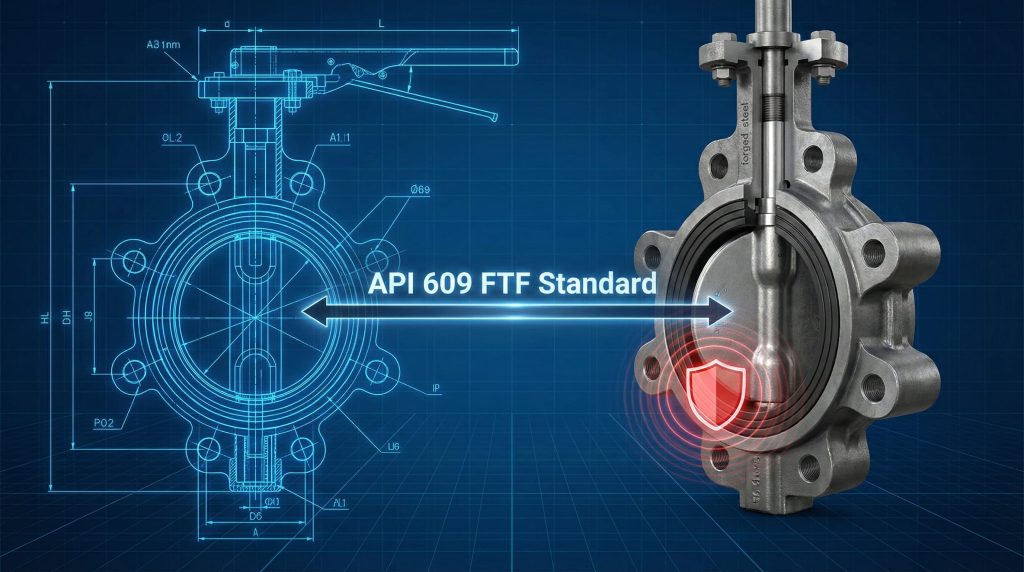
What is an api609 butterfly valve in piping?
An api609 butterfly valve in piping is a quarter-turn rotational motion valve designed to regulate or isolate flow within a system. This specific type of valve follows the American Petroleum Institute’s guidelines for dimensions, pressure-temperature ratings, and operational reliability.
Structural Design and Engineering
The engineering of this valve involves a rotating disc that resides in the center of the pipe, controlled by a stem that passes through to an external actuator. This design allows for rapid shutoff and effective flow control in large-diameter piping where space is limited.
Think about it.
- Valve Body: Typically compact and lightweight compared to other industrial valves.
- Disc: The “butterfly” component that rotates on a shaft to open or close.
- Stem: The critical link connecting the external actuator to the internal disc.
Standardized Valve Body Types
API 609 covers various body styles including wafer, lug, and flanged configurations to ensure they fit seamlessly into existing piping layouts. These standards allow engineers to select the most appropriate connection method based on the mechanical requirements of the system.
The result?
- Wafer Type: Designed to maintain a seal against bidirectional pressure differentials.
- Lug Type: Features threaded inserts that allow for downstream piping removal.
- Flanged Type: Utilizes traditional bolted flanges for high-integrity connections.
| Feature | Description |
|---|---|
| Motion | Quarter-turn (90 degrees) |
| Configuration | Wafer, Lug, or Flanged |
| Primary Use | Flow regulation and isolation |
Standardizing the structural design ensures that these valves provide consistent performance across different manufacturers.
Key Takeaway: API 609 defines the physical and structural parameters necessary for a butterfly valve to operate safely in industrial environments.
Why choose an api609 butterfly valve for oil?
Choosing an api609 butterfly valve for oil applications provides a lightweight and cost-effective alternative to heavy-duty gate valves or a ball valve when managing large flow volumes. The standard ensures that the valve can withstand the corrosive and high-temperature conditions common in petroleum refining and transport.
Critical Application Benefits
In the oil and gas sector, the reduced weight of these valves significantly lowers the stress on piping supports and infrastructure. This advantage is particularly valuable in offshore platforms where every kilogram of weight saved contributes to structural stability.
Here is the deal.
- Speed: Fast 90-degree operation is vital for emergency shutoff scenarios.
- Weight: Often 60% lighter than traditional gate valve alternatives.
- Space: The narrow face-to-face dimension saves valuable plant real estate.
Cost-Effectiveness and Efficiency
The efficiency of this valve design translates directly to lower operational costs and reduced maintenance budgets over the life of the project. Because the torque required for operation is relatively low, you can often utilize smaller and less expensive actuators.
But wait, there’s more.
- Lower Torque: Reduces the cost and size of pneumatic or electric actuators.
- Easy Maintenance: Simplified internal designs allow for faster seal replacements.
- Longevity: High-performance categories offer metal-to-metal seating for extreme durability.
| Factor | API 609 Advantage |
|---|---|
| Cost | Significant savings on large-bore installations |
| Installation | Reduced labor due to lower weight |
| Actuation | Compatible with compact, low-cost units |
Optimizing for cost and weight makes these valves the preferred choice for modern oil and gas infrastructure.
Key Takeaway: API 609 butterfly valves offer a strategic balance of performance and economy for large-scale petroleum operations.
How does the api609 butterfly valve standard work?
The api609 butterfly valve standard works by establishing a set of mandatory rules for manufacturers to ensure consistency in performance and dimensions. It acts as a technical bridge, ensuring that a valve produced by one vendor will meet the same safety and fitment criteria as a gate valve or any other API-compliant component.
Regulatory Framework and Compliance
The standard dictates minimum wall thicknesses, stem diameters, and bearing requirements to prevent mechanical failure under stress. It also provides clear envelopes for pressure and temperature ratings that engineers must follow during the design phase.
Now let’s dive deeper.
- Design Limits: Sets the boundaries for safe operating pressures.
- Manufacturing: Outlines tolerances for casting and forging processes.
- Material Traceability: Requires documented evidence of metallurgy and origin.
Interchangeability and Replacement
One of the most important aspects of the standard is the definition of face-to-face dimensions, which allows for “drop-in” replacements during maintenance. This eliminates the need for expensive piping modifications when a valve needs to be replaced after years of service.
Think about it.
- FTF Standards: Ensures length consistency across different brands.
- Standard Mounting: Compatible with universal ISO 5211 actuator mounting pads.
- Seal Geometry: Standardized seat designs for predictable sealing performance.
| Requirement | Specification |
|---|---|
| Stem Retention | Mandatory anti-blowout design |
| Wall Thickness | Compliant with ASME B16.34 |
| Interchangeability | Standardized face-to-face (FTF) |
By following these rules, the standard ensures that any valve you buy will perform as expected in the field.
Key Takeaway: The API 609 framework prioritizes structural integrity and physical compatibility to simplify plant maintenance and safety.
What materials suit an api609 butterfly valve?
Selecting the right materials for an api609 butterfly valve is essential for preventing premature corrosion and ensuring long-term seat integrity. While a globe valve might use similar alloys, the large surface area of a butterfly disc makes metallurgy even more critical for performance.
Material Selection Criteria
Material choices are typically dictated by the chemical nature of the media and the operating temperature of the system. For non-corrosive water applications, ductile iron is a common choice, whereas carbon steel or stainless steel is required for more aggressive fluids.
The result?
- Ductile Iron: Best for water and wastewater at moderate temperatures.
- Carbon Steel (WCB): Ideal for high-temperature steam and oil services.
- Stainless Steel: Necessary for chemical processing and marine environments.
High-Temperature Performance
For extreme heat applications, the standard requires materials that can maintain their structural strength without warping or losing their seal. Category B valves often utilize specialized alloys and metal-seated designs to handle temperatures that would destroy standard elastomer seals.
Here is the deal.
- Metal Seats: Essential for high-temperature steam or abrasive media.
- Stellite Overlays: Used on disc edges to provide superior wear resistance.
- Graphite Seals: Provides fire-safe protection in high-risk environments.
| Material | Typical Application | Temperature Range |
|---|---|---|
| Ductile Iron | Water / HVAC | -10°C to 120°C |
| WCB Steel | Oil / Refineries | -29°C to 425°C |
| SS316 | Chemicals / Acids | -196°C to 538°C |
Matching the metallurgy to the specific process media is the most effective way to prevent catastrophic valve failure.
Key Takeaway: Material selection under API 609 is a rigorous process that balances chemical compatibility with mechanical strength.
Are api609 butterfly valve tests necessary?
Yes, tests for an api609 butterfly valve are absolutely necessary to verify that the unit can hold pressure without leaking. These tests follow the API 598 protocol, which is the same standard used to verify the integrity of a check valve or other critical pipeline components.
Inspection and Pressure Verification
Each valve must undergo a series of hydrostatic and pneumatic tests before it leaves the factory to ensure there are no defects in the casting or assembly. These tests verify the integrity of the valve body (shell) as well as the effectiveness of the internal seals (seat).
But there is a catch.
- Shell Test: Performed at 1.5 times the rated pressure to check for leaks.
- Seat Test: Verifies that the disc and seat create a tight seal.
- Visual Check: Ensures the casting is free of “sand holes” or cracks.
Compliance with API 598
API 598 provides the specific duration and pressure levels for each test based on the valve size and material. Compliance with this standard gives you the peace of mind that the valve will not fail during the initial commissioning of your project.
Now let’s dive deeper.
- Low Pressure Air: Detects small leaks that high-pressure water might miss.
- High Pressure Seat: Simulates the maximum working conditions of the valve.
- Operational Test: Ensures the valve cycles smoothly from open to closed.
| Test Type | Objective | Pass Criteria |
|---|---|---|
| Hydrostatic Shell | Body integrity | Zero visible leakage |
| Seat Leakage | Seal performance | Zero or minimal bubbles |
| Backseat Test | Stem seal integrity | No leakage at stem |
Rigorous testing protocols are the only way to guarantee the safety of high-pressure industrial systems.
Key Takeaway: Mandatory testing per API 598 ensures that every API 609 valve meets the highest global safety standards.
How do api609 butterfly valve categories differ?
The categories for an api609 butterfly valve differ primarily in their design complexity and the severity of the applications they are intended to handle. The standard divides these valves into Category A and Category B to help engineers select the right level of performance.
Understanding Category A
Category A valves, often called “concentric” or “resilient-seated,” feature a disc centered in the middle of the valve body. These are generally used for low-pressure applications like water treatment, HVAC, or non-corrosive chemical lines.
Think about it.
- Seating: Uses a soft elastomer liner like EPDM or NBR.
- Pressure: Usually limited to ASME Class 125 or 150.
- Design: The simplest and most cost-effective butterfly design.
Advantages of Category B
Category B valves are “high-performance” units that utilize offset disc designs (double or triple eccentricity) to reduce seat wear and handle higher pressures. These are the workhorses of the oil, gas, and power generation industries.
The result?
- Offset Design: Displaces the disc from the centerline to minimize friction.
- Material: Uses PTFE, RTFE, or metal-to-metal seating for durability.
- Pressure: Capable of handling ASME Class 300, 600, and even higher.
| Feature | Category A | Category B |
|---|---|---|
| Seat Material | Elastomer (EPDM/Viton) | PTFE / Metal |
| Disc Offset | Zero Offset | Double / Triple Offset |
| Pressure Class | Class 150 | Class 300 / 600 |
Selecting between Category A and Category B is the most critical decision in the valve procurement process.
Key Takeaway: Category A is for utility service, while Category B is engineered for high-pressure, high-temperature industrial processes.
What are api609 butterfly valve face-to-face sizes?
The face-to-face sizes of an api609 butterfly valve are strictly standardized to ensure that they are thin enough to fit between pipe flanges while maintaining structural strength. This standardization is the primary reason why these valves are so easy to integrate into existing industrial layouts.
Dimensional Standardization
The standard provides specific tables for the “Face-to-Face” (FTF) dimensions, which is the total distance between the two ends of the valve body. Because these dimensions are fixed, you can swap out a valve from one manufacturer for another without having to cut or weld the pipes.
But wait, there’s more.
- Short Pattern: The most common design for space-saving installations.
- Long Pattern: Used when more robust sealing surfaces are required.
- Accuracy: Tolerances are kept within millimeters to ensure a perfect fit.
Wafer vs. Lug vs. Flanged
Each body style has slightly different dimensional requirements based on how it connects to the pipe. Wafer and lug styles are generally much thinner than the flanged style, making them ideal for tight spaces where a gate valve would never fit.
Here is the deal.
- Wafer: The thinnest profile, held in place by the clamping force of flanges.
- Lug: Slightly thicker to accommodate the threaded bolt holes.
- Flanged: The widest profile, used for the most secure piping connections.
| Valve Size (DN) | Wafer/Lug FTF (mm) | Flanged FTF (mm) |
|---|---|---|
| DN150 (6″) | 56 | 140 |
| DN200 (8″) | 60 | 152 |
| DN300 (12″) | 78 | 178 |
Precise dimensional standards allow for faster engineering design and significantly reduced downtime during repairs.
Key Takeaway: Standardization of face-to-face dimensions is the cornerstone of the API 609 standard’s versatility.
Does an api609 butterfly valve offer low resistance?
An api609 butterfly valve offers exceptionally low resistance compared to most other valve types, which helps maintain high flow rates and low pressure drops. While the disc remains in the flow path, its streamlined design ensures that turbulence is kept to a minimum.
Flow Efficiency and Cv Ratings
The flow coefficient (Cv) of a butterfly valve is typically very high, meaning it can move large volumes of fluid with very little energy loss. This efficiency is why they are so popular in gravity-fed systems and large-scale water distribution networks.
Think about it.
- Laminar Flow: Optimized disc shapes reduce turbulent eddies.
- Pressure Drop: Minimal loss of head pressure across the valve.
- Sizing: High Cv ratings often allow you to use smaller pipe sizes.
Comparison with Other Valve Types
While a full-bore ball valve has the lowest resistance possible, the API 609 butterfly valve is much more efficient than a globe valve. In many industrial cooling systems, this efficiency leads to significant electricity savings by reducing pump load.
Now let’s dive deeper.
- Vs. Globe Valve: Butterfly valves have much lower resistance.
- Vs. Ball Valve: Butterfly valves are slightly higher but more compact.
- Vs. Check Valve: Butterfly valves often offer better flow characteristics.
| Valve Type | Flow Resistance | Relative Efficiency |
|---|---|---|
| API 609 Butterfly | Low | Very High |
| Globe Valve | High | Low |
| Ball Valve | Very Low | Highest |
High flow efficiency makes this valve design the most sustainable choice for high-volume liquid transport.
Key Takeaway: API 609 valves prioritize flow efficiency to reduce energy consumption and maximize system throughput.
Can an api609 butterfly valve handle high pressure?
A Category B api609 butterfly valve can handle high pressure effectively, often rated up to ASME Class 600 or higher. Modern engineering techniques, such as the triple offset design, have allowed these valves to compete directly with heavy gate valves in high-pressure steam and gas services.
Pressure Rating Limits
The pressure rating of the valve is determined by the strength of its body casting and the design of its sealing mechanism. For high-pressure service, the standard requires reinforced seats and high-strength stems to prevent the valve from leaking or failing under the load.
But there is a catch.
- Class 150: Standard for most water and low-pressure oil lines.
- Class 300: Common in chemical processing and mid-range steam.
- Class 600: Used for high-pressure gas and power plant applications.
Sealing Technology Innovations
The introduction of the triple offset design has been a game-changer for high-pressure butterfly valves. By offsetting the disc in three different ways, the valve can achieve a metal-to-metal seal that is bubble-tight even at 100 bar of pressure.
The result?
- Frictionless: The disc only contacts the seat at the final moment of closure.
- Durability: Metal seats do not degrade like rubber or plastic.
- Reliability: Maintains a tight seal even after thousands of cycles.
| Pressure Class | Max PSI (Approx) | Typical Media |
|---|---|---|
| Class 150 | 285 | Water / Glycol |
| Class 300 | 740 | Oil / Steam |
| Class 600 | 1480 | Natural Gas |
Advancements in offset geometry have made it possible for butterfly valves to serve in the most demanding high-pressure environments.
Key Takeaway: High-performance API 609 valves are fully capable of replacing heavier valve types in high-pressure industrial circuits.
Where to buy a quality api609 butterfly valve?
When looking for a quality api609 butterfly valve, you must focus on manufacturers that provide full material traceability and documented pressure test reports. Buying from a certified vendor ensures that the valve will meet the strict safety requirements of your facility, just as you would expect when sourcing a high-precision plug valve.
Sourcing and Vendor Selection
A reliable manufacturer should be able to provide ISO 9001 certification and proof of API compliance for their production lines. It is also important to evaluate their engineering support, especially if you require custom seat materials or specialized automation.
Think about it.
- Certification: Always verify the manufacturer’s API license number.
- Testing: Ensure they perform 100% hydro-testing on every unit.
- Experience: Choose vendors with a proven track record in your specific industry.
Documentation and Certification
The documentation package is just as important as the valve itself, as it proves that the metallurgy and testing meet your project specifications. This package usually includes a Material Test Report (MTR) and a certificate of compliance with the API 609 standard.
The result?
- Traceability: Know exactly where the steel for your valve was forged.
- Verification: Proof that the valve passed its pressure tests.
- Safety: Reduced risk of liability in the event of a system failure.
| Selection Criteria | Importance | Verification |
|---|---|---|
| API Compliance | Critical | Request Audit Certificate |
| Testing Reports | High | Review API 598 Test Data |
| Support | Medium | Check Technical Data Sheets |
Investing in a high-quality, certified valve is the only way to ensure the long-term safety and efficiency of your operation.
Key Takeaway: Quality procurement requires a focus on certification, documented testing, and manufacturer reputation over the lowest initial price.
Frequently Asked Questions
Can I use an api609 butterfly valve for high-temperature steam?
Yes, Category B valves with metal-to-metal seats and stainless steel discs are specifically designed to handle high-temperature steam without losing their seal.
What’s the best way to choose between Wafer and Lug styles?
Select the Lug style if you need to perform maintenance on downstream piping while the system is pressurized, or use the Wafer style for the most compact and cost-effective installation.
How do I know if my api609 butterfly valve is fire-safe?
Check the manufacturer’s data sheet for API 607 or API 6FA certification, which indicates the valve has been tested to maintain seat integrity during a fire.
What’s the best material for a corrosive chemical line?
Stainless steel (CF8M) or even more exotic alloys like Duplex are the best choices for corrosive media to prevent pitting and structural degradation.
Can I replace a gate valve with an api609 butterfly valve?
Usually, yes, provided the face-to-face dimensions and pressure ratings are compatible; the butterfly valve will offer a significant weight reduction and faster operation.
Conclusion
Choosing the wrong valve leads to leaks, safety risks, and expensive project delays. By following the API 609 standard, you eliminate these variables and ensure your system is built on a foundation of precision engineering and proven reliability. We specialize in providing high-performance flow control solutions that meet the most rigorous international standards. If you are looking to upgrade your pipeline efficiency or need expert guidance on material selection, contact us today to discuss your project requirements. Our vision is to empower global industries with the most reliable, efficient, and sustainable valve technology available.