
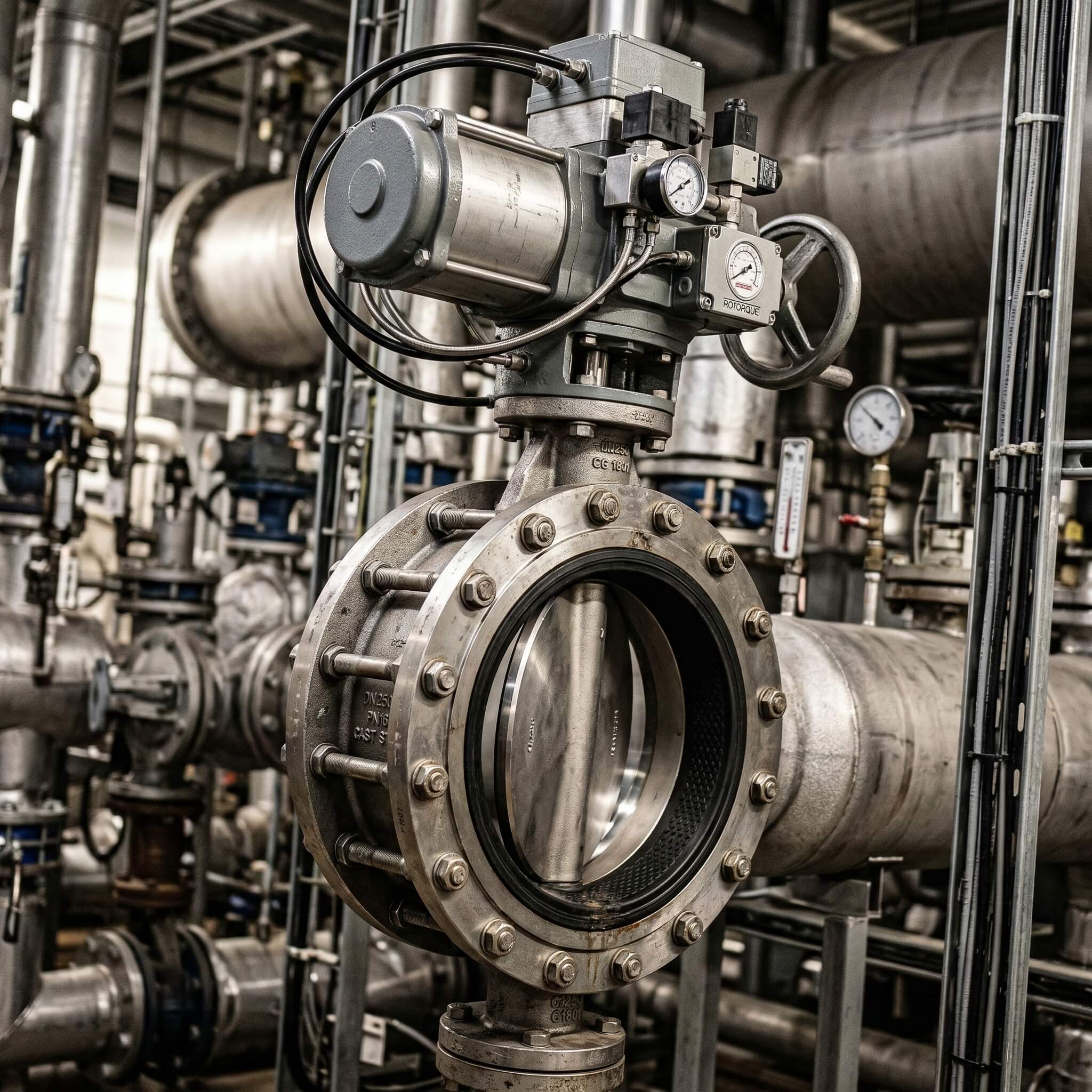
A butterfly valve is a quarter-turn rotational motion valve that uses a disc-shaped closing element to start, stop, or regulate the flow of various media within a piping system. Imagine you are overseeing a large-scale commercial piping project where every square inch of mechanical room space and every pound of weight matters. Traditional gate valves are proving too heavy for your support structures, and the high torque requirements of older ball valves are driving up your actuation costs. Utilizing a butterfly valve in hvac provides a streamlined, lightweight, and cost-effective solution that ensures reliable flow control without compromising system integrity.
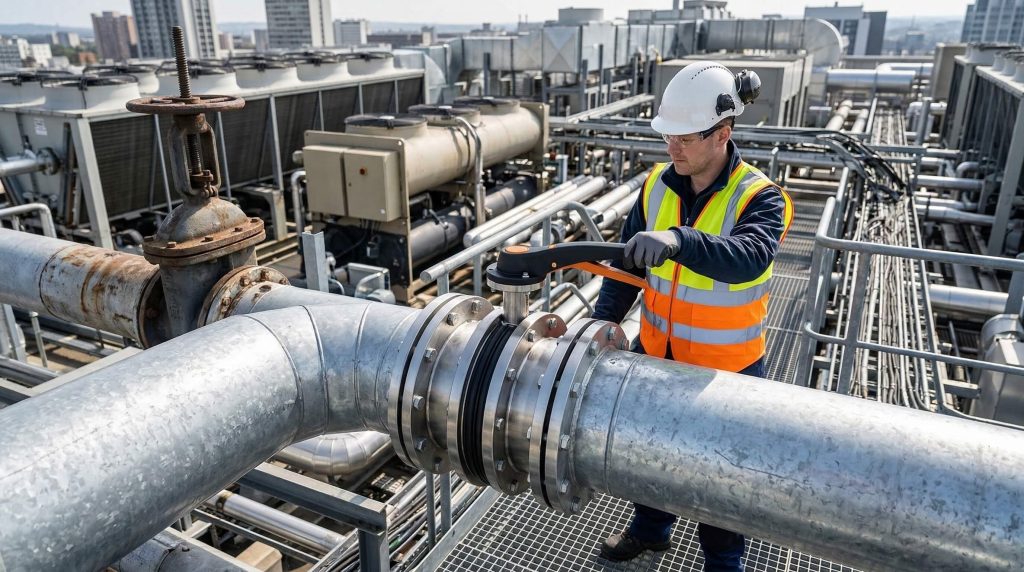
How does a butterfly valve in hvac function?
A butterfly valve in hvac functions by rotating a central disc 90 degrees to permit or obstruct the passage of fluid or gas. When the disc is turned parallel to the flow, the valve is fully open, and when it is turned perpendicular, the system is sealed.
The quarter-turn mechanism
The core efficiency of this design lies in its simplicity. By rotating the stem just one quarter-turn, you can transition from a full-flow state to a complete shutoff.
Think about it:
- Faster cycle times compared to multi-turn valves.
- Reduced wear on the internal components.
- Lower torque required for manual operation.
Manual vs automated operation
Depending on your specific system requirements, you can operate these valves using various methods. Most large-scale systems rely on actuators to maintain precise environmental conditions.
Here is the deal:
- Hand levers are ideal for smaller, manual balancing.
- Gear operators provide mechanical advantage for large diameters.
- Pneumatic and electric actuators allow for remote automation.
| Feature | Function Description |
|---|---|
| Operation | Quarter-turn (90 degrees) |
| Flow Control | On/Off or Throttling |
| Disc Motion | Rotational around a central axis |
This functional overview demonstrates how the rotating disc manages fluid dynamics with minimal physical movement.
Key Takeaway: The quarter-turn operation makes this valve type the most efficient choice for systems requiring rapid response and simple mechanical control.
Why use a butterfly valve in hvac?
You should use a butterfly valve in hvac because it offers a superior strength-to-weight ratio and a significantly lower price point for large-diameter pipelines. These valves are designed to handle high volumes of water or air while occupying minimal space between flanges.
Economic and physical advantages
When comparing industrial components, the physical footprint often dictates the final project cost. These valves use a thin, compact body that simplifies installation and reduces the load on your piping supports.
But wait, there is more:
- Lower material costs due to the slim body design.
- Reduced installation labor because of the lightweight structure.
- Minimized maintenance requirements over the long lifecycle.
Versatility in flow regulation
Beyond simple on/off service, these valves are highly capable of modulating flow to maintain system balance. This versatility ensures that your cooling and heating loops operate at peak efficiency.
The bottom line is:
- Excellent for handling large flow volumes.
- Reliable performance in both liquid and gas media.
- Compatible with a wide range of industrial standards.
| Advantage | Benefit to the User |
|---|---|
| Lightweight | Reduces structural support costs |
| Compact | Fits in tight mechanical spaces |
| Cost-effective | Lowers overall procurement budget |
These advantages make the valve a standard selection for engineers looking to optimize both performance and budget.
Key Takeaway: Choosing this valve type allows you to install high-capacity flow control in restricted spaces while keeping your project costs under control.
What parts make up a butterfly valve in hvac?
The basic structure of a butterfly valve in hvac includes the valve body, a stem, a disc, a resilient or metal seat, and the actuation handle or motor. Each component is engineered to work in harmony to provide a leak-proof seal and smooth rotation.
Critical internal components
The disc is the heart of the valve, acting as the primary barrier against the flow. It is supported by the stem, which transmits the rotational force from the operator to the disc itself.
Think about it:
- The disc shape impacts flow turbulence.
- Stem materials determine the valve’s pressure rating.
- The seat ensures a bubble-tight shutoff when closed.
Sealing and body styles
The seat can be made of various materials, such as EPDM or PTFE, depending on the temperature of the media. The body is typically designed in wafer or lug configurations to suit different piping connection needs.
Here is the deal:
- Wafer bodies are clamped between two pipe flanges.
- Lug bodies allow for downstream piping removal.
- Resilient seats provide excellent sealing for water applications.
| Component | Material/Type Examples |
|---|---|
| Body | Cast Iron, Ductile Iron, Stainless Steel |
| Disc | Nylon Coated, Stainless Steel, Bronze |
| Seat | EPDM, NBR, PTFE, Metal |
Each part is selected based on the chemical compatibility and thermal demands of your specific industrial environment.
Key Takeaway: Understanding the component breakdown helps you specify the right materials for longevity and leak prevention in your facility.
Which butterfly valve in hvac is best?
Selecting the right butterfly valve in hvac depends on whether your application requires a concentric design for low pressure or an eccentric design for higher performance. Most standard water loops utilize concentric designs, while steam or high-pressure systems require offset configurations.
Concentric vs eccentric designs
In a concentric design, the shaft passes through the center of the disc and the center of the valve body. This is the most common and cost-effective choice for general industrial services.
But wait, there is more:
- Simple design for easy maintenance.
- Ideal for low-pressure water systems.
- Resilient seats provide a tight seal at lower costs.
High-performance offset valves
Eccentric valves, including double and triple offset models, move the shaft away from the center of the disc. This reduces friction between the disc and the seat, extending the life of the valve in demanding conditions.
The point is:
- Double offset reduces seat wear during operation.
- Triple offset allows for metal-to-metal bubble-tight sealing.
- Excellent for high-temperature and high-pressure steam.
| Valve Type | Primary Application | Sealing Style |
|---|---|---|
| Concentric | Low-pressure water/air | Resilient (Soft) |
| Double Offset | High-cycle industrial | High-performance |
| Triple Offset | Extreme Temp/Pressure | Metal-to-Metal |
Matching the valve architecture to your system’s pressure profile prevents premature failure and operational downtime.
Key Takeaway: Use concentric valves for standard water utility and eccentric valves when your system demands high-cycle reliability or extreme thermal resistance.
What is the Cv for a butterfly valve in hvac?
The flow coefficient, or Cv, for a butterfly valve in hvac represents the volume of water in gallons per minute that can flow through the valve with a pressure drop of 1 psi. A higher Cv indicates that the valve offers less resistance to flow, which is crucial for maintaining pump efficiency.
Calculating flow capacity
Cv is determined by the size of the valve and the angle at which the disc is positioned. When the valve is fully open at 90 degrees, it reaches its maximum Cv, allowing for high-volume movement with minimal energy loss.
Here is the deal:
- Cv values increase exponentially as the valve opens.
- Larger valve sizes naturally offer higher Cv ratings.
- Streamlined disc designs help maximize the flow coefficient.
Impact of disc geometry
The thickness and shape of the disc directly influence the flow resistance. A thinner, more aerodynamic disc will have a higher Cv than a thicker, flat-faced disc because it creates less turbulence.
Think about it:
- High Cv reduces the workload on your pumps.
- Lower turbulence minimizes noise in the pipeline.
- Proper sizing prevents cavitation at high flow rates.
| Valve Size (DN) | Approx. Cv at 90° | Approx. Cv at 60° |
|---|---|---|
| DN100 (4″) | 600 | 230 |
| DN200 (8″) | 3,136 | 1,202 |
| DN300 (12″) | 8,250 | 3,162 |
Calculating the correct Cv ensures that your system achieves the required flow rates without excessive pressure loss.
Key Takeaway: Always consult the Cv chart for your specific valve size to ensure it can handle the maximum flow requirements of your cooling loop.
Is the butterfly valve in hvac linear?
The butterfly valve in hvac typically exhibits an equal percentage flow characteristic rather than a purely linear one. This means that at the beginning of the opening stroke, the flow changes slowly, but as the valve opens further, the flow rate increases more rapidly.
Understanding flow characteristics
In a linear characteristic, the flow rate would change proportionally with the valve’s position. However, due to the disc’s geometry, these valves are most effective for control between the 30-degree and 70-degree opening angles.
But wait, there is more:
- Fine control is possible at lower opening angles.
- High-volume throughput is achieved quickly after 50% open.
- Fast-opening designs are available for emergency shutoff needs.
Managing the control range
Because these valves are sensitive to small changes in position, choosing the right actuator resolution is critical. Operating the valve too close to the seat (less than 15 degrees) can cause high velocity and erosion.
The bottom line is:
- Ideal modulation occurs in the mid-range of movement.
- Equal percentage curves are better for temperature control.
- Proper sizing avoids the “humping” effect in flow control.
| Flow Characteristic | Flow Change Description | Ideal Use Case |
|---|---|---|
| Equal Percentage | Exponential increase in flow | General Modulation |
| Linear | Proportional flow increase | Precise Throttling |
| Fast Opening | Rapid initial flow | On/Off Service |
Selecting the right characteristic ensures that your automated control systems can maintain stable temperatures without hunting.
Key Takeaway: You should aim to size your valves so that normal operating conditions fall within the 30 to 70-degree opening range for optimal control.
Can a butterfly valve in hvac handle pressure?
A butterfly valve in hvac is highly effective for low-to-medium pressure systems, typically rated up to PN16 or PN25. While they are not the first choice for ultra-high pressure steam, advanced triple-offset designs can handle significantly higher loads than standard models.
Pressure drop and resistance
The pressure drop across the valve is an indicator of energy loss within your system. Because the disc remains in the flow path even when open, there is always a slight pressure drop, though streamlined designs minimize this impact.
Think about it:
- Fully open valves have the lowest pressure drop.
- Partially closed valves create turbulence and higher drops.
- High pressure drops can lead to cavitation and noise.
Handling vacuum and surge
In some industrial scenarios, valves must also withstand vacuum conditions or sudden pressure surges. Resilient seated valves are particularly good at maintaining a seal even when the system pressure fluctuates.
Here is the deal:
- Reinforced seats prevent “blow-out” during surges.
- High-quality seals maintain integrity under vacuum.
- Metal-seated valves are preferred for high-pressure differentials.
| Pressure Rating | Typical Application | Max Temperature |
|---|---|---|
| PN10 | Gravity/Low-pressure water | Up to 120°C (EPDM) |
| PN16 | Standard Commercial HVAC | Up to 150°C (High-temp EPDM) |
| PN25/ANSI 150 | Industrial Process | Up to 200°C+ (Metal) |
Evaluating the maximum working pressure of your system is the first step in selecting a valve that won’t leak or fail under stress.
Key Takeaway: For standard commercial cooling, a PN16 rated valve is usually sufficient, but always check for peak surge pressures in your calculations.
Does a butterfly valve in hvac save space?
Yes, a butterfly valve in hvac is one of the most space-efficient valve types available on the market today. Its “wafer” thin profile allows it to be sandwiched between pipe flanges, taking up only a fraction of the length required by a gate or globe valve.
Compact installation benefits
In modern mechanical rooms, space is at a premium. Using a compact valve allows you to design tighter piping arrays, which reduces the overall footprint of the mechanical installation.
But wait, there is more:
- Allows for more valves in a smaller area.
- Simplifies the design of modular skids.
- Reduces the total weight on the building’s structure.
Ease of maintenance access
Because these valves are smaller and lighter, they are much easier for your maintenance team to handle. Removing a 12-inch butterfly valve for service is a two-person job, whereas a gate valve of the same size might require a crane.
The point is:
- No need for heavy rigging in tight spaces.
- Faster removal and replacement during shutdowns.
- Simplified bolt patterns for quicker installation.
| Valve Type | Face-to-Face Length | Weight Comparison |
|---|---|---|
| Butterfly Valve | Very Short (Compact) | Lightest |
| Gate Valve | Long | Very Heavy |
| Ball Valve | Medium | Heavy |
The space-saving nature of this valve translates directly into lower structural costs and easier long-term facility management.
Key Takeaway: Use these valves whenever you are working with limited real estate or weight-sensitive platforms to maximize your design efficiency.
When is a butterfly valve in hvac applied?
A butterfly valve in hvac is applied in any scenario requiring the movement of large volumes of fluid, such as condenser water loops, chilled water systems, and fire protection networks. They are the workhorses of central plant cooling and heating systems.
Commercial and industrial use cases
You will find these valves in almost every major facility, from data centers to hospitals. They are used to isolate chillers, cooling towers, and primary pump headers.
Here is the deal:
- Chiller isolation for routine maintenance.
- Balancing large-scale air handling units.
- Managing flow in municipal water treatment plants.
Chemical and process applications
Beyond standard water, these valves are often used in chemical processing where corrosion resistance is required. By selecting a stainless steel disc and a PTFE seat, you can handle aggressive media with the same mechanical efficiency.
Think about it:
- Corrosive fluid handling in industrial plants.
- Slurry management in mining operations.
- Potable water distribution in municipal grids.
| Industry | Primary Use | Common Material |
|---|---|---|
| Commercial HVAC | Chilled/Condenser Water | Ductile Iron / EPDM |
| Water Treatment | Filtration/Distribution | Cast Iron / NBR |
| Chemical Process | Acid/Alkali Handling | Stainless Steel / PTFE |
The wide range of available materials makes this valve adaptable to nearly any fluid control challenge you might face.
Key Takeaway: Look for these valves in any application where you need reliable on/off or throttling control for pipes larger than 2 inches.
What limits a butterfly valve in hvac use?
The primary limits of a butterfly valve in hvac use include temperature restrictions of the soft seat materials and the potential for cavitation when the valve is used for high-pressure throttling at small opening angles. While versatile, they are not a “one-size-fits-all” solution for every extreme environment.
Temperature and seal constraints
Resilient seats made of EPDM or NBR have clear thermal limits. If your system operates at temperatures exceeding 150°C, a standard butterfly valve may experience seal degradation and leakage.
But wait, there is more:
- High heat can cause soft seats to deform.
- Extreme cold can make seal materials brittle.
- Steam applications often require specialized metal seats.
Flow velocity and cavitation
Because the disc is always in the flow stream, high-velocity fluids can cause “flutter” or cavitation if the valve is improperly sized. This can lead to noise, vibration, and eventual damage to the disc and downstream piping.
The bottom line is:
- Avoid using large valves for very small flow rates.
- Cavitation risk increases at low opening angles.
- High-velocity air can cause acoustic issues in ducts.
| Limitation | Cause | Potential Result |
|---|---|---|
| Temperature | Soft seat material limits | Leakage / Seal failure |
| Throttling | Low opening angle / High ΔP | Cavitation / Erosion |
| High Pressure | Design structure | Component deformation |
Awareness of these limitations allows you to implement protective measures, such as choosing metal seats or using multi-stage control valves for extreme pressure drops.
Key Takeaway: Always verify that your system’s peak temperature and pressure drop don’t exceed the specified limits of the valve’s seat and disc design.
Conclusion
Optimizing your fluid control systems requires a balance of reliability, cost, and physical performance. By integrating precision-engineered butterfly valves, you solve the complex challenges of weight management and flow efficiency in large-diameter piping. Our commitment is to provide engineers with the highest quality fluid control solutions that meet global standards for safety and durability. We believe that every industrial system deserves components that operate with 99.5% reliability and predictable maintenance cycles. To enhance your next project with industry-leading valve technology, reach out to us today for a technical consultation.
FAQ
Can I use a butterfly valve for steam?
Yes, but only if you select a high-performance or triple-offset model. Standard resilient-seated valves will fail under the high temperatures and pressures of steam service.
What is the best way to prevent leaks?
Ensure correct flange alignment and bolt torque during installation. Selecting a lug-style body also provides more stability and a more secure seal for downstream maintenance.
How do I know if my valve is cavitating?
Listen for a sound similar to “gravel” passing through the pipe. If you hear this during throttling, your pressure drop is too high for the current opening angle.
Can I install these valves vertically?
Yes, definitely. Butterfly valves can be installed in any orientation, though installing the stem horizontally is often recommended in systems with heavy sediment to prevent buildup in the bearings.
How do I choose between a wafer and a lug body?
Choose a wafer body for lower costs and simple installation between two flanges. Choose a lug body if you need to disconnect piping on one side of the valve while the other remains under pressure.