
Introduction
Designing modern piping systems is often an exercise in managing constraints. Engineers and facility managers constantly struggle to balance the need for precise flow control against severe space limitations and tightening budget caps. Whether you are laying out a municipal water treatment plant or retrofitting a cramped mechanical room on an offshore rig, the physical footprint of your valves can dictate the entire design of your piping racks.
But the problem goes deeper than just square footage. Choosing the wrong valve type often leads to “hidden costs” that balloon project budgets long after the initial purchase. Massive, heavy valves require expensive structural reinforcement and specialized installation crews. Multi-turn valves that take minutes to close can be disastrous during emergency shut-off scenarios. Furthermore, utilizing an over-engineered valve for a simple isolation task wastes capital that could be better deployed elsewhere.
The strategic solution to this engineering headache is the butterfly valve. Far more than just a simple shut-off device, the butterfly valve is a quarter-turn workhorse that solves the space-weight-speed equation better than almost any other valve type on the market. By offering a high-flow capacity in a narrow body design, it allows for compact system layouts without sacrificing performance. This guide covers everything from internal mechanics to industrial applications, ensuring you make the right selection for your specific system needs.
Understanding the Design and Use of Butterfly Valves
To appreciate why these valves are ubiquitous in industrial settings, one must first understand the simplicity of their mechanical design. Unlike complex globe valves or bulky gate valves, the use of butterfly valves is predicated on efficiency of motion and material.
How does the quarter-turn work?
The defining characteristic of this valve is its rotational operation. You only need a simple 90-degree turn to go from fully open to fully closed. This is achieved through a disc mounted on a rotating shaft (stem). When the actuator or handle turns the stem, the disc swings 90 degrees.
Here is why speed matters in this context:
- Rapid Actuation: Compared to a gate valve, which may require multiple full turns of a handwheel to close, a butterfly valve closes instantly. This is critical in emergency shutdown systems (ESD).
- Rotational Axis: The disc pivots around a central axis, requiring significantly less torque to operate than lifting a heavy wedge against line pressure.
- Automation Friendly: The 90-degree motion is easily adapted to pneumatic and electric actuators, making these valves ideal for automated process loops.
What is the flow control logic?
The flow control logic of a butterfly valve is unique because the closure element (the disc) remains inside the flow path at all times. In a ball valve, the bore is clear when open; however, in a butterfly valve, you must understand that the disc is always present, even at full flow.
- Perpendicular vs. Parallel: When closed, the disc is perpendicular to the flow, sealing against the seat. When open, it is parallel, allowing fluid to pass around it.
- Throttling Capabilities: Butterfly valves exhibit arguably better linear flow characteristics than gate or ball valves between 30% and 70% open, making them useful for throttling (regulating) flow, not just stopping it.
- Pressure Drop: Because the disc divides the flow stream, there is a slight pressure drop. However, the aerodynamic profile of modern discs minimizes this resistance significantly.
Key Takeaway: Why choose this design?
The design prioritizes speed and compactness over a completely unobstructed flow path. This makes the use of butterfly valves the ideal choice for large-volume systems where saving weight and space is more critical than eliminating a minor pressure drop.
Critical Components That Enable Butterfly Valve Usage
The reliability of a butterfly valve depends entirely on the quality and configuration of its three main components: the body, the disc, and the seat.
What makes up the valve body?
The body connects the valve to the pipeline. You will typically choose between two main body styles based on your pipeline setup and maintenance requirements.
- Wafer Style: This body type is designed to be “sandwiched” between two pipe flanges. Long bolts pass from one flange, through the holes (or around the body), to the other flange. It is the most cost-effective and lightweight option but makes it impossible to disconnect one side of the piping without draining the entire system.
- Lug Style: This body features threaded inserts (lugs) on both sides. You can bolt the pipe flanges directly to the valve body. This allows for “dead-end service,” meaning you can remove the downstream piping for maintenance while the valve remains bolted to the upstream pipe, acting as a plug.
- Materials: Bodies are cast from ductile iron for general water service, stainless steel for corrosive environments, or PVC for chemical handling.
How do seats prevent leakage?
The seat is the interior lining of the valve body. When the disc closes, it presses into this seat to form a seal.
But there is a catch regarding temperature and pressure…
- Elastomer (EPDM/Buna-N): These are “soft seats.” They provide a zero-leakage (bubble-tight) shutoff and are standard for water, HVAC, and general utility lines. However, they have temperature limits (typically up to 250°F).
- Metal-to-Metal: Used in high-performance valves, metal seats are required for extreme temperatures (steam) or abrasive applications where rubber would melt or shred.
- PTFE/Teflon: These seats offer excellent chemical resistance, making them the standard for aggressive acids and solvents where elastomers would degrade.
Key Takeaway: Material selection matters
The longevity of your butterfly valve usage depends entirely on matching the seat and disc material to your specific media. A mismatch—such as using a Buna-N seat with a hydrocarbon solvent—will lead to seat swelling, increased torque, and eventual valve failure.
Major Advantages Driving the Use of a Butterfly Valve
Why do engineers specify butterfly valves over other types? The decision is usually driven by the “Impossible Triangle” of engineering: Cost, Weight, and Space.
How much space do they save?
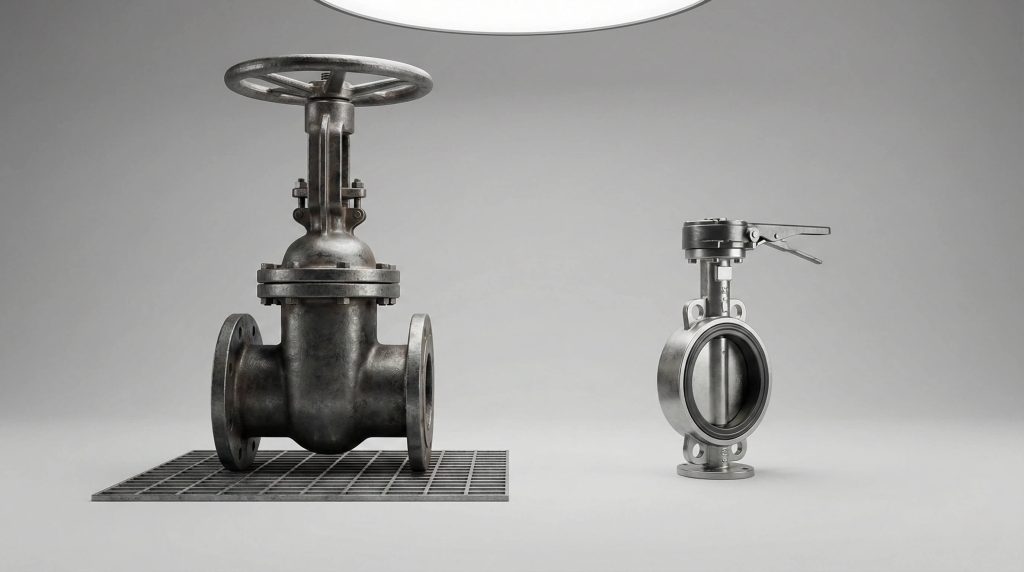
If you are working in a cramped mechanical room or an offshore platform, every inch counts. The “face-to-face” dimension (the width of the valve along the pipe) of a butterfly valve is significantly smaller than a ball or gate valve of the same diameter.
- Narrow Profile: A 6-inch gate valve might be 10 inches wide; a 6-inch butterfly valve is often less than 3 inches wide.
- Reduced Weight: Because the body uses less metal, the valve is lighter. This reduces the need for robust pipe hangers and structural support beams, which is a massive advantage in shipbuilding and overhead piping.
- Easier Installation: A single technician can often lift and install a moderate-sized butterfly valve, whereas a gate valve of the same size might require a chain hoist or crane.
Are they cost-effective options?
Let’s look at the bottom line. The manufacturing process for butterfly valves is inherently more economical.
- Lower Material Usage: Less cast iron or stainless steel is required to cast the body.
- Cheaper Actuation: Because of the balanced torque (in many designs), actuators can be smaller and less powerful than those required for ball valves, reducing the cost of automation packages.
- Reduced Labor: Faster installation and simpler maintenance (often just a seat replacement) drive down long-term operational costs (OPEX).
Key Takeaway: Efficiency meets economy
You get a high-performance flow control solution that costs less and weighs less than the alternatives. This makes them the default standard for pipes larger than 4 inches.
Expert Analysis: “While the initial purchase price is attractive, the true value of butterfly valves lies in the reduced structural support requirements and faster installation times. In large-scale industrial projects, shifting from gate valves to butterfly valves can cut total project capital expenditures (CAPEX) for piping systems by up to 15%.”
Table: Pros vs. Cons of Butterfly Valves
| Feature | Advantages | Disadvantages |
|---|---|---|
| Physical Footprint | Compact and lightweight; fits tight spaces. | Disc obstructs flow path slightly (pressure drop). |
| Operation Speed | Fast quarter-turn opening/closing. | Fast closing can cause water hammer if not damped. |
| Cost | Economical, especially in large sizes (>4″). | Higher torque needed for very large sizes. |
| Maintenance | Few moving parts; easy seat replacement. | Not “piggable” (cannot clean line with pig). |
| Flow Control | Good linear throttling capability. | Potential for cavitation at certain angles. |
Selecting Types for Specific Butterfly Valve Uses
Not all butterfly valves are created equal. They are categorized by the alignment of the stem and disc, which dictates their pressure capabilities.
What is a concentric valve?
This is the standard, general-purpose valve. The stem is centered in the middle of the disc, and the disc is centered in the bore.
- Mechanism: The disc interferes with the rubber seat to create a seal.
- Engagement: You will see this type most often in water treatment plants, HVAC cooling loops, and fire protection systems.
- Limitation: The rubber seat is constantly rubbed by the disc, limiting it to lower pressures (typically up to 150-250 PSI) and non-abrasive fluids.
When to use triple-offset valves?
Now, things get technical. For high-pressure, high-temperature, or critical isolation, standard rubber-lined valves will fail. This is where Eccentric (Offset) valves come in.
- Double-Eccentric: The stem is offset from the center of the disc and the center of the bore. This cam action lifts the disc off the seat immediately upon opening, reducing wear.
- Triple-Eccentric: A third angular offset is machined into the seat cone. This allows for a metal-to-metal seal that is “bubble-tight” and frictionless.
- Application: These are used in high-pressure steam, hydrocarbon refining, and chemical processing where leakage is not an option.
Key Takeaway: Offset equals performance
Standard concentric valves handle general utilities, but you must upgrade to double or triple offset designs (High-Performance Butterfly Valves) for extreme heat, high pressure, or when longevity is the priority.
Comparison: When to Use Butterfly Valves vs. Others
Choosing a valve is often a comparative exercise. How does the butterfly stack up against the two other most common industrial valves?
Butterfly valve vs. ball valve?
This is the battle of the quarter-turn valves.
- Ball Valves: Feature a sphere with a hole. When open, the flow path is unobstructed (full bore). They seal tighter at high pressures and are generally superior for small pipes (< 2 inches).
- Butterfly Valves: Lighter and cheaper for pipes > 4 inches. While ball valves become exponentially heavy and expensive as size increases, butterfly valves remain manageable.
- You might prefer: A ball valve for a 1-inch chemical line, but a butterfly valve for a 10-inch water main.
Butterfly valve vs. gate valve?
This compares Rotational vs. Linear motion.
- Gate Valves: A wedge moves up and down. They are multi-turn (slow) and very heavy. They are excellent for strictly on/off service where full flow is needed, but they cannot throttle.
- Butterfly Valves: Fast actuation and good throttling capabilities. They require significantly less vertical clearance (headroom) than a gate valve, which needs room for the stem to rise.
Key Takeaway: The weight advantage
In large diameter applications (6 inches and up), the massive weight difference makes the use of butterfly valves the only logical logistical choice.
Expert Analysis: “The tipping point typically occurs at the 4-inch diameter mark. Below this, ball valves offer superior flow characteristics. However, above 4 inches, the weight and cost savings of butterfly valves become exponentially more beneficial, often weighing 50-70% less than an equivalent gate valve.”
Table: Valve Type Comparison Matrix
| Feature | Butterfly Valve | Ball Valve | Gate Valve |
|---|---|---|---|
| Mechanism | Quarter-Turn Rotational | Quarter-Turn Rotational | Multi-Turn Linear |
| Flow Restriction | Partial (Disc in flow) | None (Full Port) | None (When open) |
| Weight/Size | Light/Compact | Heavy/Bulky | Heavy/Tall |
| Throttling | Good (Linear 30-70%) | Poor | Very Poor |
| Ideal Size Range | 4″ to 60″+ | 0.5″ to 4″ | 2″ to 24″+ |
Industrial Uses for Butterfly Valves in Energy Sectors
The energy sector demands durability. Here, valves are not just plumbing; they are safety devices.
How are they used in oil and gas?
You cannot afford leaks when dealing with hydrocarbons.
- Fire-Safe Standards: In refineries, valves must meet API 607 fire-safe standards. Triple-offset butterfly valves are preferred here because their metal seats withstand the intense heat of a fire while maintaining a seal.
- Applications: They are used in cooling loops, tank farms for fuel storage, and offshore rig ballast systems where weight reduction is critical for vessel stability.
What role in power generation?
Consider the scale of power plants—they move massive volumes of water and steam.
- Cooling Water: Enormous intake and outtake pipes (sometimes 60+ inches wide) utilize butterfly valves to manage river or ocean water used for cooling condensers.
- FGD Systems: Flue Gas Desulfurization scrubbers use butterfly valves to control the lime slurry that cleans exhaust gases.
- Penstocks: In hydroelectric dams, large butterfly valves act as turbine inlet valves, safeguarding the turbines from water hammer.
Key Takeaway: Reliability in harsh zones
In energy sectors, the use of butterfly valves—specifically high-performance and triple-offset types—ensures safety compliance and operational continuity in environments where failure could be catastrophic.
Critical Butterfly Valve Uses in Water & Food Systems
While energy sectors demand pressure resistance, the water and food industries demand purity and corrosion resistance.
Are they safe for drinking water?
Municipal water distribution is the largest global user of concentric butterfly valves.
- Standards: You need valves that resist corrosion and protect public health. Valves must meet NSF/ANSI 61 (USA) or WRAS (UK) standards for potable water contact.
- Coatings: The discs are often coated in nylon or epoxy, and the bodies are lined with bonded rubber to prevent the water from ever touching the iron metal body.
- Desalination: In desalination plants, valves with Duplex Stainless Steel discs are used to resist the highly corrosive brine.
How do food industries benefit?
In food processing, “sanitary” or “hygienic” valves are required.
- Cleanability: Sanitary butterfly valves feature polished stainless steel (316L) discs and FDA-approved elastomer seats (Silicone/Viton) that do not harbor bacteria.
- Split-Body Design: These valves often use a clamp-together body that can be easily disassembled by hand for daily cleaning or are designed for Clean-in-Place (CIP) procedures.
- Applications: They handle viscous fluids like syrups, dairy, and beer, where flow control must be precise to ensure recipe consistency.
Key Takeaway: Versatility in infrastructure
From the water tap to the dairy plant, sanitary butterfly valve usage guarantees purity, prevents contamination, and ensures consistent flow rates in consumer-facing industries.
Installation and Maintenance for Butterfly Valve Usage
Even the best valve will fail if installed incorrectly.
How to install correctly?
Alignment is everything.
- Flange Alignment: Pipe flanges must be parallel. Forcing a valve into misaligned pipes places stress on the body, leading to cracks or leaks.
- Disc Position: Crucial: You must install the valve with the disc slightly open (about 10 degrees). If installed fully closed, the seat may be compressed too tightly by the flanges, making it impossible to open. If installed fully open, the disc might extend beyond the body and be damaged by the flange bolts during tightening.
- Interference Check: Ensure adjacent piping (especially Schedule 80 or thick-walled pipe) allows enough clearance for the disc to swing open.
What are common failure signs?
- Seat Hardening: Over time, elastomers harden due to heat or chemical attack, leading to leaks.
- Stem Leakage: If the packing gland wears out, media will leak up the shaft.
- Actuator Hesitation: If the valve is hard to turn, it may be due to swollen seats (chemical incompatibility) or an undersized actuator.
Key Takeaway: Prevention saves money
Proper alignment during installation prevents 90% of premature failures in butterfly valve usage. Never force a valve into a gap that is too small.
Expert Analysis: “Most seat failures are not due to manufacturing defects, but rather improper installation where the valve is bolted into a completely closed position. This compresses the rubber seat unevenly before the system is even pressurized, creating permanent deformation.”
Table: Common Troubleshooting Guide
| Symptom | Probable Cause | Corrective Action |
|---|---|---|
| Leakage across seal | Seat damage or debris trapped. | Cycle valve to flush debris; replace seat if cut. |
| Stem Leakage | Worn packing/O-rings. | Tighten packing gland or replace O-rings. |
| Hard to Operate | Actuator undersized or seat swollen. | Check media compatibility with seat; verify torque specs. |
| Noisy Operation | Cavitation or high velocity. | Check flow rates; ensure valve isn’t undersized/throttling too much. |
Conclusion
We have explored how butterfly valves solve the engineering “impossible triangle” of weight, cost, and performance. From the simple concentric designs regulating flow in your local water treatment plant to the sophisticated triple-offset beasts securing high-pressure lines in oil refineries, these components are indispensable to modern infrastructure.
As industries move toward total automation, the lightweight, low-torque, and fast-acting nature of these valves makes them the primary candidate for the smart, actuated flow control systems of the future.
Don’t let outdated, heavy gate valves slow down your operations or weigh down your budget. Audit your piping systems today to identify where high-efficiency butterfly valves can reduce maintenance costs, lower structural loads, and improve emergency response times.
FAQ: Frequently Asked Questions
- Can I use a butterfly valve for throttling flow?
Yes, but with caution. While they are better than gate valves for throttling, butterfly valves are most effective and linear between 30% and 70% open. Using them for long periods near the closed position (<20%) can cause high-velocity fluid to cut the seat (wire drawing) and induce cavitation. - Are butterfly valves suitable for slurry or abrasive fluids?
Generally, standard butterfly valves are not recommended for heavy slurries because the disc sits directly in the flow path and can be eroded by particles. However, specialized valves with hardened metal discs and robust, abrasion-resistant seats are designed specifically for these harsh environments. - Can I “pig” a pipeline that has butterfly valves installed?
No, you cannot. Because the disc remains in the center of the pipe even when fully open, it obstructs the passage of a cleaning “pig.” If your line requires pigging for cleaning or inspection, you must use a full-port ball valve or gate valve. - What is the difference between a Lug and Wafer style body?
Wafer valves are sandwiched between two pipe flanges and held by long bolts; if you remove the pipe on one side, the valve falls out and the line drains. Lug valves have threaded inserts, allowing you to bolt the valve to the pipe. This allows you to remove the downstream piping while the valve remains attached and closed (dead-end service). - Do butterfly valves provide a bubble-tight shutoff?
It depends on the type. Resilient-seated (rubber) valves and high-performance triple-offset valves provide a bubble-tight (zero leakage) seal. However, older metal-seated or loosely toleranced valves may allow a small, allowable leakage rate according to specific API standards.