
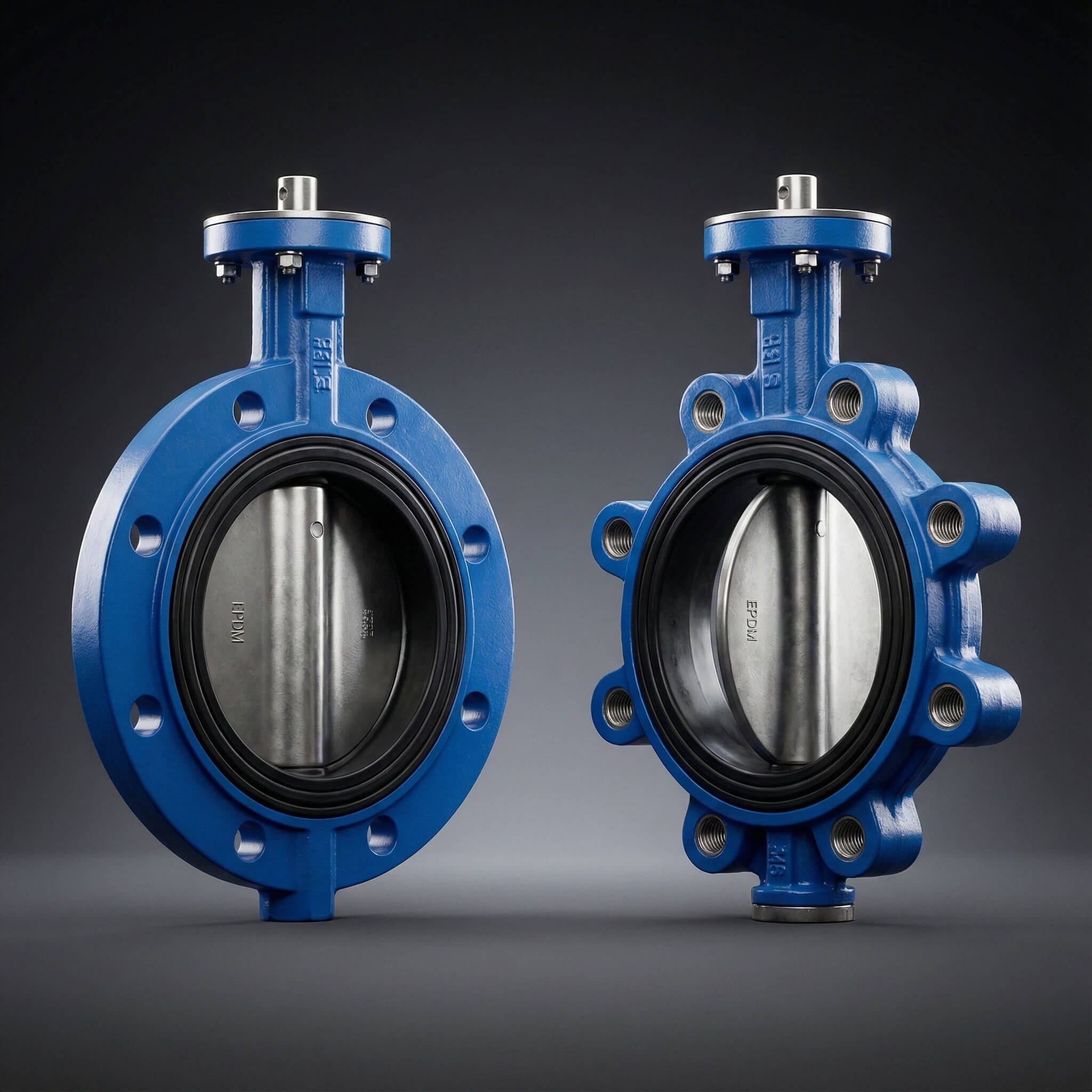
In complex industrial piping systems—whether for municipal water treatment or marine shipbuilding—you often face a critical junction during the procurement phase: choosing between wafer and lug-style butterfly valves.
Selecting the wrong connection type can lead to disastrous consequences, including the inability to perform downstream maintenance without system shutdown, flange incompatibility, or catastrophic leaks under high-pressure dead-end service. These errors drive up Total Cost of Ownership (TCO) and delay project timelines.
Understanding the specific mechanical and operational differences is vital. Backed by RUITO’s 20 years of manufacturing expertise and compliance with ISO/DIN standards, this guide provides a technical comparison to ensure your project selects the correct valve for long-term stability and safety.

Structural Design in Wafer vs Lugged Butterfly Valve
How is the body shaped?
The physical construction defines the primary difference between these two valve types.
- Wafer: Features a thin body designed to be sandwiched between flanges.
- Lug: Features threaded inserts (lugs) around the entire circumference.
- Design Focus: Wafer focuses on compression; Lug focuses on bolting.
What is the bolt alignment?
Consider the way bolts interact with the valve body during assembly.
- Wafer: Long bolts pass through the entire body connecting both pipe flanges.
- Lug: Short bolts screw directly into the threaded valve lugs from both sides.
- Stability: Lug connections provide independent fastening for each flange.
Is the centering self-guided?
Proper alignment is critical for preventing seal leakage in your system.
- Wafer: Relies on the bolts surrounding the body for centering.
- Lug: Self-centers automatically as bolts are tightened into the threads.
- Precision: Lug valves minimize installation error margins.
| Feature | Wafer Style | Lug Style |
|---|---|---|
| Body Shape | Sandwich design | Threaded inserts |
| Bolt Type | Long stud bolts | Short cap screws |
| Centering | Manual alignment | Self-centering |
Analysis: For critical DIN or ANSI standard projects, the structural rigidity of the lugged design offers superior alignment assurance. While wafer designs are lighter, RUITO recommends lugged bodies where vibration or precise alignment is a priority.
Key Takeaway: The wafer vs lugged butterfly valve structural choice depends on whether you prioritize lightweight installation or rigid, independent flange connection.
Installation Methods for Wafer vs Lugged Butterfly Valve
Does it require two flanges?
You must consider the piping prerequisites before installation begins.
- Wafer: Requires two flanges to compress the valve in place.
- Lug: Can attach to a single flange or two, depending on the need.
- Flexibility: Lug valves allow single-sided installation.
How are bolts tightened?
The tightening sequence impacts labor time and seal integrity.
- Wafer: Tightening one bolt affects the compression on both sides simultaneously.
- Lug: Bolts are tightened independently on the upstream and downstream sides.
- Control: Lug valves offer granular control over flange pressure.
Is alignment easier to manage?
Here is how the installation process impacts your crew’s efficiency.
- Wafer: Harder to center perfectly between vertical pipes.
- Lug: Threads hold the valve in place during bolt insertion.
- Efficiency: Lug reduces the number of hands needed for install.
| Installation Factor | Wafer Style | Lug Style |
|---|---|---|
| Labor Difficulty | Medium (requires centering) | Low (self-aligning) |
| Bolt Quantity | Fewer, longer bolts | More, shorter bolts |
| Flange Need | Strictly two | One or two |
Analysis: While wafer valves reduce bolt count, they increase difficulty in vertical pipe runs where gravity affects alignment. Lug valves, despite requiring more bolts, streamline the fit-up process in complex skids.
Key Takeaway: In the wafer vs lugged butterfly valve installation debate, lug styles significantly reduce labor complexity for maintenance teams.
Dead-End Service Capabilities of Wafer vs Lugged Butterfly Valve
Can it block end-of-line flow?
This is the most critical operational distinction you must recognize.
- Wafer: Cannot be used at the end of a line safely.
- Lug: Designed specifically to cap off a line as an isolation point.
- Function: Lug valves act as a terminal stopper.
Is a downstream flange needed?
Think about what happens when you remove the downstream piping.
- Wafer: The valve falls out or loses seal compression if piping is removed.
- Lug: The valve stays bolted to the upstream flange securely.
- Independence: Lug valves do not rely on the downstream pipe.
What are the safety risks?
Safety protocols prohibit improper valve application in dead-end services.
- Wafer: Risk of blowout if downstream pressure support is removed.
- Lug: Securely holds pressure even without a downstream counterpart.
- Compliance: Essential for adhering to safety standards like API 609.
| Capability | Wafer Style | Lug Style |
|---|---|---|
| End-of-Line | Not Permitted | Permitted |
| Seal Retention | Compression dependent | Bolt dependent |
| Safety Risk | High in open lines | Low |
Analysis: For municipal water or chemical systems requiring future expansion, lug valves are indispensable. Using a wafer valve here creates a catastrophic failure point if a technician disconnects the downstream pipe.
Key Takeaway: For end-of-line isolation, the wafer vs lugged butterfly valve choice is clear: only the lug style is safe and compliant.
Maintenance Flexibility in Wafer vs Lugged Butterfly Valve
Can I remove downstream pipes?
Consider the logistics of repairing pump equipment or cleaning filters.
- Wafer: You must shut down the entire system to remove surrounding pipe.
- Lug: You can remove downstream piping while keeping the valve closed.
- Utility: Allows for localized maintenance without full plant shutdowns.
Is system drainage required?
Drainage adds significant time and cost to maintenance cycles.
- Wafer: Often requires draining the full loop to prevent leakage.
- Lug: Maintains the seal, negating the need for total drainage.
- Efficiency: Saves cubic meters of treated water or expensive fluids.
How does this affect downtime?
Here is the impact on your facility’s operational uptime.
- Wafer: Longer shutdowns due to complex disassembly.
- Lug: Quick isolation allows for rapid equipment swaps.
- Continuity: Lug valves support continuous process availability.
| Maintenance Metric | Wafer Style | Lug Style |
|---|---|---|
| Downstream Access | Impossible under pressure | Possible under pressure |
| System Impact | Full shutdown often needed | Localized isolation |
| Time Cost | High | Low |
Analysis: From a TCO perspective, the lug valve pays for its higher initial cost by reducing downtime hours. RUITO advises lug valves for all isolation points near pumps or critical heat exchangers.
Key Takeaway: In the wafer vs lugged butterfly valve maintenance comparison, lug valves offer superior flexibility for active systems.
Pressure Handling in Wafer vs Lugged Butterfly Valve
Does rating drop at dead-end?
You must verify the pressure capabilities for specific configurations.
- Wafer: Rated only for inline service; zero rating for dead-end.
- Lug: Often de-rated (e.g., from PN16 to PN10) in dead-end service.
- Verification: Always check RUITO’s specific technical data sheets.
Is the seal integrity equal?
The internal sealing mechanism remains consistent across styles.
- Wafer: Relies on flange compression to energize the seat.
- Lug: Bolts maintain the seat compression against the disc.
- Consistency: RUITO uses high-grade EPDM/PTFE in both types.
What is the PN/PSI limit?
RUITO valves meet rigorous pressure standards regardless of style.
- Wafer: Typically handles full rated pressure (PN10-PN25).
- Lug: Handles full pressure inline; reduced pressure at dead-end.
- Range: Covers 150 PSI to 600 PSI applications.
| Pressure Factor | Wafer Style | Lug Style |
|---|---|---|
| Inline Rating | Full Rating (e.g., PN16) | Full Rating (e.g., PN16) |
| Dead-End Rating | N/A (Unsafe) | Reduced (e.g., ~75% max) |
| Testing | 1.5x Hydrostatic | 1.5x Hydrostatic |
Analysis: While the internal disc and seat design are identical, the external retention limits the dead-end pressure of lug valves. RUITO performs 100% hydrostatic testing to ensure reliability in both scenarios.
Key Takeaway: When evaluating wafer vs lugged butterfly valve pressure, remember that lug valves may have lower limits when used for end-of-line isolation.
Weight and Space Analysis of Wafer vs Lugged Butterfly Valve
Which design is lighter?
Weight affects shipping costs and installation handling.
- Wafer: Significantly lighter due to less metal in the body.
- Lug: Heavier due to the solid body and threaded ears.
- Handling: Wafer valves are easier to position manually.
Does it reduce pipe support?
Lighter components put less stress on your piping hangers.
- Wafer: Ideal for PVC or lightweight piping systems.
- Lug: May require additional support for large diameters (DN300+).
- Engineering: Factor valve weight into load calculations.
Is the face-to-face distinct?
Space constraints are common in skid-mounted systems.
- Wafer: Adheres to standard ISO 5752 / EN 558 short series.
- Lug: Usually follows the same face-to-face dimensions.
- Swap-ability: Typically interchangeable regarding length.
| Physical Attribute | Wafer Style | Lug Style |
|---|---|---|
| Weight | Low | Medium/High |
| Pipe Stress | Minimal | Moderate |
| Dimensions | Standardized | Standardized |
Analysis: For shipbuilding or compact skids where every kilogram counts, wafer valves are the preferred engineering choice. RUITO provides precise weight charts to assist in your structural planning.
Key Takeaway: The wafer vs lugged butterfly valve weight difference makes wafer the clear winner for lightweight or non-critical piping lines.
Cost Implications of Wafer vs Lugged Butterfly Valve
Is machining more expensive?
Manufacturing complexity dictates the unit price.
- Wafer: Requires less casting material and machining time.
- Lug: Drilling and tapping threaded holes increases production cost.
- Price: Wafer is generally 10-20% cheaper.
How do bolt costs compare?
Consumables also factor into the total installation budget.
- Wafer: Uses fewer but longer stud bolts (can be expensive in high alloys).
- Lug: Uses double the quantity of shorter bolts.
- Total: Bolt costs are often comparable, depending on material.
What is the long-term ROI?
Look beyond the invoice price to operational value.
- Wafer: Lower CapEx, potentially higher OpEx if maintenance is hard.
- Lug: Higher CapEx, lower OpEx due to isolation capabilities.
- Strategy: Balance budget against future maintenance needs.
| Cost Driver | Wafer Style | Lug Style |
|---|---|---|
| Unit Price | Economical | Premium |
| Machining | Low complexity | High complexity |
| Lifetime Value | Standard | High (versatility) |
Analysis: For large-scale municipal projects with hundreds of valves, the savings from wafer valves are substantial. However, for critical process lines, the “insurance” of a lug valve is worth the premium.
Key Takeaway: Choosing between wafer vs lugged butterfly valve requires balancing upfront procurement savings against long-term maintenance efficiency.
Material Compatibility for Wafer vs Lugged Butterfly Valve
Is cast iron sufficient?
Standard materials cover the majority of water applications.
- Wafer: Ductile iron (GGG40) is standard for general service.
- Lug: Also available in ductile iron with epoxy coating.
- Durability: RUITO ensures consistent casting quality.
Can RUITO customize alloys?
Aggressive environments require specialized metallurgy.
- Wafer: Available in Stainless Steel 304/316L and Aluminum Bronze.
- Lug: Thread strength in softer alloys (like bronze) must be calculated.
- Customization: We match materials to your media (e.g., seawater).
What suits corrosive media?
Lining options extend the service life of the valve body.
- Wafer: Excellent candidate for PTFE lining in chemical plants.
- Lug: Threaded holes must be protected from corrosive atmosphere.
- Protection: RUITO’s PTFE workshop ensures zero-leakage linings.
| Material Option | Wafer Style | Lug Style |
|---|---|---|
| Standard Body | Ductile Iron / Cast Iron | Ductile Iron / Cast Iron |
| Corrosion Resist | SS316 / Duplex | SS316 / Duplex |
| Lining | PTFE / Rubber | PTFE / Rubber |
Analysis: The body style does not limit material choice, but thread corrosion in lug valves is a risk in saline environments. RUITO recommends specific coatings or stainless inserts for lug valves in marine applications.
Key Takeaway: In wafer vs lugged butterfly valve selection, material compatibility is identical, but environmental protection for lug threads is crucial.
RUITO Recommendations for Wafer vs Lugged Butterfly Valve
When to choose Wafer style?
Opt for wafer when budget and weight are your primary constraints.
- Best For: New construction with strictly defined maintenance protocols.
- Application: HVAC loops, general water transport, and air lines.
- Benefit: Maximizes budget efficiency on large quantity orders.
When is Lug style mandatory?
Select lug style for critical infrastructure and safety.
- Best For: End-of-line service and pump isolation.
- Application: Ship hulls, chemical processing, and municipal mains.
- Benefit: Ensures system integrity during downstream repairs.
How can RUITO engineers help?
Leverage our technical team to audit your piping schematics.
- Support: We provide TCO analysis and fluid dynamics calculations.
- Documents: Full CAD drawings and 3.1 Material Certificates provided.
- Service: We identify exactly where to spend extra on lug valves.
| Scenario | Recommended Style | RUITO Support |
|---|---|---|
| General HVAC | Wafer | Bulk pricing & stock |
| Pump Isolation | Lug | Stress analysis |
| Shipbuilding | Lug / Wafer (mix) | DNV/Marine certification |
Analysis: A hybrid approach is often best: use lug valves at equipment connection points and wafer valves for long, straight pipe runs. RUITO’s project managers can help optimize this mix for cost and performance.
Key Takeaway: Expert wafer vs lugged butterfly valve selection involves a strategic mix of both types to optimize safety and budget.
Conclusion
The trade-off is clear: Wafer valves offer economy and weight savings for general applications, while Lug valves provide essential versatility and dead-end service capabilities for critical maintenance zones. Making the wrong choice compromises system safety and increases long-term costs.
RUITO eliminates this risk. With 100% pressure testing, compliance with API 609 and EN 593, and certifications including CE, WRAS, and DNV, we ensure your valves meet the highest global standards. Our ability to provide detailed technical drawings and material traceability gives you the control you need over your supply chain.
Don’t leave your system integrity to chance. Contact RUITO’s technical team today for a comprehensive TCO analysis and a specific valve selection plan based on your piping schematics.
RUITO: Pioneering reliable fluid control for a sustainable industrial future.
FAQ
- Can I use wafer valves for dead-end service?
Judgment: No.
Reason: Wafer valves rely on compression from two opposing flanges to stay in place; removing one flange eliminates the seal and causes the valve to fail or eject. - Is the lugged valve suitable for high-pressure applications?
Judgment: Yes.
Reason: Lug valves are robust and securely bolted, typically rated up to PN25 (360 PSI), making them suitable for demanding industrial pressures. - Do RUITO wafer and lug valves share the same sealing technology?
Judgment: Yes.
Reason: Both styles utilize the same high-quality seat (EPDM, NBR, or PTFE) and disc design to ensure a consistent, bubble-tight seal compliant with ISO standards. - How does installation time differ between the two styles?
Judgment: Lug valves are generally faster to align.
Reason: The threaded inserts on lug valves self-align the bolt holes with the flange, whereas wafer valves require manual centering which can be tedious. - Can I replace a wafer valve with a lug valve in existing lines?
Judgment: Yes.
Reason: Since both typically adhere to ISO 5752/EN 558 face-to-face dimensions, a lug valve can usually physically fit into the space vacated by a wafer valve.