
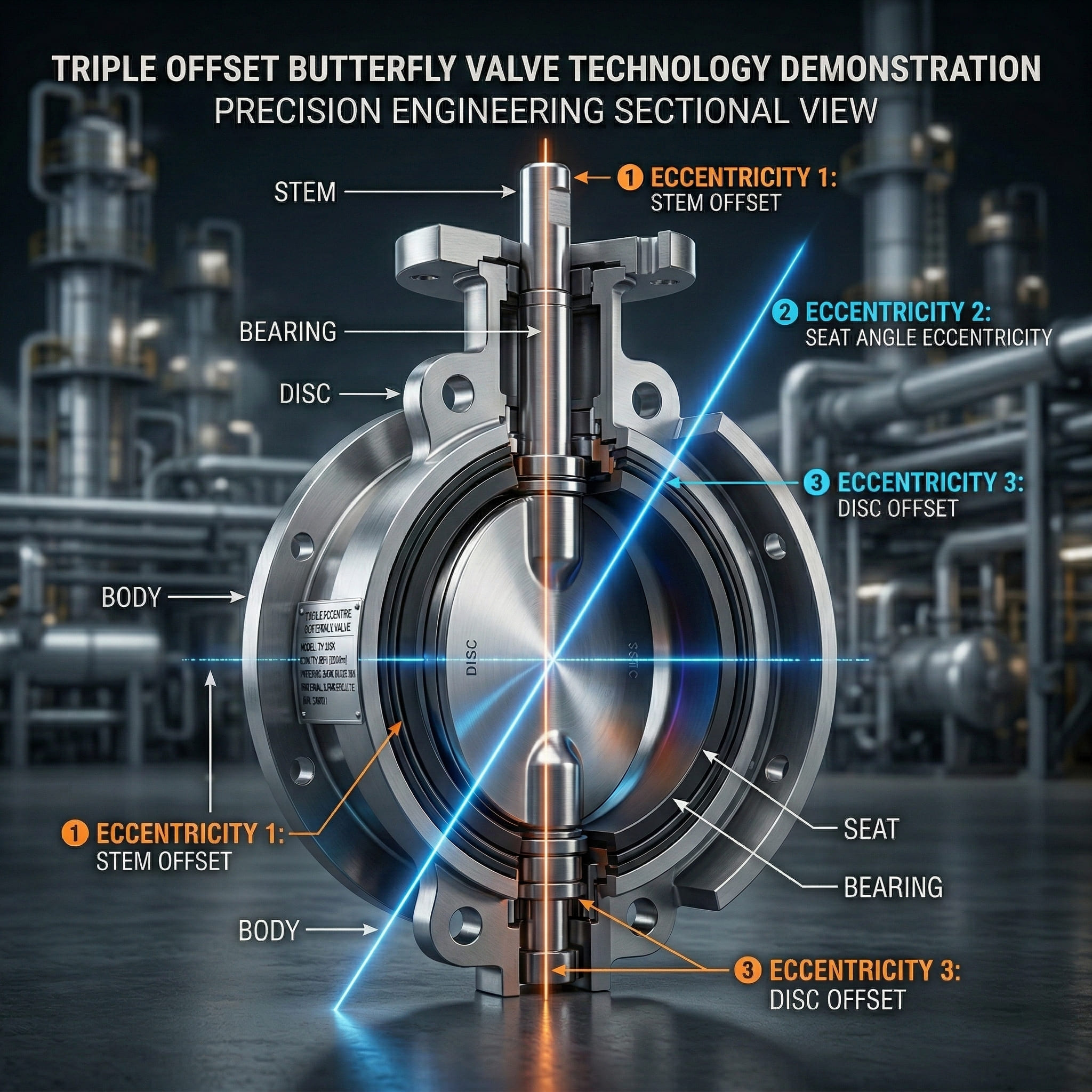
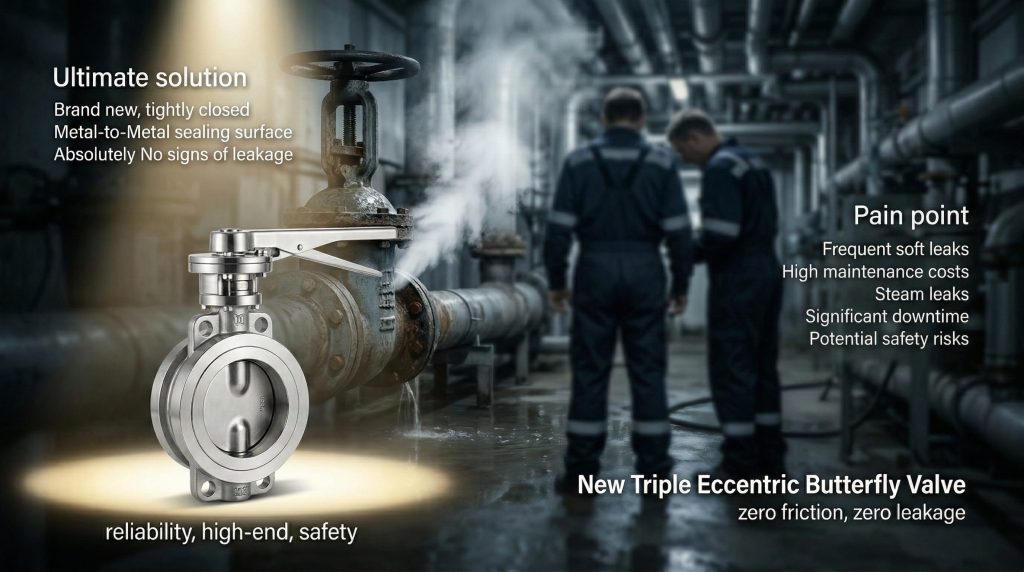
A triple eccentric butterfly valve works by using three specific geometric offsets to create a cam-like motion that allows the disc to seal against the seat with zero friction. Imagine you are managing a high-pressure steam system where traditional valves frequently leak, leading to dangerous conditions and expensive downtime. This constant cycle of failure and repair drains your maintenance budget and compromises plant safety. The solution is the high-performance butterfly valve triple eccentric, which utilizes a metal-to-metal sealing design to ensure bubble-tight shut-off in the most extreme industrial environments.
What is a butterfly valve triple eccentric?
A butterfly valve triple eccentric is a high-performance rotary valve designed for severe service applications where standard soft-seated valves would fail due to pressure or temperature. It belongs to the quarter-turn valve family but features a unique three-offset geometry that distinguishes it from basic concentric models. You can rely on this design for critical isolation tasks in refineries and power plants.
How does the design evolve from basic models?
The evolution from a standard concentric design to the triple offset version involves moving the shaft and the sealing cone to eliminate friction. While basic valves rub the seat during the entire rotation, this advanced design only makes contact at the moment of closure. Think about it:
- Standard valves suffer from high seat wear.
- Triple eccentric valves use a “cam-action” to preserve the seal.
- This evolution allows for metal-to-metal seating.
Why is it considered high performance?
You define high performance by the valve’s ability to maintain a tight seal under Class 600 or higher pressure ratings. Because it uses durable materials like stainless steel and Stellite, it can handle media that would destroy a rubber-seated valve. But that’s not all:
- It handles temperatures from cryogenic to over 600°C.
- It provides bi-directional zero-leakage capabilities.
- The compact profile saves significant weight in large piping systems.
Key Takeaway: The triple eccentric design transforms a simple rotary valve into a heavy-duty instrument capable of handling the toughest industrial fluids.
| Feature | Standard Butterfly | Triple Eccentric |
|---|---|---|
| Sealing Surface | Rubber/TFE | Metal-to-Metal |
| Friction Level | High during travel | Zero until closure |
| Service Type | Utility/Water | Severe/Critical |
The shift from friction-based sealing to a cam-action mechanism is what enables the high-performance ratings of these valves.
How does a butterfly valve triple eccentric work?
You can understand how a butterfly valve triple eccentric works by observing its unique “cam-action” closing mechanism. This motion ensures that the disc approaches the seat like a door entering a frame rather than rubbing against it. As you rotate the handle or actuator, the disc remains clear of the seat for nearly the entire 90-degree stroke.
How does it eliminate mechanical wear?
Mechanical wear is eliminated because the seal ring on the disc does not contact the body seat until the final degree of closure. This means that during the majority of the valve’s operation, there is no friction to degrade the sealing surfaces. Consider the benefits:
- Reduced frequency of seat replacements.
- Consistent sealing performance over thousands of cycles.
- Lower risk of sudden valve failure during operation.
How does torque-seating improve the seal?
Torque-seating means that the tighter you close the valve, the tighter the seal becomes. Unlike position-seated valves that rely on a specific stop point, the triple eccentric valve uses mechanical force to wedge the disc into the seat. Look at the facts:
- It ensures a bubble-tight seal regardless of line pressure.
- The seal remains effective even if the pressure direction changes.
- It compensates for small thermal expansions within the valve body.
Key Takeaway: By utilizing a cam-like motion and torque-based sealing, the valve minimizes wear while maximizing shut-off integrity.
| Phase | Disc Position | Seat Interaction |
|---|---|---|
| Opening | 1° to 90° | Immediate lift-off; no contact |
| Closing | 90° to 1° | No contact; frictionless travel |
| Shut-off | 0° | Uniform compression; tight seal |
The absence of contact during the rotation phase is the primary reason these valves outlast traditional designs in high-cycle applications.
What defines the butterfly valve triple eccentric offsets?
The term “triple eccentric” refers to three specific geometric displacements within the butterfly valve triple eccentric design that work together to create a frictionless sealing path. These offsets shift the shaft and the seat cone away from the center to facilitate a “wedging” effect. You can see these offsets as the engineering foundation for high-pressure reliability.
What are the first and second offsets?
The first offset moves the shaft center away from the sealing surface centerline, while the second offset places the shaft behind the seat plane. These two displacements allow the disc to rotate in a cam-like path rather than a perfectly circular one. Think about it:
- Offset 1 provides a continuous 360-degree sealing surface.
- Offset 2 allows the disc to lift off the seat immediately.
- Together, they prevent the “scrubbing” action found in standard valves.
Why is the third offset the most critical?
The third offset involves inclining the axis of the seat cone relative to the shaft centerline, creating a right-angle cone shape. This specific geometry ensures that the disc only makes contact with the seat at the very final point of closure. But that’s not all:
- It enables a true metal-to-metal, friction-free seal.
- It allows for a uniform seal across the entire circumference.
- The conical shape prevents the valve from jamming during thermal cycles.
Key Takeaway: The combination of three geometric offsets eliminates friction and enables the use of hard-faced metal seals.
| Offset | Component | Primary Function |
|---|---|---|
| 1st | Shaft Position | Enables continuous sealing |
| 2nd | Shaft Depth | Provides cam-action movement |
| 3rd | Seat Cone Angle | Eliminates friction at closure |
These three geometric shifts are what allow the valve to provide a bubble-tight seal without the need for soft, degradable materials.
Why choose a butterfly valve triple eccentric for high heat?
Choosing a butterfly valve triple eccentric for high heat is essential because its metal-to-metal construction does not melt or deform like soft PTFE seats. You need a valve that can withstand thermal expansion without losing its ability to shut off tightly. In steam or molten salt applications, this design is the industry standard for reliability.
How does it handle thermal expansion?
Thermal expansion can cause traditional ball or gate valves to jam, but the conical geometry of the triple eccentric valve prevents this. Because the disc only contacts the seat at the final closing point, there is enough clearance for the metal to expand without sticking. Consider the advantages:
- No jamming during rapid temperature changes.
- Operational torque remains stable across temperature ranges.
- Minimal stress on the valve shaft and bearings.
What materials are used for extreme heat?
For extreme heat, these valves often use laminated seats made of stainless steel and graphite or solid Stellite-faced seats. These materials maintain their structural integrity at temperatures where standard seals would vanish. Look at the options:
- Stainless steel laminations for steam and gas.
- Stellite 6 hard-facing for abrasive high-heat media.
- Inconel or Monel for corrosive and hot environments.
Key Takeaway: The use of heat-resistant metal alloys combined with a non-jamming geometry makes this valve perfect for high-temperature service.
| Material | Max Temperature | Common Application |
|---|---|---|
| SS + Graphite | 450°C (842°F) | Saturated Steam |
| Solid Metal | 600°C+ (1112°F+) | Refinery Tail Gas |
| Alloy 20 | 400°C (752°F) | Hot Acidic Media |
The ability to operate in extreme heat without seal degradation ensures that your plant remains safe and productive over the long term.
Where is the butterfly valve triple eccentric used?
The butterfly valve triple eccentric is used in any industrial setting where zero leakage and high-pressure resistance are required simultaneously. You will find them in oil refineries, chemical plants, and offshore platforms where safety is the top priority. They are the go-to solution for isolating hazardous fluids in large-diameter piping.
Is it suitable for the oil and gas industry?
In the oil and gas sector, these valves are used for emergency shutdown (ESD) and pipeline isolation because of their fire-safe design and tight shut-off. Their ability to handle hydrocarbons at high pressures makes them indispensable for both upstream and downstream operations. Think about it:
- They protect against catastrophic leaks in refineries.
- Their compact size is ideal for space-limited offshore rigs.
- They meet rigorous fire-safety standards like API 607.
How does it perform in power plants?
Power plants use these valves for high-pressure steam isolation and turbine bypass systems where temperatures fluctuate wildly. You can trust them to provide a reliable seal even when the steam is superheated and the pressure is intense. But that’s not all:
- They reduce the risk of steam loss, improving efficiency.
- They are easier to automate than large gate valves.
- Their long service life reduces plant maintenance outages.
Key Takeaway: The versatility of the triple eccentric design allows it to serve as a reliable isolation point in the world’s most dangerous environments.
| Industry | Specific Media | Valve Function |
|---|---|---|
| Refining | Crude Oil / Gasoline | Unit Isolation |
| LNG | Liquid Natural Gas | Cryogenic Shut-off |
| Water | High-Pressure Mains | District Heating |
By selecting this valve type, you ensure that your critical infrastructure is protected by the highest standard of sealing technology.
Is a butterfly valve triple eccentric truly zero leakage?
A butterfly valve triple eccentric is considered truly zero leakage because it passes the most stringent “bubble-tight” testing standards in the industry. Unlike traditional butterfly valves that might allow minor seepage at high pressures, this design uses mechanical torque to create a perfect seal. You can verify this performance through standard tests like API 598 or ISO 5208.
What is the bi-directional sealing capability?
Bi-directional sealing means the valve can stop the flow of media from either direction with equal effectiveness. This is critical in complex piping networks where pressure might fluctuate or reverse during a process upset. Look at the benefits:
- Simplified installation without worrying about flow direction.
- Enhanced safety during backflow scenarios.
- Reliability in manifold systems and tank farms.
Which standards define zero leakage?
To be classified as zero leakage, the valve must show no visible bubbles or drops during a high-pressure water or air test. The triple eccentric design consistently achieves Rate A (ISO 5208) or Class VI (ANSI) shut-off. But that’s not all:
- API 598 requires zero leakage for metal-seated valves.
- These valves are tested at 1.1 times their rated pressure.
- They maintain this seal even after thousands of cycles.
Key Takeaway: True zero-leakage performance is achieved through the marriage of precision conical geometry and torque-seated mechanics.
| Standard | Rating | Performance Metric |
|---|---|---|
| ISO 5208 | Rate A | No visible leakage detected |
| API 598 | Zero Leakage | 0 bubbles/drops during test |
| ANSI/FCI 70-2 | Class VI | Highest level of shut-off |
Testing results prove that this valve provides a level of security previously only available with much larger and more expensive gate valves.
What are the butterfly valve triple eccentric body types?
The butterfly valve triple eccentric body types are designed to accommodate different piping standards and installation requirements. You can choose from wafer, lug, or double-flanged bodies depending on the pressure rating and whether you need “dead-end” service capability. Selecting the right body style is the first step toward a successful installation.
When should you use a wafer or lug body?
Wafer bodies are lightweight and fit between two pipe flanges, while lug bodies have threaded inserts that allow them to be bolted to a single flange. Lug bodies are essential if you need to remove the piping on one side of the valve while the other side remains under pressure. Think about it:
- Wafer bodies save space and reduce shipping costs.
- Lug bodies are safer for downstream maintenance tasks.
- Both types are common in low to medium-pressure systems.
Are double flanged bodies better for high pressure?
Double flanged bodies are the preferred choice for high-pressure or large-diameter pipelines because they provide the most stable connection. They feature two separate flanges that bolt directly to the pipe, ensuring that the valve stays perfectly aligned under heavy stress. But that’s not all:
- They offer better resistance to piping vibrations.
- They are easier to install in heavy industrial settings.
- They are typically used for Class 300 and Class 600 applications.
Key Takeaway: Choosing the correct body type ensures that your valve integrates perfectly with your existing piping and maintenance protocols.
| Body Type | Key Advantage | Typical Application |
|---|---|---|
| Wafer | Lowest weight/cost | General chemical service |
| Lug | Dead-end service | Tank drainage/Isolation |
| Flanged | Maximum stability | High-pressure steam/Oil |
The diversity of body types ensures that there is a triple eccentric solution for every structural and mechanical piping requirement.
How does a butterfly valve triple eccentric reduce torque?
You can reduce torque requirements significantly by using a butterfly valve triple eccentric because the disc does not rub against the seat. In traditional valves, the actuator must overcome heavy friction throughout the entire opening and closing cycle. With the triple offset design, high torque is only required for the final “seating” moment.
How does this affect actuator sizing?
Because the “running torque” is so low, you can use smaller, more affordable pneumatic or electric actuators to operate the valve. This leads to a lower total cost of ownership for your automated systems. Consider the savings:
- Reduced capital expenditure on large actuators.
- Lower air or electricity consumption during operation.
- Smaller footprint for automated valve assemblies.
Does it improve automation reliability?
Automation reliability is improved because there is less stress on the valve stem and the internal components of the actuator. Without constant friction, the valve is less likely to stick or stall during an automated cycle. Think about it:
- Fewer failures in the automation control loop.
- Longer life for actuator seals and gears.
- Faster response times during emergency shutdowns.
Key Takeaway: The frictionless design translates directly into lower energy costs and smaller, more reliable automation packages.
| Torque Type | Standard Valve | Triple Eccentric |
|---|---|---|
| Breakout Torque | Very High (Friction) | Medium (Compression) |
| Running Torque | High | Extremely Low |
| Total Energy | High Consumption | Optimized/Low |
Reducing the mechanical load on your automation system ensures that your process control remains precise and maintenance-free for longer.
How to maintain a butterfly valve triple eccentric?
To maintain a butterfly valve triple eccentric, you only need to perform periodic visual inspections and check the integrity of the replaceable seal ring. Unlike ball or gate valves, this design has no internal cavities where debris can collect and cause clogs or corrosion. You can significantly reduce your maintenance downtime by switching to this “clean” valve design.
Why is the absence of cavities important?
The absence of cavities means that media cannot get trapped inside the valve body, which prevents the “caking” or hardening of fluids. This is a massive advantage when handling slurries, resins, or fluids that tend to solidify. Look at the benefits:
- No need for flushing ports or cavity cleaners.
- Reduced risk of internal corrosion from trapped media.
- Smoother operation even after long periods of inactivity.
How do you replace the seal ring?
The seal ring is located on the disc and can usually be replaced without removing the entire valve from the pipeline in larger flanged models. This allows you to refurbish the valve’s sealing capability quickly and get back to production. But that’s not all:
- You can upgrade seal materials without buying a new valve.
- Inspections can be done during routine plant turnarounds.
- Minimal specialized tools are required for most seal swaps.
Key Takeaway: Low maintenance requirements and a cavity-free design make the triple eccentric valve the most cost-effective choice over its lifecycle.
| Task | Frequency | Expected Result |
|---|---|---|
| Packing Check | Bi-annually | Prevents external stem leaks |
| Seal Inspection | During Shutdown | Ensures zero-leakage shut-off |
| Bearing Lube | Annually | Maintains smooth rotary motion |
By following a simple maintenance schedule, you can ensure that your high-performance valves last for decades in even the harshest service.
Who makes the best butterfly valve triple eccentric?
Finding who makes the best butterfly valve triple eccentric involves looking for manufacturers with advanced CNC machining capabilities and extensive quality certifications. Precision is the most important factor in this design; even a fraction of a millimeter of error in the offsets can ruin the zero-leakage seal. You should partner with a supplier that offers customized material options and rigorous testing.
What quality standards should you look for?
You should look for manufacturers that hold API 609, SIL 3, and ISO 9001 certifications to ensure the valves meet international safety standards. These certifications guarantee that the valve has been engineered and tested to handle the specific pressures and temperatures of your project. Think about it:
- API 609 ensures correct design and thickness.
- SIL 3 ratings are vital for safety-instrumented systems.
- ISO 9001 guarantees a consistent manufacturing process.
Can they provide customized solutions?
A top-tier manufacturer will offer customization for corrosive or abrasive media, such as using Duplex Stainless Steel or Monel components. They should be able to provide technical drawings and flow calculations to ensure the valve fits your specific application. But that’s not all:
- Custom face-to-face dimensions for retrofitting.
- Specialized coatings for underwater or underground use.
- Integration with your preferred brand of actuators.
Key Takeaway: The best manufacturer is one that combines precision engineering with the flexibility to meet your unique project specifications.
| Requirement | Standard Spec | Premium Spec |
|---|---|---|
| Body Material | WCB / LCB Carbon Steel | Duplex / Super Duplex |
| Seat Hardness | Standard Stainless | Stellite 6 Hard-facing |
| Testing | Hydrostatic Test | Low Fugitive Emission |
Partnering with a dedicated expert ensures that you receive a valve engineered for performance rather than just a commodity product.
Conclusion
The triple eccentric butterfly valve is a masterpiece of mechanical engineering that solves the most persistent leakage and wear problems in industrial piping. By utilizing three geometric offsets, it provides a frictionless, metal-to-metal seal that handles extreme temperatures and pressures with ease. At Ruitoflow, our vision is to provide the global industry with high-precision flow control solutions that enhance safety and operational efficiency. If you are ready to upgrade your system to zero-leakage technology or need a technical consultation for your next project, please contact us today.
FAQ
Can I use a triple eccentric valve for throttling?
Yes, because the frictionless design allows for precise positioning of the disc without damaging the seat. However, you should consult with engineers for high-pressure drop applications to avoid cavitation.
What’s the best material for a steam valve seat?
Stainless steel laminations with graphite are generally the best choice because they provide enough flexibility to create a tight seal while resisting high temperatures. Solid metal seats are better for even higher temperatures or abrasive steam.
How do I know if my valve is truly zero leakage?
You should request a test report that shows the valve passed API 598 or ISO 5208 Rate A standards. These tests confirm that no bubbles or drops were detected during the pressure holding period.
Can I replace the seat without removing the valve?
It depends on the body type, but many flanged triple eccentric valves allow for the seal ring on the disc to be replaced while the body remains in the line. This significantly reduces maintenance downtime.
Why is it called a “cam-action” valve?
The offsets cause the disc to move in an elliptical path similar to a mechanical cam. This allows the disc to “drop” into the seat at the final moment rather than sliding across it.