
System failures, budget overruns, and sleepless nights caused by leaking infrastructure are the nightmares of every procurement manager. You plan a municipal water project or an industrial cooling system with precision. Then, a single component fails. Suddenly, you face emergency shutdowns, angry stakeholders, and spiraling maintenance costs. Michael, I know you value stability and Total Cost of Ownership (TCO) above all else. Selecting the wrong valve type or a supplier who cuts corners on ISO standards creates risks you simply cannot afford.
We provide the engineering certainty you require. RUITO Industrial Valves has spent two decades perfecting fluid control solutions. We eliminate the gamble. Our factories combine rigorous European manufacturing standards with the efficiency of Chinese production. We focus on delivering certified, high-performance valves that withstand the test of time.
Here is the promise we make to you. This guide clarifies exactly what a butterfly valve functions as, why it dominates water supply networks, and how our manufacturing protocols ensure you never face a quality crisis.

1. What exactly is a butterfly valve design?
- Understanding the quarter-turn mechanism
- Identifying key components for longevity
- Analyzing the flow control characteristics
Do you know the core components?
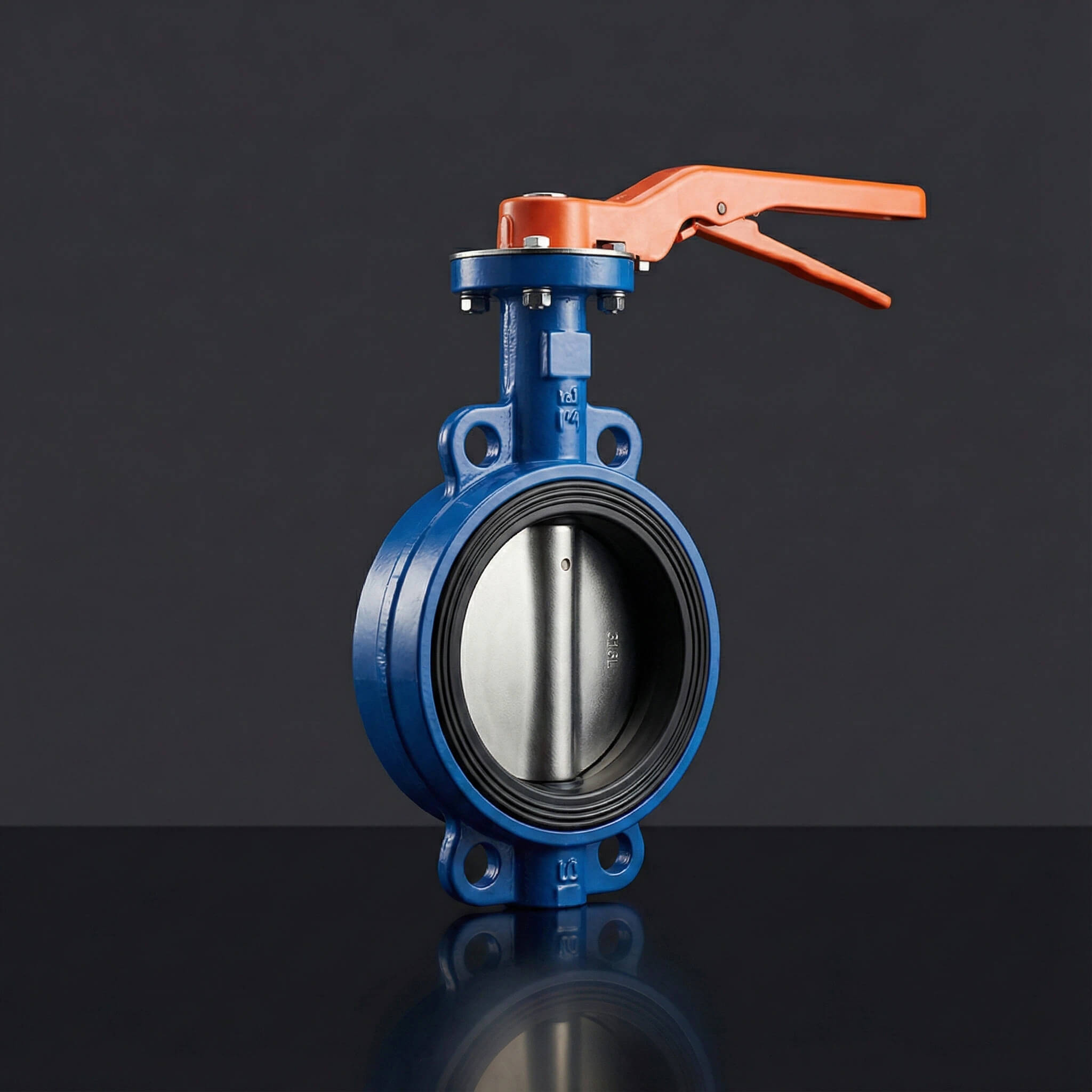
Engineers define a butterfly valve as a quarter-turn rotational motion device. You use it to stop, regulate, or start fluid flow. Here’s the deal. Its design philosophy centers on compactness and speed. A circular disc mounts on a rotating shaft inside the pipe. When you rotate this actuator 90 degrees, the disc aligns with the flow (open) or blocks it perpendicular (closed).
We construct these valves using four critical parts. First, the body fits between two pipe flanges. Common designs include Wafer or Lug styles. Second, the disc acts as the gatekeeper. We manufacture ours from Ductile Iron or Stainless Steel 316L to resist corrosion. Third, the stem connects the actuator to the disc. Finally, the seat provides the watertight seal. For water supply, we typically use EPDM rubber. It offers resilience and long-term elasticity.
How does the quarter-turn mechanism work?
Speed matters in emergency situations. A gate valve might require multiple turns of a handwheel to close. A butterfly valve needs only a quarter turn. This 90-degree operation allows for rapid isolation. You can automate this easily. Pneumatic or electric actuators mount directly to the top flange (ISO 5211 standard).
But here’s the kicker… Simplicity reduces failure points. Fewer moving parts mean less wear. The disc stays in the flow stream even when fully open. This creates a slight pressure drop. However, the aerodynamic design of our discs minimizes this drag. Fluid passes around the disc efficiently.
Key Takeaway
A butterfly valve offers a lightweight, fast-acting solution for flow control, utilizing a rotating disc and resilient seat to ensure tight shutoff with minimal maintenance requirements.
| Component | Material Options (RUITO Standard) | Function & Benefit |
|---|---|---|
| Body | Ductile Iron (GGG40/50), Carbon Steel | Provides structural integrity; withstands pipeline stress. |
| Disc | SS304/316L, Aluminum Bronze, Ductile Iron | Regulates flow; Stainless Steel ensures corrosion resistance. |
| Seat | EPDM, NBR, PTFE (Teflon) | Creates bubble-tight seal; EPDM ideal for water/HVAC (-10°C to 120°C). |
| Stem | Stainless Steel 416/420/316 | Transfers torque; high tensile strength prevents twisting. |
| Actuator | Lever, Gearbox, Pneumatic, Electric | Controls operation; ISO 5211 pads allow easy automation upgrades. |
Expert Analysis: For municipal water applications, Ductile Iron bodies paired with EPDM seats offer the optimal balance of cost-efficiency and durability, providing a lifespan exceeding 15 years under normal operating conditions.
2. How do different disc types impact performance?
- Concentric designs for general water
- Eccentric options for high pressure
- Selecting the right geometry for your project
When should you use concentric designs?
Most water supply projects rely on the Concentric (Zero Offset) design. You might be wondering… why is this the industry standard? In this configuration, the stem centers directly in the middle of the disc and the pipe. The disc pivots around this central axis. Rubber seating covers the inner body wall.
We recommend this type for low-pressure and ambient-temperature applications. Think potable water distribution, HVAC systems, or wastewater treatment. The resilient rubber seat ensures a “bubble-tight” shutoff. Since the media only contacts the seat and disc (not the body), we can use cost-effective body materials without risking corrosion. This keeps your procurement costs down.
Why upgrade to double eccentric?
Sometimes standard solutions fall short. High-performance scenarios demand the Double Eccentric (Double Offset) valve. Here, we offset the stem from the disc center and the pipe centerline. Ready for the good part? This geometry creates a cam action. The disc lifts off the seat immediately upon opening.
Friction practically disappears. Reduced contact means less wear on the seat. You gain extended service life and lower operating torque. We advise using double eccentric valves for higher pressure ratings (PN25+) or when frequent cycling occurs. While the initial investment sits higher, the reduced maintenance lowers your TCO significantly over 20 years.
Key Takeaway
Choose concentric valves for standard water infrastructure to maximize value, but upgrade to double eccentric designs when system pressures or cycle frequencies demand reduced friction and extended seal life.
| Valve Type | Offset Configuration | Primary Benefit | Typical Application |
|---|---|---|---|
| Concentric | Zero Offset | Cost-effective; Tight Sealing | Water Treatment, HVAC, Fire Protection |
| Double Eccentric | Stem offset from disc & center | Low Friction; Long Life | High-Pressure Distribution, Industrial Water |
| Triple Eccentric | Cone-shaped sealing profile | Metal-to-Metal Seal; Zero Leakage | High Temp Steam, Critical Isolation, Chemical |
Expert Analysis: While 90% of water supply projects succeed with Concentric valves, specifying Double Eccentric valves for main pumping stations can reduce actuator size requirements due to lower torque, saving energy and equipment costs.
3. Where are they essential in water infrastructure?
- Municipal distribution networks
- Water treatment plant processes
- Pumping stations and reservoirs
Can you use them in treatment plants?
Absolutely. Water Treatment Plants (WTP) utilize butterfly valves at nearly every stage. You will find them regulating raw water intake. What’s the real story? Precise flow control matters here. During filtration and sedimentation, operators must modulate flow rates accurately. Our valves handle this throttling task effectively between 15° and 70° open positions.
We also install them in sludge handling lines. Standard gate valves might clog. A butterfly valve, particularly with a streamlined disc, allows solids to pass. Chemical dosing lines use our PTFE-lined butterfly valves. These resist aggressive coagulants and disinfectants that corrode standard rubber or iron.
Are they safe for potable water distribution?
Safety remains non-negotiable. We supply valves for drinking water networks that meet strict hygiene standards. This is where it gets interesting… The rubber seat material must not leach contaminants. RUITO utilizes EPDM seats certified to WRAS and NSF 61 standards.
In distribution networks, you need isolation points. Pipelines require maintenance. Burst pipes happen. Strategically placed butterfly valves allow utility companies to shut down small grid sections. This minimizes service disruption. Their compact nature allows installation in crowded underground vaults where bulky gate valves simply would not fit.
Key Takeaway
Butterfly valves serve as the backbone of water infrastructure, providing safe, certified isolation for potable water and robust, clog-resistant flow control for complex treatment processes.
| Application Area | Role of Butterfly Valve | Key Requirement |
|---|---|---|
| Raw Water Intake | Flow regulation from source | Abrasion resistance (sand/silt) |
| Filtration Systems | Backwash control sequencing | Fast cycling capability |
| Chemical Dosing | Isolating additive lines | Chemical resistance (PTFE/SS316) |
| Distribution Mains | Zonal isolation for repair | WRAS/NSF 61 Compliance |
| Pumping Stations | Pump discharge protection | Non-slam check & isolation |
Expert Analysis: In modern treatment plants, automating butterfly valves with pneumatic actuators allows for centralized SCADA control, significantly improving reaction times to changing water quality parameters compared to manual operation.
4. Why choose butterfly valves over gate valves?
- Weight and space advantages
- Cost implications for large diameters
- Operation speed and maintenance
Do you save space with butterfly valves?
Space constraints plague many engineering projects. But wait, there is more. A gate valve requires significant vertical clearance. The stem rises during operation. A DN600 gate valve might stand nearly two meters tall. A butterfly valve of the same bore fits comfortably between flanges, taking up mere inches of pipeline length.
We call this “Face-to-Face” dimension. For large diameter pipes (DN300 and up), the difference becomes massive. You can design smaller valve chambers. You reduce excavation costs. In the tight confines of a ship’s hull or a compact municipal pump room, this spatial economy often makes the butterfly valve the only viable option.
How does cost efficiency compare?
Michael, I know you analyze the bottom line. Gate valves perform well, but they demand heavy casting. More metal equals higher cost. Here’s the secret. As pipe diameter increases, the weight gap widens. A 24-inch gate valve is a heavy beast requiring a crane for installation. A 24-inch butterfly valve is manageable.
Lower weight reduces shipping costs from China to Germany. It simplifies installation labor. It requires less robust pipe supports. For sizes above DN150 (6 inches), a butterfly valve typically costs 30% to 50% less than an equivalent gate valve. You achieve the same isolation function without the heavy price tag.
Key Takeaway
For pipelines larger than DN150, butterfly valves offer superior ROI through reduced purchasing costs, lower shipping fees, and minimized installation space compared to traditional gate valves.
| Feature | Butterfly Valve | Gate Valve |
|---|---|---|
| Face-to-Face | Short (Wafer/Lug) | Long (Standard) |
| Weight | Lightweight | Heavy (Cast body) |
| Operation | Fast (Quarter-Turn) | Slow (Multi-Turn) |
| Flow Control | Good (Throttling capable) | Poor (On/Off only) |
| Pressure Drop | Low (Disc in stream) | Very Low (Full bore) |
Expert Analysis: While gate valves offer slightly better hydraulic performance (zero obstruction), the logistical and capital savings of butterfly valves in sizes >DN300 usually outweigh the marginal energy costs associated with the minor pressure drop.
5. Which standards ensure long-term reliability?
- Critical global certifications (DIN, ISO, AWWA)
- Pressure testing protocols
- Material traceability importance
Do your valves meet AWWA C504?
In the global water sector, standards define quality. The American Water Works Association (AWWA) sets the benchmark with C504. Let’s look at the facts. This standard governs rubber-seated butterfly valves. It dictates rigorous body shell thickness, shaft diameter, and cycle life testing.
RUITO manufactures strictly to these parameters. We also adhere to EN 593 for European markets. This ensures our valves handle the mechanical stress of water hammer and continuous pressure. For your projects in Germany, we ensure flange compatibility with DIN 2501 (PN10/16) standards. You never have to worry about bolt holes not aligning during site installation.
Why is WRAS certification vital?
For potable water, material safety is paramount. It gets better… We hold WRAS (Water Regulations Advisory Scheme) approval. This certification verifies that our non-metallic components—specifically the EPDM seat and internal coatings—do not degrade water quality.
We implement full traceability. Every valve body carries a heat number. We can trace the raw casting back to the specific furnace batch. Our ISO 9001:2015 quality management system mandates this. Before a valve leaves our factory, it undergoes hydrostatic testing at 1.5 times its rated pressure. We guarantee the shell holds and the seat seals.
Key Takeaway
adherence to AWWA C504, EN 593, and WRAS standards is the only way to guarantee mechanical reliability and hygienic safety in public water supply projects.
| Standard | Scope/Purpose | Relevance to Buyer |
|---|---|---|
| API 609 | Design Standard | Ensures dimensional interchangeability. |
| EN 593 | European Product Standard | Mandatory for EU municipal projects. |
| ISO 5752 | Face-to-Face Dimensions | Guarantees fit in existing piping. |
| WRAS | Hygienic Certification | Legal requirement for drinking water. |
| ISO 5211 | Top Flange Standard | Allows easy actuator mounting. |
Expert Analysis: Procurement managers should always request the “Mill Test Certificate” (EN 10204 3.1) with shipment; this document validates the chemical composition and mechanical properties, proving compliance with the specified standards.
6. How does RUITO ensure zero-leakage quality?
- Factory testing procedures
- Customization capabilities
- Inventory and delivery speed
How do we control casting quality?
Quality starts before machining. We partner with elite foundries. You’ll love this part. We inspect raw castings for porosity and sand inclusions. RUITO employs 5-axis CNC machining centers. This technology ensures the disc edge is perfectly spherical.
A perfect disc geometry prevents seat tearing. We grind our shafts to a surface finish of Ra 0.8μm. This smoothness protects the shaft seals, ensuring 100,000+ operational cycles without leakage. We coat our valve bodies with fusion-bonded epoxy (min 250 microns). This creates an impenetrable barrier against rust, even in humid valve pits.
Do we test every single unit?
Random sampling is not enough for critical infrastructure. Here is our promise. We pressure test 100% of our valves. Not 10%. Not 50%. Every single unit. We perform a shell test to check body integrity and a seat test to verify zero leakage.
We understand your need for speed. Michael, delay is not an option for you. RUITO maintains a massive inventory of semi-finished parts. We can assemble and test standard DN50-DN300 valves in 72 hours. For your larger projects, our monthly capacity hits 20,000 units. We deliver reliability, on time, every time.
Key Takeaway
RUITO combines 100% hydrostatic testing, precision CNC machining, and rapid assembly protocols to deliver zero-leakage valves that eliminate project delays and post-installation failures.
| Feature | RUITO Standard Specification | Customer Benefit |
|---|---|---|
| Testing | 100% Hydrostatic (1.5x PN) | Zero DOA (Dead on Arrival) risk. |
| Coating | Fusion Bonded Epoxy (AkzoNobel) | Superior corrosion protection. |
| Machining | CNC Precision Grinding | Lower torque; longer seat life. |
| Traceability | Cast Heat Numbers on Body | Full accountability & QC records. |
| Warranty | 12 Months (Standard) | Peace of mind operation. |
Expert Analysis: The use of Fusion Bonded Epoxy (FBE) rather than liquid paint is critical; FBE prevents “under-film creep” corrosion, ensuring the valve body remains intact even if the coating sustains minor scratches during installation.
Conclusion
Water infrastructure demands resilience. You cannot build a reliable network on questionable components. We have explored the butterfly valve’s efficiency, its pivotal role in flow regulation, and the engineering nuances that separate a generic product from a high-performance asset.
The bottom line is simple. Cheap valves cost more. They cost you in downtime, labor, and reputation. RUITO offers you a strategic partnership. We provide the technical documentation, the certifications (WRAS, CE, ISO), and the manufacturing transparency you crave. We help you lower your Total Cost of Ownership by supplying valves designed to last decades, not just the warranty period.
Let’s secure your next project. Don’t let supply chain uncertainty jeopardize your deadlines. Contact our engineering team today for a technical consultation or a quote. Experience the difference of a supplier who speaks your language of quality and precision.
FAQ
Q1: Can I use RUITO butterfly valves for potable drinking water applications?
Yes, absolutely. We supply butterfly valves with EPDM seats and internal coatings that are fully certified to WRAS and NSF 61 standards. These certifications ensure that the materials are non-toxic, lead-free, and will not affect the taste, odor, or safety of the water supply, making them compliant for municipal drinking water networks globally.
Q2: What is the difference between a Wafer and a Lug style butterfly valve?
The difference lies in the installation method. A Wafer valve is sandwiched between two pipe flanges using long bolts that span the entire valve body; it is lighter and cheaper but cannot be used as an end-of-line valve. A Lug valve has threaded inserts (lugs) on the body; bolts are screwed in from both sides, allowing you to disconnect piping on one side while the other remains pressurized, making it ideal for dead-end service.
Q3: How quickly can you deliver a standard order of DN150 valves?
We understand the urgency of project timelines. For standard specifications (such as Ductile Iron body, EPDM seat, Wafer type), we maintain a robust inventory of semi-finished components. This allows us to assemble, test, and dispatch emergency orders within 72 hours. For larger project quantities, our efficient production lines typically ensure delivery within 15-25 days.
Q4: Do butterfly valves reduce water pressure significantly?
Butterfly valves do create a minor pressure drop because the disc remains in the center of the flow path even when fully open. However, RUITO designs discs with a streamlined, hydrodynamic profile to minimize this resistance. In most water supply applications, the pressure loss is negligible (typically less than 0.2 bar) and does not impact overall system performance compared to the significant space and cost savings.
Q5: Can I automate your butterfly valves with my existing SCADA system?
Yes. All RUITO butterfly valves are designed with a top flange that complies with the ISO 5211 standard. This universal mounting interface allows you to easily install electric or pneumatic actuators from almost any brand (like AUMA, Rotork, or our own RUITO actuators). We can verify torque requirements and provide the necessary mounting brackets to ensure seamless integration with your automation system.