
The flow coefficient, or Cv, is the primary metric used to determine how much fluid a valve can pass at a specific pressure drop. If you choose a valve with the wrong Cv, your system will suffer from inefficient flow, wasted energy, and potential mechanical failure. You might face high operational costs or even complete equipment breakdowns if the sizing is incorrect. By mastering precise butterfly valve design calculations, you can optimize your infrastructure for maximum reliability and performance.
What is Cv in butterfly valve design calculations?
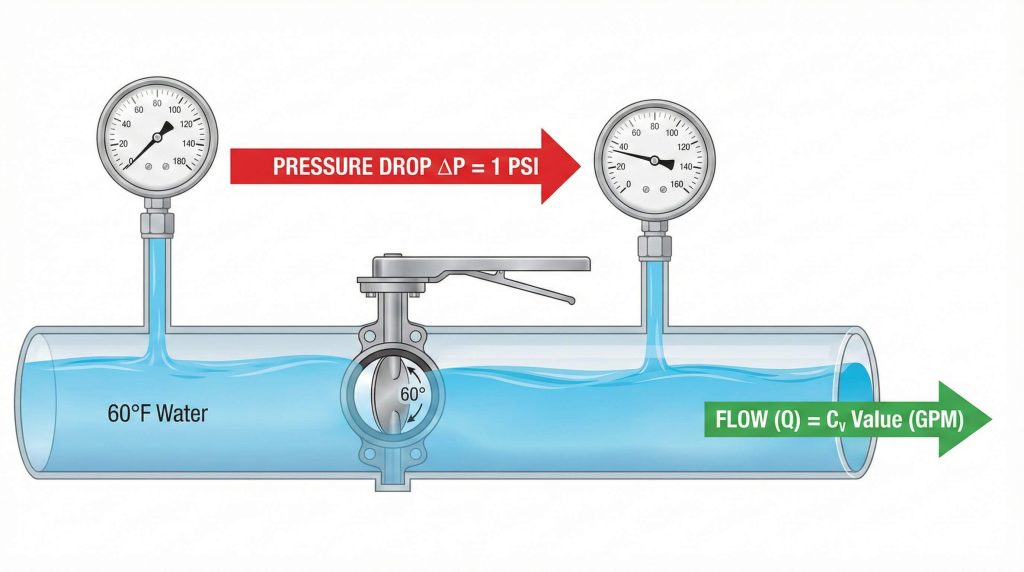
Cv is the mathematical representation of the number of gallons of 60°F water that flow through a valve per minute with a 1 PSI pressure drop. When you perform butterfly valve design calculations, this value serves as the universal language for comparing different valve capacities. It allows you to predict how a specific valve will behave under various hydraulic conditions.
What is the standard flow coefficient definition?
The standard definition provides a consistent baseline for engineers to evaluate hardware performance. It eliminates guesswork by providing a repeatable metric based on controlled testing environments.
You should evaluate:
- The specific gravity of your fluid.
- The maximum required flow rate.
- The allowable pressure loss across the disc.
How is the mathematical formula applied?
The formula links the flow rate to the square root of the pressure differential and the fluid density. It ensures that the valve you select can handle the peak demands of your application without causing a bottleneck.
Which measurement units are essential for accuracy?
Accuracy depends on using the correct units for volume, pressure, and time.
- Flow rate is typically measured in GPM.
- Pressure drop is measured in PSI.
- Specific gravity is a dimensionless ratio.
| Parameter | Symbol | Unit of Measure |
|---|---|---|
| Flow Rate | Q | Gallons Per Minute (GPM) |
| Pressure Drop | ΔP | Pounds Per Square Inch (PSI) |
| Fluid Density | SG | Specific Gravity (Water=1) |
The table above summarizes the fundamental inputs required to determine the flow capacity of your equipment.
Key Takeaway: Understanding the core definition and variables of Cv is the foundation for any successful fluid control project.
Why use Cv in butterfly valve design calculations?
Using Cv allows you to size your valves accurately to prevent system-wide hydraulic imbalances. In every set of butterfly valve design calculations, the Cv value acts as the bridge between theoretical flow requirements and physical hardware selection. It prevents you from installing a valve that is either too restrictive or too large for your needs.
How does Cv impact overall system efficiency?
A correctly sized Cv ensures that your pumps operate within their preferred range. This reduces electricity consumption and extends the life of your rotating equipment.
The benefits include:
- Lower energy costs.
- Reduced vibration in the piping.
- Consistent downstream pressure levels.
Can incorrect values cause cavitation and noise?
Yes, because an undersized valve creates high-velocity zones that lead to vapor bubbles and loud acoustic levels. This physical stress can erode the valve disc and body over time.
But wait, there’s more.
Why is predicting pressure drops critical for safety?
Predicting pressure drops is vital for maintaining the structural integrity of your piping system. If the drop is too high, it can lead to surges or hammer effects that damage sensitive instrumentation.
| Risk Factor | Effect of Incorrect Cv | Consequence |
|---|---|---|
| Cavitation | Vapor bubble collapse | Pitting and erosion |
| Noise | Excessive turbulence | Operator discomfort |
| Vibration | Mechanical resonance | Seal and joint failure |
This data shows why matching your valve’s capacity to the system’s actual flow is a non-negotiable safety step.
Key Takeaway: Using Cv as a design metric protects your infrastructure from the destructive forces of cavitation and mechanical stress.
How do types affect butterfly valve design calculations?
The physical configuration of the valve, such as its offset or seat design, directly dictates the maximum available Cv. Your butterfly valve design calculations must account for these geometric variations to ensure the flow path remains as efficient as possible. Different designs offer unique flow profiles that suit specific industrial tasks.
Do concentric designs result in lower Cv values?
Concentric designs often have a thicker disc profile that can create slightly more resistance compared to high-performance versions. However, they remain an excellent choice for low-pressure water and air applications.
You may notice:
- Simpler flow paths.
- Lower initial purchase costs.
- Standardized replacement parts.
Why do eccentric valves offer better flow capacity?
Eccentric valves move the disc out of the flow stream more effectively than concentric models. This reduces the obstruction and allows for a higher volume of fluid to pass through the same diameter.
Think about it.
How do high-performance offsets improve performance?
High-performance triple-offset designs minimize seat contact during the opening cycle. This reduces friction and allows for a more streamlined flow at various opening angles.
| Valve Type | Flow Profile | Relative Cv Rating |
|---|---|---|
| Concentric | Standard | Moderate |
| Double Offset | High Efficiency | High |
| Triple Offset | Premium Efficiency | Very High |
The comparative data reveals that moving toward multi-offset designs generally increases the flow efficiency of your system.
Key Takeaway: Selecting the right valve geometry is just as important as the nominal size when trying to maximize flow capacity.
Are angles key in butterfly valve design calculations?
The opening angle of the disc is the most significant variable in determining the instantaneous Cv of the valve. During butterfly valve design calculations, you must consider the entire travel range from 0 to 90 degrees to understand control sensitivity. Most butterfly valves are not used strictly for on-off service, making their modulation characteristics vital.
Is the Cv progression non-linear across openings?
The flow rate does not increase at a constant rate as you open the valve. It typically follows an “equal percentage” or “linear” curve that speeds up as the disc reaches the fully open position.
Common observations include:
- Low sensitivity at 0-20 degrees.
- High sensitivity at 30-70 degrees.
- Max capacity reached at 90 degrees.
What flow rates occur at a full 90-degree opening?
At 90 degrees, the disc is parallel to the flow, providing the minimum possible resistance. This is where the valve reaches its rated Cv capacity as specified by the manufacturer.
Here’s the kicker:
How does the disc position change resistance?
The disc position creates a changing projected area that the fluid must move around. As the angle increases, the turbulence behind the disc decreases, allowing for a smoother transition of energy.
| Opening Angle | Flow Characteristic | Control Utility |
|---|---|---|
| 10° – 30° | High Restriction | Sealing/Tight Control |
| 40° – 70° | Optimal Flow | Throttling/Modulation |
| 80° – 90° | Low Restriction | Full Flow/Isolation |
Analysis of these angles shows that the most effective control range for these valves is between 30 and 70 degrees.
Key Takeaway: You must calculate Cv across the entire range of motion to ensure stable control and avoid rapid wear at low angles.
Does material change butterfly valve design calculations?
Material choices for the disc and seat affect the surface roughness and the thickness of the internal components. Incorporating material properties into your butterfly valve design calculations helps you account for friction losses that standard tables might overlook. A smoother disc surface will naturally support a slightly higher flow coefficient than a rougher cast part.
How do soft versus metal seats influence friction?
Soft seats, like EPDM, provide a tight seal but may protrude slightly into the flow path. Metal seats are thinner and more rigid, which can sometimes lead to a cleaner flow profile at high pressures.
Consider these factors:
- Seating torque requirements.
- Surface finish of the disc.
- Elastomer deformation under load.
Does disc material choice affect flow resistance?
Stainless steel discs are often machined to tighter tolerances and smoother finishes than ductile iron. This reduced friction can marginally increase the Cv and improve the long-term efficiency of the valve.
It gets better.
How does surface roughness impact the final Cv?
Rough surfaces create a boundary layer of turbulence that effectively narrows the flow path. By choosing polished or coated internals, you can reduce this drag and maintain a higher flow rate.
| Material | Surface Finish | Flow Benefit |
|---|---|---|
| Ductile Iron | Cast/Painted | Standard |
| Stainless Steel | Machined/Polished | Enhanced |
| PTFE Lined | Ultra-Smooth | Maximum |
This comparison highlights how high-end materials contribute to better hydraulic performance by reducing internal fluid friction.
Key Takeaway: Don’t ignore material specs, as surface finish and seat design play a direct role in your valve’s ultimate flow capacity.
How to apply butterfly valve design calculations?
Applying these calculations involves matching the calculated Cv requirement of your system to a specific valve size from a manufacturer’s catalog. In butterfly valve design calculations, you always want to select a valve where the required Cv falls between 60% and 80% of the valve’s full-open capacity. This range provides enough headroom for flow surges while maintaining control sensitivity.
How to match valve sizing to system flow demands?
You start by identifying the maximum and minimum flow rates your process will ever require. Then, you calculate the required Cv for both extremes to see if one valve size can handle the entire range.
Steps to take:
- Define the process fluid properties.
- Determine the pressure at the inlet.
- Set the desired downstream pressure.
What variables determine the required flow capacity?
The required capacity is determined by the total volume of fluid that needs to move through the line to meet production targets. You must also account for future expansions or potential increases in fluid viscosity.
The best part?
How to calculate expected pressure differentials?
You calculate the differential by subtracting the downstream pressure from the upstream pressure. This “delta-P” is the driving force that overcomes the resistance of the valve internals.
| Scenario | Required Flow | Calculated Cv | Recommended Size |
|---|---|---|---|
| Low Demand | 100 GPM | 15 | DN50 |
| Normal Op | 500 GPM | 75 | DN150 |
| Peak Demand | 850 GPM | 128 | DN200 |
Selecting the DN200 valve ensures that even at peak demand, the system remains within safe operating limits.
Key Takeaway: Proper application requires checking your calculations against both minimum and maximum flow scenarios to ensure total system reliability.
Can environment shift butterfly valve design calculations?
Environmental factors such as extreme temperatures or corrosive atmospheres can change the physical dimensions or surface state of the valve. Your butterfly valve design calculations should be periodically reviewed if the operating environment changes significantly. Harsh conditions can lead to scale buildup or material swelling, both of which reduce the effective Cv over time.
Do corrosive fluids alter long-term Cv performance?
Corrosive fluids can pit the disc and seat, creating turbulence where there was once smooth flow. This degradation increases the resistance and lowers the valve’s actual flow capacity compared to its “as-new” state.
Watch out for:
- Chemical compatibility issues.
- Pitting on the disc edges.
- Buildup of corrosion products.
How do extreme temperatures affect material expansion?
High temperatures cause metals and elastomers to expand, which can narrow the flow passage. Conversely, extreme cold can make seals brittle, potentially leading to leaks that disrupt the pressure balance.
Believe it or not.
Are specific alloys needed for high-pressure tasks?
High-pressure environments require alloys that won’t deform under stress. If a disc deforms even slightly, it changes the hydraulic profile and invalidates your original flow calculations.
| Environment | Primary Impact | Effect on Cv |
|---|---|---|
| High Heat | Thermal Expansion | Reduction |
| Acidic Media | Surface Erosion | Turbulence Increase |
| Marine/Salt | Scaling/Crusting | Obstruction |
These environmental factors prove that Cv is not a static number but one that can evolve throughout the valve’s lifecycle.
Key Takeaway: Account for environmental degradation in your initial design to ensure the valve remains functional for its entire service life.
Why verify butterfly valve design calculations often?
Regular verification ensures that your system continues to operate at its designed efficiency even as components age. Within the framework of butterfly valve design calculations, verification acts as a diagnostic tool for identifying internal wear before it causes a failure. If your observed flow rates don’t match your calculations, it’s a sign that something is wrong inside the pipe.
Does seat wear degrade the original Cv rating?
As the seat wears down, the seal may become less precise, or the disc might not sit perfectly in the flow stream. This can create unintended bypass flow or increased turbulence, skewing your expected results.
Signs of wear:
- Unexplained pressure drops.
- Increased actuator torque.
- Inconsistent flow readings.
How often should flow rates be monitored?
In critical applications, you should monitor flow rates in real-time using digital sensors. For standard utility lines, a quarterly or bi-annual check is usually sufficient to catch any significant drift.
Think about the possibilities.
Can internal scaling lead to calculation errors?
Scaling reduces the internal diameter of the valve, which significantly increases resistance. Your original calculations will no longer be accurate if a layer of mineral deposits has formed on the disc.
| Inspection Interval | Method | Goal |
|---|---|---|
| Monthly | Visual/Data Log | Trend Analysis |
| Annually | Physical Teardown | Wear Measurement |
| 5-Year | System Audit | Recalculation |
Consistent monitoring allows you to schedule maintenance based on actual performance rather than just estimated timeframes.
Key Takeaway: Frequent verification turns static calculations into a dynamic management tool for your entire fluid network.
Do errors ruin butterfly valve design calculations?
A single error in your math can lead to selecting a valve that is fundamentally incompatible with your process. When butterfly valve design calculations are performed incorrectly, the resulting issues like water hammer or poor control stability can be extremely expensive to fix. Precision in the early stages of project planning saves you from the headache of field modifications later.
How does valve misalignment impact flow precision?
If a valve is not perfectly centered between the flanges, the flow enters the disc at an angle. This creates asymmetric turbulence that can drastically lower the effective Cv and cause vibration.
Common mistakes include:
- Using the wrong flange gaskets.
- Miscalculating the fluid velocity.
- Ignoring upstream pipe bends.
Can partial blockages distort pressure readings?
Yes, because debris caught in the valve body will create a localized pressure drop that isn’t related to the valve’s design. This leads to false data that can make a healthy valve look like it is failing.
But wait, there’s more.
What are the risks of using the wrong valve size?
An oversized valve will operate nearly closed, leading to “hunting” where the actuator constantly moves to find the right flow. This wears out the motor and the valve stem much faster than normal.
| Error Type | Direct Result | System Impact |
|---|---|---|
| Oversizing | Poor Control | Actuator Failure |
| Undersizing | Flow Restriction | Pump Overload |
| Units Error | Wrong Cv Value | Total System Imbalance |
The risks associated with calculation errors demonstrate why double-checking your work is a critical engineering practice.
Key Takeaway: Avoiding common errors in sizing and installation is the most cost-effective way to ensure long-term system stability.
How to optimize butterfly valve design calculations?
Optimization means going beyond basic sizing to consider how the valve interacts with the rest of your piping network. Final butterfly valve design calculations should include safety factors and considerations for the specific type of actuator you plan to use. By refining these numbers, you ensure that the valve provides the highest possible ROI through reduced maintenance and better process control.
Can preventive maintenance sustain peak efficiency?
By keeping the valve clean and well-lubricated, you ensure that it can reach its full-open position without resistance. This maintains the original Cv and prevents the system from working harder than necessary.
Optimization steps:
- Regularly flush the lines.
- Inspect seals for swelling.
- Calibrate the actuators.
What are the final steps for reliable valve selection?
The final steps involve cross-referencing your calculated Cv with the manufacturer’s pressure-temperature curves. You must ensure the valve body can handle the static pressure while the disc handles the dynamic flow.
Here is the secret.
How to ensure long-term system performance?
Long-term performance is achieved by selecting high-quality components that meet international standards like ISO or CE. This guarantees that the materials and tolerances match the specifications used in your calculations.
| Optimization Goal | Action Item | Expected Result |
|---|---|---|
| Efficiency | Polish Disc Internals | Lower Energy Use |
| Reliability | Use Triple-Offset | Zero Leakage |
| Control | Size for 70% Open | Stable Throttling |
Following these optimization strategies ensures that your valve selection is both technically sound and economically efficient.
Key Takeaway: Optimization is a continuous process that begins with accurate math and ends with a commitment to quality maintenance.
Conclusion
Sourcing high-quality valves shouldn’t be a gamble for your industrial projects. At RUITO, we eliminate the risks of flow mismatch and system downtime by providing precision-engineered solutions backed by traceable documentation and international certifications. Our mission is to empower EPCs and plant managers with reliable fluid control systems that perform exactly as calculated. To secure your infrastructure with valves designed for excellence, contact us today for a technical consultation and custom quote.
FAQ
Can I use the same Cv for different fluids?
No, you must adjust for the specific gravity and viscosity of each fluid, as heavier or thicker liquids will pass through the valve differently than water.
What’s the best way to determine the Cv of an existing valve?
The most reliable method is to check the manufacturer’s original datasheet or look for a flow coefficient rating stamped on the valve’s identification plate.
How do I know if my valve is oversized based on Cv?
If your valve provides the required flow rate at an opening angle of less than 20% or 30%, it is likely oversized and may suffer from control instability.
Can internal coatings improve my flow coefficient?
Yes, ultra-smooth coatings like PTFE can reduce surface friction and turbulence, potentially providing a higher effective Cv compared to an uncoated metal surface.
What happens to Cv if I install a valve near a pipe bend?
Installing a valve too close to a bend creates non-uniform flow profiles that can reduce the effective Cv and cause significant noise and vibration issues.