
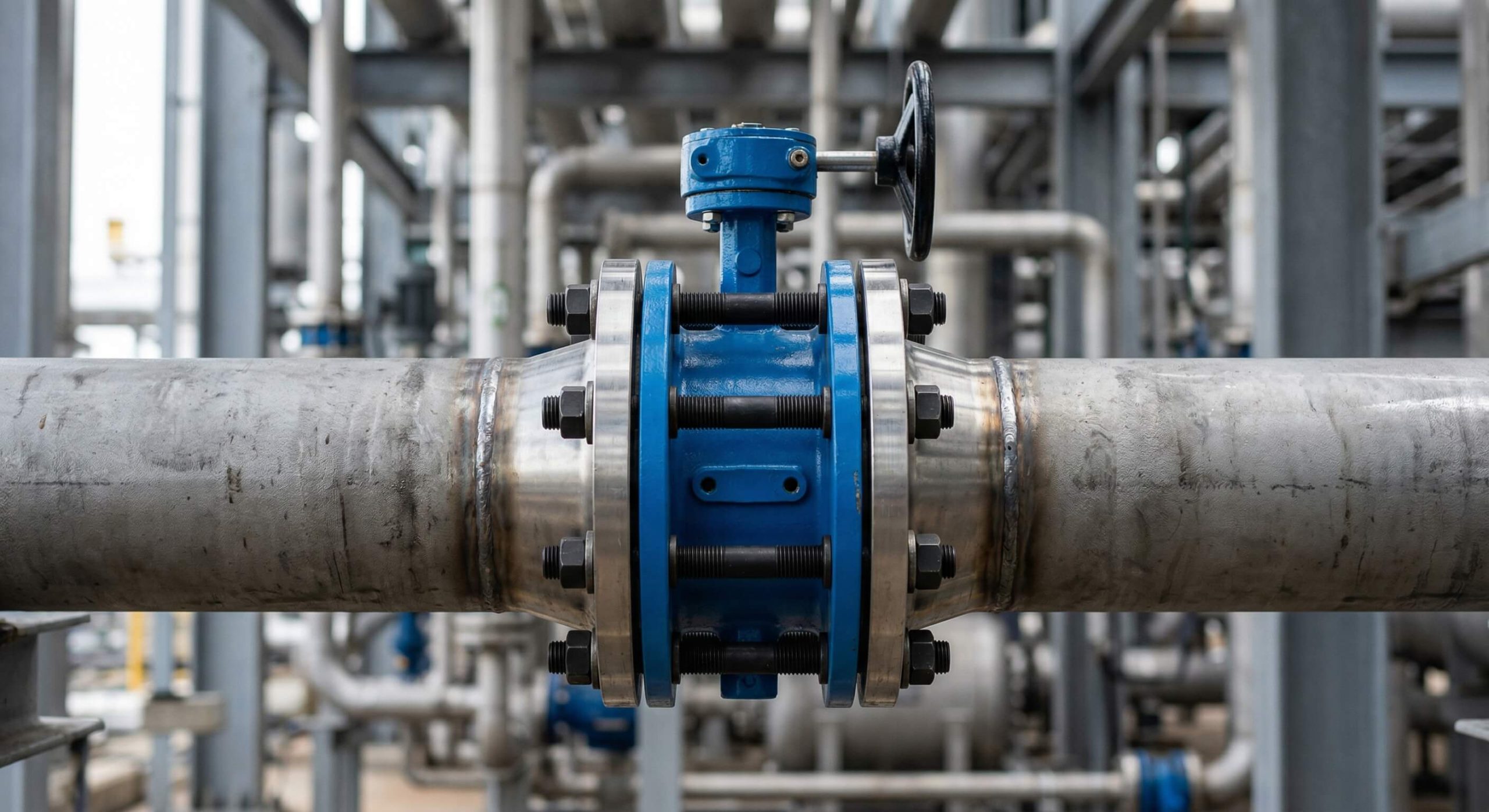
The primary difference between wafer and flange butterfly valves lies in their physical body design and the specific method used to secure them between pipe flanges. Imagine you are overseeing a high-pressure line installation where a simple choice between two valve types determines if the system stays leak-free for years or fails within weeks. Selecting the wrong interface often leads to catastrophic joint leaks, bolt shearing, or the nightmare of being unable to isolate a downstream section for maintenance. This technical guide provides the clarity you need to choose the correct butterfly wafer type valve or flanged alternative for your specific engineering requirements.
What defines a butterfly wafer type valve in industrial systems?
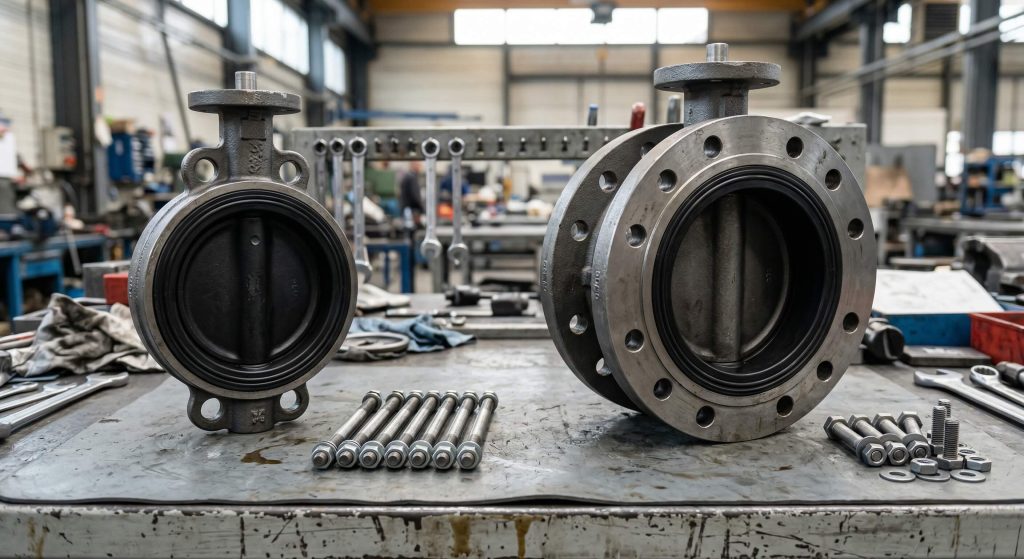
An industrial butterfly wafer type valve is defined by its compact, flangeless body that is “sandwiched” between two pipe flanges using long through-bolts. This design relies on the clamping force of the external piping system to maintain its position and seal integrity.
What are the core structural features?
You will notice immediately that these valves lack the heavy, integrated bolt-hole circles found on other models. But that’s not all; their slim profile makes them the lightest option in the butterfly category.
- Minimal face-to-face dimensions.
- Centric or eccentric disc placement.
- Resilient seat that acts as a gasket.
How does the connection mechanism work?
When you install this component, you are essentially relying on the compression of the seat between two flat-faced pipe flanges. Here’s the best part: the simple design reduces the number of leak paths significantly.
- Through-bolt alignment.
- Uniform seat compression.
- Symmetrical pressure distribution.
Key Takeaway: The wafer design is the go-to solution for space-constrained environments where a lightweight, efficient flow control mechanism is required.
| Feature | Wafer Type Specification |
|---|---|
| Connection Style | Clamped/Sandwich |
| Body Width | Narrow (Space-saving) |
| Typical Standards | DIN, ANSI, JIS Compatible |
This compact footprint allows you to optimize piping layouts without sacrificing flow performance.
How does a butterfly wafer type valve differ in body construction?
A butterfly wafer type valve features a sleek, flangeless body designed to fit snugly between pipe ends, whereas a flange type possesses integrated bolt holes on both sides. This fundamental structural difference dictates how the valve handles mechanical stress and internal pressure.
Are there integrated flanges on the body?
You will find that the wafer version is essentially a disc held within a ring, devoid of the heavy protruding flanges seen on double-flanged valves. Think about this: removing the excess metal makes the unit significantly easier to handle during high-elevation installs.
- Smooth exterior body.
- No integrated bolt circles.
- Reduced material volume.
What is the role of pilot bolt holes?
Even though the body is flangeless, you might see two to four small “ears” or holes on the top and bottom. The secret is this: these are not for securing the valve, but for ensuring perfect alignment with the piping bolts during the tightening process.
- Centering assistance.
- Rotation prevention.
- Installation accuracy.
Key Takeaway: By eliminating integrated flanges, the construction focuses on a “less is more” philosophy that prioritizes material efficiency and weight reduction.
| Construction Element | Wafer Design | Flange Design |
|---|---|---|
| Flange Holes | Positioning holes only | Full bolt circle |
| Material Volume | Lower (Lightweight) | Higher (Heavy duty) |
| Face-to-Face | Short | Long |
Choosing the wafer body allows you to reduce the total structural load on your piping supports.
Is a butterfly wafer type valve more cost-effective than flanged?
The initial purchase price of a butterfly wafer type valve is typically 30% to 40% lower than its flanged counterpart due to the significant reduction in raw materials. For large-scale projects requiring hundreds of units, this price gap represents a substantial capital expenditure saving.
Why is the initial purchase price lower?
You are paying for less ductile iron or stainless steel because the wafer body is much thinner than a double-flanged body. It gets even better: the manufacturing process is streamlined, leading to lower production overheads that are passed on to you.
- Reduced metal casting weight.
- Simplified machining requirements.
- Lower shipping costs.
Do installation and hardware costs vary?
While the valve itself is cheaper, you must account for the specialized long studs and nuts required for the “sandwich” mount. But here’s the kicker: even with slightly more expensive hardware, the total installed cost usually remains lower than the flanged alternative.
- Fewer bolts required (one set of long studs).
- Reduced labor hours for handling.
- Lower maintenance on smaller parts.
Key Takeaway: For budget-conscious projects that do not require high-cycle downstream maintenance, the wafer type is the most economical choice.
| Economic Metric | Wafer Type | Flange Type |
|---|---|---|
| Manufacturing Cost | Low | High |
| Material Weight | ~30% Lighter | Heavy |
| Hardware Expense | Moderate (Long Studs) | High (Multiple Bolts) |
The combination of lower unit price and reduced shipping weight makes the wafer design a winner for global procurement.
Why is installation precision vital for a butterfly wafer type valve?
Installing a butterfly wafer type valve requires absolute precision because the seal depends entirely on the parallel alignment of the upstream and downstream pipe flanges. Any misalignment can lead to uneven seat compression and eventual failure.
What happens if flanges are misaligned?
If you tighten the bolts when the pipe flanges are not perfectly parallel, you risk warping the valve seat or even cracking the body. But that’s only the beginning: a skewed installation places extreme shearing force on the long mounting studs.
- High leakage risk at joints.
- Potential bolt snapping.
- Uneven disc wear.
How does construction accuracy affect sealing?
You must follow a strict star-pattern tightening sequence to ensure the butterfly wafer type valve is compressed evenly. The beauty of this is that when done correctly, the integrated seat provides a bubble-tight seal without the need for additional gaskets.
- Calibrated torque requirements.
- Parallel flange verification.
- Gradual tensioning stages.
Key Takeaway: Success with wafer valves depends on the skill of the installer and the quality of the surrounding piping alignment.
| Installation Risk | Impact on Wafer Type |
|---|---|
| Misalignment | High Leakage Risk |
| Shearing Force | Concentrated on Studs |
| Torque Sensitivity | Critical for Sealing |
Professional installation ensures that the compressed seat maintains its integrity across thousands of cycles.
Can a butterfly wafer type valve handle high-temperature expansion?
A butterfly wafer type valve is generally limited to lower temperature ranges because the long mounting bolts are susceptible to thermal expansion. When these bolts elongate due to heat, the clamping force on the valve seat decreases, often resulting in dangerous leaks.
How do long bolts react to thermal stress?
When you run high-temperature media through the line, the long studs holding the butterfly wafer type valve expand linearly. You should know that even a fraction of a millimeter of expansion can break the tension required to keep the seat sealed.
- Loss of clamping torque.
- Gasket relaxation.
- Increased risk of blowouts.
What are the diameter limits for heat applications?
As you increase the pipe diameter, the length of the mounting bolts also increases, compounding the expansion problem. In large-diameter systems under high heat, you are almost always better off selecting a flanged design with independent, shorter bolts.
- Recommended limit < 200°C.
- DN600+ threshold for design change.
- Linear expansion coefficients matter.
Key Takeaway: Avoid long-bolt wafer configurations in high-heat cycles where thermal expansion could compromise the joint’s safety.
| Thermal Factor | Wafer Limitation |
|---|---|
| Bolt Expansion | Significant (Leads to leaks) |
| Max Temperature | Recommended < 200°C |
| Pipe Diameter | Limited in High Heat |
Understanding the mechanical limits of long-bolt systems prevents costly emergency shutdowns in thermal plants.
Is the sealing reliability of a butterfly wafer type valve superior?
While a butterfly wafer type valve provides excellent sealing under standard conditions, its reliability is considered “single-point” because the seal on both sides depends on the same set of bolts. If one side fails or needs service, the entire connection must be broken.
How does the double-surface seal function?
You are essentially dealing with two sealing faces that are pressurized by the same mechanical force. But wait, here’s the interesting part: because the seat often wraps around the body, it creates a seamless barrier against the media.
- Integrated seat gaskets.
- Symmetrical compression.
- Bi-directional flow capability.
Is the flanged connection more robust?
In high-vibration environments, you will find that the flanged type offers more security because it is bolted independently to each pipe end. This means that if you experience vibration on the downstream side, the upstream seal remains undisturbed and secure.
- Independent bolt circles.
- Vibration dampening.
- Redundant sealing surfaces.
Key Takeaway: Wafer valves offer high reliability for stable, inline service, but flanged valves provide better security in dynamic or unstable systems.
| Sealing Metric | Wafer Type | Flange Type |
|---|---|---|
| Reliability | Standard | High |
| Maintenance | Full disassembly required | Partial disassembly possible |
| Gasket Style | Integrated Seat | Separate Gaskets |
Evaluate your system’s vibration profile before deciding between a wafer or flanged interface.
When should you avoid using a butterfly wafer type valve at pipe ends?
You should never use a standard butterfly wafer type valve for dead-end service because removing the downstream flange will cause the valve to fall out. Since the valve is held by the tension of both flanges, it cannot maintain pressure if one side is disconnected.
Is dead-end service possible?
If you need to close off the end of a line for future expansion, the wafer type is not your friend. The secret is this: without a second flange to provide clamping force, the valve cannot stay in place against the internal fluid pressure.
- Risk of catastrophic blowout.
- Manual support required during removal.
- Incompatibility with end-of-line testing.
Are there workarounds for downstream disassembly?
If you are forced to use a butterfly wafer type valve in a spot that requires frequent downstream maintenance, you must install a separate spool piece or joint. However, you will find that it is much easier and safer to simply specify a lug or flange type valve from the start.
- Extra hardware required.
- Increased system complexity.
- Maintenance labor intensifies.
Key Takeaway: For any application requiring the ability to work on downstream piping while the upstream is under pressure, the wafer design is strictly prohibited.
| Application Suitability | Wafer Type | Flange Type |
|---|---|---|
| Dead-End Service | Not Recommended | Excellent |
| System Isolation | Moderate | Superior |
| Inline Service | Excellent | Excellent |
Safety protocols dictate that flanged or lug-style valves must be used for all terminal pipeline points.
How does the weight of a butterfly wafer type valve affect logistics?
The reduced mass of a butterfly wafer type valve makes it significantly cheaper to ship and easier for your crews to install in tight spaces. On average, these valves are 25% to 40% lighter than flanged versions of the same size.
Does reduced mass lower freight costs?
When you are ordering valves for a major project, the weight difference adds up to tons of saved freight charges. Think about this: you can fit more units into a single container, maximizing your shipping efficiency and reducing the carbon footprint of your project.
- Lower per-unit shipping fee.
- Higher container density.
- Reduced handling equipment needs.
Is handling easier for maintenance crews?
You will appreciate the lighter weight when your team has to install a valve 10 meters up on a pipe rack. The best part is: smaller crews can often manage the installation of mid-sized butterfly wafer type valve units without needing heavy-duty cranes or hoists.
- Reduced manual labor strain.
- Faster positioning in tight corners.
- Lower risk of onsite injuries.
Key Takeaway: Logistics managers prefer the wafer type for its “light and lean” characteristics that simplify transport and installation.
| Logistics Factor | Wafer Benefit |
|---|---|
| Shipping Weight | Reduced by 25-40% |
| Installation Labor | Lower (Fewer man-hours) |
| Structural Support | Less Pipe Stress |
Reducing valve weight not only saves money but also minimizes the structural requirements for pipe hangers and supports.
Does a butterfly wafer type valve require specific bolt lengths?
Procuring the correct hardware for a butterfly wafer type valve is more complex because you must calculate the “stack height” of the entire joint. This includes the thickness of both pipe flanges plus the face-to-face dimension of the valve itself.
What are the standard stud requirements?
You cannot use standard short bolts for this setup; instead, you need all-thread studs that pass through the entire assembly. Here’s the best part: using a single long stud per hole ensures that the tension is applied uniformly to both sealing faces at once.
- Full-length through-studs.
- Two nuts per bolt.
- Hardened washers for even pressure.
What are the risks of using incorrect hardware?
If you use bolts that are too short, you won’t get full thread engagement in the nuts, leading to a potential joint failure under pressure. You must verify that your butterfly wafer type valve installation has at least two threads protruding from each nut after final torque.
- Thread stripping under load.
- Uneven clamping force.
- Safety hazards during pressure tests.
Key Takeaway: Always consult the manufacturer’s stack-height chart to ensure your hardware procurement matches the specific valve and flange combination.
| Hardware Spec | Wafer Requirement |
|---|---|
| Bolt Type | All-thread Studs |
| Thread Depth | Full pass-through |
| Nut Count | 2 per Stud |
Precision in hardware selection is just as important as the quality of the valve body itself for a leak-free system.
Which application best suits a butterfly wafer type valve selection?
The butterfly wafer type valve is ideal for general-purpose fluid control in water treatment, HVAC systems, and low-pressure chemical processing. Its versatility makes it a staple in municipal infrastructure projects across the globe.
Is it ideal for water treatment?
You will find these valves in almost every wastewater and potable water facility due to their cost-effectiveness. The secret is this: since these systems operate at moderate temperatures and pressures, the wafer design provides the perfect balance of performance and price.
- High-volume water lines.
- Sludge and slurry handling.
- Backwash system control.
How does it perform in chemical processing?
In systems where you need corrosion resistance, you can choose a butterfly wafer type valve with a PTFE or EPDM liner. But that’s not all; the simple design allows for easy cleaning and lining, making it a favorite for aggressive media that isn’t under high thermal stress.
- Chemical dosing lines.
- Process water loops.
- Low-pressure acid transport.
Key Takeaway: When space is tight and the temperature is controlled, the wafer type is the most efficient solution for fluid management.
| Selection Criteria | Preferred Valve Type |
|---|---|
| High Pressure (>PN25) | Flange Type |
| Restricted Space | Wafer Type |
| Frequent Maintenance | Flange Type |
Matching the valve type to the specific demands of your media ensures long-term operational reliability.
Conclusion: Precision Engineering for Fluid Mastery
Selecting between a wafer and a flange butterfly valve is a critical decision that balances project economics with mechanical necessity. While the wafer type offers unmatched value and lightweight efficiency for standard inline applications, the flange type provides the rugged reliability and maintenance flexibility required for terminal points and high-temperature infrastructure. At RUITO, we solve your fluid control challenges by providing precision-engineered valves that eliminate leaks and reduce operational downtime. Our brand vision is to empower global industries with the most reliable, traceable, and efficient valve solutions on the market. Contact us today to discover how our engineering expertise can de-risk your next project and ensure system integrity from day one.
Frequently Asked Questions
Can I use a wafer valve for dead-end service?
No. Because the wafer valve is held in place by the tension of both flanges, removing the downstream flange causes the valve to fall out of the line.
What’s the best way to prevent leaks in wafer installations?
The best method is ensuring pipe flanges are perfectly parallel and using a calibrated torque wrench to tighten the studs in a star pattern.
How do I know if I need a flange type instead?
You should choose a flange type if your application involves temperatures above 200°C, pipe diameters above DN600, or requires downstream isolation capabilities.
Can I replace a flange valve with a wafer type directly?
Generally, no. Flange type valves have a significantly longer face-to-face dimension, meaning a wafer valve would leave a gap that requires a spool piece.
What’s the best temperature limit for long-bolt wafer designs?
For most standard applications, it is best to keep wafer valves below 200°C to avoid the risks associated with the thermal expansion of long mounting studs.