
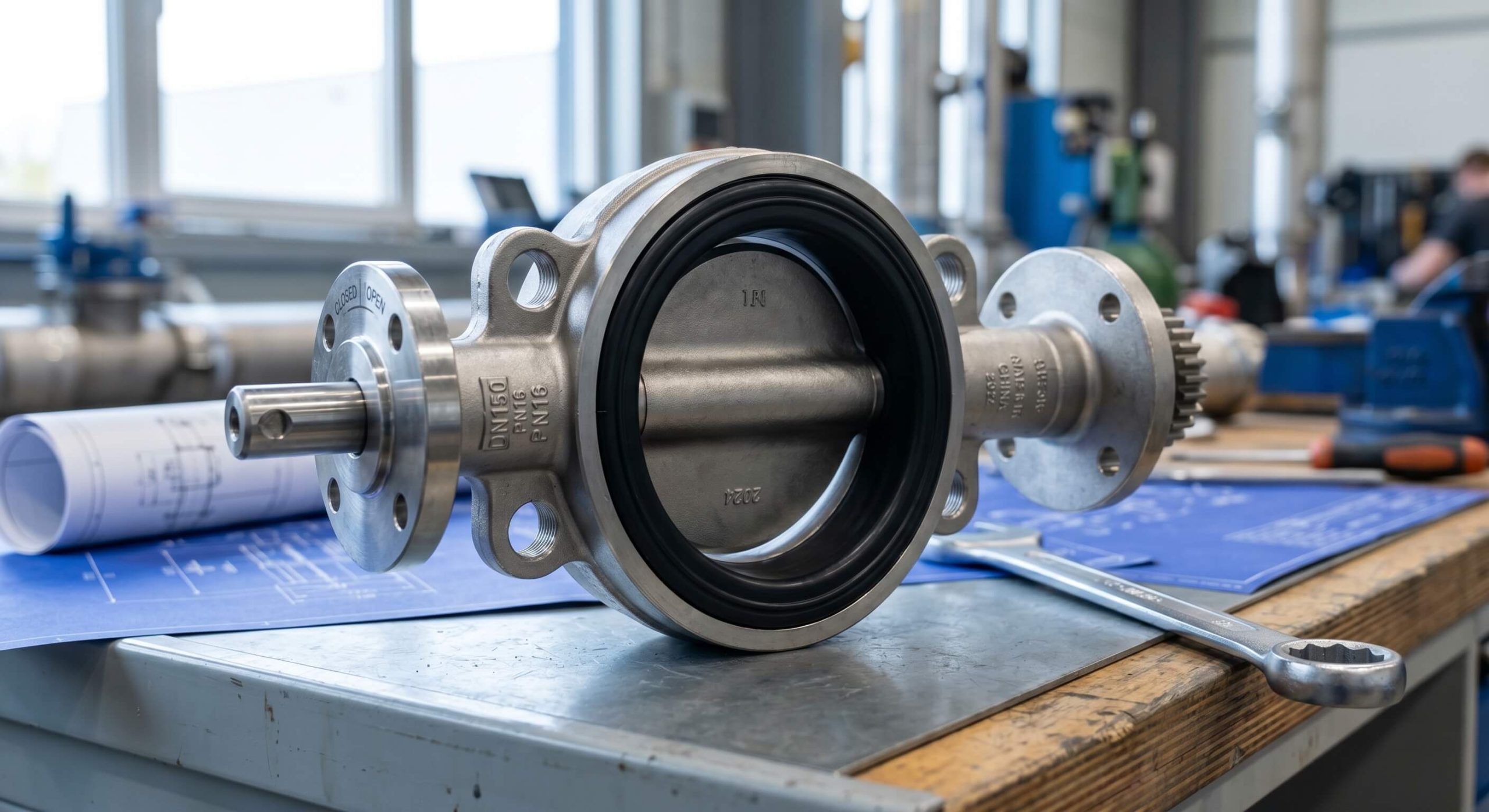
A single eccentric butterfly valve uniquely offsets its stem from the disc center, separating that part functionally from double and triple designs. Facility managers often face unexpected pipe leaks. Unchecked fluid loss ruins production schedules rapidly. Our optimized single eccentric butterfly valve directly prevents these disastrous system failures. This guide explains how different offset designs operate.

1. What is a single eccentric butterfly valve?
A single eccentric butterfly valve features a stem positioned slightly behind the disc centerline. This single eccentric butterfly valve design reduces friction during initial opening stages. Engineers favor this setup for moderately demanding applications.
Why choose this specific offset design?
Here is the deal: offsetting that stem creates a cam effect. This movement pulls the disc away quickly. Wear drops greatly compared to standard concentric models.
- Reduced friction during operation.
- Extended seal lifespan.
- Lower torque requirements.
Can this valve handle high pressure?
Performance remains stable under moderate pressure conditions. Extreme pressure applications typically require double or triple offsets. What is the real story? Cost savings make single offsets highly attractive for low-pressure systems.
| Feature | Concentric | Single Eccentric |
|---|---|---|
| Offset | None | One |
| Friction | High | Medium |
| Cost | Low | Medium |
This table shows how single offsets balance cost and operational efficiency perfectly.
Key Takeaway: You save money while achieving superior sealing by selecting this specific configuration for standard water lines.
2. How does a single eccentric butterfly valve work?
A single eccentric butterfly valve operates by rotating its disc ninety degrees around an offset axis. You open the pipe entirely with one quick quarter turn. This mechanism minimizes contact between sealing surfaces.
What happens during rotation?
This is where things get interesting: that offset axis forces a non-linear path. That disc completely clears the seat almost immediately.
- Instant seat clearance.
- Minimal scraping.
- Smooth torque curve.
Why does the offset matter?
That slight shift prevents constant rubbing against rubber liners. You avoid frequent replacements. You might be wondering: does this complicate maintenance? Routine checks remain remarkably simple.
| Action | Concentric Valve | Single Offset Valve |
|---|---|---|
| Opening | Constant rubbing | Immediate clearance |
| Sealing | Squeeze fit | Cam action fit |
The comparison above illustrates the mechanical advantage gained by moving that rotational axis.
Key Takeaway: Your maintenance team will spend less time replacing torn seals due to this intelligent motion path.
3. Where do you use a single eccentric butterfly valve?
You deploy a single eccentric butterfly valve primarily within water treatment and low-pressure piping systems. This single eccentric butterfly valve handles clean fluids exceptionally well. Facility operators prefer them for large diameter cooling lines.
Are they suitable for harsh chemicals?
But here is the kicker: corrosive chemicals often degrade standard rubber seats rapidly. You should select specialized materials for aggressive fluids.
- Standard rubber suits water.
- PTFE handles mild chemicals.
- Metals resist high temperatures.
How do they perform in HVAC?
HVAC systems benefit immensely from their lightweight construction. You install them easily in tight ceiling spaces. Ready for the good part? They reduce overall structural load greatly.
| Application | Suitability | Recommended Material |
|---|---|---|
| Water Supply | Excellent | EPDM Rubber |
| HVAC Chillers | Very Good | Nitrile |
| Harsh Acids | Poor | Not Recommended |
That data clearly shows ideal performance occurs within clean water environments.
Key Takeaway: You achieve maximum ROI by limiting these units to non-abrasive, standard-temperature fluid applications.
4. Why pick a single eccentric butterfly valve now?
Choosing a single eccentric butterfly valve provides immediate relief from high-friction concentric failures. You gain a reliable shutoff mechanism without breaking your budget. Upgrading older plants using a single eccentric butterfly valve saves immense capital.
What are the main benefits?
What is the catch? There really isn’t one for appropriate applications. You enjoy longer service life.
- Lower purchase price.
- Readily available parts.
- Fast installation process.
Do they require special actuators?
Standard pneumatic or electric actuators fit these units perfectly. You don’t need expensive high-torque motors. Here is the deal: lower friction means smaller, cheaper automation equipment works flawlessly.
| Actuator Type | Compatibility | Cost Impact |
|---|---|---|
| Manual Lever | Yes | Lowest |
| Pneumatic | Yes | Moderate |
| Electric | Yes | Highest |
Selecting manual or pneumatic options keeps your total project expenses remarkably low.
Key Takeaway: Your automation budget stretches further because these low-friction designs require much smaller drive mechanisms.
5. How does a single eccentric butterfly valve seal?
A single eccentric butterfly valve seals through an interference fit modified by cam action. That disc pushes into a resilient seat just before fully closing. This single eccentric butterfly valve guarantees tight shutoff.
Does the seal degrade quickly?
This is where it gets interesting: that cam effect delays contact until final degrees. You experience vastly reduced wear compared to older styles.
- Delayed contact point.
- Less abrasive friction.
- Tighter final compression.
Can you replace the seat?
Most manufacturers design these with replaceable elastomer seats. You simply swap out worn rubber rather than buying new hardware. What is the real story? Field repairs take minutes instead of hours.
| Component | Lifespan | Replacement Difficulty |
|---|---|---|
| Disc | 10+ Years | Hard |
| Rubber Seat | 3-5 Years | Easy |
| Stem | 10+ Years | Hard |
Routine seat replacement extends overall hardware life indefinitely while keeping repair costs negligible.
Key Takeaway: You empower your maintenance crew to perform rapid field overhauls, drastically reducing costly system downtime.
6. Single eccentric butterfly valve vs concentric?
A single eccentric butterfly valve drastically outperforms concentric models regarding longevity and torque requirements. Concentric designs rub continuously, destroying seals rapidly. You should avoid concentric units for high-cycle duties entirely.
Is the price difference justified?
But here is the kicker: that slight price premium pays for itself within months. You stop buying replacement parts constantly.
- Fewer replacement cycles.
- Lower maintenance labor.
- Reduced process interruptions.
Which one handles slurries better?
Concentric designs sometimes handle light slurries better due to symmetrical flow paths. Eccentric units might trap particles behind that offset stem. You might be wondering: what about clean water? Eccentric reigns supreme there.
| Metric | Concentric | Single Offset |
|---|---|---|
| Lifespan | Short | Medium |
| Wear Rate | High | Moderate |
| Best Fluid | Slurry | Clean Liquid |
Upgrading from concentric designs greatly improves reliability across standard liquid handling operations.
Key Takeaway: You eliminate chronic maintenance headaches by abandoning outdated concentric technology in favor of offset geometry.
7. Single eccentric butterfly valve vs double offset?
A single eccentric butterfly valve falls short of a double offset regarding high-pressure capabilities. Double offsets shift the stem twice, completely eliminating rubbing. You specify a single eccentric butterfly valve for lighter duties.
When do double offsets win?
Ready for the good part? Double offsets handle extreme pressures and utilize metal seals easily. You need them for demanding industrial processing.
- Handles higher pressures.
- Supports metal seating.
- Zero friction design.
Why stick with a single offset?
Single offsets cost greatly less than double offset equivalents. You avoid over-engineering simple water lines. Here is the deal: buying double offsets for low-pressure water wastes money.
| Feature | Single Offset | Double Offset |
|---|---|---|
| Pressure Limit | Low-Medium | High |
| Seal Material | Rubber | PTFE/Metal |
| Relative Cost | Low | High |
Choosing between these two depends entirely upon your specific system pressure and budget constraints.
Key Takeaway: You conserve capital by deploying single offsets where high-performance double offsets represent unnecessary overkill.
8. Single eccentric butterfly valve vs triple offset?
A single eccentric butterfly valve cannot compete with a triple offset in harsh, high-temperature environments. Triple offsets use conical seating to achieve zero leakage under extreme thermal stress. This single eccentric butterfly valve remains a basic utility option.
What makes triple offset special?
What is the real story? Triple offsets eliminate all physical contact until exact closure moments. You use them for lethal gases or steam.
- Zero leakage performance.
- Extreme temperature tolerance.
- Fire-safe metal sealing.
Should you ever upgrade?
You must upgrade if your process fluid becomes hazardous or extremely hot. Standard rubber seats melt or degrade instantly under those conditions. What is the catch? Triple offsets carry massive price tags.
| Capability | Single Offset | Triple Offset |
|---|---|---|
| Temperature | < 120°C | > 400°C |
| Fluid Type | Water/Air | Steam/Gas |
| Leakage | Class VI | Zero Leakage |
Triple offsets dominate extreme engineering challenges while single offsets reliably manage everyday fluid movement.
Key Takeaway: You guarantee plant safety by reserving triple offsets for hazardous lines, utilizing simpler valves elsewhere.
9. How to install a single eccentric butterfly valve?
You install a single eccentric butterfly valve by clamping that unit carefully between two pipe flanges. Always verify the flow direction arrow matches your system parameters before tightening bolts. A single eccentric butterfly valve requires precise alignment.
What are common installation mistakes?
This is where things get interesting: tightening bolts unevenly warps rubber seats causing instant leaks. You must follow a star-pattern torque sequence.
- Clean all flange faces.
- Use a star pattern.
- Do not over-torque bolts.
Can it be mounted vertically?
You can mount them vertically but horizontal stem orientation usually proves safer. Debris settles at bottom sections, potentially damaging vertical stem bearings. But here is the kicker: horizontal stems sweep debris away naturally.
| Orientation | Stem Position | Risk Level |
|---|---|---|
| Horizontal | Horizontal | Lowest |
| Vertical | Horizontal | Low |
| Vertical | Vertical | Higher (Debris) |
Correct spatial orientation prevents particulate buildup from destroying internal mechanical bearings prematurely.
Key Takeaway: You protect your investment by strictly enforcing horizontal stem orientations during all contractor installations.
10. How to maintain a single eccentric butterfly valve?
Maintaining a single eccentric butterfly valve involves periodic visual inspections and occasional actuator lubrication. You should monitor the flange connections for any minor weeping or pressure drops. Routine single eccentric butterfly valve checks prevent disasters.
How often should you inspect?
You might be wondering: does that unit need monthly checks? Bi-annual inspections usually suffice for standard water operations.
- Check for visible leaks.
- Cycle the actuator manually.
- Inspect seat for cracking.
What parts fail first?
That elastomer seat typically degrades before any metallic components. You simply order a replacement seat kit from your supplier. Ready for the good part? That massive cast iron body practically lasts forever.
| Maintenance Task | Frequency | Skill Required |
|---|---|---|
| Visual Inspection | 6 Months | Low |
| Actuator Testing | 12 Months | Medium |
| Seat Replacement | 3-5 Years | High |
A predictable maintenance schedule drastically lowers the probability of sudden catastrophic pipeline failures.
Key Takeaway: You guarantee continuous facility operations by maintaining a strict, proactive replacement schedule for elastomer seats.
Final Thoughts
Our guide clarified exactly how single offsets solve excessive friction and premature seal failure. We provide premium industrial flow solutions designed for maximum reliability and efficiency. Excellence defines our engineering approach. Please contact us today for personalized project support.
FAQ
Q1: Can I use this for high-pressure steam?
No, you can’t. High temperatures and pressures will destroy that rubber seat instantly, requiring a triple offset alternative.
Q2: What position works best for installation?
Horizontal stem placement works best. This position prevents sediment from accumulating inside bottom bearing mechanisms.
Q3: How do I know if the seat is failing?
You will notice pressure drops or visible weeping. Worn rubber allows fluid bypass past closed discs.
Q4: Can I replace a concentric valve directly?
Yes, you absolutely can. They share identical face-to-face dimensions, making retrofits incredibly fast and straightforward.
Q5: What material works best for drinking water?
EPDM rubber comes highly recommended. That material resists degradation and meets strict safety standards for potable water systems.