
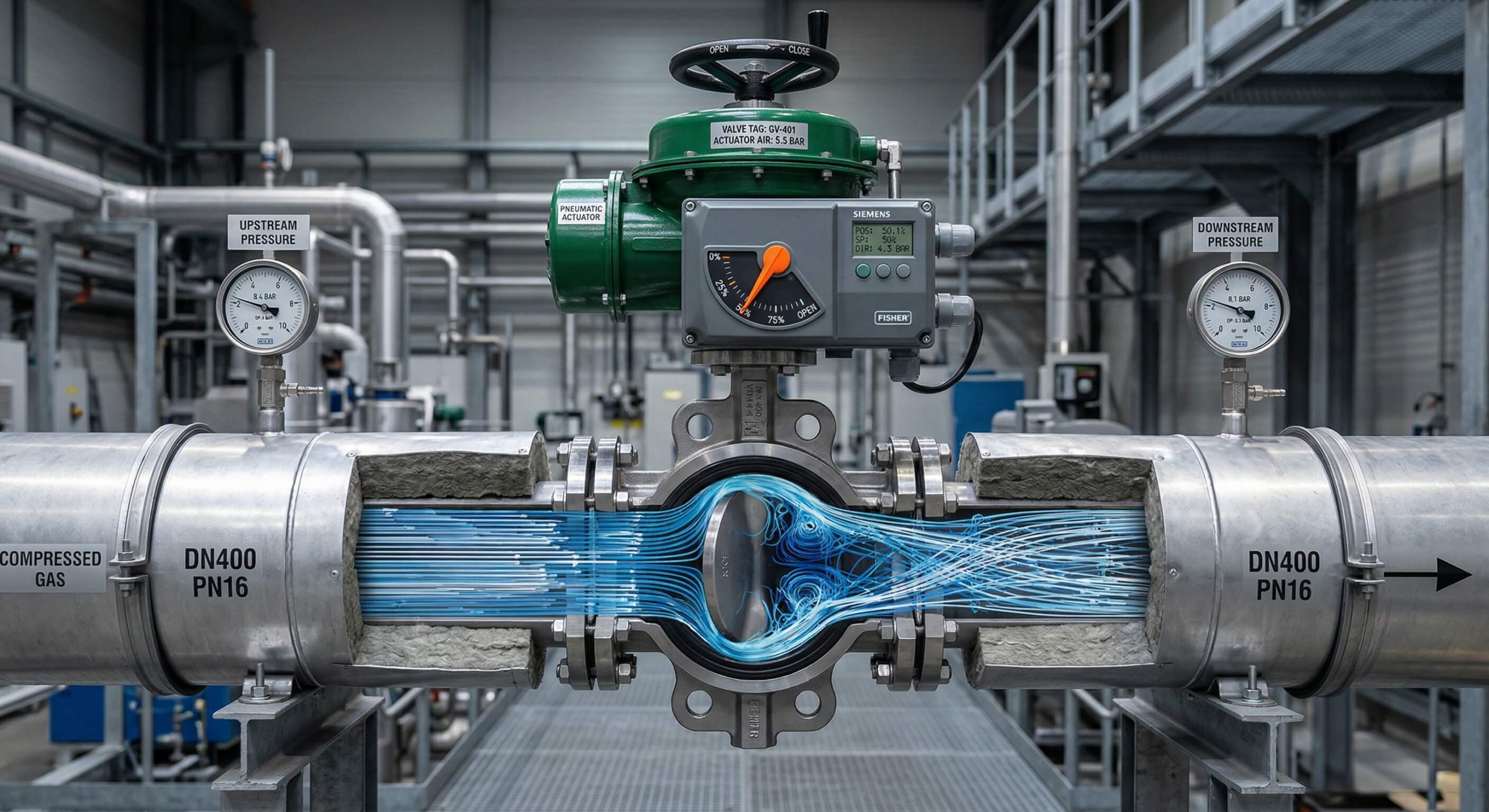
Butterfly valves function as control valves when precision requirements fall within a 1-2% accuracy margin and operating conditions remain between 20 and 80 degrees of opening. Engineering teams often face a critical bottleneck when choosing between the extreme precision of globe valves and the restrictive budgets of large-scale industrial projects. Selecting the wrong hardware leads to catastrophic flow instability or unnecessary capital expenditure that drains your project resources. You can solve this dilemma by implementing strategic butterfly valve air flow control through high-performance designs available at RuitoFlow.
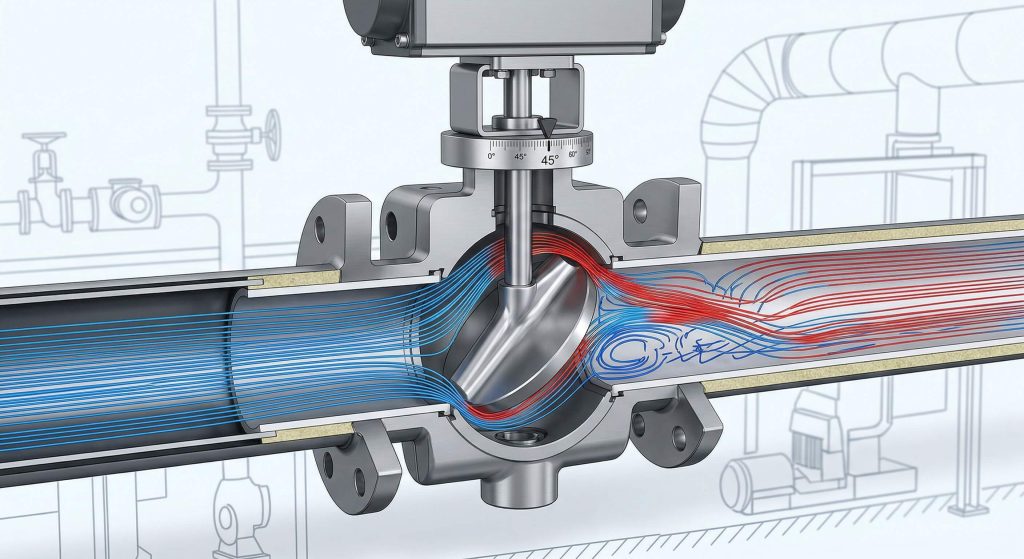
1. Can butterfly valve air flow control provide sufficient accuracy?
Control accuracy is achievable when you operate the disc within its optimal throttling range to maintain stable flow coefficients. You must recognize that while these valves are not intended for ultra-precise chemical mixing, they excel in general modulation tasks. Using a butterfly valve air flow control strategy allows for a repeatable 1% to 2% accuracy threshold in most industrial environments.
The 20-80 Degree Throttling Range
Think about this:
The physics of a rotating disc means the flow characteristic is non-linear at the extreme ends of the stroke.
- Most effective control occurs between 20° and 80° open.
- Low-angle operation increases the risk of seat erosion.
- High-angle operation offers minimal resistance but loses control sensitivity.
- Proper sizing ensures your normal operating point stays centered.
The bottom line:
You gain the best results by matching the valve’s Cv curve to your actual system demand.
- Utilize digital positioners for better linearity.
- Monitor downstream pressure to prevent cavitation.
- Ensure the actuator torque exceeds the dynamic flow forces.
| Feature | Control Capability | Precision Level |
|---|---|---|
| Accuracy | 1% to 2% Deviation | Moderate |
| Operating Range | 20° to 80° Opening | High |
| Sensitivity | Variable by Angle | Moderate |
Key Takeaway: You should trust butterfly valves for any control process where a slight margin of error is acceptable compared to the high cost of globe-style alternatives.
This analysis confirms that balancing the operating angle is the most critical factor for maintaining accuracy.
2. Is butterfly valve air flow control cost-effective for large projects?
Implementing a butterfly valve air flow control system is significantly more economical than traditional control valves because the simple design reduces material costs. You will find that as pipe diameters increase, the price gap between butterfly and globe valves widens exponentially. This makes them the primary choice for high-volume, large-scale infrastructure projects.
CAPEX vs. OPEX in Flow Modulation
Wait, there’s more:
The initial purchase price is only the beginning of your total cost of ownership savings.
- Lower initial capital expenditure for large bore sizes.
- Reduced weight translates to lower shipping and handling costs.
- Simplified maintenance reduces long-term labor requirements.
- Minimal pressure drop lowers the energy consumption of your pumps.
The secret is:
You can reallocate your budget to other critical system components by using these cost-effective throttlers.
- Standardized parts lower your spare inventory costs.
- Faster installation times reduce project schedule risks.
- Rugged designs extend the service interval in clean media.
| Expense Category | Butterfly Valve | Alternative (Globe) |
|---|---|---|
| Purchase Price | Low | Very High |
| Installation Cost | Low | Moderate to High |
| Maintenance | Minimal | Complex/Frequent |
Key Takeaway: Choosing butterfly valves for your control loops provides an immediate financial advantage without sacrificing the operational reliability of your facility.
This data illustrates that the economic benefits are consistent across both immediate acquisition and long-term utility.
3. Does a butterfly valve air flow control unit save installation space?
A butterfly valve air flow control unit occupies significantly less physical space due to its slim wafer or lug profile. You can install these valves in tight piping arrays where traditional sliding-stem valves simply would not fit. This compact geometry allows for more creative and efficient plant layouts.
Geometry Advantages of Quarter-Turn Designs
Here is the deal:
The “face-to-face” dimension of a butterfly valve is often a fraction of other control valve styles.
- Slim profile fits between standard pipe flanges.
- Lower overhead clearance is required for the actuator.
- Reduced weight eliminates the need for heavy structural supports.
- Simplified mounting facilitates horizontal or vertical installation.
Think about this:
You can significantly reduce the total footprint of your skid or manifold by utilizing quarter-turn technology.
- Wafer designs offer the most compact installation.
- Lug designs allow for downstream piping removal during maintenance.
- Integrated actuators reduce the overall height profile of the assembly.
| Metric | Butterfly Valve | Globe Valve |
|---|---|---|
| Weight | Lightweight | Heavy |
| Footprint | Compact | Large |
| Support Needs | Minimal | Significant |
Key Takeaway: You can maximize your facility’s floor space and reduce structural engineering costs by selecting valves with high power-to-weight ratios.
The spatial efficiency of the butterfly design makes it the undisputed leader for modular and compact skid assemblies.
4. How does a butterfly valve air flow control the pressure drop?
The straight-through flow path of a butterfly valve air flow control system ensures a very high flow coefficient (Cv) with minimal pressure loss. You will benefit from lower pumping or blower costs because the disc offers less resistance than the tortuous path of a globe valve. This efficiency is vital for maintaining system pressure in large-diameter gas lines.
Fluid Dynamics and Energy Efficiency
It gets even better:
Lower head loss means your system operates at a higher overall efficiency rating.
- Minimal obstruction when the disc is fully open.
- Low pressure drop reduces the risk of flashing.
- Energy savings directly impact your facility’s bottom line.
- High Cv values allow for smaller valve sizing in some cases.
The reality is:
You can achieve massive flow volumes without the energy-sapping resistance found in other valve designs.
- Optimized disc profiles reduce turbulence.
- Smooth internal bores prevent sediment buildup.
- Consistent flow paths minimize energy-wasting eddies.
| Metric | Butterfly Valve | Globe Valve |
|---|---|---|
| Flow Path | Straight-through | Tortuous |
| Pressure Drop | Low | High |
| Energy Loss | Minimal | High |
Key Takeaway: Utilizing butterfly valves for throttling allows you to move larger volumes of media using less energy compared to more restrictive valve types.
Reducing the energy required for flow movement is a primary driver for choosing butterfly valves in modern green-energy projects.
5. Can smart positioners improve butterfly valve air flow control?
Smart positioners are the essential link that transforms standard hardware into a high-precision butterfly valve air flow control solution. You can use digital instrumentation to electronically linearize the inherently non-linear flow curve of the disc. This technology provides the “brain” needed for sophisticated process automation.
Linearization and Signal Correction
Think about it:
The non-linear nature of a disc’s rotation can be corrected at the software level in the positioner.
- Signal characterization matches the input to the flow curve.
- Real-time feedback ensures the disc reaches the exact commanded angle.
- Advanced diagnostics predict seal wear before a failure occurs.
- Integration with DCS systems allows for remote calibration.
Look at the facts:
Digital positioners eliminate the “slop” or hysteresis that often plagues mechanical control loops.
- Tighter deadband control improves system stability.
- Faster response times allow for rapid process adjustments.
- Fail-safe configurations protect your equipment during power loss.
| Device | Benefit | Control Result |
|---|---|---|
| Analog Positioner | Basic Response | Adequate |
| Smart Positioner | Curve Correction | Excellent |
| Limit Switches | Status Monitoring | Safety Only |
Key Takeaway: You should always pair your control butterfly valves with smart positioners to achieve the highest possible modulation performance.
Digital correction is the most effective way to overcome the inherent mechanical limitations of quarter-turn hardware.
6. Is butterfly valve air flow control suitable for high-velocity ducts?
High-velocity environments require a butterfly valve air flow control unit with a robust stem and disc assembly to withstand dynamic forces. You must ensure that the valve is designed to resist the vibration and flutter that occur when air speeds exceed standard thresholds. When properly engineered, these valves provide reliable service in demanding ventilation systems.
Stem Strength and Vibration Resistance
Here is the kicker:
High-speed air can act like a physical hammer against a poorly supported valve disc.
- Heavy-duty stems prevent bending under aerodynamic load.
- Secure disc-to-stem connections eliminate mechanical play.
- Aerodynamic disc profiles reduce the shedding of vortices.
- High-quality bearings prevent stem seizing during rapid cycles.
The bottom line is:
You need a valve that is built for durability if you expect it to throttle high-velocity air consistently.
- Metal-to-metal seating options handle higher temperatures.
- Reinforced seals prevent erosion in high-speed paths.
- Proper torque sizing ensures the actuator can hold its position.
| Velocity Effect | Risk | Mitigation Strategy |
|---|---|---|
| Disc Flutter | High | Increase Stem Diameter |
| Noise | High | Optimize Disc Profile |
| Erosion | Moderate | Use Hardened Materials |
Key Takeaway: High-velocity applications demand premium valve construction to ensure that vibration does not lead to premature mechanical failure.
Ensuring mechanical rigidity is the only way to maintain control stability in high-velocity airflow scenarios.
7. When should you avoid butterfly valve air flow control?
You must avoid using butterfly valve air flow control in processes where the media is highly abrasive or if you require absolute 0.1% accuracy. There are specific boundary conditions—such as high pressure drops that cause cavitation—where a globe valve or specialized V-port ball valve is a safer choice. Recognizing these limits protects your system from catastrophic damage.
Critical Limits and Application Warnings
Think about this:
Every valve has a breaking point where its design benefits become liabilities.
- High-pressure steam can quickly destroy resilient seats.
- Slurries with high solid content can clog the disc cavity.
- Processes requiring extreme linearity at 5% open should use globe valves.
- High-purity pharmaceutical lines may require different internal geometries.
It gets even better:
Knowing when to say “no” to a butterfly valve is just as important as knowing when to use one.
- Cavitation risk is higher in liquid lines with high pressure drops.
- Precise mixing of minute ingredients requires sliding-stem accuracy.
- Extremely high-temperature gasses exceed standard elastomer limits.
| Constraint | Limit | Recommendation |
|---|---|---|
| Precision | <0.5% Accuracy | Switch to Globe |
| Pressure Drop | High ΔP Risk | Use Multi-Stage Trim |
| Media Type | Heavy Slurries | Use Pinch/Gate Valves |
Key Takeaway: You should reserve butterfly valves for high-capacity, moderate-precision tasks and select specialized trim for extreme or high-accuracy environments.
This distinction ensures that you do not misapply hardware in environments that demand different flow physics.
8. What materials optimize butterfly valve air flow control?
Choosing the correct metallurgy and elastomer is vital for a butterfly valve air flow control system to survive corrosive or high-heat environments. You must match the seat material—whether EPDM, PTFE, or metal—to the chemical composition and temperature of your media. Material science is the foundation of valve longevity and performance.
Metallurgy and Elastomer Selection
Here is the deal:
The wrong seat material will swell or degrade, leading to seat leakage or stem binding.
- PTFE seats offer the best chemical resistance for air and gas.
- Stainless steel discs prevent corrosion in humid air environments.
- Ductile iron bodies provide a cost-effective yet strong exterior.
- Metal-seated designs handle temperatures that melt standard polymers.
Look at the facts:
High-performance butterfly valves often use specialized alloys to handle extreme industrial conditions.
- Carbon steel provides strength for high-pressure water loops.
- Special coatings can reduce friction and extend disc life.
- Triple-offset designs use metal laminates for zero-leakage control.
| Material | Media Compatibility | Temp Range |
|---|---|---|
| EPDM | Water / Low Pressure Air | -20°F to 250°F |
| PTFE | Chemicals / Dry Air | -50°F to 400°F |
| Metal Seat | High Temp / Steam | Up to 1200°F |
Key Takeaway: You must specify materials that align with your process chemistry to prevent premature failure and ensure stable control.
Matching materials to media is the most effective way to guarantee the long-term reliability of your control loop.
9. How do you size a butterfly valve air flow control system?
Proper sizing for a butterfly valve air flow control system requires calculating the flow coefficient (Cv) to ensure the valve throttles in its “sweet spot.” You must avoid the common mistake of sizing the valve based solely on the pipe diameter, which often leads to an oversized valve that hunts for position. Accurate sizing is an engineering necessity, not a suggestion.
Calculating Cv and Flow Dynamics
Think about it:
An oversized valve loses its ability to control at low flow rates, leading to process instability.
- Calculate minimum, normal, and maximum flow rates.
- Target a valve that is 50-70% open during normal operation.
- Factor in the pressure drop across the valve at various positions.
- Utilize RuitoFlow’s about us resources for technical engineering support.
The bottom line:
Accurate sizing ensures that your actuator and positioner can maintain a stable control loop.
- Use flow modeling software for complex gas systems.
- Account for the expansion of gas in high-velocity air ducts.
- Ensure the valve can handle the “worst-case” flow scenario.
| Step | Action | Outcome |
|---|---|---|
| Step 1 | Define Flow Min/Max | Baseline Data |
| Step 2 | Calculate Required Cv | Valve Size Selection |
| Step 3 | Verify Open Angle | Control Stability |
Key Takeaway: You will achieve superior control by selecting a valve that operates in its mid-range during standard production cycles.
This systematic approach prevents the mechanical wear and instability associated with oversized control hardware.
10. Is butterfly valve air flow control reliable for long-term use?
A high-quality butterfly valve air flow control system is incredibly reliable if you follow a consistent maintenance schedule. You will find that the limited number of moving parts makes these valves more robust than complex globe assemblies. Their simplicity is their greatest strength in harsh industrial settings.
Seal Integrity and Mechanical Durability
Wait, there’s more:
Modern manufacturing techniques have significantly improved the cycle life of quarter-turn seals.
- Blow-out proof stems enhance operator safety.
- Low-friction bearings reduce the load on your actuators.
- Replaceable seats make refurbishing the valve fast and easy.
- Corrosion-resistant coatings protect the valve in coastal environments.
Here is the kicker:
A properly maintained butterfly valve can last for decades in clean gas or air service.
- Periodic seal inspection prevents unexpected leaks.
- Actuator calibration ensures the loop remains tight.
- Stem packing adjustments maintain a bubble-tight exterior seal.
| Component | Life Expectancy | Maintenance Needs |
|---|---|---|
| Disc/Stem | 15+ Years | Periodic Lubrication |
| Resilient Seat | 5-8 Years | Replacement |
| Actuator | 10+ Years | Recalibration |
Key Takeaway: You can depend on butterfly valves for long-term service as long as you match the valve grade to your specific application duty.
Mechanical simplicity remains the best path toward long-term operational uptime in any industrial facility.
Summary of Solutions
By implementing butterfly valves as control units, you have solved the issues of high capital costs, excessive installation weight, and complex maintenance routines. Our analysis shows that when operated within the 20-80 degree range and paired with smart positioners, these valves provide the accuracy needed for modern industrial gas and air systems. At RuitoFlow, we take a definitive stance: Economic efficiency should never come at the cost of engineering integrity. We provide the high-performance hardware and technical guidance to ensure your flow control systems are both cost-effective and perfectly modulated.
If you are ready to optimize your system’s performance, contact us today to speak with a valve specialist about your specific application requirements.
FAQ: Common Control Questions
Can I use a butterfly valve for high-pressure steam control?
No, it is generally not recommended unless you use a high-performance triple-offset valve. Standard resilient seats will melt or deform under steam temperatures.
What’s the best angle for butterfly valve air flow control?
The optimal range is 20 to 70 degrees. Operating outside this range leads to poor sensitivity and increased mechanical wear.
How do I know if my butterfly valve is oversized?
If your valve spends most of its time operating below 15% open to maintain the setpoint, it is likely oversized. This leads to seat erosion and “hunting” in the control loop.
What’s the best material for chemical-rich air control?
PTFE (Teflon) is the industry standard for chemical resistance. It handles a wide range of corrosive gasses without degrading like standard EPDM.
Can I achieve zero leakage with a control valve?
Yes, but you must specify a high-performance or triple-offset design. Standard control valves prioritize modulation, so zero-leakage shut-off requires specific sealing technology.