

Accurate butterfly valve torque calculation is the primary safeguard against actuator failure and hazardous system leaks in your industrial pipeline. If you ignore the specific force required to rotate the disc, you risk shearing the valve stem or experiencing an incomplete seal during a critical shutdown. By mastering a precise butterfly valve torque calculation, you can ensure your flow control systems remain reliable, efficient, and safe under all operating conditions.
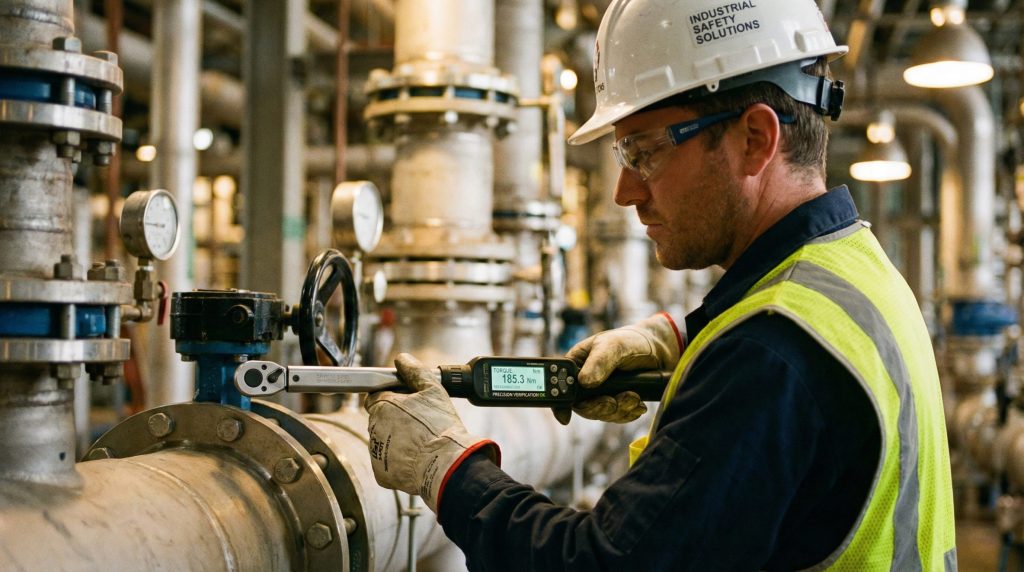
Why is butterfly valve torque calculation critical for safety?
A precise butterfly valve torque calculation ensures that your chosen actuator has sufficient power to overcome the internal friction and fluid resistance during an emergency closure. When you account for the breaking torque accurately, you prevent the valve from sticking, which could otherwise lead to catastrophic pressure surges or chemical spills.
What happens if you ignore the breaking torque?
Ignoring the breaking torque means your actuator might stall exactly when you need it to perform. You will likely face increased wear on the stem and potential seal deformation if the force applied is inconsistent with the valve’s requirements.
- Mechanical stall risks.
- Stem shear potential.
- Seat deformation hazards.
Believe it or not, most valve failures in high-pressure environments are traced back to this single calculation oversight.
Key Takeaway: Correctly calculating breaking torque prevents mechanical failure and ensures immediate response during emergency shutdowns.
| Safety Factor | Impact on Operation | Recommended Buffer |
|---|---|---|
| Breaking Torque | Initiates movement | 20-30% Margin |
| Actuator Compatibility | Prevents motor burnout | 1.25x Torque |
Ensuring your actuator can handle the initial “breakaway” force is the most vital step in protecting your personnel and equipment.
How does media affect butterfly valve torque calculation?
The type of fluid or gas passing through your system directly dictates the friction coefficient used in your butterfly valve torque calculation. You must adjust your figures based on whether the media provides lubrication or increases the resistance between the disc and the seat.
Why does dry media increase your torque needs?
When you handle dry gases or abrasive powders, the lack of lubrication significantly raises the friction levels. You will find that the torque required to move the disc is often 20% to 50% higher than it would be for water or oil.
- High friction coefficients.
- Increased seat abrasion.
- Surface tension effects.
Here’s the kicker: using “wet” torque figures for a “dry” application will almost certainly lead to an underpowered system.
Key Takeaway: You must always categorize your media as lubricating or non-lubricating before finalizing your torque equations.
| Media Category | Friction Level | Torque Adjustment |
|---|---|---|
| Lubricating (Oils) | Low | Standard Base |
| Non-Lubricating (Gas) | High | +35% Increase |
Properly identifying your media type ensures that you don’t accidentally specify an actuator that lacks the necessary power.
Does standards aid butterfly valve torque calculation?
Adhering to international standards like API 609 or ISO 5208 provides the necessary benchmarks for your butterfly valve torque calculation to remain consistent across different manufacturers. These guidelines help you determine the maximum allowable stem torque and ensure that your testing methods meet global safety requirements.
How do API standards protect your system?
You can rely on API standards to define the pressure classes and testing durations that validate your torque figures. When you follow these rules, you ensure that the valve can withstand the maximum differential pressure without leaking or failing mechanically.
- Standardized pressure classes.
- Verified leakage rates.
- Material stress limits.
But that’s not all; these standards also simplify the process of matching third-party actuators to your existing valves.
Key Takeaway: International standards provide a universal language that ensures your calculations meet rigorous safety and performance benchmarks.
| Standard | Focus Area | Benefit to User |
|---|---|---|
| API 609 | Design & Dimensions | Interchangeability |
| ISO 5208 | Pressure Testing | Leakage Assurance |
Using standardized benchmarks allows you to verify that your calculations align with industry best practices for high-stakes environments.
Is pressure vital for butterfly valve torque calculation?
Differential pressure is the most influential variable in your butterfly valve torque calculation because it determines the load applied directly to the valve disc. You will see that as the pressure difference across the closed disc increases, the force required to open the valve rises proportionally.
How does sealing pressure affect your actuator?
When you have high pressure on one side of the disc, the seat friction increases as the disc is pushed harder into the sealing surface. You must calculate this additional resistance to ensure your actuator doesn’t trip or fail during high-load cycles.
- Hydrostatic seat loading.
- Bearing friction increases.
- Disc deflection risks.
Think about this: even a small increase in line pressure can exponentially increase the required seating torque.
Key Takeaway: You must base your torque figures on the maximum possible differential pressure the valve will encounter in the field.
| Pressure Level | Disc Resistance | Torque Impact |
|---|---|---|
| Low (PN10) | Minimal | Baseline |
| High (PN40) | Significant | +50-80% Increase |
Evaluating the highest potential pressure differential is the only way to guarantee the valve will open and close when needed.
Can design influence butterfly valve torque calculation?
The structural design, whether it is concentric or eccentric, significantly alters the friction profile in your butterfly valve torque calculation. You will notice that triple-offset designs require different torque considerations compared to standard resilient-seated valves due to their non-rubbing nature.
Why does the offset design change your results?
In a triple-offset valve, you benefit from a cam-like action that reduces seat friction until the final moment of closure. This means you generally require lower running torque, though the seating torque remains critical for maintaining a bubble-tight seal.
- Cam-action sealing.
- Reduced rubbing wear.
- Optimized torque curve.
The best part? This design allows you to use smaller actuators while maintaining higher pressure ratings.
Key Takeaway: Understanding the mechanical advantage of your specific valve design is essential for optimizing your actuator sizing.
| Design Type | Friction Pattern | Torque Profile |
|---|---|---|
| Concentric | Continuous Rubbing | Constant |
| Triple Offset | Intermittent Contact | Peak at Close |
Matching your torque calculation to the specific geometry of the valve disc ensures maximum efficiency and reduced mechanical stress.
How is butterfly valve torque calculation tested on site?
Verifying your butterfly valve torque calculation through on-site testing involves using specialized torque wrenches or electronic sensors during the commissioning phase. You need to measure the actual force required to operate the valve under real-world conditions to confirm it matches your theoretical data.
Can you use electronic sensors for accuracy?
Electronic torque sensors allow you to capture a full torque profile across the entire 90-degree rotation of the disc. You can identify specific points of resistance that might indicate poor lubrication or internal misalignment before they become major problems.
- Real-time data logging.
- Full rotation mapping.
- Early fault detection.
In other words, live testing is the ultimate proof that your initial engineering assumptions were correct.
Key Takeaway: Field testing validates your theoretical calculations and ensures the valve performs reliably under actual operating loads.
| Test Method | Accuracy | Equipment |
|---|---|---|
| Manual Wrench | Moderate | Torque Wrench |
| Electronic Sensor | High | Strain Gauges |
Integrating sensor data into your maintenance routine allows you to track torque changes over time and prevent unexpected failures.
Can testing improve butterfly valve torque calculation?
Regular performance testing allows you to refine your butterfly valve torque calculation by accounting for real-world wear and environmental aging. You will find that data collected from the field often reveals hidden variables, such as mineral buildup, that your initial formulas might have missed.
How does iterative testing benefit your facility?
By comparing your initial calculations with actual test results over several years, you can develop more accurate safety factors for future installations. You gain the ability to predict exactly when a valve will require maintenance based on torque increases.
- Refined safety margins.
- Predictive maintenance data.
- Improved actuator selection.
Look no further than your own maintenance logs to find the most valuable data for your next system design.
Key Takeaway: Continuous testing transforms your torque calculations from theoretical estimates into highly accurate operational tools.
| Testing Frequency | Data Utility | Long-term Goal |
|---|---|---|
| Initial Commissioning | Baseline Setting | Validation |
| Annual Review | Trend Analysis | Prevention |
Using historical testing data ensures that your future calculations are grounded in the specific realities of your plant’s environment.
Does aging impact butterfly valve torque calculation?
As your valves age, the friction between the seat and the disc inevitably increases, requiring you to update your butterfly valve torque calculation. You must account for material degradation and the hardening of elastomers, which can make the valve significantly harder to turn over time.
How do you calculate torque for older valves?
When you evaluate an older valve, you should apply a “degradation factor” to your original torque figures to account for potential corrosion or seat swelling. You need to ensure your actuator still has enough reserve power to handle this increased resistance without burning out.
- Elastomer hardening.
- Corrosion resistance.
- Sediment accumulation.
It gets better: by planning for this aging process now, you can extend the life of your actuators by 30% or more.
Key Takeaway: Incorporating an aging factor into your calculations prevents your actuators from becoming underpowered as the valve matures.
| Valve Age | Resistance Change | Required Action |
|---|---|---|
| 1-3 Years | Minimal | Monitoring |
| 5+ Years | Moderate to High | Recalculation |
Proactively adjusting your torque expectations for older equipment is a hallmark of a high-performance maintenance strategy.
Why link automation to butterfly valve torque calculation?
Successful automation is entirely dependent on an accurate butterfly valve torque calculation to prevent the electric or pneumatic motor from overloading. You must ensure the actuator’s output curve perfectly matches the valve’s torque demand to avoid jerky movements or mechanical stalls.
Is the actuator output curve important to you?
You need to compare the torque your actuator produces at various stages of its stroke with the torque the valve demands. If the actuator’s power drops off at the exact moment the valve encounters maximum seat friction, your automated system will fail.
- Output-demand matching.
- Voltage drop considerations.
- Pneumatic pressure limits.
Simply put, your automation is only as reliable as the torque data you provide to the actuator manufacturer.
Key Takeaway: Precise torque matching is the foundation of smooth, reliable, and energy-efficient automated flow control.
| Actuator Type | Power Delivery | Torque Consideration |
|---|---|---|
| Electric | Linear / Consistent | Motor Duty Cycle |
| Pneumatic | Variable / Peak | Air Supply PSI |
Properly aligning your torque calculations with actuator capabilities ensures a seamless transition from manual to automated control.
How to verify butterfly valve torque calculation results?
The final step in your butterfly valve torque calculation process is a rigorous verification phase that includes both static and dynamic testing. You must prove that your calculations hold true not just in a workshop environment, but also when the valve is under full flow and pressure.
What are the signs of a successful verification?
You will know your verification is successful when the valve operates smoothly without excessive vibration or motor strain. If the actual measured torque falls within 10% of your calculated values, you can be confident in the long-term reliability of your installation.
- Smooth disc rotation.
- Stable motor current.
- Zero bypass leakage.
Moreover, a well-verified valve reduces your total cost of ownership by minimizing emergency repairs and replacement parts.
Key Takeaway: Comprehensive verification bridges the gap between engineering theory and reliable field performance.
| Verification Step | Success Metric | Indicator |
|---|---|---|
| Hydrostatic Test | No Leakage | Seal Integrity |
| Operational Test | Low Amperage | Correct Torque |
Confirming your results through rigorous testing provides the peace of mind that your system is built to last.
Summary and Next Steps
Mastering butterfly valve torque calculation is a non-negotiable requirement for any engineer or facility manager seeking to maintain a safe and efficient B2B operation. By addressing the critical variables of media type, pressure differentials, and aging factors, you eliminate the guesswork that leads to system failure. This article has detailed the standards and testing methods necessary to validate your engineering decisions and protect your infrastructure.
At the core of our mission is the commitment to precision engineering and the delivery of high-performance flow control solutions that exceed international standards. We believe that every component in your pipeline should be backed by rigorous data and uncompromising quality.
To optimize your system’s performance or to receive a custom assessment of your valve requirements, contact us today to speak with our technical experts.
Frequently Asked Questions
Can I use the same torque value for different seat materials?
No, because materials like PTFE (Teflon) and EPDM rubber have vastly different friction coefficients. You must adjust your calculation based on the specific seat material to ensure the actuator is appropriately sized.
What’s the best way to handle torque for abrasive media?
The most effective method is to apply a significant safety factor, typically 1.5 to 2.0 times the standard torque. You need this extra margin to overcome the added friction caused by particles trapped between the disc and the seat.
How do I know if my actuator is under-torqued?
You will notice the valve struggling to reach its final seating position or the actuator motor becoming excessively hot during operation. In many cases, the valve may simply stop moving entirely when it hits the high-friction zone near closure.
Can I rely solely on the manufacturer’s catalog torque?
No, because catalog values are usually based on “clean water” at room temperature. You must perform your own calculation to account for your specific temperature, pressure, and media characteristics.
How do I know if a triple-offset valve needs less torque?
You can confirm this by looking at the torque curve, which should show a significant drop-off during the middle of the stroke compared to a concentric design. However, the final seating torque will still be substantial to ensure a metal-to-metal seal.