
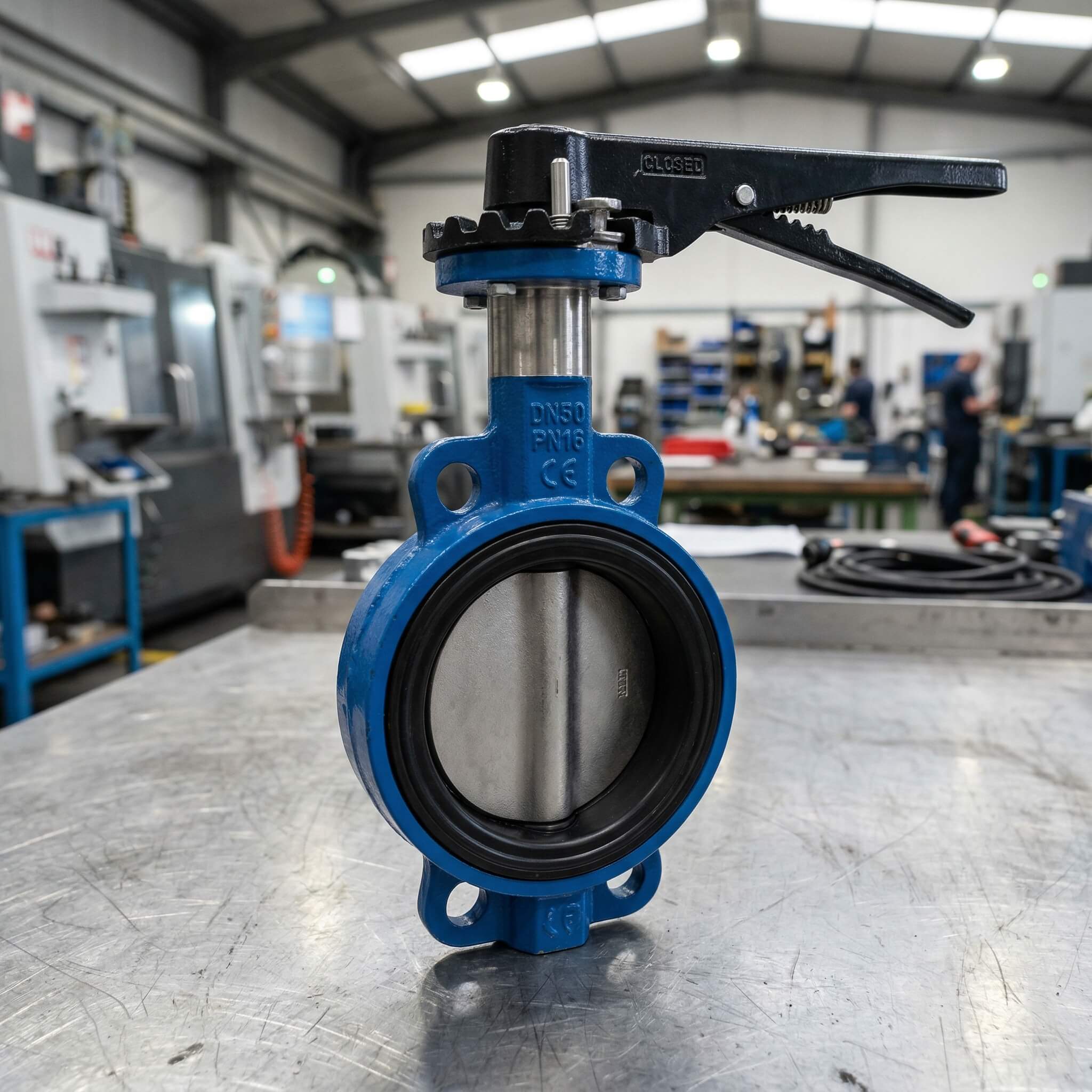
The DN50(2 Inch) butterfly valve wafer type is a compact flow control device designed for efficient on/off or modulating service in 2-inch pipelines. Many procurement managers face the challenge of finding high-performance valves that fit tight budgets without sacrificing long-term reliability. Substandard units often lead to frequent maintenance and system downtime, which can erode your operational profits. By choosing a precision-engineered butterfly valve dn 50, you ensure a leak-proof solution that balances cost with durability for your industrial needs.
1. What defines a butterfly valve dn 50?
The butterfly valve dn 50 is a 2-inch nominal diameter valve designed with a disc-on-shaft mechanism for rapid flow isolation. You will find that these components are essential for systems requiring a slim profile and reliable shut-off.
Technical Specifications
- Size: DN50 (2 Inch).
- Pressure Rating: PN10, PN16, or Class 150.
- Connection: Wafer style for easy flange mounting.
- Media: Water, oil, gas, and viscous fluids.
The design adheres to global standards like DIN and ANSI. This ensures you can integrate the valve into existing infrastructure without compatibility issues.
Why Choose the Wafer Style?
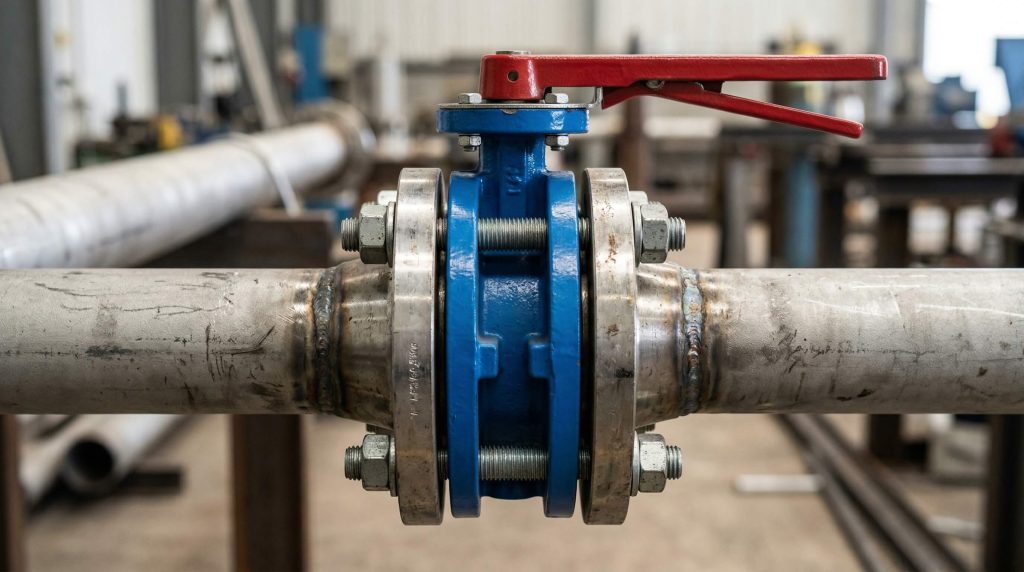
Think about it: the wafer design allows you to sandwich the valve between two pipeline flanges using only long bolts. This significantly reduces the total weight of your assembly compared to lug or flanged types.
Key Takeaway: The wafer-style DN50 valve offers a lightweight, high-performance solution that optimizes space in industrial piping.
| Feature | Specification |
|---|---|
| Nominal Diameter | 50mm / 2 Inch |
| Body Type | Wafer |
| Operation | Manual or Actuated |
The specifications highlight why this valve size is a versatile choice for diverse flow control environments.
2. How does the butterfly valve dn 50 operate?
The butterfly valve dn 50 operates through a 90-degree rotation of a central disc to open or close the flow path. You can control the fluid by rotating a handle or using an automated actuator.
Quarter-Turn Actuation Benefits
The best part? The quarter-turn mechanism provides much faster response times than multi-turn gate valves. You can achieve full closure in seconds, which is critical for safety and process efficiency.
Low Torque Requirements
- Manual Lever: Standard for quick adjustments.
- Gear Box: Ideal for precise throttling control.
- Pneumatic: Used for high-speed automated systems.
- Electric: Preferred for remote digital integration.
Lower torque requirements mean you can use smaller, more affordable actuators. This reduces the overall cost of your automated valve assembly.
Key Takeaway: Rapid 90-degree operation ensures your system responds instantly to flow changes while keeping mechanical wear minimal.
| Component | Function |
|---|---|
| Stem | Transfers torque to the disc |
| Disc | Rotates to block or allow flow |
| Handle | Provides manual leverage |
This mechanical simplicity translates to fewer moving parts and a longer operational lifespan for your system.
3. What materials make a butterfly valve dn 50?
A butterfly valve dn 50 typically features a ductile iron or stainless steel body to handle diverse pressure requirements. You must select the right combination of metals and elastomers to match your specific media.
Body and Disc Metal Options
- Ductile Iron: Cost-effective for water and HVAC.
- Stainless Steel: Best for corrosive chemical environments.
- Aluminum Bronze: Ideal for marine and seawater use.
- Carbon Steel: Suitable for higher temperature industrial loops.
Each material offers specific resistance properties. Choosing correctly prevents premature corrosion and ensures your system remains safe.
Selecting the Best Seat Material
In fact: the seat material is what creates the zero-leakage seal in your pipeline. Common options include EPDM for hot water and NBR for oil-based fluids.
Key Takeaway: Strategic material selection directly impacts the durability and chemical compatibility of your valve in the field.
| Material | Temp Range | Common Application |
|---|---|---|
| EPDM | -10°C to 110°C | Potable Water / HVAC |
| NBR | -10°C to 80°C | Oil and Gas |
| PTFE | -20°C to 200°C | Aggressive Chemicals |
Matching the elastomer to the fluid temperature prevents seal degradation and costly leaks.
4. What factors impact butterfly valve dn 50 price?
The price of a butterfly valve dn 50 is primarily determined by its material composition and the complexity of its actuation. You should expect market fluctuations in raw metals to influence the final quote from manufacturers.
Raw Material Impact on Cost
Believe it or not: the cost difference between a ductile iron body and a 316 stainless steel body can be substantial. If your application does not involve corrosive fluids, ductile iron provides the best value.
Testing and Certification Fees
- Pressure Testing: 100% hydro-testing adds value.
- Certifications: ISO, CE, and WRAS increase reliability.
- Material Reports: Traceable documentation is essential for audits.
- Packaging: Export-grade crating protects your investment.
Investing in certified valves reduces the risk of project delays. Higher initial costs often lead to lower total ownership costs.
Key Takeaway: Balancing your budget with necessary certifications ensures you get a valve that meets both financial and safety goals.
| Cost Driver | Influence Level | Reason |
|---|---|---|
| Body Material | High | Metal market prices vary |
| Actuator Type | Medium | Automation increases hardware cost |
| Standards | Low | Compliance is a baseline requirement |
Understanding these drivers allows you to make informed procurement decisions for large-scale projects.
5. How do you vet a butterfly valve dn 50 supplier?
Vetting a butterfly valve dn 50 supplier requires looking into their manufacturing standards, production capacity, and export history. You need a partner who can provide consistent quality across every batch delivered.
Capacity and Manufacturing Standards
- ISO 9001: Validates the quality management system.
- CNC Machining: Ensures precision tolerances for the disc.
- Stock Levels: Critical for meeting tight project deadlines.
- Testing Labs: In-house labs ensure every unit is verified.
A reliable manufacturer will be transparent about their factory processes. You should look for suppliers with at least a decade of industry experience.
Technical Support and Global Reach
The reality? You need a supplier that understands international shipping and provides bilingual technical documentation. Having access to a dedicated engineering team for consultation can save you hours of troubleshooting.
Key Takeaway: Supplier reliability is built on a foundation of rigorous testing, certified processes, and responsive technical support.
| Metric | Benchmark |
|---|---|
| Lead Time | 5 to 25 days |
| Warranty | 12 months minimum |
| Accuracy | +/- 0.1 mm tolerance |
Strong performance in these metrics indicates a manufacturer capable of supporting critical industrial operations.
6. Why select the wafer butterfly valve dn 50?
Choosing a butterfly valve dn 50 in a wafer configuration minimizes the weight and space required within your piping infrastructure. You will benefit from a design that is both economical and highly versatile.
Efficiency in Space-Constrained Areas
Look at it this way: a wafer valve is often one-third the width of a comparable gate or globe valve. This allows you to design more compact pump skids and modular systems.
Does it Lower Installation Costs?
- Lower Weight: Easier to handle without heavy lifting gear.
- Fewer Bolts: Reduces labor time during assembly.
- No Gaskets: Resilient seats often act as their own gaskets.
- Standardized Fit: Works with PN10, PN16, and ANSI flanges.
Lowering the weight of the valve also reduces the stress on your pipe supports. This contributes to the overall structural integrity of the facility.
Key Takeaway: The wafer design’s compact nature and ease of installation make it the most cost-effective choice for modern engineering.
| Type | Space Required | Weight |
|---|---|---|
| Wafer | Minimal | Very Light |
| Lug | Moderate | Medium |
| Flanged | High | Heavy |
This comparison clarifies why the wafer model remains the industry standard for 2-inch pipelines.
7. How to install a butterfly valve dn 50?
To install a butterfly valve dn 50 correctly, you must align it perfectly between two pipe flanges before tightening any bolts. You should ensure the pipe faces are clean and free of debris to prevent seat damage.
Alignment and Flange Preparation
- Disc Position: Keep the disc slightly open during installation.
- Flange Type: Use standard weld neck or slip-on flanges.
- Cleaning: Remove all rust and scale from the pipe.
- Centering: Use the valve body to center the assembly.
Proper centering prevents the disc from hitting the inner diameter of the pipe. This simple step prevents mechanical failure upon the first operation.
What Are the Torque Requirements?
Truth be told: unevenly tightening bolts is the number one cause of seat distortion and leaks. You should use a star-pattern tightening sequence to apply pressure evenly across the flange face.
Key Takeaway: Precise alignment and a controlled tightening sequence are essential for a leak-free and long-lasting installation.
| Step | Action | Benefit |
|---|---|---|
| 1 | Align flanges | Prevents disc interference |
| 2 | Hand-tighten bolts | Keeps valve centered |
| 3 | Torque to spec | Ensures uniform seal |
Following these steps will guarantee the performance of your valve from the moment you start the system.
8. What are butterfly valve dn 50 applications?
The butterfly valve dn 50 is used extensively in industries ranging from municipal water treatment to complex HVAC systems. You can find these valves wherever reliable flow regulation is needed in a 2-inch line.
Water Treatment and HVAC Uses
What’s more? These valves are the backbone of commercial building chilled water loops. They provide excellent isolation for pumps and heat exchangers, ensuring your climate control systems run efficiently.
Industrial and Chemical Compatibility
- Cooling Water: Manages flow in industrial machinery.
- Wastewater: Handles fluids with small suspended solids.
- Process Air: Controls low-pressure air in manufacturing.
- Petrochemical: Uses stainless steel versions for fuel lines.
The ability to handle slightly viscous media makes them superior to ball valves in certain process scenarios. This versatility is why they are a staple in industrial design.
Key Takeaway: From simple water lines to complex industrial processes, the DN50 valve is a universal tool for fluid management.
| Industry | Typical Fluid | Sealing Material |
|---|---|---|
| Municipal | Potable Water | EPDM |
| Oil & Gas | Lubricating Oil | NBR |
| Food & Bev | Washdown Water | White EPDM |
Selecting the application-specific seal ensures the valve meets all health and safety regulations.
9. How to maintain your butterfly valve dn 50?
Maintaining a butterfly valve dn 50 involves regular cycle testing and inspection of the seat for debris or wear. You can significantly extend the life of the valve by performing these simple checks twice a year.
Inspection and Lubrication Cycles
- Cycle Testing: Open and close the valve to prevent sticking.
- Visual Check: Look for signs of external stem leaks.
- Stem Lubrication: Apply grease to the actuator interface.
- Seat Check: Verify the elastomer has not become brittle.
Regular movement prevents the build-up of mineral deposits on the disc. This keeps the operating torque low and protects your automated actuators.
How to Handle Seat Leakage?
The reality? Most leaks are caused by debris trapped in the resilient seat. You can often resolve this by flushing the line or, if necessary, replacing the replaceable seat insert.
Key Takeaway: Proactive maintenance and simple cleaning cycles prevent major system failures and reduce the need for valve replacements.
| Maintenance Task | Frequency | Expected Result |
|---|---|---|
| Full Cycle Test | Semi-Annual | Prevents mineral bonding |
| Stem Seal Check | Annual | Ensures zero external leaks |
| Seat Inspection | Every 2 Years | Verifies seal integrity |
A structured maintenance schedule ensures your plant operates at peak efficiency without unexpected interruptions.
10. Who is a quality butterfly valve dn 50 maker?
A quality butterfly valve dn 50 maker is defined by their adherence to international quality standards and their investment in modern technology. You should look for a manufacturer that provides a 12-month warranty and full pressure test reports.
ISO 9001 and CE Compliance
Interestingly enough: a manufacturer with CE certification has proven their products meet rigorous European safety and performance standards. This gives you peace of mind when installing valves in high-pressure or critical environments.
Production and Logistics Expertise
- Batch Testing: 100% of valves should be hydro-tested.
- Material Traceability: Essential for chemical and oil industries.
- Bilingual Support: Eases the communication for global projects.
- Fast Shipping: Ability to ship stock items within 5 days.
A factory that manages its own casting and machining has better control over the final product quality. This vertical integration is a hallmark of a top-tier manufacturer.
Key Takeaway: Choosing a manufacturer with traceable quality and robust logistical support is the best way to de-risk your procurement process.
| Manufacturer Asset | Value to Buyer |
|---|---|
| In-house CNC | Precision and consistency |
| Testing Benches | Guaranteed zero leakage |
| Global Logistics | Predictable project timelines |
Evaluating these assets helps you partner with a maker that supports your long-term growth and operational stability.
Conclusion
The butterfly valve dn 50 wafer type is a vital component for modern fluid systems, offering an unmatched balance of space-saving design and reliable performance. By prioritizing high-quality materials, professional manufacturers, and proper installation techniques, you ensure the longevity and efficiency of your industrial projects.
At RUITO, we specialize in providing precision-engineered valve solutions that meet the strictest global standards. We provide a comprehensive range of industrial valves, including butterfly, ball, and gate valves, all backed by 15 years of engineering excellence and a 12-month warranty. Our vision is to empower global industries with fluid control products that define reliability and cost-effectiveness.
Please contact us today to receive a technical consultation and a competitive quote for your next project.
FAQ
Can I use a butterfly valve dn 50 for steam applications?
Standard resilient seated valves are generally not suitable for steam; you should use a high-performance metal-seated version for temperatures exceeding 110°C.
What’s the best way to prevent valve leaks?
The most effective method is to ensure 100% pressure testing before installation and to follow a strict star-pattern tightening sequence on the flange bolts.
How do I know if the valve seat is worn?
You will notice an increase in operating torque or internal leakage when the valve is in the fully closed position, indicating the elastomer has lost its resilience.
Can I install this valve in vertical pipes?
Yes, the butterfly valve dn 50 is designed to operate effectively in both horizontal and vertical orientations without losing sealing capabilities.
What’s the best material for sea water?
For saltwater environments, you should choose a valve with an Aluminum Bronze disc and a 316 stainless steel stem to resist chloride-induced corrosion.