
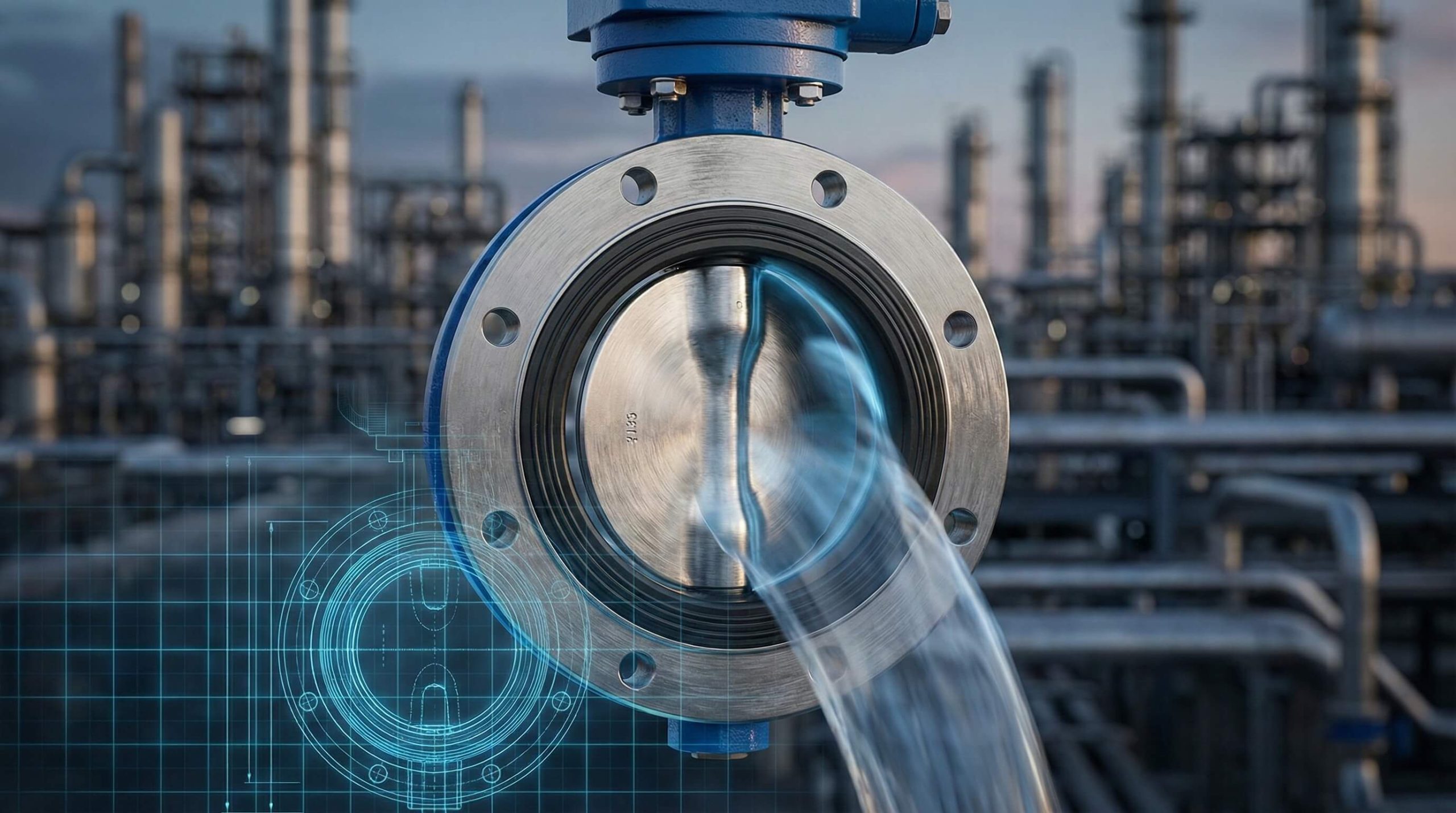
A butterfly valve is a rotational motion valve used to stop, regulate, or start flow via a disc that pivots on a central axis. Many engineering teams struggle with traditional gate or globe valves that are too heavy, bulky, and expensive for modern, space-constrained piping layouts. These oversized components drive up shipping costs, complicate installation, and increase the structural load on your piping systems. To solve these logistical and financial hurdles, you can define butterfly valve technology as the premier compact alternative for high-capacity flow management.
How do engineers define butterfly valve technology?
Engineers define butterfly valve technology as a quarter-turn flow control system where a circular disc rotates around a stem to manage the passage of media. This streamlined design allows the valve to function efficiently in both high-pressure and low-pressure environments. When you [define butterfly valve] mechanics, you focus on the simplicity of the 90-degree movement.
The core quarter-turn mechanism
The mechanical essence of the valve lies in its ability to toggle between states with just 90 degrees of travel. This efficiency is why many procurement specialists seek to define butterfly valve technology as the ultimate time-saver in high-frequency operations.
Think about it:
- Rapid opening and closing speeds reduce downtime.
- Minimal mechanical wear occurs during short travel distances.
- Smaller actuators are required compared to multi-turn valves.
Disc and stem interaction
The disc is the heart of the valve, sitting directly in the center of the pipe and connected to a stem. As you rotate the stem, the disc turns either parallel or perpendicular to the fluid flow.
The truth is:
- A horizontal disc allows full flow.
- A vertical disc provides a complete shut-off.
- The stem ensures the disc remains centered under pressure.
Primary flow control roles
These valves are versatile enough to handle both on-off service and basic throttling. While they excel at quick isolation, their ability to regulate flow at specific angles makes them indispensable.
But wait, there’s more:
- They handle large volumes of fluid with minimal pressure loss.
- Their design prevents the accumulation of debris.
- They are suitable for water, gases, and slurries.
Key Takeaway: The fundamental simplicity of the butterfly valve makes it a top choice for rapid shut-off applications where space and speed are critical.
| Component | Function | Advantage |
|---|---|---|
| Quarter-turn Disc | Flow Interruption | Fast Operation |
| Internal Stem | Torque Transmission | Reliable Control |
| Symmetric Body | Structural Support | Compact Profile |
This geometric arrangement ensures that the valve remains lightweight while providing reliable flow interruption.
What parts define butterfly valve construction?
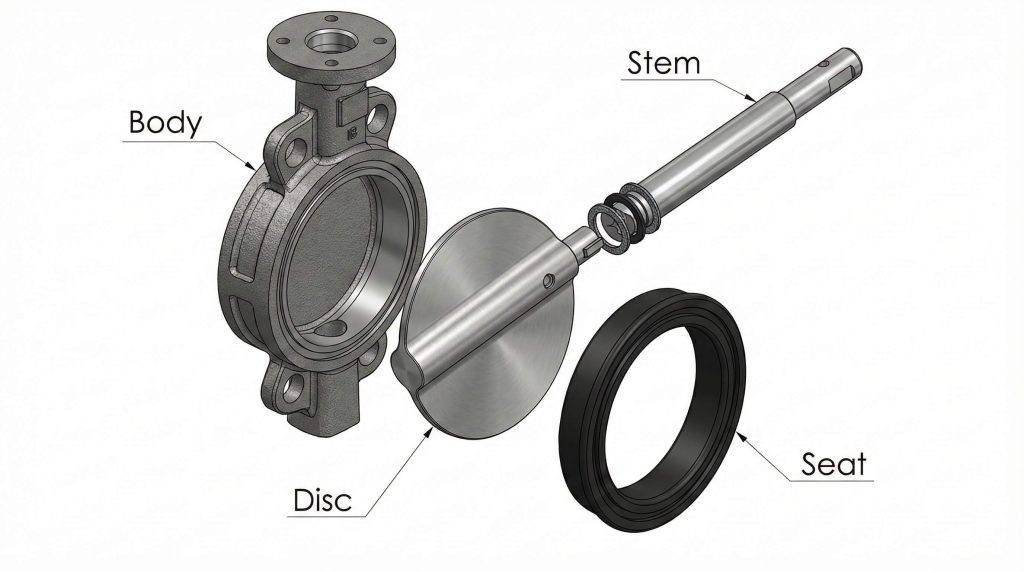
The physical components that define butterfly valve construction include the body, disc, stem, and seat, all working in unison to maintain a leak-proof seal. To ensure your system remains operational, you must define butterfly valve components based on your specific media requirements.
Body and disc synergy
The valve body is the outer shell that houses the disc and connects to the piping. The disc, which is the only moving part in the flow stream, must be made of materials compatible with the fluid.
Here is why:
- Cast iron bodies offer cost-effectiveness for water.
- Stainless steel discs prevent corrosion in chemical lines.
- Compact body widths save significant installation space.
Resilient vs metal seats
The seat provides the sealing surface against which the disc presses to stop the flow. You can choose between soft, resilient materials or hard metal-to-metal surfaces depending on the temperature.
But wait, there’s more:
- EPDM seats are perfect for general water service.
- Metal seats handle extreme temperatures and abrasive media.
- Resilient seats provide “bubble-tight” shut-off capabilities.
Stem and packing assemblies
The stem transmits the torque from the actuator to the disc, while the packing prevents fluid from leaking out of the stem housing. High-quality packing is essential for preventing environmental contamination.
The truth is:
- Blow-out proof stems increase operator safety.
- Adjustable packing glands extend the valve’s service life.
- One-piece stems offer higher torque resistance.
Key Takeaway: Understanding the material science behind each component ensures that your valve selection matches the chemical and thermal demands of your application.
| Part | Material Options | Primary Benefit |
|---|---|---|
| Disc | SS316, Ductile Iron, Alu-Bronze | Corrosion Resistance |
| Seat | PTFE, EPDM, NBR, Metal | Leakage Prevention |
| Body | Wafer, Lug, Flanged | Mounting Versatility |
The synergy between the disc material and seat type determines the overall pressure rating and seal integrity of the unit.
How does the working principle define butterfly valve use?
The working principle defines butterfly valve use through a 90-degree rotational movement that modulates fluid passage across a wide range of industrial pressures. Because the disc is always present in the flow, the physics of the fluid path must be understood to [define butterfly valve] performance accurately.
Fully open to closed states
When the valve is in the fully open position, the disc is parallel to the flow, offering the least resistance. Moving the disc to the perpendicular position creates a seal against the seat, stopping all movement.
Here is why:
- 0-degree position results in maximum flow capacity.
- 90-degree position results in a complete seal.
- Intermediate positions allow for flow modulation.
Throttling and regulation
Throttling with a butterfly valve involves positioning the disc at an angle between 0 and 90 degrees. You must be careful to avoid angles where high-velocity flow might cause cavitation or vibration.
Think about it:
- Ideal throttling occurs between 30 and 70 degrees.
- Precision control is achievable with the right actuator.
- Butterfly valves offer better throttling than standard gate valves.
Pressure drop considerations
Because the disc stays in the flow path even when open, a slight pressure drop is inevitable. However, the thin profile of modern discs is designed to minimize this effect.
But wait, there’s more:
- High Cv (flow coefficient) values are typical for these valves.
- Streamlined discs reduce turbulence.
- Disc thickness is optimized for structural integrity vs. flow.
Key Takeaway: The 90-degree principle allows for a versatile range of flow conditions, provided the operator respects the limits of the disc position.
| Disc Angle | Flow State | Usage |
|---|---|---|
| 0° | Full Flow | System Operation |
| 30° – 70° | Throttling | Flow Regulation |
| 90° | Shut-off | System Isolation |
Precise positioning is the key to balancing flow volume with system pressure stability.
Which actuation types define butterfly valve control?
Actuation types that define butterfly valve control range from manual levers to advanced automated pneumatic and electric systems. Before selecting a motor, you should define butterfly valve mounting requirements to ensure the actuator fits the body style and torque needs.
Manual levers and gears
For smaller valves or systems that don’t require frequent adjustment, manual operation is the most cost-effective choice. You can use a simple lever or a gear operator for larger diameters where torque is higher.
The truth is:
- Levers provide instant visual confirmation of valve position.
- Gearboxes make it easy for one person to turn large valves.
- Locking devices prevent unauthorized valve operation.
Pneumatic and hydraulic systems
Pneumatic actuators are the workhorses of the automation world, using compressed air to move the valve quickly. They are often preferred in hazardous environments where electricity might pose a risk.
Here is why:
- High speed and high cycle life.
- Fail-safe options (spring return) improve safety.
- Reliable performance in demanding industrial settings.
Electric motor actuators
Electric actuators provide the highest level of precision and are easily integrated into computerized control systems. They allow you to [define butterfly valve] positions with extreme accuracy via remote signals.
But wait, there’s more:
- No need for expensive air compressors.
- Real-time feedback on valve status and health.
- Ideal for remote locations with existing power grids.
Key Takeaway: Choosing the right actuator depends on your need for speed, precision, and available power sources at the installation site.
| Actuator Type | Power Source | Best Use Case |
|---|---|---|
| Manual Lever | Human Force | Small Bore / Low Frequency |
| Pneumatic | Compressed Air | High Speed / Safe Failure |
| Electric | Electricity | Precision / Remote Control |
Automation transforms a simple mechanical valve into a sophisticated component of a smart industrial network.
What benefits define butterfly valve efficiency?
High-level efficiency is what helps define butterfly valve adoption, primarily due to their lightweight design and low cost. When you [define butterfly valve] benefits, you see that they outperform bulkier valve types in almost every logistical category.
Compact and lightweight design
Butterfly valves take up significantly less space than gate or ball valves of the same diameter. This reduced weight means you can install them without needing heavy-duty pipe supports.
Think about it:
- Up to 80% lighter than traditional gate valves.
- Narrow “face-to-face” dimensions allow for tight installs.
- Easier transport and lower shipping costs.
Cost-effective installation
Because they are smaller and lighter, the total cost of ownership is much lower. You save money not just on the valve itself, but on the labor and hardware required to install it.
The truth is:
- Fewer bolts and gaskets are needed for installation.
- Faster installation reduces system downtime.
- Lower initial purchase price for large diameter lines.
Rapid cycle times
The quarter-turn nature of the butterfly valve allows for incredibly fast opening and closing. This is critical in emergency shut-off scenarios where every second counts.
But wait, there’s more:
- Higher productivity in batch processing.
- Reduced risk of water hammer when operated correctly.
- Simplified maintenance due to fewer moving parts.
Key Takeaway: The combination of low weight, small footprint, and low price makes the butterfly valve the most efficient choice for large-scale fluid handling.
| Feature | Efficiency Impact | Business Value |
|---|---|---|
| Low Weight | Reduced Pipe Stress | Lower Infrastructure Costs |
| Small Footprint | Fits Tight Spaces | Flexible Plant Layout |
| Simple Design | Less Maintenance | Higher Uptime |
Efficiency in this context refers to both the physical performance and the long-term financial return on the asset.
How does double-eccentricity define butterfly valve seats?
Double-eccentricity defines butterfly valve seats by offsetting the shaft from both the centerline and the sealing surface to minimize friction during operation. Modern engineers often define butterfly valve performance by its ability to handle high-cycle applications without seat wear.
Offset shaft positioning
In a double-offset design, the stem is located behind the disc and slightly to one side. This prevents the disc from constantly rubbing against the seat throughout its entire rotation.
Here is why:
- The disc only contacts the seat in the final degrees of closing.
- Reduced friction leads to lower torque requirements.
- The seat remains intact for much longer periods.
Reduced seat wear and friction
By minimizing the contact time between the disc and the seat, the valve experiences significantly less mechanical degradation. This makes the double-offset design ideal for high-performance industrial tasks.
The truth is:
- Maintenance intervals are greatly extended.
- The valve can handle higher velocities without seat damage.
- Better sealing is achieved with less force.
High-pressure performance
Double-offset valves are capable of handling much higher pressures than standard concentric designs. They are the standard choice for steam and high-pressure water systems.
But wait, there’s more:
- Suitable for ASME Class 150 and 300 applications.
- Often available with fire-safe certifications.
- Can be used in more aggressive chemical environments.
Key Takeaway: The double-offset design is a major leap in engineering that allows butterfly valves to compete in high-pressure arenas previously reserved for ball valves.
| Offset Type | Design Feature | Result |
|---|---|---|
| Concentric | Central Shaft | Economical, Low Pressure |
| Double-Offset | Two-Axis Offset | Low Wear, High Performance |
| Triple-Offset | Three-Axis Offset | Zero Leakage, High Temp |
Moving from a concentric to an eccentric design dramatically improves the service life and reliability of the seal.
Does the triple-offset design define butterfly valve seal?
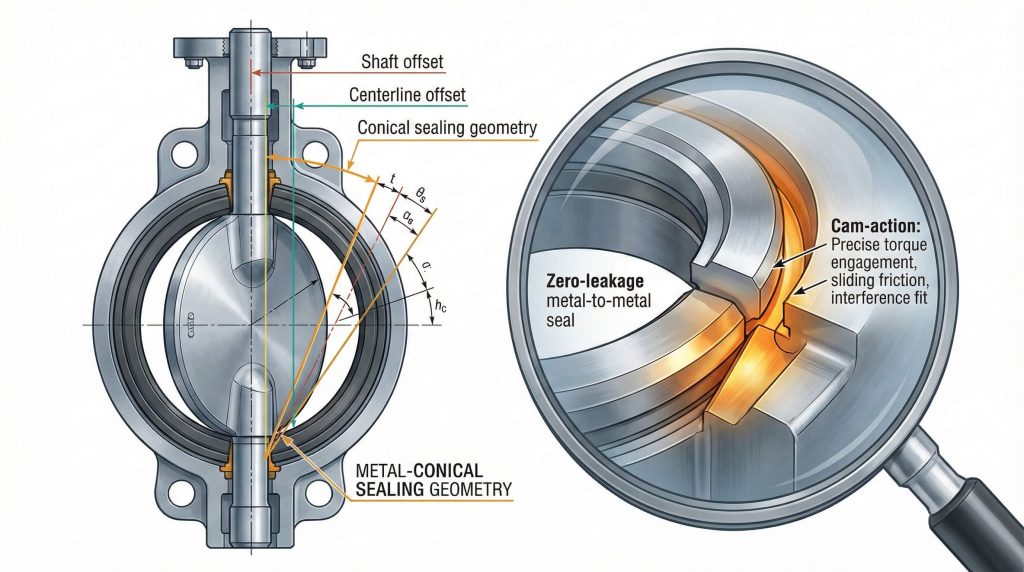
The triple-offset design defines butterfly valve seal technology by using a cone-shaped seating surface to achieve bubble-tight, metal-to-metal closure. This advanced geometry is necessary when you [define butterfly valve] capabilities in extreme temperature and high-pressure steam environments.
The third angular offset
The “triple” offset adds a third geometric adjustment to the seating surface itself, creating a cam-like action. This ensures that the disc and seat only meet at the very last moment of closure.
Think about it:
- Eliminates friction entirely during travel.
- Provides a torque-seated seal rather than an interference seal.
- Allows for metal-to-metal contact without galling.
Zero-leakage metal seals
Because of the precise geometry, triple-offset valves can achieve a “zero-leakage” seal even with metal components. This is critical for hazardous fluids where any escape is unacceptable.
The truth is:
- Meets the strictest leakage standards like API 598.
- Resistant to “sticking” after long periods of closure.
- Reliable in both high-pressure and vacuum services.
Extreme temperature resistance
Without the need for soft, resilient liners, these valves can operate in temperatures that would melt standard seats. They are staples in power plants and refineries.
But wait, there’s more:
- Handles temperatures from cryogenic to over 1000°F.
- Inherently fire-safe due to all-metal construction.
- Resistant to thermal shock and expansion.
Key Takeaway: The triple-offset butterfly valve is the ultimate evolution of the design, offering the performance of a gate valve with the weight of a butterfly valve.
| Feature | Triple-Offset Benefit |
|---|---|
| Cam-Action | Zero seat rubbing |
| Metal Seating | Extreme heat tolerance |
| Torque Sealing | Consistent bubble-tight shutoff |
This design allows the butterfly valve to function in the most demanding industrial processes on Earth.
How do body styles define butterfly valve mounting?
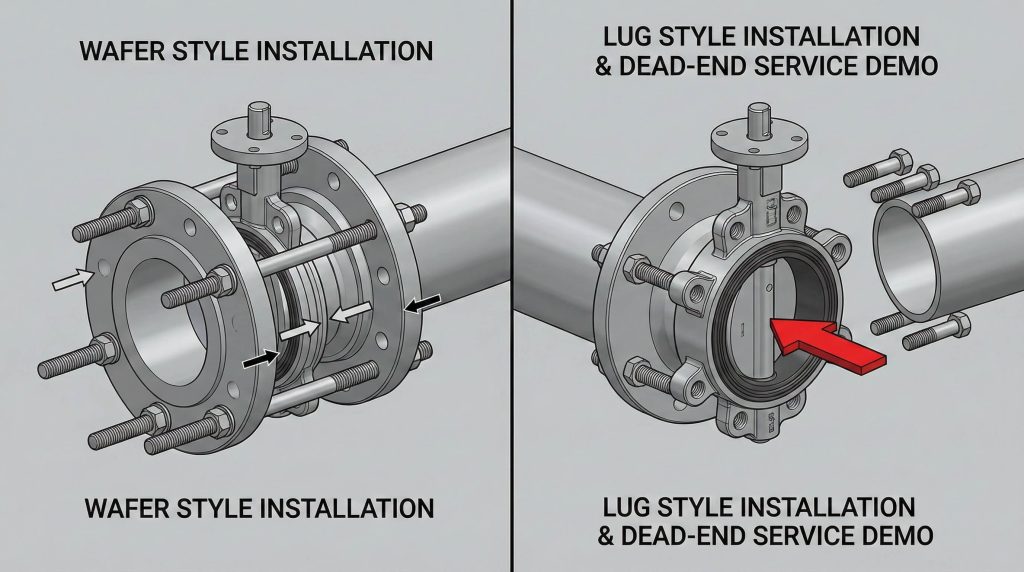
Different body styles define butterfly valve mounting by determining how the unit is secured between pipe flanges and whether it can support end-of-line service. Accurate installation begins when you define butterfly valve torque and mounting requirements based on the chosen body style.
Wafer style sandwiching
The wafer style is designed to be “sandwiched” between two pipe flanges using long bolts that span the entire width of the valve. It is the most economical and lightweight mounting option available.
Here is why:
- Lowest cost for procurement and shipping.
- Simplest design with the fewest parts.
- Easiest to replace during routine maintenance.
Lug style for end-of-line
Lug valves have threaded metal inserts (lugs) around the body that allow them to be bolted directly to each pipe flange. This design allows you to remove one side of the piping while the valve remains in place.
The truth is:
- Enables “dead-end” service without downstream pressure loss.
- More secure than wafer styles in high-vibration areas.
- Preferred for systems requiring frequent downstream cleaning.
Flanged connections for stability
Flanged butterfly valves have built-in flanges that match the pipe’s bolt pattern. These are typically used for very large diameters where structural stability is the primary concern.
But wait, there’s more:
- Provides the most robust connection to the piping.
- Commonly found in municipal water and wastewater plants.
- Easier to align during the installation of heavy valves.
Key Takeaway: Your choice of body style dictates not just the cost, but the future maintenance flexibility and structural integrity of your piping system.
| Body Style | Bolt Configuration | Best Application |
|---|---|---|
| Wafer | Through-bolts | General Purpose / Cost Savings |
| Lug | Individual Bolts | End-of-line / Isolation |
| Flanged | Bolt-to-Flange | Large Bore / Heavy Duty |
Matching the body style to your piping requirements is essential for a safe and long-lasting installation.
Do industry standards define butterfly valve quality?
Strict industry standards define butterfly valve quality by ensuring materials, wall thicknesses, and pressure ratings meet safety benchmarks. To maintain compliance, engineers must [define butterfly valve] specifications according to globally recognized protocols.
API and ASME requirements
The American Petroleum Institute (API) and the American Society of Mechanical Engineers (ASME) set the rules for valve design and testing. These standards ensure that a valve from one manufacturer will perform as safely as one from another.
Here is why:
- API 609 covers the design of butterfly valves specifically.
- ASME B16.34 defines pressure-temperature ratings.
- Compliance ensures safety in high-risk environments.
Material compliance standards
Material standards like ASTM ensure that the metals and polymers used in construction are free from defects. This is crucial when you [define butterfly valve] utility in corrosive or high-stress environments.
Think about it:
- Ensures chemical compatibility with the media.
- Guarantees the mechanical strength of the stem and disc.
- Prevents premature failure due to material impurities.
Leakage testing protocols
Every high-quality valve must undergo rigorous pressure testing before leaving the factory. These tests verify that the seat and shell can hold the rated pressure without any visible leaks.
But wait, there’s more:
- API 598 is the gold standard for valve inspection.
- MSS-SP-61 provides guidelines for pressure testing.
- Testing reports provide peace of mind for the end-user.
Key Takeaway: Industry certifications are not just paperwork; they are your guarantee that the valve will perform safely under its rated conditions.
| Standard | Focus Area | Significance |
|---|---|---|
| API 609 | Valve Design | Ensures geometry compliance |
| API 598 | Testing | Guarantees seal integrity |
| ASME B16.34 | Pressure/Temp | Sets operational limits |
Following these standards eliminates the guesswork from valve procurement and ensures system safety.
Which applications define butterfly valve utility?
Diverse applications define butterfly valve utility, spanning across municipal water treatment, commercial HVAC, and heavy industrial process lines. You can [define butterfly valve] success by how well it handles the specific flow characteristics of these varied sectors.
Water and wastewater treatment
In the water sector, butterfly valves are the standard for handling massive volumes of water. Their compact size makes them ideal for the sprawling pipe networks found in treatment plants.
Here is why:
- Excellent for isolating large filter beds.
- Resistant to the chemicals used in water purification.
- Low maintenance requirements for long-term municipal use.
HVAC and cooling systems
Commercial buildings rely on these valves to regulate the flow of chilled and hot water through climate control systems. Their ability to provide basic throttling makes them perfect for temperature regulation.
Think about it:
- Lightweight design doesn’t stress building structures.
- Fast operation allows for quick system adjustments.
- Cost-effective for the high number of valves needed in HVAC.
Chemical and petroleum process
For more aggressive media, high-performance butterfly valves with specialized coatings or metal seats are used. They provide the reliable shut-off needed for safety in refineries.
But wait, there’s more:
- Triple-offset designs handle volatile hydrocarbons.
- PTFE-lined valves resist highly corrosive acids.
- Fire-safe models protect the facility during emergencies.
Key Takeaway: From the water you drink to the fuel in your car, butterfly valves play a silent but critical role in modern infrastructure.
| Industry | Typical Fluid | Valve Requirement |
|---|---|---|
| Municipal | Potable Water | Corrosion resistance, Size |
| HVAC | Chilled Water | Throttling, Compactness |
| Refining | Oil / Gas | High Pressure, Fire-safe |
The adaptability of the butterfly valve is what makes it a universal tool in the world of fluid dynamics.
Conclusion
Understanding what a butterfly valve is and how it functions is the first step toward optimizing your industrial flow control. By addressing the common struggles of excessive weight, high costs, and limited space, the butterfly valve provides a modern solution that fits almost any application. Whether you need a simple wafer valve for water service or a sophisticated triple-offset unit for high-pressure steam, selecting the right configuration is vital for your system’s longevity. Our stance is that every engineering project deserves high-performance, cost-effective components that don’t compromise on safety. For expert guidance on choosing the right model for your specific needs, please contact us today to speak with a flow control specialist.
FAQ
Can I use a butterfly valve for high-pressure steam?
Generally, only triple-offset, metal-seated butterfly valves are suitable for high-pressure steam because soft resilient seats will melt or deform.
What’s the best seat material for corrosive chemicals?
PTFE or Viton seats are typically the best choice because they offer superior resistance to a wide range of aggressive acids and bases.
Can I install a wafer valve at the end of a pipe?
No, you should not use a wafer valve for end-of-line service; you must use a lug-style valve to ensure the unit remains securely bolted when downstream piping is removed.
What’s the best way to prevent water hammer?
Slow down the actuation speed, as the most effective way to prevent water hammer is to ensure the 90-degree turn occurs over several seconds rather than instantly.
Can I use a butterfly valve for precise flow control?
Yes, but only within the 30 to 70-degree range; using them outside this window for throttling can lead to turbulence and seat erosion.