

Butterfly Valve Dimensions: A Complete Guide is the essential reference for ensuring mechanical compatibility and flow efficiency in industrial piping systems. Selecting the wrong valve size often leads to immediate installation failures and long-term operational leaks. This mismatch agitates maintenance budgets and risks catastrophic system downtime due to fluid bypass or structural fatigue. To prevent these issues, you must master the technical specifications of butterfly valve flange dimensions to ensure a seamless fit within your infrastructure.
Why are butterfly valve flange dimensions so critical?
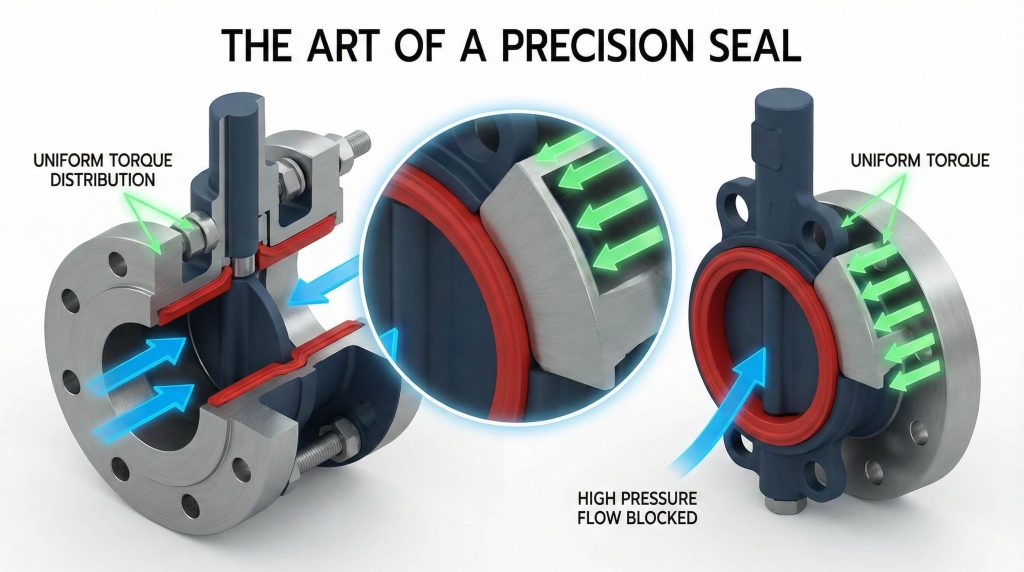
Butterfly valve flange dimensions are critical because they dictate the physical interface between the valve body and the surrounding pipeline flanges. Proper alignment ensures that the gaskets are compressed evenly, which is the primary defense against high-pressure leaks. When these dimensions are accurate, the valve remains stable under thermal expansion and mechanical vibration.
Impact on System Seal and Leak Prevention
A precise dimensional match ensures that the sealing face of the valve aligns perfectly with the pipe flange.
Here is the kicker: even a few millimeters of deviation can cause uneven torque distribution.
- Prevents localized stress on the resilient seat.
- Ensures uniform gasket compression across the entire circumference.
- Reduces the risk of fugitive emissions in chemical lines.
Reliability in High-Pressure Environments
In high-pressure systems, the flange must withstand significant axial forces without deforming.
But it doesn’t stop there.
- Thicker flanges provide the necessary rigidity for Class 300 ratings and above.
- Precise bolt hole alignment prevents stem binding during operation.
Key Takeaway
Correct flange measurements are the foundation of a leak-free industrial system, especially under variable pressure loads.
| Feature | Importance | Risk of Non-Compliance |
|---|---|---|
| Face-to-Face | Installation space | Pipe modification costs |
| Bolt Circle | Mounting alignment | Structural failure |
| Flange Thickness | Pressure containment | Rupture or deformation |
Industrial safety depends directly on the structural integrity provided by matching valve and pipe dimensions.
What are the primary butterfly valve flange dimensions?
The primary dimensions include the nominal pipe size (NPS), the face-to-face length, and the bolt circle diameter (BCD). These butterfly valve flange dimensions determine whether the valve can be physically inserted into a standard piping gap. Without these specific metrics, procurement teams cannot verify if a replacement unit will fit existing hardware.
Face-to-Face and Nominal Diameter Definitions
The face-to-face dimension is the total distance between the two sealing surfaces of the valve.
Believe it or not, this is the most common point of error in procurement.
- Nominal Diameter (DN) refers to the internal bore size.
- Face-to-Face (L) must comply with API 609 or EN 558-1 standards.
- Variations occur based on whether the valve is a short or long pattern.
Understanding Bolt Circle Diameter (BCD)
The BCD is the diameter of the imaginary circle passing through the center of the bolt holes.
It gets better: matching the BCD ensures the valve remains centered in the flow stream.
- Determines the number of bolts required for a secure seal.
- Governs the spacing between bolts to prevent flange warping.
Key Takeaway
The BCD and face-to-face length are the two most critical metrics for ensuring a valve is physically compatible with existing pipework.
| Parameter | Measurement Basis | Application |
|---|---|---|
| NPS / DN | Internal flow path | Sizing the flow capacity |
| BCD | Hole center-to-center | Ensuring bolt alignment |
| Stem Length | Height from body | Actuator mounting clearance |
Standardizing these parameters across your facility simplifies inventory management and reduces emergency repair times.
How do wafer butterfly valve flange dimensions vary?
Wafer butterfly valve flange dimensions are notably thin because the valve body is designed to be clamped between two pipe flanges. Unlike other styles, the wafer body does not have its own mounting holes, but rather centering lugs or a smooth outer rim. This design minimizes the material used, making it a cost-effective choice for low-pressure applications.
Design Characteristics of Wafer-Style Valves
Wafer valves utilize long bolts that span the entire width of the valve body and both pipe flanges.
Think about it: this requires highly accurate face-to-face measurements to ensure the bolts aren’t overstressed.
- Minimal face-to-face width saves space in tight mechanical rooms.
- Centering lugs help align the valve during the initial bolting phase.
- Suitable for systems where frequent removal is not required.
Sizing for Standard Class 150 Systems
For Class 150 systems, the wafer valve must match the specific outside diameter of the pipe flange.
Here is the deal: if the valve body is too large, it will interfere with the bolt circle.
- Standard thicknesses range from 43mm for 2-inch valves to 78mm for 12-inch valves.
- Body outer diameter must stay within the inner circle of the bolts.
Key Takeaway
Wafer valves require strict adherence to face-to-face standards because they lack independent bolting points, relying entirely on pipe compression.
| Size (Inches) | Face-to-Face (mm) | Bolt Hole Count (Reference) |
|---|---|---|
| 2″ | 43 | 4 |
| 4″ | 52 | 8 |
| 8″ | 60 | 8 |
This table shows how the compact nature of wafer designs allows for significant space savings in industrial manifolds.
What defines lug butterfly valve flange dimensions?
Lug butterfly valve flange dimensions are characterized by threaded metal inserts, or “lugs,” extending from the body. These butterfly valve flange dimensions allow the valve to be bolted directly to each pipe flange independently. This specific geometry makes lug valves ideal for “dead-end” service where one side of the pipe may be removed.
Threaded Insert and Bolt Pattern Specifications
The lugs are drilled and tapped to match the thread pitch of the flange bolts.
But wait, there’s more: this design allows you to tighten one side without affecting the other.
- Thread sizes vary between UNC for American standards and Metric for European systems.
- The number of lugs always matches the bolt hole count of the corresponding pipe flange.
Dimensional Tolerances for Medium-Pressure Systems
Lug valves are generally thicker than wafer valves to accommodate the threaded inserts.
You might be wondering why this matters.
- Provides a more robust structure for pressures up to 300 PSI.
- Ensures the valve can hold the full system pressure when the downstream pipe is removed.
Key Takeaway
The threaded lug pattern is the defining dimensional feature that provides the structural integrity required for isolation and dead-end service.
| DN Size | Thread Specification | Lug Count |
|---|---|---|
| 50 | 5/8″ – 11 | 4 |
| 100 | 5/8″ – 11 | 8 |
| 200 | 3/4″ – 10 | 8 |
Matching the thread pitch of the lugs is vital to prevent stripping the valve body during high-torque installations.
How do flanged butterfly valve flange dimensions differ?
Flanged butterfly valve flange dimensions involve two integral, full-faced flanges that are part of the valve casting. This design is most common in very large diameters, typically exceeding 24 inches, where structural stability is paramount. Because the flanges are part of the body, they provide the most secure connection method for heavy-duty waterworks or oil and gas lines.
Integral Flange Thickness vs. End Connections
The thickness of the integral flange is governed by the pressure rating of the valve.
Make no mistake: a Class 600 flanged valve will have significantly thicker flanges than a Class 150 version.
- Raised face (RF) or flat face (FF) options affect the total length.
- Integral flanges provide a massive surface area for sealing in high-vibration areas.
Dimensional Standards for Large Bore Applications
Large bore valves follow ASME B16.47 or AWWA standards for their outer dimensions.
Here is the kicker: the weight of these valves increases exponentially with the flange diameter.
- Sizes can reach up to 72 inches or more for municipal water lines.
- Face-to-face dimensions are much longer than wafer or lug types to support the heavy disc.
Key Takeaway
Integral flanges offer the highest level of structural support for large-diameter pipelines, requiring precise matching of thickness and bolt patterns.
| Size (Inches) | Flange OD (mm) | Face-to-Face (mm) |
|---|---|---|
| 24″ | 813 | 203 |
| 36″ | 1168 | 311 |
| 48″ | 1511 | 381 |
Large flanged valves provide the necessary rigidity to handle the massive torque generated by high-flow water systems.
What are triple offset butterfly valve flange dimensions?
Triple offset butterfly valve flange dimensions are designed to accommodate a unique, non-concentric sealing geometry. These butterfly valve flange dimensions often require a wider body to house the complex eccentric shaft and the metal seat. This design is standard for high-performance applications where bubble-tight shutoff is required at extreme temperatures.
High-Performance Geometry and Precision Sizing
The triple offset design moves the shaft away from the centerline in three distinct ways.
The best part is: this geometry eliminates friction between the seal and the seat during the entire stroke.
- Requires precision-machined face-to-face dimensions to ensure the disc clears the pipe.
- Stem diameter is typically larger to handle the high torque of metal-to-metal sealing.
Sealing Surface Offset and Stem Requirements
The third offset involves an inclined conical axis of the sealing surface.
But it doesn’t stop there.
- This specific angle dictates the internal bore geometry.
- The overall valve height increases to accommodate the heavy-duty bearings required.
Key Takeaway
Triple offset valves prioritize sealing precision, leading to more robust body dimensions and specialized face-to-face lengths compared to standard valves.
| Pressure Class | Typical Application | Dimensional Standard |
|---|---|---|
| Class 150 | General Industrial | API 609 Cat. B |
| Class 300 | Steam / High Temp | ISO 5752 |
| Class 600 | High Pressure Oil | ASME B16.10 |
The complex offsets within these valves necessitate a more substantial body casting to maintain long-term sealing accuracy.
How can you measure butterfly valve flange dimensions onsite?
Measuring butterfly valve flange dimensions onsite is a necessary skill for maintenance teams during retrofit projects. Technicians must verify the face-to-face distance and the bolt circle diameter before a replacement valve is ordered. Accurate field measurements prevent the “wrong-valve” scenario which can delay a project by weeks.
Essential Tools for Industrial Precision Checks
To get the most accurate results, you need professional-grade measuring tools.
Surprisingly, many technicians rely on simple tape measures when they should use calipers.
- Vernier Calipers are essential for measuring stem diameter and flange thickness.
- A Steel Ruler provides the accuracy needed for face-to-face checks.
- A Bolt Circle Gauge helps identify the BCD without complex math.
Step-by-Step Field Measurement Protocol
Start by cleaning the flange faces to remove any old gasket material.
Here is a pro tip: always measure the bore diameter at the narrowest point of the valve body.
- Confirm the number of bolt holes and their thread size.
- Measure the distance between the center of two opposite bolt holes for the BCD.
- Document the total valve height to ensure clearance for actuators.
Key Takeaway
Using calibrated calipers for BCD and face-to-face measurements is the only way to guarantee a perfect fit during an onsite replacement.
| Dimension | Tool | Tolerance |
|---|---|---|
| Face-to-Face | Steel Ruler | +/- 1.5mm |
| BCD | Caliper | +/- 0.5mm |
| Stem Diameter | Micrometer | +/- 0.1mm |
Field measurement accuracy reduces the likelihood of “shimming” flanges, which is a major cause of future leaks.
Which standards govern butterfly valve flange dimensions?
Global standards ensure that butterfly valve flange dimensions are consistent across different manufacturers and regions. The most common frameworks include ASME/ANSI for the Americas, DIN/EN for Europe, and JIS for Asia. Understanding these standards is the only way to ensure that a valve manufactured in one country will fit a pipe manufactured in another.
ANSI/ASME vs. DIN Dimensional Frameworks
The primary difference between these standards lies in the measurement units and pressure increments.
Keep in mind: an ANSI 150 valve will not bolt directly to a DIN PN16 flange without an adapter.
- ANSI/ASME B16.5 uses imperial units and Class ratings (150, 300, 600).
- DIN/EN 1092-1 uses metric units and PN ratings (PN10, PN16, PN25).
- Bolt hole diameters and counts often differ even for the same nominal pipe size.
ISO 5211 Actuator Mounting Standardization
While flange dimensions focus on the pipe connection, the top flange must also be standardized.
The kicker is: this standard ensures that any brand of actuator can fit any brand of valve.
- Uses “F” patterns (e.g., F05, F07, F10) to define bolt patterns on the top works.
- Standardizes the square or keyed drive dimensions of the valve stem.
Key Takeaway
Standardization through ASME, DIN, and ISO 5211 is the backbone of global industrial interoperability, preventing costly custom machining.
| Metric | ASME / ANSI | DIN / EN |
|---|---|---|
| Length Units | Inches | Millimeters |
| Pressure | Class (e.g., 150) | PN (e.g., PN16) |
| Face-to-Face | API 609 | EN 558-1 |
Understanding the crossover between these standards is essential for global procurement and multi-national engineering projects.
How do materials affect butterfly valve flange dimensions?
The material used in the valve construction significantly influences the final butterfly valve flange dimensions and overall weight. For example, plastic valves often require thicker flanges to achieve the same structural strength as their metal counterparts. Conversely, high-strength alloys like Duplex stainless steel allow for thinner walls while maintaining high pressure ratings.
Metal vs. Thermoplastic Body Thickness Variances
Thermoplastic valves made from PVC or CPVC feature much wider flange faces.
You see: this compensates for the lower tensile strength of plastic compared to ductile iron.
- Plastic flanges often require longer bolts due to their increased thickness.
- Cast iron and steel valves offer the most compact dimensional profile.
Thermal Expansion and Sealing Clearance
Materials expand and contract at different rates as the temperature changes.
This is where it gets interesting: the valve dimensions must account for this “growth” to prevent seizing.
- Stainless steel has a higher expansion rate than carbon steel.
- High-temperature valves feature “pre-collapsed” dimensions to allow for expansion at operating heat.
Key Takeaway
Material choice dictates the wall thickness and flange profile of the valve, directly impacting the bolt length and installation space required.
| Material | Relative Thickness | Weight Impact |
|---|---|---|
| Ductile Iron | Standard | Medium |
| Stainless Steel | Standard | Medium-High |
| UPVC / PVC | Heavy | Low |
Choosing the right material ensures the valve can handle both the internal pressure and the external stresses of the piping system.
How do you select the correct butterfly valve size?
Selecting the correct size requires more than just matching the nominal pipe diameter with the valve bore. You must evaluate the flow velocity, pressure drop, and the specific butterfly valve flange dimensions required by your system. Sizing a valve too small creates excessive turbulence, while sizing it too large leads to poor control and increased costs.
Determining Pipe Size and Flow Requirements
The first step is always identifying the Nominal Pipe Size (NPS) of the existing infrastructure.
But here’s the kicker: for control applications, you might actually need a valve smaller than the pipe.
- Use the Flow Coefficient (Cv) to determine the valve’s capacity at various open positions.
- Ensure the internal disc clearance matches the pipe’s internal diameter to prevent damage.
Compliance with International Standards
Ensure the selected valve complies with the pressure-temperature ratings of your specific industry.
But it doesn’t stop there.
- Check that the flange drilling matches the existing pipe standard (ANSI vs. DIN).
- Verify the face-to-face length matches the “envelope” allocated in the CAD drawings.
Key Takeaway
Effective valve selection balances flow performance with physical dimensional constraints to ensure long-term system efficiency.
| Step | Action | Objective |
|---|---|---|
| 1 | Check NPS | Basic fitment |
| 2 | Verify BCD | Bolting compatibility |
| 3 | Calculate Cv | Flow performance |
This logical approach guarantees that the valve you order will perform exactly as expected once it is installed in the line.
Conclusion
Our commitment to engineering excellence drives us to provide the most accurate technical data for your flow control needs. Understanding every nuance of butterfly valve sizing is just the beginning of achieving a world-class piping infrastructure. If you are ready to optimize your system with precision-engineered components, contact us today to speak with our technical experts. We are dedicated to your vision of a safe, efficient, and leak-free industrial future.
Frequently Asked Questions
Can I install a butterfly valve between flanges of different standards?
Generally, no. You should never attempt to bolt an ANSI valve to a DIN flange because the bolt circle diameter and hole counts rarely align, which will result in a compromised seal.
What’s the best way to measure face-to-face dimensions on a valve still in the line?
The most accurate method is to measure the distance between the two pipe flanges with a precision steel ruler, though you must account for the thickness of any gaskets that are currently compressed.
Can I use a wafer valve for dead-end service if I only need it for a short time?
No, you should never use a wafer valve for dead-end service because it requires the compression of two flanges to stay in place; removing one side will cause the valve to fall out and the line to drain.
How do I know if my butterfly valve needs an extended stem?
If your valve is located in a deeply insulated pipe or is buried underground, you will need to measure the required “stand-off” distance and order a valve with a stem length that clears the obstruction.
What is the most common mistake made when ordering a flanged butterfly valve?
The most frequent error is failing to specify whether the flanges should be “Flat Face” or “Raised Face,” which can lead to catastrophic flange breakage if you attempt to bolt mismatched types together.