
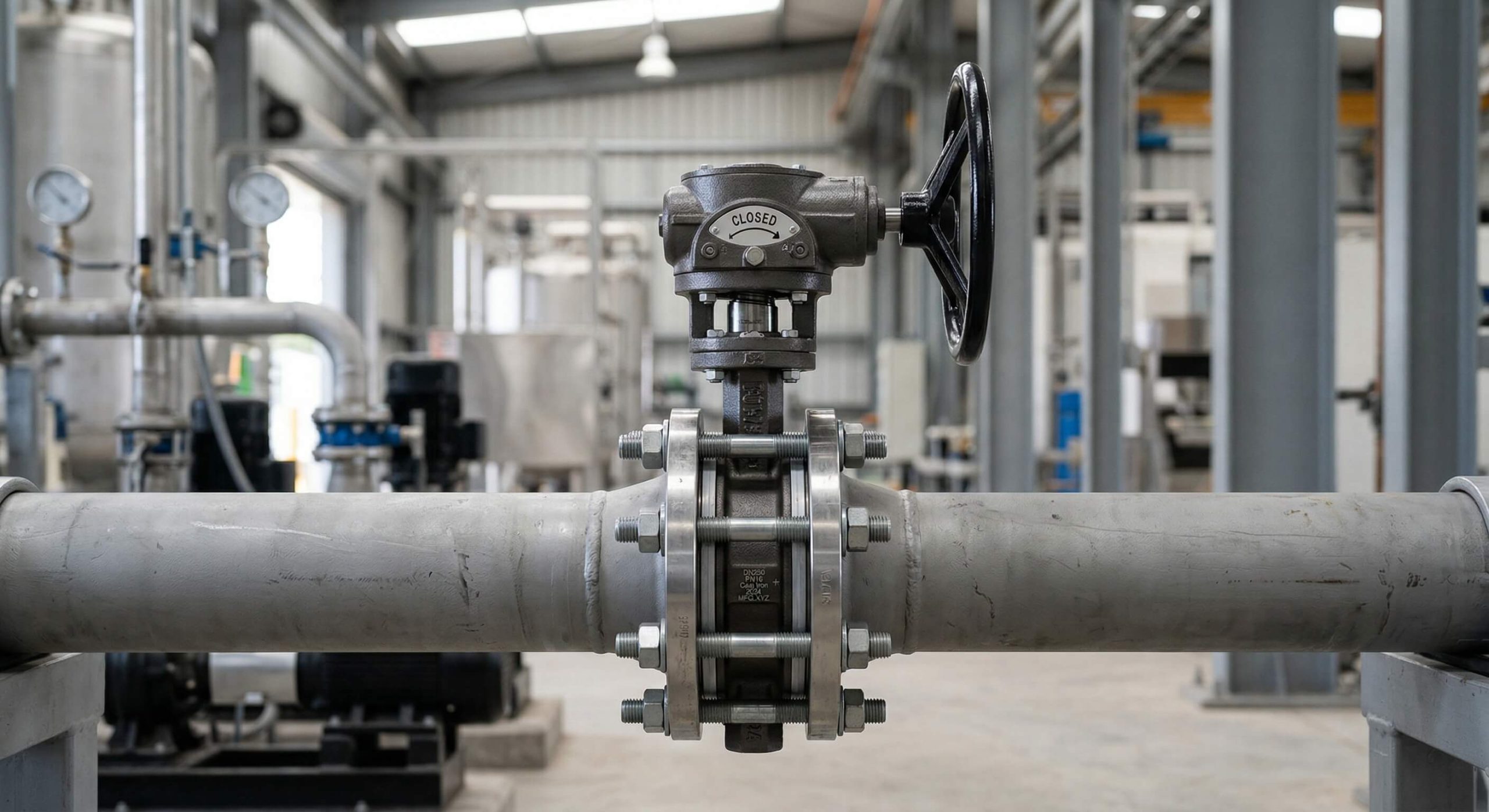
Choosing the wrong connection interface for your pipeline leads to catastrophic leaks and expensive system downtime. You might find yourself forced to shut down a whole production line just to swap a simple seal because your valve isn’t designed for downstream isolation. Selecting a high-performance waffer butterfly valve offers a lightweight, cost-saving solution that fits seamlessly into modern industrial systems.
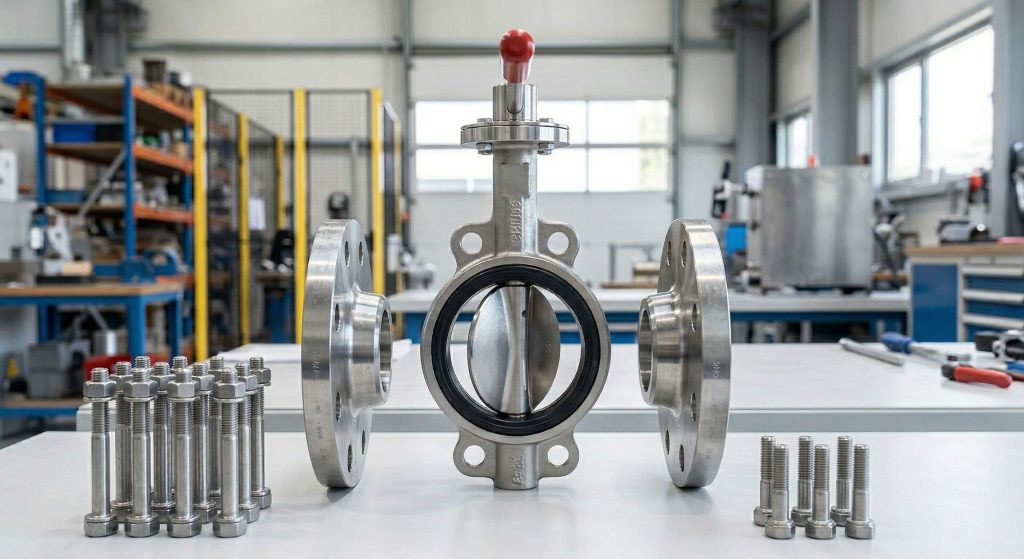
What is a waffer butterfly valve exactly?
A waffer butterfly valve is a quarter-turn flow control component designed to be clamped between two pipe flanges. It uses the tension of the flange bolts to stay in position and create a bubble-tight seal. This design is highly efficient for general isolation needs in standard piping.
How does the seating mechanism work?
The seating mechanism relies on a resilient elastomer or a hard metal seat that the disc presses against when closed. When the actuator rotates the stem, the disc turns to allow or block the media flow.
Believe it or not:
- The disc remains in the flow path even when fully open.
- Resilient seats provide a tighter seal for liquids.
- Metal seats are used for high-temperature gases.
Key Takeaway: The wafer design prioritizes a slim profile and reduced weight for easier handling and lower material costs.
| Feature | Wafer Specification |
|---|---|
| Connection | Sandwich clamping |
| Weight | Lowest among styles |
| Main Use | General flow isolation |
You should evaluate the weight savings of this design before finalizing your pipeline support structure.
When should you use a lug-style butterfly valve?
You should choose a lug-style model over a waffer butterfly valve when your system requires end-of-line service or independent flange bolting. Lug valves feature threaded inserts that allow them to be bolted directly to a single flange. This provides structural stability that wafer versions cannot match in dead-end situations.
Is end-of-line service possible with lugs?
End-of-line service is a primary advantage of the lug design because the valve remains securely attached even if the downstream pipe is removed. This allows you to perform maintenance on one side of the system while keeping the other side pressurized.
Here is the kicker:
- Each side has its own set of bolts.
- The valve acts as a temporary pipe plug.
- It is safer for maintenance teams working downstream.
Key Takeaway: Lug-style valves offer superior mechanical versatility for systems requiring frequent downstream modifications or repairs.
| Service Type | Lug Capability |
|---|---|
| End-of-Line | Fully Compatible |
| Independent Bolting | Yes |
| Maintenance Isolation | High Efficiency |
Use this data to determine if your future maintenance plan requires the isolation flexibility of a lugged body.
How do installation requirements differ between styles?
The installation of a waffer butterfly valve requires precise centering between the flanges to prevent the disc from hitting the pipe walls. Because there are no threaded lugs to guide the bolts, you must manually align the valve body during the tightening process. Incorrect alignment often results in seat damage or operational failure.
Why is centering critical during setup?
Centering ensures that the disc can rotate freely without catching on the internal edges of the connecting pipe. If the valve is even slightly off-center, the actuator will require more torque, leading to premature wear.
Think about this:
- Misalignment causes uneven seat compression.
- Centering lugs help guide the through-bolts.
- Disc clearance must be verified before final torquing.
Key Takeaway: Professional installers prefer the wafer style for its speed, provided they have the tools for accurate centering.
| Step | Installation Priority |
|---|---|
| Alignment | Critical for Wafer |
| Bolt Pattern | Star pattern required |
| Disc Position | Partially open during bolt-up |
Follow these alignment priorities to ensure your seals last for the full duration of their intended service life.
Which valve type is more cost-effective?
A waffer butterfly valve is significantly more cost-effective than its lugged counterpart due to its lower material volume. Since it lacks the protruding metal lugs and threaded inserts, it is lighter and cheaper to manufacture. This cost difference becomes even more apparent in larger pipe diameters where metal costs skyrocket.
Do weight differences impact your budget?
Reduced weight lowers your overall project budget by minimizing shipping costs and requiring less robust pipe supports. For large-scale installations, the cumulative weight savings can lead to thousands of dollars in infrastructure reductions.
Check this out:
- Wafer bodies use up to 20% less metal.
- Shipping fees are reduced for bulk orders.
- Installation labor is faster due to easier handling.
Key Takeaway: For budget-conscious projects that do not require end-of-line service, the wafer style is the superior financial choice.
| Cost Factor | Wafer Advantage |
|---|---|
| Purchase Price | Usually 10-15% lower |
| Freight Costs | Lower due to mass |
| Support Brackets | Minimal requirement |
Analyze your total system weight to see how much you can save by switching to a wafer-patterned body.
Can you perform maintenance without system shutdowns?
Maintenance on a waffer butterfly valve generally requires a full system shutdown because the valve is held by the shared bolts of both flanges. If you loosen the bolts to remove the valve, both sides of the pipeline will lose their seal. This makes system-wide depressurization a necessity for any repair or inspection.
How does isolation facilitate repairs?
Isolation allows you to segment your system, but the wafer style lacks the independent bolting needed to keep one side sealed. Without those threaded lugs, the valve simply cannot stay in place without the pressure from both flanking pipes.
Simply put:
- Wafer valves require “sandwich” pressure.
- Removing a pipe section releases the valve.
- Complete drainage of the line is usually required.
Key Takeaway: Plan for scheduled outages if you rely on wafer valves, as they cannot be serviced under partial pressure.
| Repair Aspect | Wafer Limitation |
|---|---|
| Live System Maintenance | Not Possible |
| Seal Replacement | Requires full removal |
| Downstream Access | Requires line shutdown |
Compare these limitations against your operational uptime goals to decide if a shutdown is acceptable for your facility.
What seat materials provide the best seal?
The longevity of a waffer butterfly valve depends heavily on matching the seat material to the specific media being transported. EPDM is excellent for water and steam, while Nitrile (Buna-N) is the standard for oils and fats. Selecting the wrong material will lead to swelling, cracking, or total seal failure within weeks.
Is EPDM better than Nitrile for water?
EPDM is almost always the better choice for water-based systems because it offers superior resistance to heat and aging. Nitrile, while durable, is specifically engineered for petroleum products and will degrade faster in high-temperature water applications.
The best part?
- EPDM handles temperatures up to 120°C.
- Nitrile prevents swelling in oily environments.
- PTFE provides the highest chemical resistance.
Key Takeaway: Always verify the chemical compatibility and temperature range of your seat before placing an order.
| Media | Recommended Seat |
|---|---|
| Potable Water | EPDM |
| Hydraulic Oil | Nitrile (Buna-N) |
| Corrosive Acid | PTFE (Teflon) |
Review your fluid specifications to select the seat material that ensures a bubble-tight seal for years to come.
Why do pressure ratings matter for selection?
You must verify that your waffer butterfly valve is rated for the maximum surge pressure of your system. While these valves are efficient, their “sandwich” design means they rely on the integrity of the flange bolts to maintain pressure. Exceeding the rated PN or ANSI class can cause the seat to blow out or the disc to warp.
Can these valves handle high-pressure surges?
High-pressure surges can be managed if you choose a high-performance design with reinforced seats and stems. Most standard wafer valves are rated for PN10 or PN16, which is sufficient for municipal and HVAC water loops.
You might be wondering:
- What happens during a water hammer?
- How do pressure classes (150 vs 300) differ?
- Does the disc thickness affect the rating?
Key Takeaway: Selecting a valve with a pressure rating higher than your operating pressure provides a necessary safety margin.
| Pressure Class | Typical Application |
|---|---|
| ANSI 150 | General Industry |
| ANSI 300 | High-Pressure Steam |
| PN16 | Municipal Water |
Cross-reference your pump’s peak pressure with the valve’s rating to prevent catastrophic hardware failure.
How do you read technical valve schematics?
Understanding a waffer butterfly valve schematic is essential for ensuring that the component fits within the physical constraints of your piping. Schematics provide the face-to-face dimensions, which tell you exactly how much space the valve body occupies. They also indicate the orientation of the actuator mounting pad.
What do P&ID symbols tell the engineer?
P&ID symbols represent the valve’s function and actuation method on a system-wide diagram. A bowtie shape with a vertical line or a circle usually denotes a butterfly-style valve in standard engineering drawings.
Let’s dive deeper:
- The symbol shows if the valve is normally open.
- It indicates if the actuator is manual or electric.
- Schematic lines show the control signal path.
Key Takeaway: Accurate interpretation of schematics prevents spatial conflicts during the construction phase of your project.
| Schematic Detail | Engineering Use |
|---|---|
| Face-to-Face | Pipe length calculation |
| Actuator Type | Wiring/Air line planning |
| Flow Direction | Bi-directional verification |
Study the dimensional drawings carefully to avoid costly modifications during the physical installation of the pipeline.
Which industries benefit most from these valves?
The waffer butterfly valve is the workhorse of the HVAC, water treatment, and chemical processing industries. Because these sectors often deal with large-diameter pipes and relatively low pressures, the wafer’s efficiency is highly valued. Its compact size also makes it perfect for the tight confines of shipboard engine rooms.
Is food processing a suitable application?
Food processing is a perfect application for wafer valves when equipped with stainless steel discs and FDA-approved seats. These valves allow for quick cleaning and offer a smooth flow path that minimizes the risk of product entrapment.
Keep this in mind:
- Stainless steel prevents rust contamination.
- Polished discs ensure sanitary flow.
- Fast operation aids in automated batching.
Key Takeaway: The versatility of body and disc materials allows this valve to adapt to almost any industrial environment.
| Industry | Primary Benefit |
|---|---|
| HVAC | Space-saving design |
| Wastewater | Corrosion resistance |
| Shipbuilding | Weight reduction |
Consult with an applications engineer to see how these valves can optimize your specific industrial process.
How do you ensure long-term valve reliability?
To maximize the life of your waffer butterfly valve, you must establish a strict routine of periodic cycling and lubrication. Valves that remain in one position for years are prone to “seizing” or developing permanent set in the elastomer seat. Cycling the valve helps clear debris and keeps the internal surfaces smooth.
Does frequent cycling improve performance?
Frequent cycling prevents the buildup of scale and minerals on the disc and seat, ensuring the valve remains easy to operate. For automated systems, regular movement tests the actuator’s response and ensures the stem is properly lubricated.
But wait, there’s more:
- Cycling prevents the seat from sticking.
- It identifies potential leaks early.
- Automated tests reduce manual labor.
Key Takeaway: A proactive maintenance schedule is the single most effective way to prevent unexpected valve failure.
| Maintenance Task | Frequency |
|---|---|
| Visual Inspection | Monthly |
| Operational Cycling | Quarterly |
| Seat Lubrication | Bi-annually |
Implement a digital maintenance log to track the performance and health of every valve in your facility.
Frequently Asked Questions
Can I use a wafer valve for steam?
Yes, but only if it features a high-temperature seat like PTFE or a metal-seated design. Standard EPDM seats will degrade quickly if exposed to continuous high-pressure steam.
What’s the best way to prevent leaks during install?
Simple alignment is the key, along with ensuring the disc is partially open so it doesn’t pinch the seat. You must also tighten the flange bolts in a cross-pattern to ensure even pressure.
Can I install these valves vertically?
Certainly, butterfly valves can operate in any orientation, though horizontal stems are often preferred to prevent sediment buildup. Ensure the actuator has enough clearance for manual override if needed.
What is the life expectancy of a resilient seat?
Usually, you can expect five to ten years of service depending on the frequency of use and the harshness of the media. High-temperature or abrasive fluids will naturally shorten this lifespan.
How do I know if the valve is fully closed?
Judgment is based on the position indicator on the actuator or handle, which stays parallel to the disc. If the handle is perpendicular to the pipe, the valve is in the closed position.
Conclusion
Mastering the choice between wafer and lug-style valves is essential for building a safe and efficient industrial system. At the core of our brand stance is a commitment to precision engineering and the delivery of reliable flow control solutions that stand the test of time. For expert guidance on your next project or to request a detailed quote, please contact us today.