

PFA Lined Butterfly Valve: Engineered Fluid Isolation for Severe Chemical Media
Continuous virgin PFA wetted barrier seamlessly encapsulates the valve body and disc core, delivering dependable shutoff protection across designated chemical concentrations, temperatures, and working pressures.
Engineered specifically for qualified NaOH, HCl, H₂SO₄, and NaClO chemical applications. Final valve configuration and trim specifications are tailored to your media composition, concentration, temperature, and operating pressure.
Aggressive Chemical Media Requires Comprehensive Fluid Path Evaluation, Not Just Body Material Selection
Chemical degradation does not stop at the outer casting. Media chemistry, concentration gradients, thermal peaks, impurities, and wash cycles impact the liner, elastomeric energizer, shaft seals, and flange faces. Specifying an authentic, engineered PFA lined valve ensures complete fluid path isolation under actual plant conditions.
Corrosion Risk Encompasses the Entire Wetted Path
Ductile iron or stainless body integrity is only part of the equation. The disc encapsulation, liner wall, shaft seal assembly, and flange sealing faces must form an unbroken barrier, eliminating localized metallurgical vulnerabilities.
Concentration and Temperature Define Service Limits
Identical chemical nomenclature exhibits drastically distinct permeation rates and corrosive aggression across varying temperatures and concentrations. Valve selection must be reviewed against actual chemical assay and operating pressure.
Permeation Resistance Dictates Long-Term Integrity
Aggressive chemistry requires more than basic surface inertness. PFA lining density, uniform wall thickness, and vacuum retention prevent gaseous diffusion through the fluoropolymer, guarding internal load-bearing substrates.
Shaft Sealing, Flange Faces & Backing Resilience
The PFA wetted barrier operates in tight synchrony with dynamic shaft sealing cartridges and resilient elastomer backings. Uniform mechanical compression prevents cold flow and preserves bubble-tight external sealing.
Verify your specific corrosive chemical media compatibility with our engineering specialists.
Consult Chemical Compatibility & Trim Options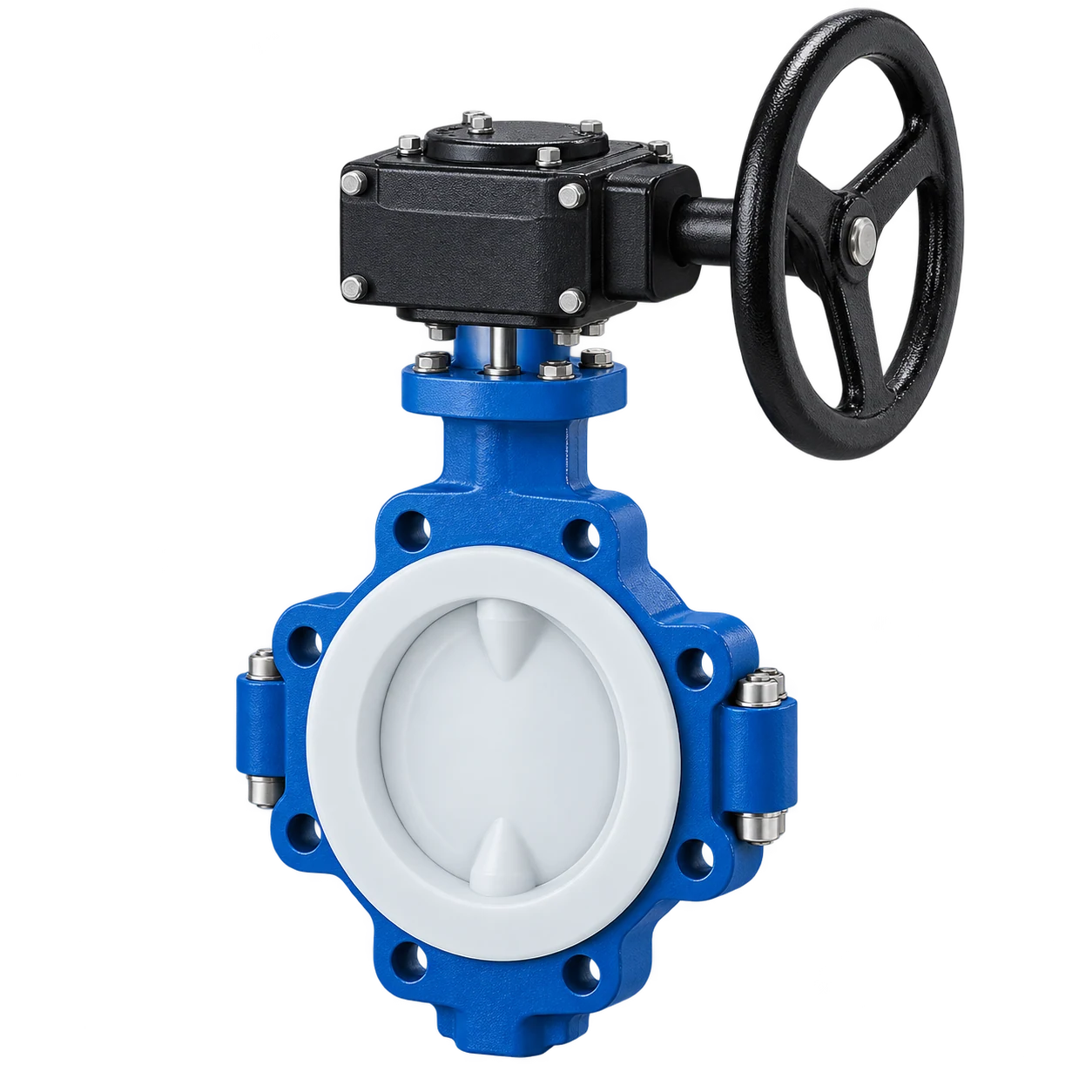
What is a PFA Lined Butterfly Valve?
A PFA Lined Butterfly Valve is an engineered quarter-turn isolation valve specifically developed for severe corrosive chemical media shutoff and flow pathway control. By utilizing a continuous virgin PFA wetted body liner combined with an encapsulated PFA disc, it establishes a reliable fluid barrier between aggressive chemicals and load-bearing metallic shell substrates. Explore our butterfly valve range for other body and sealing configurations.
Designed for compact installation envelopes demanding certified chemical media compatibility, this valve offers flexible wafer and lugged connections tailored to actual piping standards, media assay, concentration, operating temperature, and system working pressure.
Looking for specific valve dimensions, actuator configurations, or GA drawings for your pipeline?
Inquire for Product Specifications & GA Drawings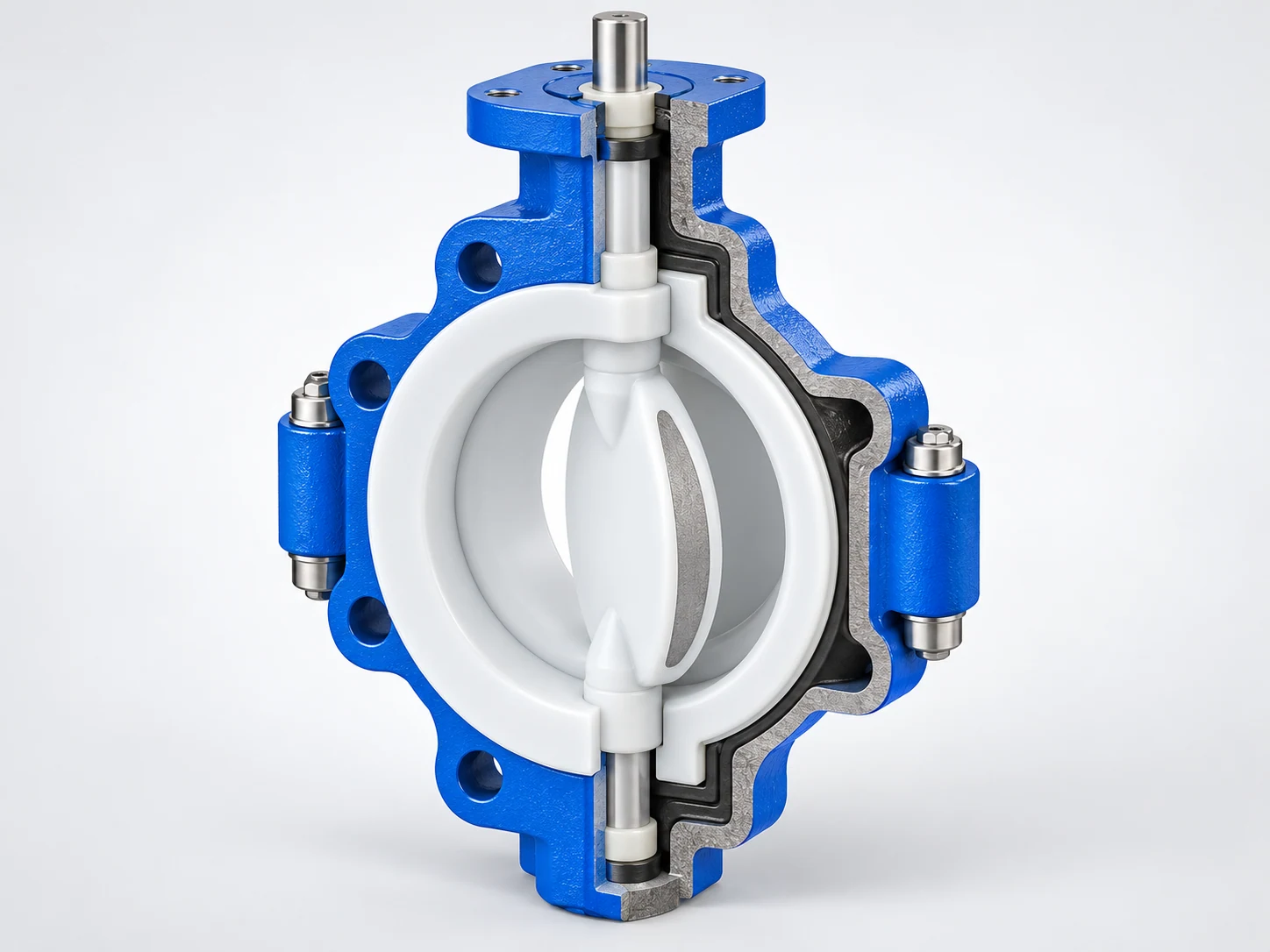
Isolating Corrosive Fluid from Metallic Substrates
The PFA Lined Butterfly Valve achieves dependable media isolation through a continuous wetted-path fluoropolymer lining combined with a fully encapsulated disc core, reinforced by resilient elastomer backing cushions and dynamic multi-level shaft sealing cartridges.
01. Continuous PFA Body Liner
High-integrity virgin PFA directly lines all interior body wetted surfaces, forming a seamless chemical barrier that completely shields the cast body from corrosive attack and permeation.
02. PFA Encapsulated Disc Core
The ductile iron or stainless disc substrate is encapsulated in thick PFA fluoropolymer, ensuring uncompromised flow passage isolation throughout opening and closing cycles.
03. Dynamic Shaft Sealing Area
Precision-machined stem penetration interfaces utilize energized fluoropolymer packing sets, preventing media migration along the valve shaft and eliminating atmospheric fugitive emissions.
04. Resilient Backing & Structure Support
A calibrated elastomer backing energizer absorbs thermal expansion, compensates for mechanical wear, and maintains constant radial seating contact across temperature cycles.
Need to verify wetted-path liner thickness or shaft seal configuration against your process parameters?
Consult Structural Isolation Scheme with EngineersControlled Wetted Materials Managed Under a Single BOM
Material integrity in a PFA Lined Butterfly Valve extends beyond selecting PFA resin. Critical parameters including liner thickness, encapsulation uniformity, elastomeric backing energizers, and stem packing sets are tightly controlled to match approved fabrication drawings and actual chemical service envelopes. For a specified PTFE lining package, compare our PTFE-lined butterfly valves against the same service and inspection requirements.
PFA Body Lining
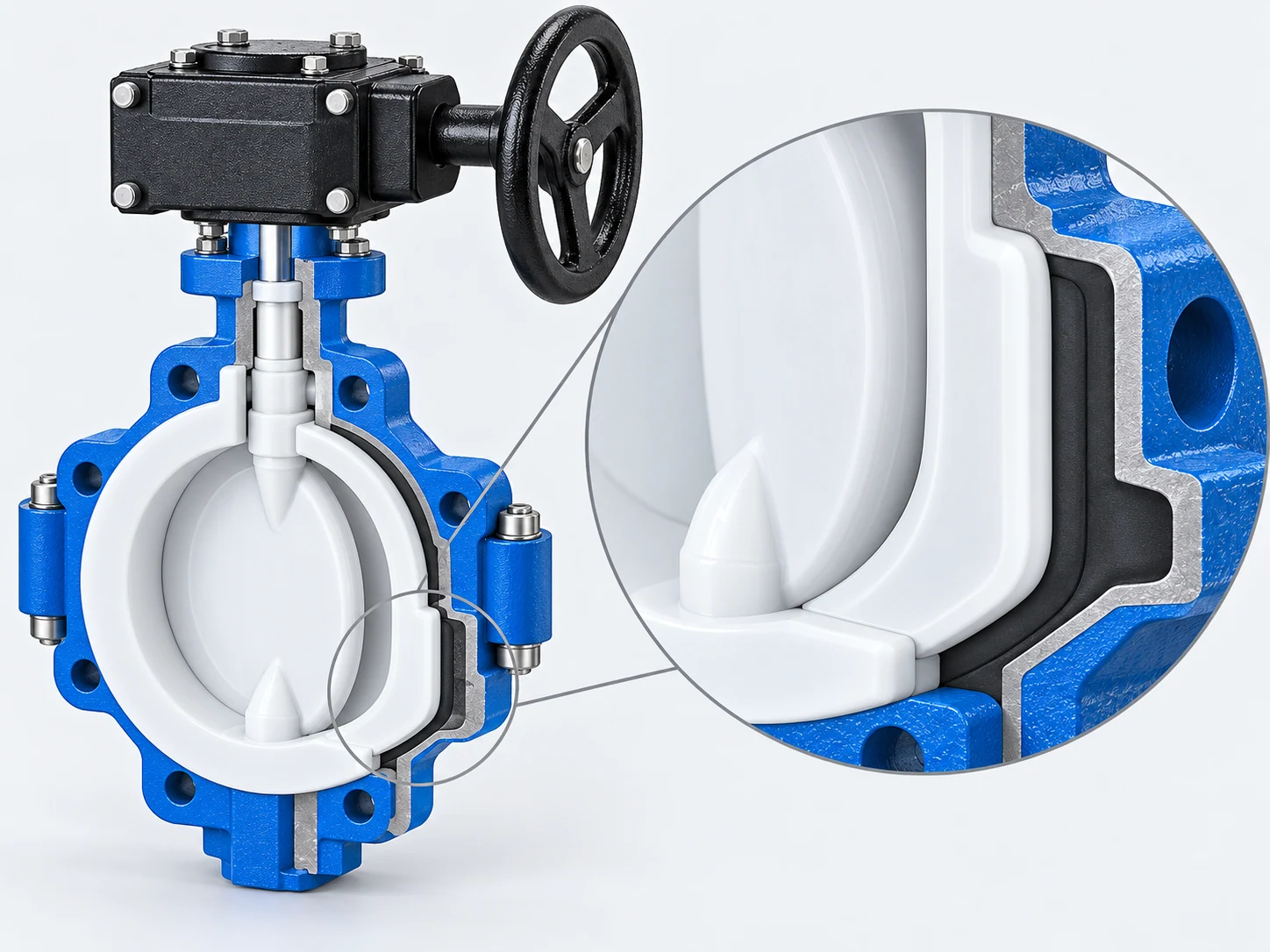
Design Thickness: 3–5 mmVirgin PFA fluoropolymer lines the entire body wetted envelope with an engineered thickness of 3–5 mm. Specific local minimum wall thicknesses adhere strictly to approved general assembly drawings rather than single generic approximations.
PFA Encapsulated Disc
Wetted Surface: PFA EncapsulatedThe internal disc substrate is molded with continuous PFA encapsulation, managed synchronously under the same corrosive chemical service trim code. Encapsulation material and mechanical core conform rigorously to approved BOM revisions.
Backing, Shaft Seals & PFA Resin
Independent Material ControlElastomeric backing energizers, dynamic shaft packings, and raw PFA resin maintain independent batch verification. Resin procurement complies with ASTM D3307 classifications and manufacturer TDS, avoiding generic PTFE standards.
Request certified resin certificates (TDS/MTR) or custom liner thickness engineering review.
Review Material Specifications & MTRsConfigured Specifically for Defined Chemical Media & Concentrations
PFA Lined Butterfly Valves are tailored for qualified alkaline solutions, severe inorganic acids, and oxidizing dosing agents. Configurations are validated against defined chemical formulations, operating temperatures, and working pressures—never generic "all-chemical resistance" claims.
NaOH | Sodium Hydroxide
10%–30% wt. Aqueous SolutionEngineered for alkaline dosing systems, caustic scrubbing loops, and industrial CIP neutralization lines operating under verified fluid velocity and temperature profiles.
HCl | Hydrochloric Acid
1%–20% wt. Aqueous SolutionDedicated fluid isolation for hydrochloric acid transfer headers and process skids. Established under dedicated acid trim schemes to control hydrogen chloride gas permeation.
H₂SO₄ | Sulfuric Acid
1%–30% wt. Aqueous SolutionFormulated for regulated sulfuric acid dilution and recirculation systems. Governed by independent thermodynamic data sets rather than bundled with generic acid ratings.
NaClO | Sodium Hypochlorite
0.5%–5% wt. Aqueous SolutionOptimized for oxidative bleaching and chlorination dosing packages. Requires review of available chlorine levels, solution pH, and line off-gassing characteristics.
Uncertain if your process chemical assay and operating temperature match our PFA lining envelope?
Submit Your Chemical Assay for Engineering ConfirmationSize, Pressure & Temperature Working Envelope
Precision fluoropolymer lining combined with high-integrity ductile iron architecture guarantees complete chemical protection, maximizing service life across standard process pipelines without compromising structural safety.
Extensive standard modular diameter coverage matches process equipment tie-ins, eliminating expensive line transitions and streamlining inventory across operations.
Robust pressure containment barrier maintains mechanical integrity under sustained static pressures, safeguarding containment in standard pressurized utility circuits.
Thermally stabilized virgin PFA polymers resist mechanical creep during hot cycles, securing continuous elastomeric shut-off without thermal seizure.
| Media | Concentration | Operating Temp | Max Working Pressure |
|---|---|---|---|
| Sodium Hydroxide (NaOH) | 10%–30% wt. | 20–60°C | ≤6 barg |
| Hydrochloric Acid (HCl) | 1%–20% wt. | 5–50°C | ≤6 barg |
| Sulfuric Acid (H2SO4) | 1%–30% wt. | 5–50°C | ≤6 barg |
| Sodium Hypochlorite (NaClO) | 0.5%–5% wt. | 5–35°C | ≤4 barg |
Access validated thermal derating charts and ensure precise specification compliance for severe process streams.
Request Pressure-Temperature Derating Curves & Engineering ReviewFrom Chemical Isolation to Dynamic Piping System Integration
Engineered for hostile chemical service, our lined quarter-turn solutions unite zero-leakage isolation barriers with automation precision, ensuring reliable operation under tough conditions.
Dependable Chemical Fluid Isolation
Virgin seamless fluoropolymer lining wraps disc and body geometry to eliminate permeation pathways, guaranteeing bubble-tight shutoff and stopping cross-contamination in aggressive acid distribution networks.
Flexible Flange & Lugged Matching
Standardized dual-drilled lugged bodies interface smoothly with DIN PN10 and ASME Class 150 companion flanges, delivering rapid replacement and reliable pipe alignment without specialized adaptors.
Tailored Operating Actuation
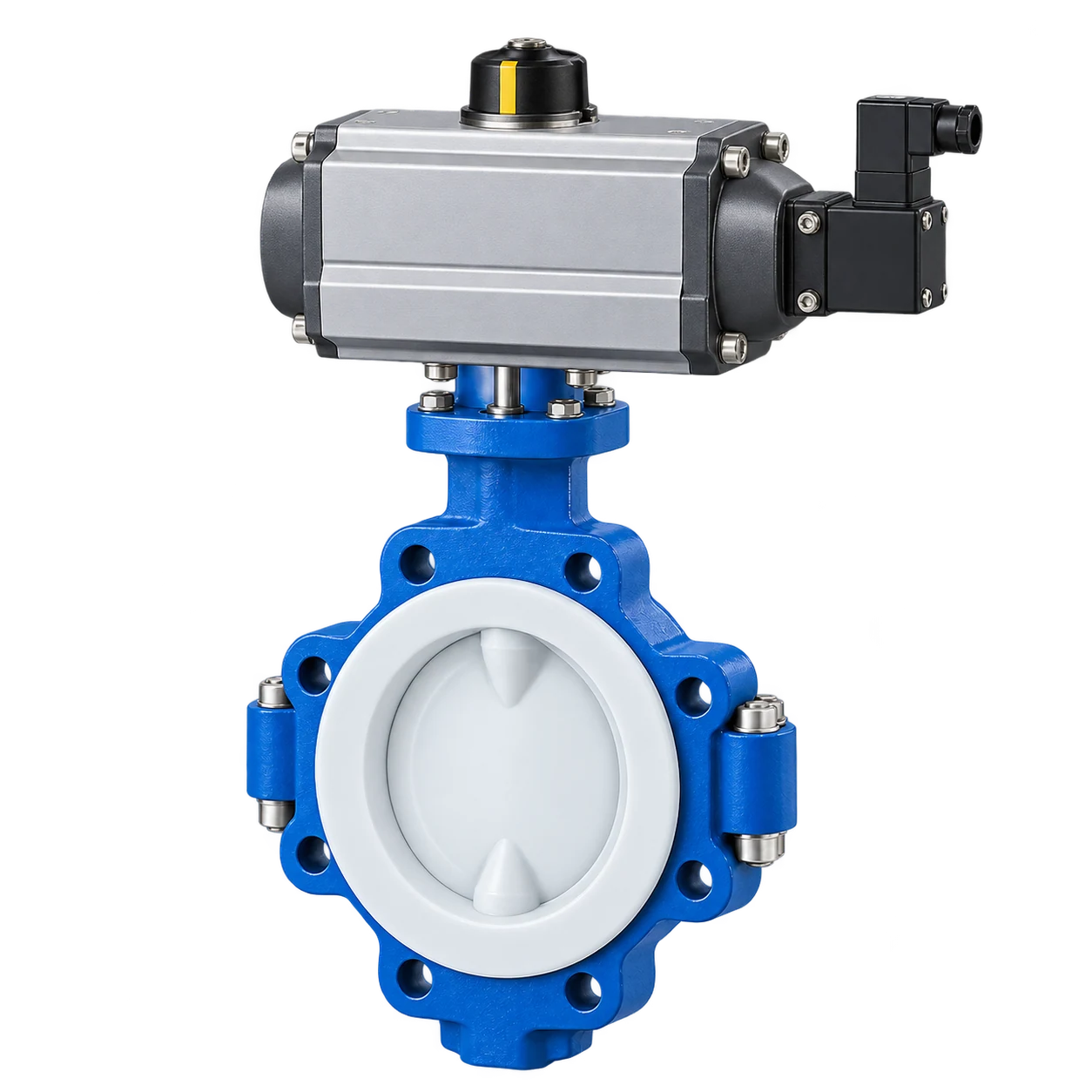
ISO 5211 direct-mount patterns pair directly with pneumatic rack-and-pinion units, delivering reliable shut-off torques against line surges while preventing stem over-stressing.
Precise Cv, Torque & Drop Calculation
Hydrodynamically optimized disc contours maximize flow coefficients, lowering pressure losses across throttled stages and reducing energy draw in continuous-duty pumping lines.
Optimize pneumatic and electric actuator sizing with application-specific hydrodynamic calculations.
Calculate Operating Torque & Valve Flow CharacteristicsLong-Term Wetted Isolation Beyond Generic Material Selection
Under severe corrosive chemical duties, the reliability of a PFA Lined Butterfly Valve requires rigorous simultaneous evaluation of chemical inertness, molecular permeation resistance, and lining structural integrity under dynamic service. Generic resin claims cannot substitute for engineered condition appraisal.
"The objective is not merely utilizing PFA fluoropolymer, but maintaining a verified, hermetic wetted barrier throughout the approved operational envelope."
Media Compatibility Control
Distinct chemical formulations, varying concentrations, trace impurities, and aggressive CIP regimes dictate tailored material formulations rather than applying single generic resistance assumptions.
Permeation Risk Assessment
Concentrated inorganic acids and halogen compounds exhibit elevated vapor permeation tendencies. Liner density, wall thickness, and vacuum retention prevent microscopic diffusion to metallic cores.
Structural Lining Retention
Virgin PFA liners must withstand mechanical stress during cycling, thermal fluctuations, and pipeline transients without buckling, cold flow, or dimensional distortion.
Need project engineering verification for high-permeation acids or aggressive chemical combinations?
Request Chemical Compatibility & Permeation EvaluationMulti-Barrier Sealing Architecture from Port Closure to Atmosphere
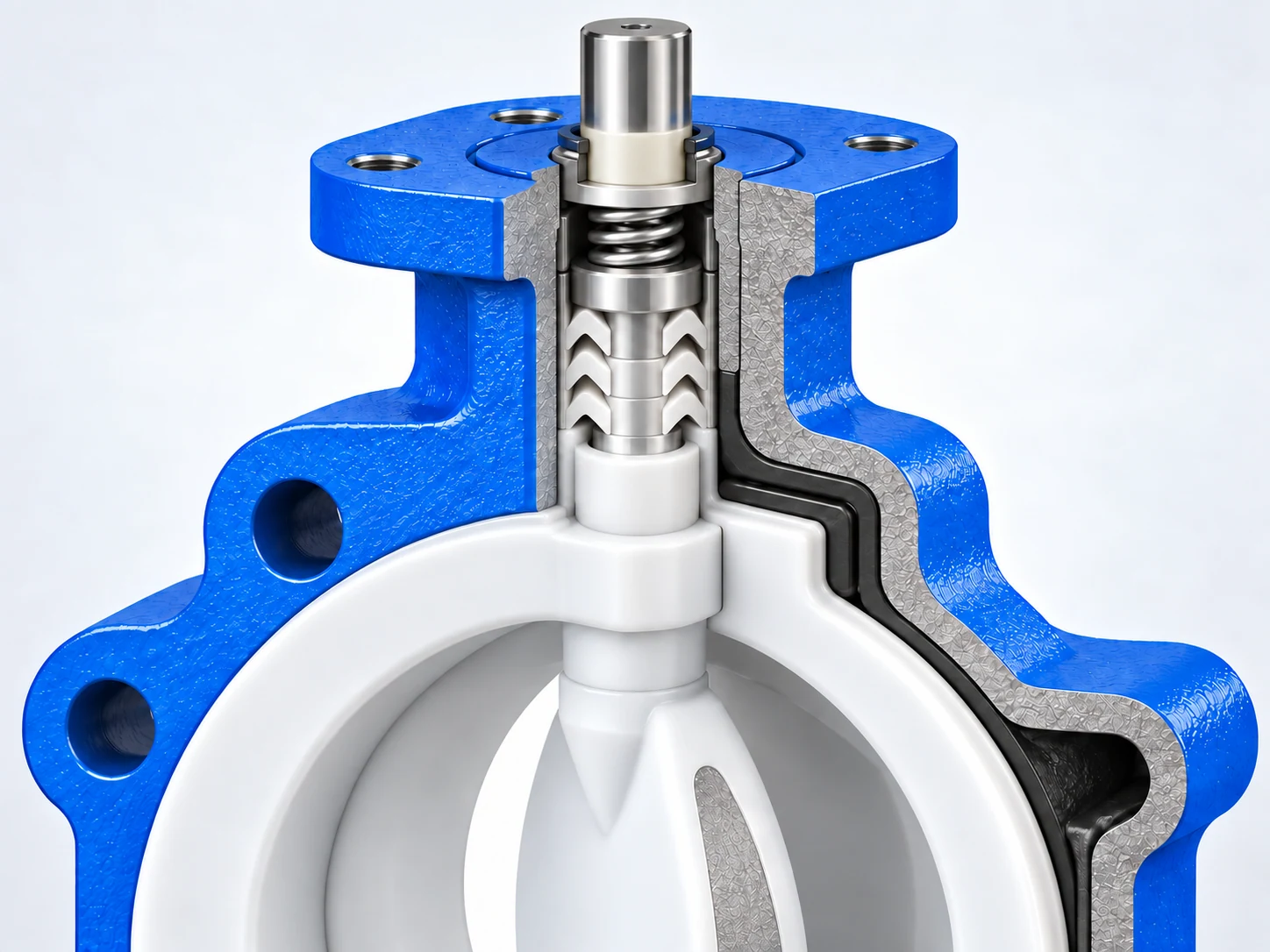
Multi-barrier sealing architecture protects every leak path from port closure to atmosphere under chemical service.
Precision Dynamic Shaft Sealing
Stem penetrations through the wetted passage are secured by multiple energized V-ring packings and secondary atmospheric seals, mitigating fugitive emissions and protecting operators.
Controlled Radial Sealing Interface
Encapsulated disc profiles mate smoothly with energized resilient seat geometry under calibrated compression, delivering bi-directional bubble-tight shutoff across thermal cycles.
Flared PFA Flange Sealing Face
Virgin PFA liner extends continuously over the body end-faces to form integrated gasket surfaces. Uniform flange contact eliminates separate gaskets and prevents crevice corrosion.
Mating Flange Interface & Disc Clearance
Flange bolt tightening loads, companion flange internal diameters, and disc swing clearance must be strictly aligned to avoid mechanical interference or liner compression damage.
Installation Notice: Avoid Uncontrolled Torque & Mechanical Pinching
PFA lined flange faces require calibrated star-pattern bolt torque according to manufacturer GA drawings. Excessive uneven torque can crush the fluoropolymer flare and compromise seal integrity.
Review certified shaft emission test records and recommended installation torque specifications.
Download Sealing Architecture Guide & Torque TablesPrecise Flange Interface Alignment Protects Fluoropolymer Lining Integrity
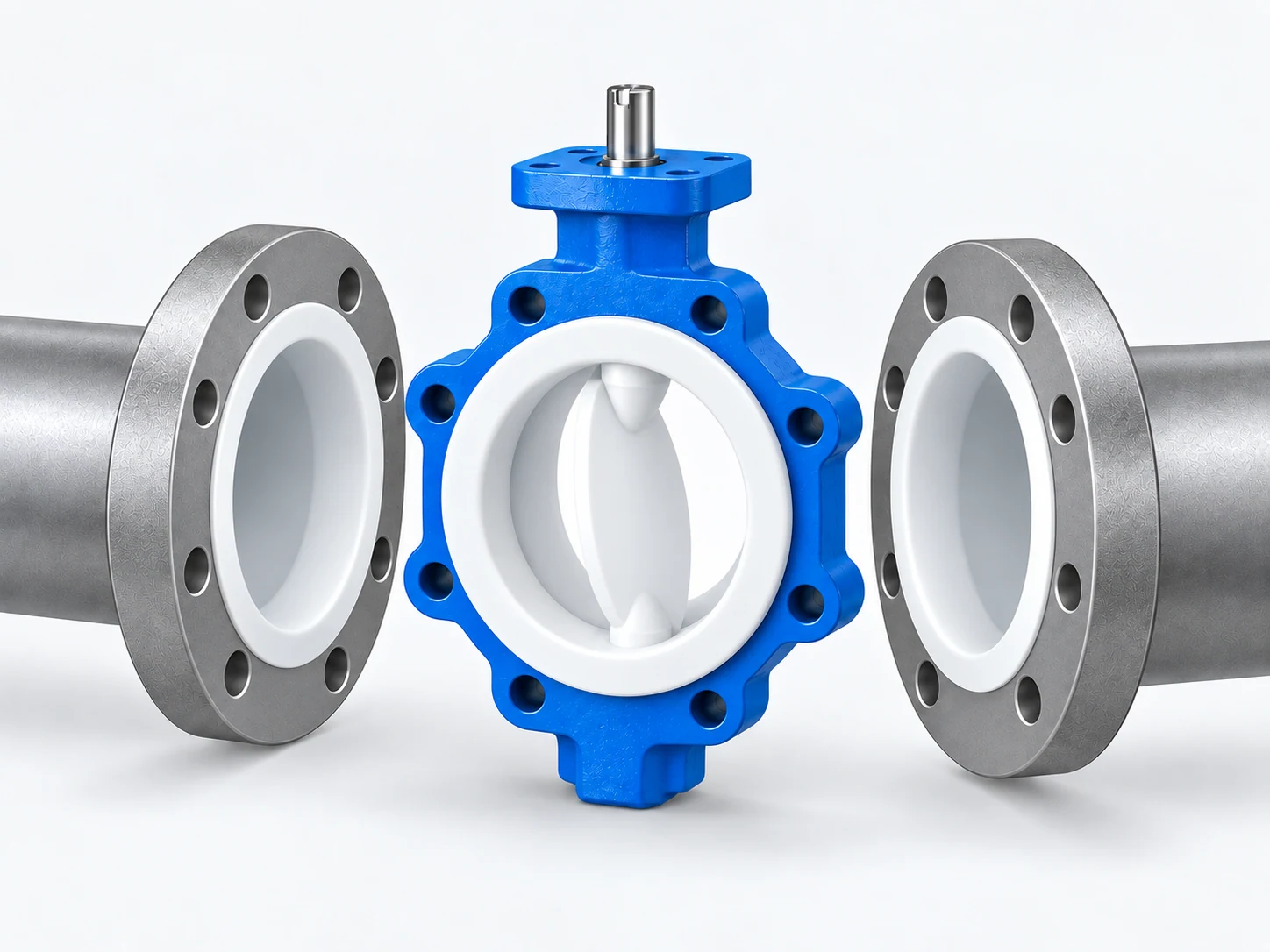
Prior to pipeline bolting, verifying mating flange inner diameters, disc swing clearances, uniform face compression, and lug connection torque is paramount. Dimension mismatches or excessive clamping loads induce unnecessary mechanical stress on the virgin PFA wetted barrier.
Verify Companion Flange I.D.
Both wafer and lugged patterns require verification against actual mating flange inside diameters, ensuring open piping bores clear internal wetted flow profiles without relying strictly on nominal ratings.
Retain Full Disc Swing Clearance
Verify complete 90-degree disc travel freedom within adjacent pipe bores prior to commissioning. Prevent mechanical jamming or gouging between the encapsulated PFA disc edge and neighboring pipe walls.
Prevent PFA Flare Crushing
Liner flare surfaces forming the flange gasket must be uniformly compressed under controlled torque. Never force misaligned pipe spools together with bolts, avoiding cold flow stress and local liner crushing.
Lugged Bolting Load Protocol
For threaded lug connections, verify exact tapped hole depth, stud engagement length, and cross-pattern torque values against certified GA drawings rather than applying generic structural bolt limits.
Pre-Installation Pipeline Interface Verification Checklist
Ensure flawless pipe integration and avoid wetted liner damage during mechanical assembly.
Download Flange Fit & Bolting Installation ManualEngineered Fluid Isolation Across Severe Chemical Environments
PFA Lined Butterfly Valves excel across verified chemical batching, automated dosing skids, industrial CIP wash circuits, and bulk acid transfer lines, executing dependable line shutoff and process routing.
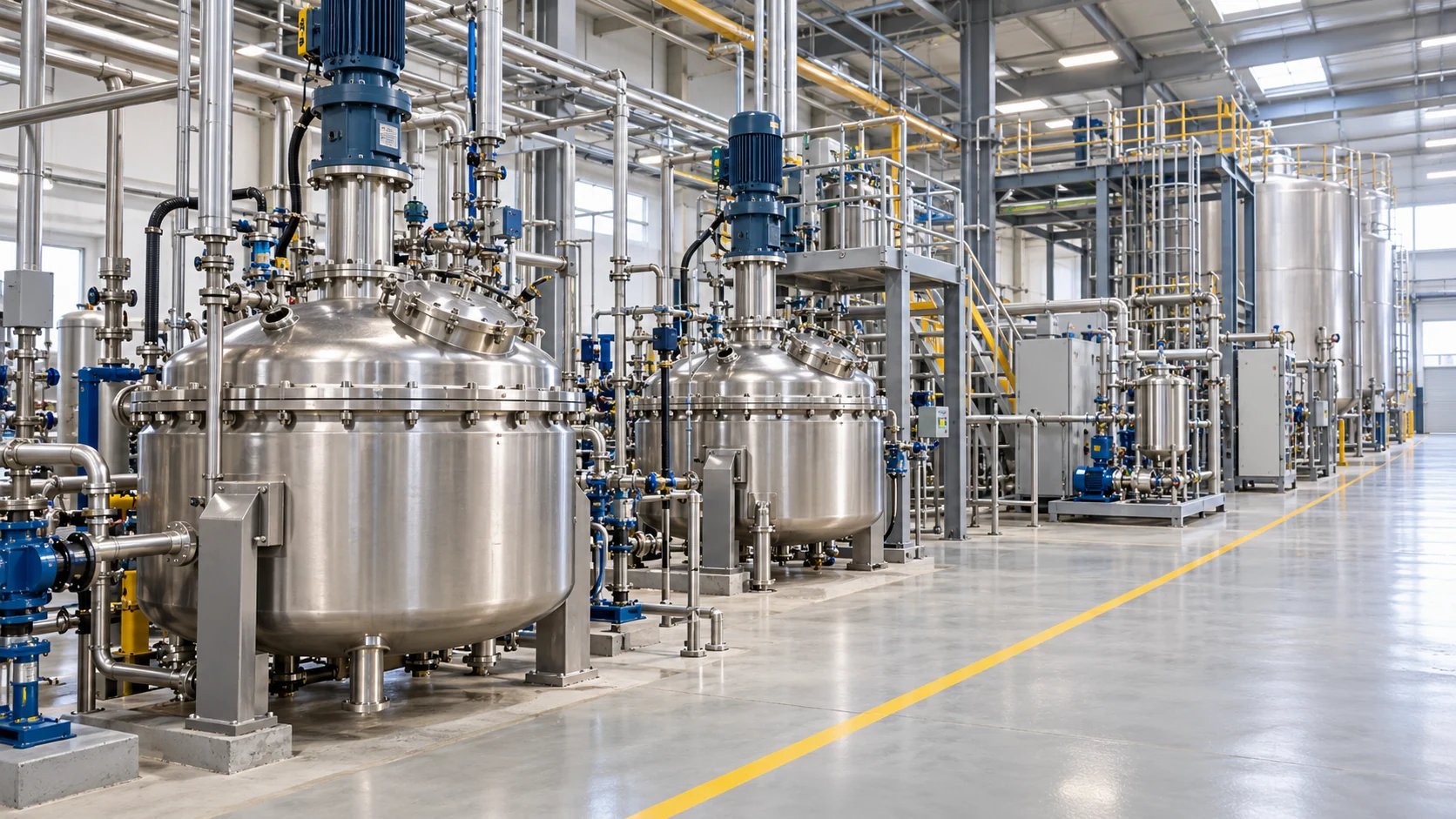
Chemical Batching & Blending Skids
Installed at raw reagent feed headers and reaction vessel outlets to manage multi-stage blend isolating. The seamless PFA wetted barrier eliminates metallic ion contamination and resists aggressive reagent blends.
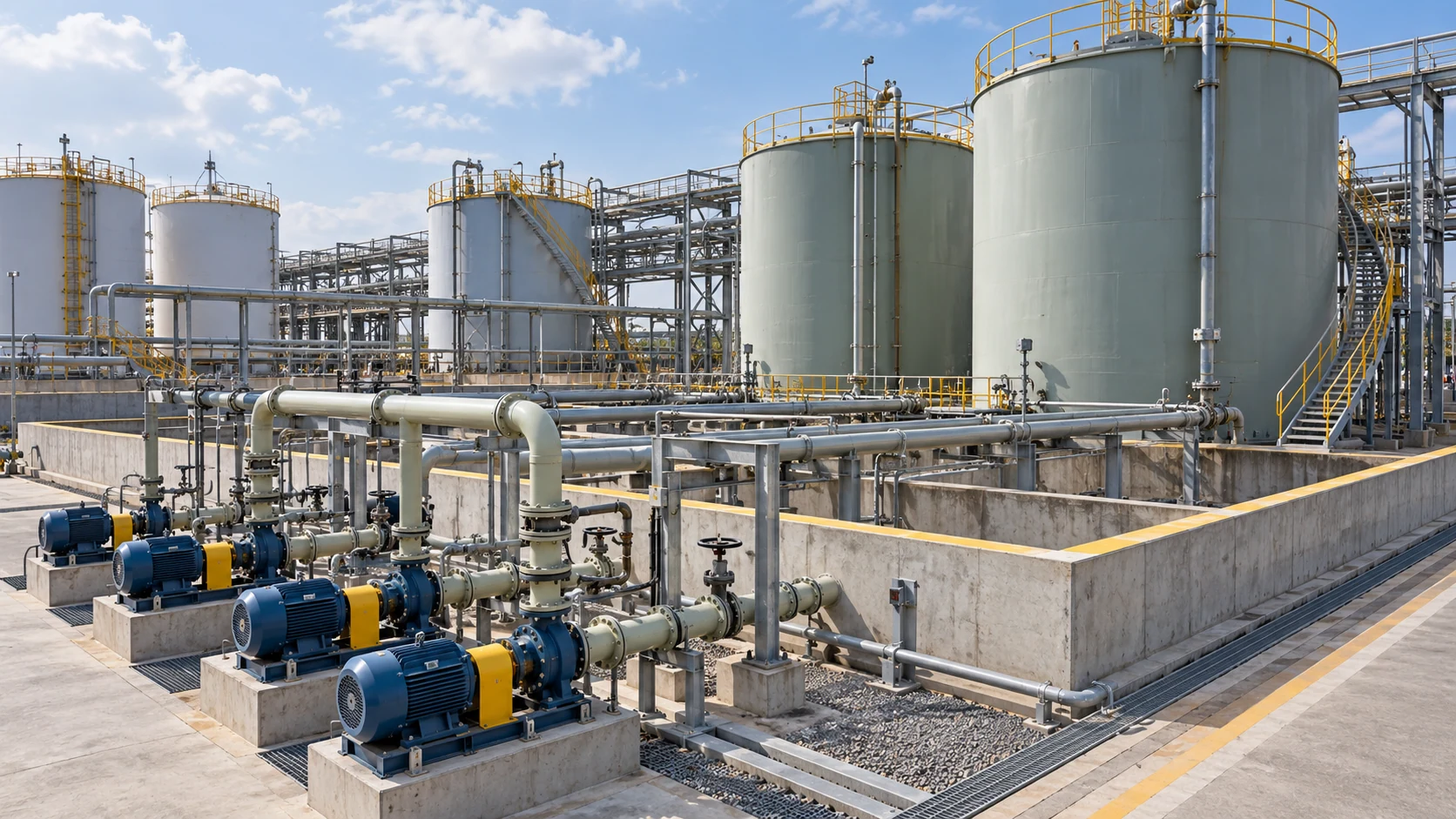
Severe Acid Transfer & Tank Farm Headers
Configured for storage tank isolation and pressurized loading/unloading manifolds carrying HCl, H₂SO₄, and caustic streams, securing zero fugitive emissions during high-throughput transfer.
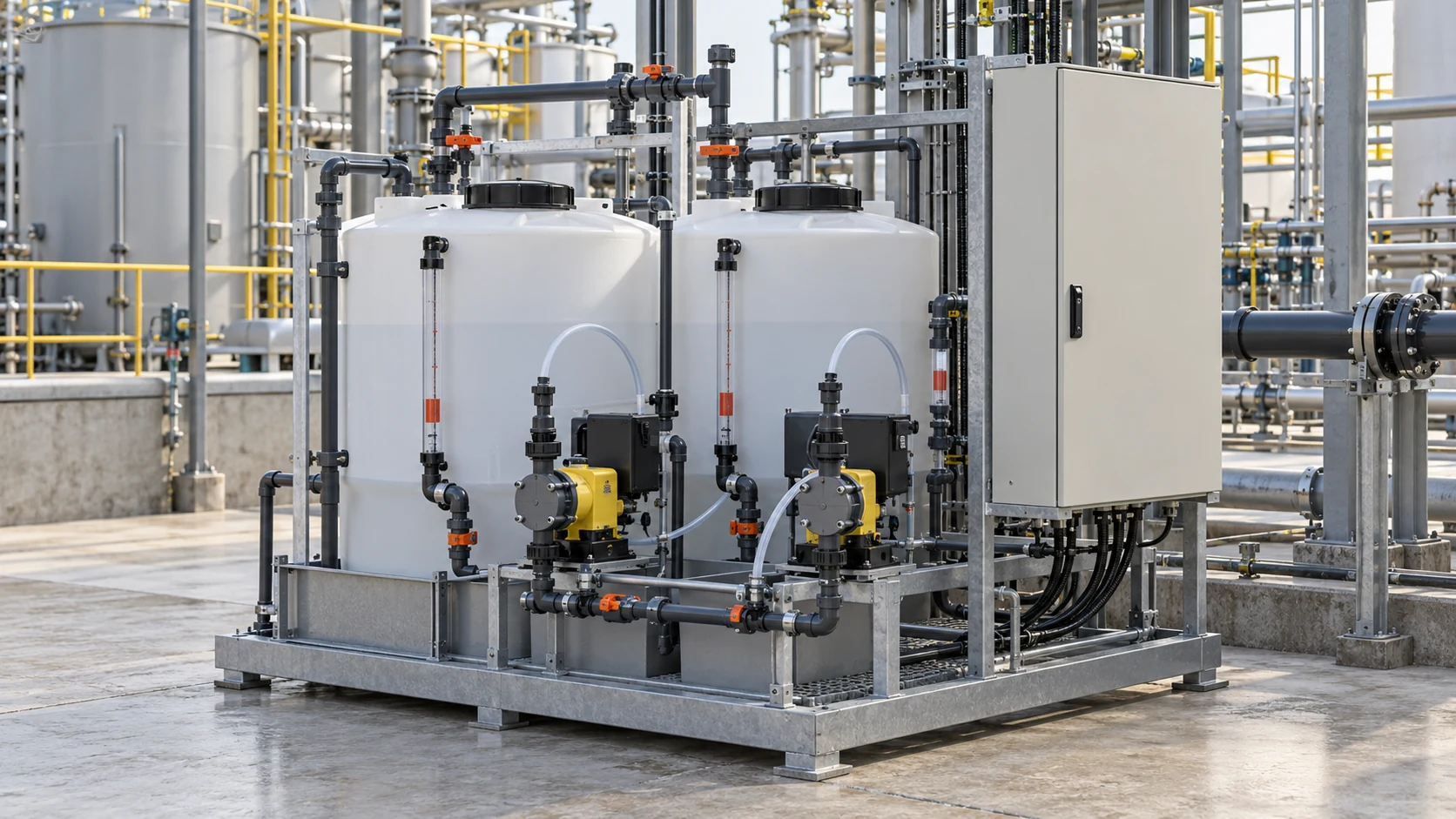
Automated Chemical Dosing Packages
Interfacing metering pumps and injection points for reactive dosing chemicals like sodium hypochlorite (NaClO). Quarter-turn actuation provides rapid cyclic response with chemical degradation resistance. For chlorination projects in water treatment, review our water and wastewater valve solutions alongside the specified dosing chemistry.
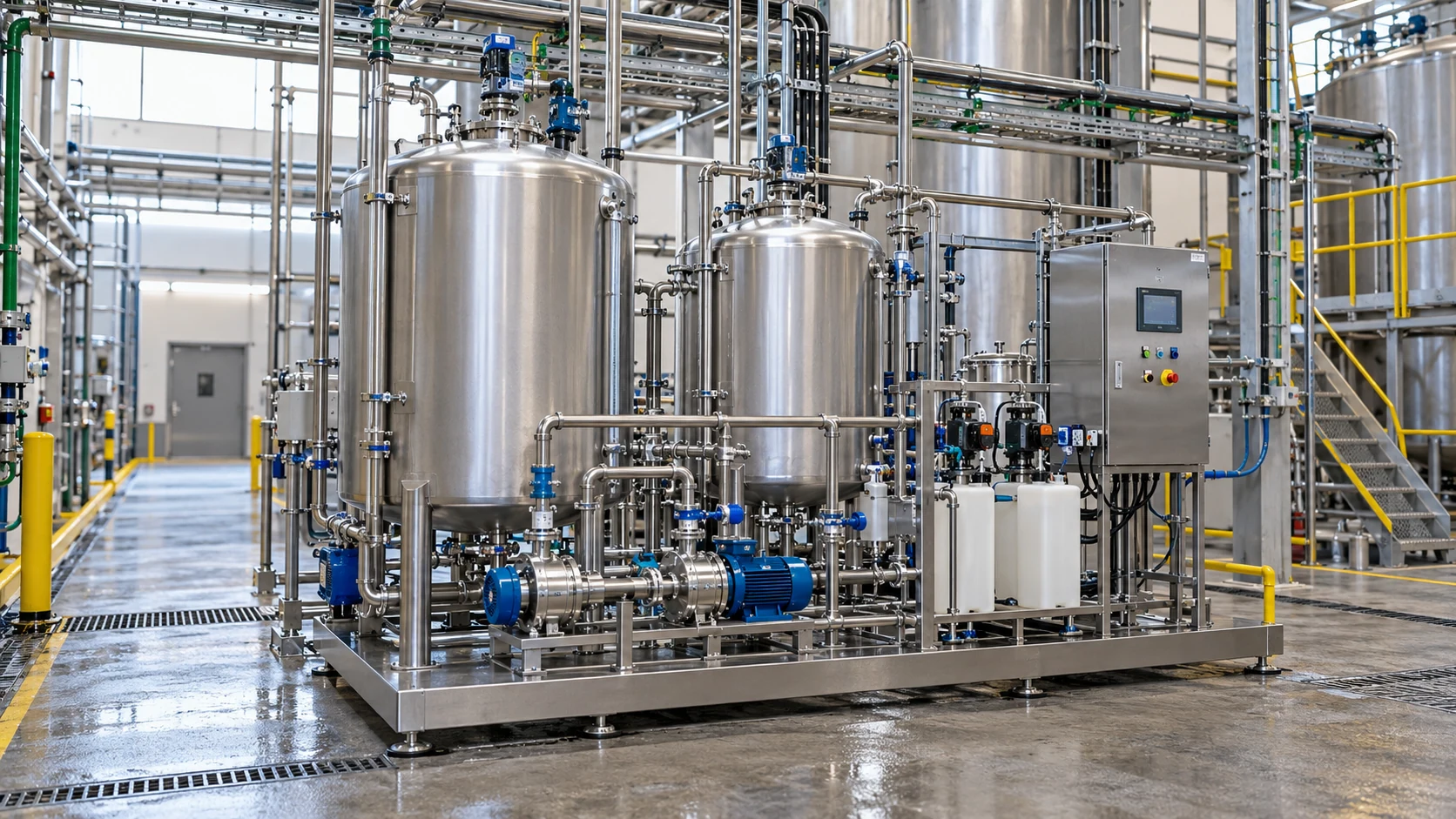
Industrial CIP & Neutralization Skids
Regulating caustic washes, nitric/phosphoric acid rinses, and hot sanitization loops. The smooth virgin PFA surface prevents residue accumulation and withstands continuous thermal cycling.
Need project-specific valve trim confirmation for aggressive chemical skids or process lines?
Consult Application Engineering for Custom SizingItemized Verification from Lining Continuity to Pressure Containment
Quality assurance for PFA Lined Butterfly Valves extends far beyond generic hydraulic testing. Every individual wetted shell undergoes meticulous thickness verification, high-voltage spark testing, and certified soft-seated bubble-tight isolation checks before signoff. Review RUITO's manufacturing and inspection capabilities for supplier qualification.
Lining Thickness Audit
Precision magnetic induction gauges verify virgin PFA body liner wall thicknesses across wetted profiles and disc radii, ensuring absolute compliance with approved minimal tolerance drawings.
Spark Pin-Hole Inspection
100% of manufactured wetted surfaces are subjected to high-voltage electrostatic spark testing. Test potentials are calibrated to exact liner thickness to detect microscopic fissures without dielectric breakdown.
Shell & Seat Pressure Test
Hydrostatic test routines conform strictly to EN 12266-1 and ISO 5208 Rate A. Standard PN10 valve builds execute 15 bar shell hydrostatic proofing and 11 bar bi-directional seat leakage validation.
Type Integrity Validation
Severe service configurations undergo rigorous batch prototype type validation, incorporating elevated thermal cycling (-10°C to 150°C), full vacuum stability, and media immersion stability trials.
Request factory Inspection & Test Plans (ITP) or certified hydrostatic batch test records.
Download Quality Assurance & Testing SpecificationsTranslating Process Chemical Data into Executable BOM, GA & Inspection Protocols
Engineering selection begins with thorough operational input. Media assay, temperature, shutoff delta-P, and piping connection geometries are systematically synthesized into certified bill of materials, dimensional general arrangements, and verified inspection documentation.
Process Data Input
Submit complete fluid chemistry, concentration wt%, operating temperature, line pressure, cleaning regime, and interface standards.
Lining Boundary Review
Senior application engineers evaluate PFA liner retention, backings, stem seals, and thermodynamic deratings against stated boundaries.
BOM & Trim Freezing
Lock in itemized wetted trim, encapsulation resins, elastomer cushions, and shaft gland specifications to eliminate scope drift.
GA & Actuator Sizing
Finalize companion flange connections, envelope dimensions, actuator torque margins, and hydrodynamic flow sizing calculations.
ITP & Dossier Signoff
Define inspection hold points, hydrostatic durations, spark voltage settings, and project quality dossier documentation criteria.
Certified Engineering Documentation Delivered with Every Project
Supporting EPC contractor approval workflows, vendor data registers (VDR), and plant commissioning files.
Datasheet
Verified valve design inputs, process media limits, and trim configuration parameters.
GA & Installation Drawing
Accurate outer envelope dimensions, port bore clearances, and bolting centerlines.
BOM / Material List
Explicit part-by-part resin classification, metallic substrate, and energized packing details.
Torque, Kv & Pressure Drop
Calculated flow coefficients and breakaway torque profiles across discrete travel increments.
ITP & Inspection Reports
Certified hydrostatic shell tests, seat leakage rates, and spark test certification.
MDR & Traceability Records
Individual heat numbers, resin lot MTR certificates, and manufacturing data books.
Start technical review and obtain application-engineered BOM and CAD drawing packages.
Submit Process Parameters for Sizing & Documentation
Tell Us Your Process Conditions & Get PFA Valve Selection Recommendations
Submit your chemical media and core project requirements. We will assess the optimal PFA lined butterfly valve configuration based on your actual operating conditions and establish an engineered sizing baseline.
- Engineered sizing based on verified media & process parameters
- PFA wetted trim configured strictly to project boundaries
- Comprehensive BOM & certified GA drawing packages provided
- Direct matching for actuation sizing and hydrodynamic Kv/torque data
- Full project inspection, ITP protocols & quality documentation supported
Request Selection Recommendations
Simply provide your core project details to get started.