
Avoid costly factory mistakes by auditing a gear operated high performance butterfly valve factory against the exact valve construction, manufacturing route and inspection requirements in your order. A finished valve can look correct while its seat compound, shaft fit or gearbox setting differs from the approved build. Those differences can leave an installation crew with a valve that binds or fails acceptance. Follow the product from incoming material through machining, assembly and recorded testing before agreeing to release it.
1. Which gear operated high performance butterfly valve factory fits?
Choose a gear operated high performance butterfly valve factory whose demonstrated production route covers your ordered construction and service conditions. Start with a completed example of the same structural family, then compare its manufacturing records with your inspection plan. A general product range provides a starting point for questions; it does not establish high performance qualification.
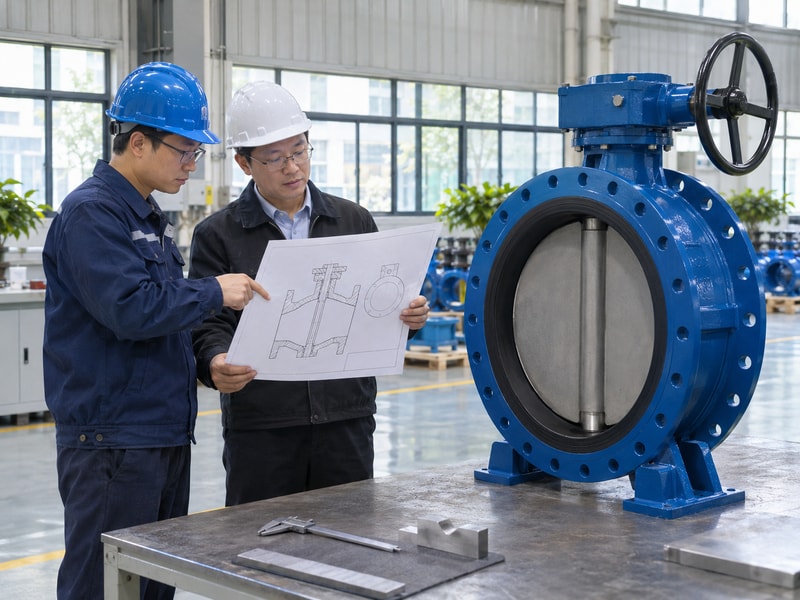
Match the workshop to the ordered construction
Gear operated describes a handwheel and reduction gearbox; it adds no pressure or temperature qualification. Double offset and triple offset constructions require separate checks, while a PTFE seat differs from a continuous PTFE lining. RUITO’s stated double flanged, double offset water range covers DN350–3000 and PN10/16, with forward and reverse closing differential pressure declared by model. Any proposed severe service configuration needs its own engineering confirmation.
- Identify the body, disc, shaft, seat and packing configuration.
- Match the service pressure and temperature to one approved bill of materials.
- Ask which production operations the site performs for that configuration.
| Audit item | Evidence to examine |
|---|---|
| Construction | Approved section drawing |
| Service envelope | Model-specific pressure–temperature data |
| Manufacturing route | Work order and operation sequence |
Keep an unresolved service mismatch open even when the workshop has spare capacity.
2. How do you verify the actual production site?
Verify the gear operated high performance butterfly valve factory by following an identified work order across the actual site and any subcontracted operations. Ask the team to select an unfinished valve, locate its traveler and show the next operation. A planned tour should leave enough time for you to choose a different sample.
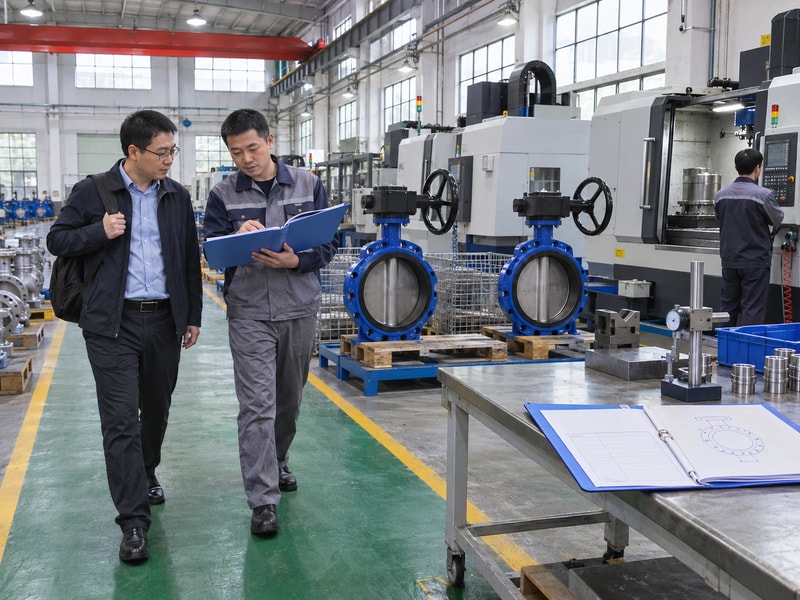
Follow the work between departments
Compare the legal entity, site address and certificate scope with the location performing the work. A quality system certificate describes a management system; product approval needs separate evidence for the applicable model and market. If casting, heat treatment, coating or testing occurs elsewhere, examine how the factory identifies the subcontractor’s batch and accepts the returned work. Record who can release each operation and who can stop production.
- Trace one job from material storage to machining and assembly.
- Check subcontractor orders against receiving and inspection records.
- Ask an operator to retrieve the current drawing at the workstation.
| Site check | Useful record |
|---|---|
| Production identity | Job traveler linked to order |
| External operation | Purchase order and acceptance report |
| Release authority | Signed operation approval |
A missing handover record leaves a gap even if both workshops have suitable equipment.
3. Can incoming materials be traced through the order?
Yes, a gear operated high performance butterfly valve factory should connect incoming material identification with the parts installed in your valve. Select a body and shaft from work in progress, then trace their material records backward. Follow a seat batch forward into an assembly record to check that identification survives both directions.
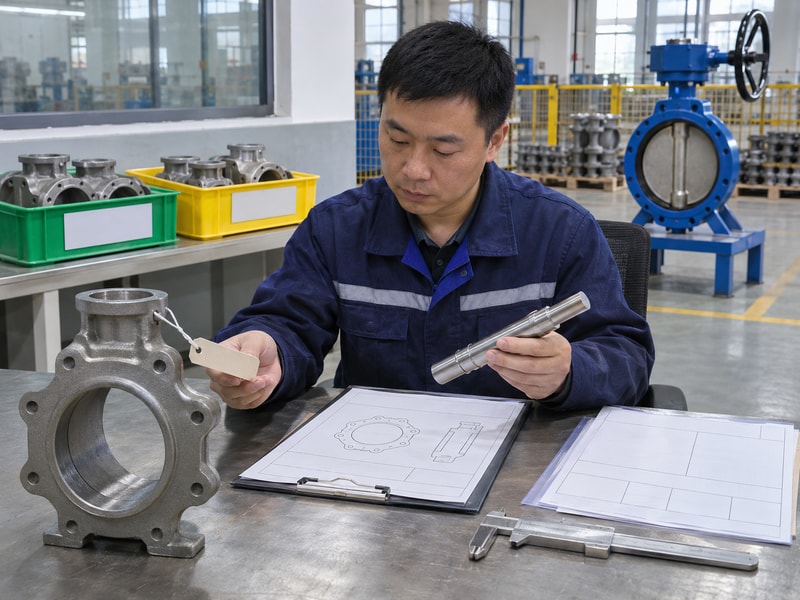
Check materials before they lose their identity
A material report needs a link to the physical item through the factory’s marking and transfer procedure. Examine what happens when machining removes a casting mark or a bar becomes several shafts. For polymer seats and packing, ask for the controlled material specification, batch identity and storage conditions. Chemical analysis of a metal part cannot verify a seat compound, casting integrity or completed valve performance.
- Compare purchased material grades with the approved material list.
- Check transferred identification after cutting and machining.
- Inspect segregation of accepted, awaiting-inspection and rejected material.
| Component | Traceability connection |
|---|---|
| Body or disc | Casting batch to machining traveler |
| Shaft | Material batch to finished part identity |
| Seat and packing | Compound specification and batch to assembly |
If a critical material loses identity, require an approved disposition before assembly continues.
4. Which machining measurements need recorded results?
Record the dimensions that control fit, sealing and installation at the gear operated high performance butterfly valve factory. Agree those characteristics from the approved drawing before sampling begins. Photographs of a machining center show equipment; measured results show what that equipment produced on the selected job.
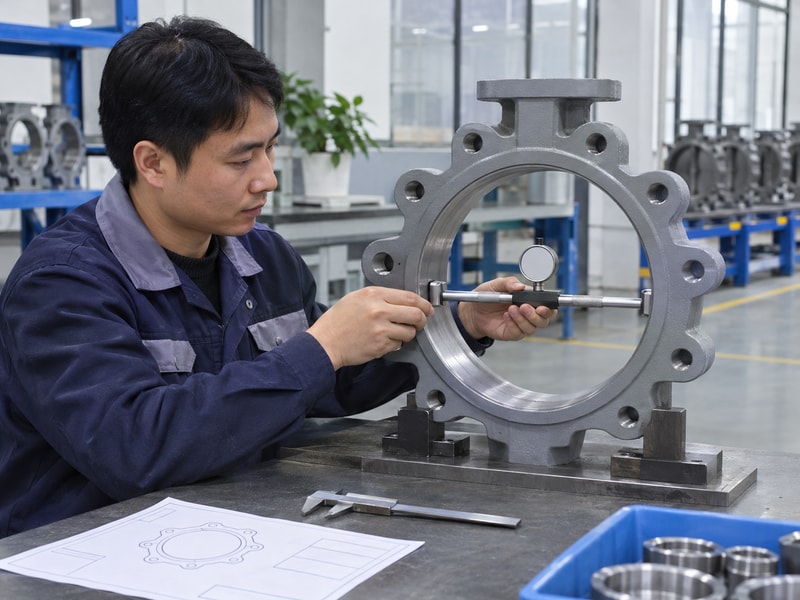
Inspect features that affect sealing and installation
Review shaft bores, seat locations, disc alignment features, flange drilling and face-to-face dimensions where the drawing specifies them. For a flanged butterfly valve, use its own approved interface drawing rather than a wafer valve dimension sheet. Check the measurement method and instrument range as well as calibration status. A large bore may require a different fixture and measurement approach from a small machined component.
- Compare setup approval with measurements taken during the batch.
- Check drawing revision, tolerance and actual result on each report.
- Review tool wear controls and disposition of out-of-tolerance parts.
| Characteristic | Audit connection |
|---|---|
| Shaft and bore fit | Part measurements and assembly limits |
| Seat location | Drawing datum and inspection setup |
| Installation interface | Face-to-face and flange results |
Choose measurements that can reveal an installation or sealing failure rather than collecting unrelated dimensions.
5. How should the factory control seat and shaft assembly?
The gear operated high performance butterfly valve factory should assemble the seat, shaft, bearings and packing against a controlled procedure for the ordered construction. Watch an assembly before covers or retainers hide its critical parts. Ask the operator how the work order prevents a similar-looking seat from entering the wrong valve.
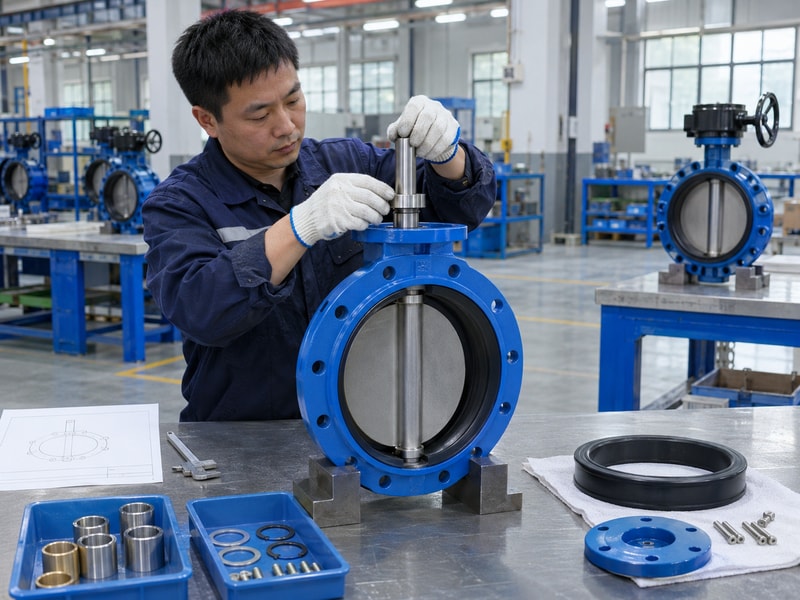
Watch one assembly before closing the housing
Check seat orientation, shaft engagement, bearing installation, packing identification and fastener instructions against the approved assembly documents. Where the procedure specifies tightening values or fitting limits, inspect the recorded result and the tools used. Keep seat compound changes visible in the work order. A PTFE-seated high performance design and a fully lined chemical valve have different wetted boundaries, fitting requirements and inspection needs.
- Confirm that components come from accepted, identified batches.
- Observe cleaning and protection of sealing surfaces during assembly.
- Check required retention features before the next operation conceals them.
| Assembly check | Record to retain |
|---|---|
| Seat and packing | Material batch and configuration |
| Shaft retention | Inspection sign-off at the specified stage |
| Fasteners | Procedure and required tightening record |
Investigate repeated fitting adjustments; they may point to a dimensional problem upstream.
6. Does the gearbox fit the valve’s torque and travel?
The gearbox fits only when the gear operated high performance butterfly valve factory verifies output capacity, shaft limits, input effort and travel for the assembled valve. An ISO 5211 mounting interface confirms a connection arrangement, not torque suitability. Ask the factory to show the selected gearbox against the valve’s approved torque requirements.
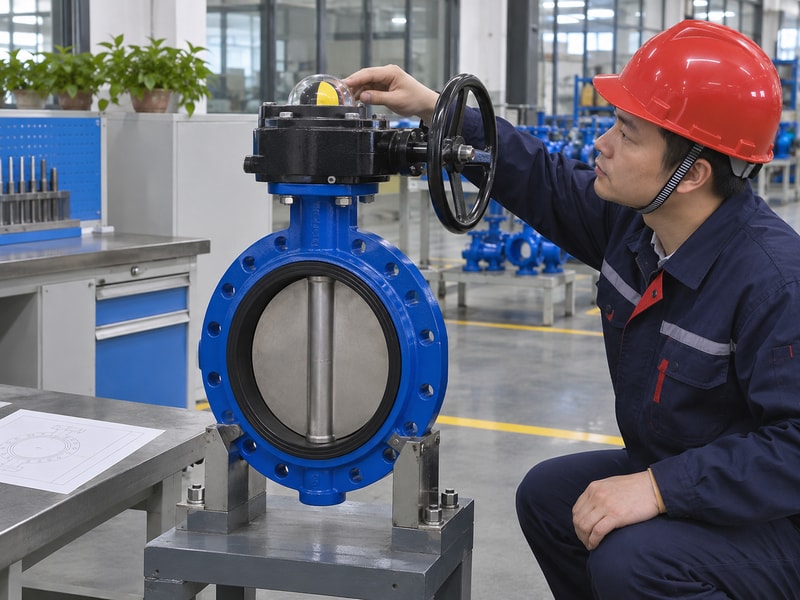
Check output, input effort and position together
Use starting, running and seating torque at the actual maximum closing differential pressure and specified service conditions. Examine the chosen allowance, gearbox efficiency and permissible shaft torque together. Gear ratio and handwheel diameter alone do not establish rated output. During functional inspection, compare disc position, indicator direction and stops with the exact installation, operation and maintenance manual; adjustment values cannot be copied across valve models.
- Verify gearbox identification against the assembly work order.
- Check required output and permissible input force through the travel.
- Confirm rotation, position indication and full opening clearance.
| Gearbox item | Acceptance basis |
|---|---|
| Output capacity | Approved valve torque requirement |
| Shaft loading | Permissible torque for the fitted shaft |
| Travel and stops | Exact model’s operating instructions |
A smooth unloaded handwheel check does not reproduce closing under the specified differential pressure.
7. Which pressure and function tests need unit records?
Require the gear operated high performance butterfly valve factory to retain the shell, closure, external leakage and functional results required by the agreed inspection plan for each valve. Define the test standard and edition, medium, direction, pressure, duration and acceptance criteria before the witness date. A pressure reading without those conditions cannot establish acceptance.
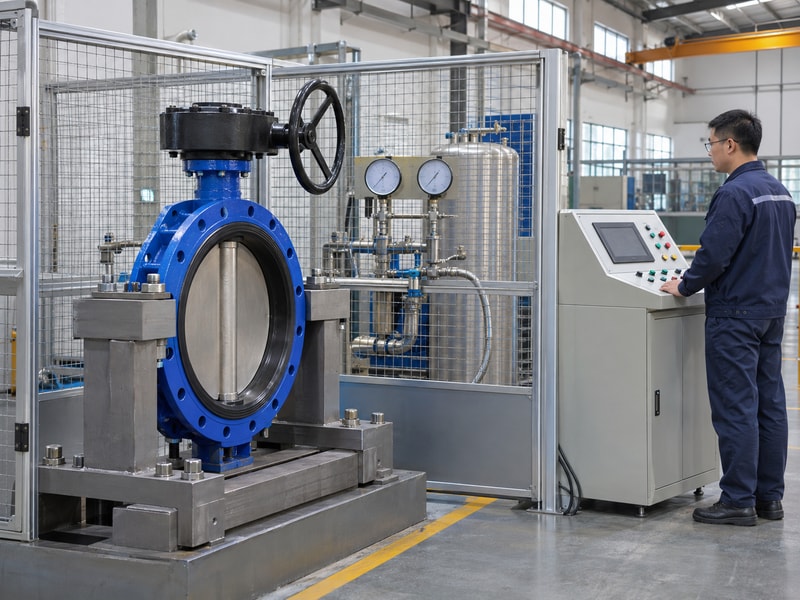
Witness the method as well as the pressure
For an agreed EN 12266-1 or ISO 5208 route, inspect the approved procedure and applicable criteria rather than mixing requirements from different standards. Shell test pressure is a test condition, separate from allowable working pressure. Forward and reverse closure tests must follow the model’s declared directional ratings. Metal seats need an explicit leakage criterion; a metal seat description does not promise zero leakage.
- Match the valve identity and instrument identities to the test record.
- Observe the specified hold period and leakage observation method.
- Check functional travel after assembly and any required additional tests.
| Test record field | What it resolves |
|---|---|
| Direction and differential | Which sealing condition was tested |
| Medium and duration | Whether the approved method was followed |
| Measured result and criterion | Whether that unit met acceptance |
Keep routine production tests separate from configuration-specific qualification or thermal cycling evidence.
8. Can you trace one valve through the quality file?
Yes, the gear operated high performance butterfly valve factory should retrieve a coherent record trail from one valve’s identity. Select the valve yourself and request its drawing revision, material batches, machining results, assembly record and test report. Repeat the exercise from a test report back to the physical valve to expose indexing errors.
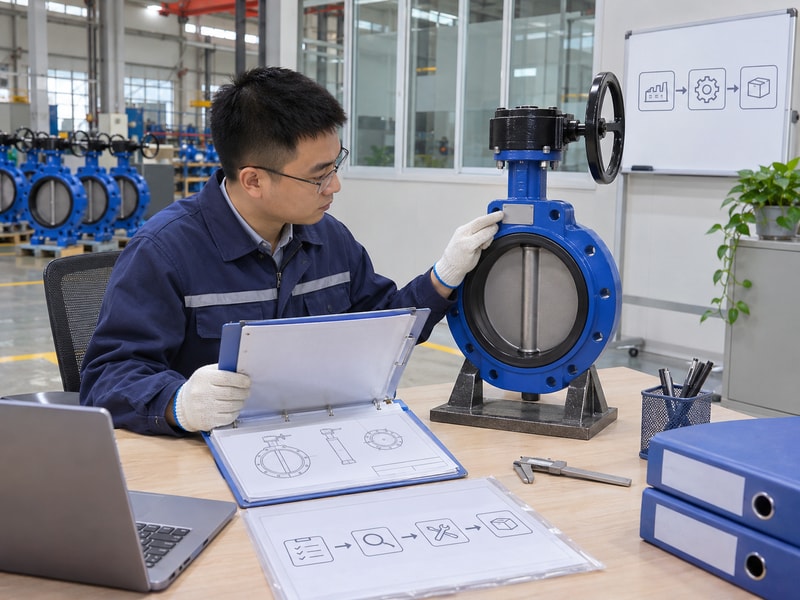
Build a record trail from the nameplate
The manufacturing record dossier should show which inspection and test plan steps apply and where the supporting results sit. Define batch-level evidence and unit-level evidence separately so a casting batch certificate does not appear to certify every assembly operation. Check signatures, dates, revision history and instrument references. For witnessed steps, the attendance record must correspond to the units and tests identified in the report.
- Reconcile ordered quantities with completed unit records.
- Check that superseded drawings cannot enter the release package.
- Retrieve a closed nonconformance and its linked reinspection result.
| Dossier layer | Required connection |
|---|---|
| Approved configuration | Drawing and material list revision |
| Production history | Job and component identities |
| Acceptance evidence | Unit report and signed release status |
Resolve missing links while the product and the operators are still available at the site.
9. Can a gear operated high performance butterfly valve factory pass?
A gear operated high performance butterfly valve factory can pass your audit when it closes findings against agreed acceptance requirements and demonstrates the applicable production controls. Separate an isolated incomplete record from a recurring loss of material identity or an unverified sealing configuration. Assign each finding an owner, required evidence and closure date.
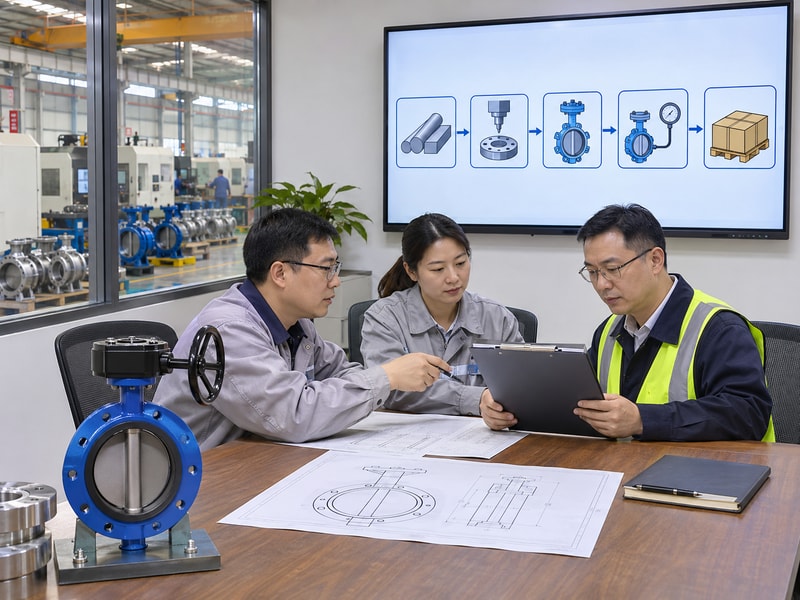
Close findings before authorizing release
Ask for containment of affected work, investigation of the cause and evidence that the correction reached the relevant units. A revised procedure alone cannot show that an already assembled batch meets requirements. Where rework changes a sealing component or gearbox setting, define the reinspection and retest needed by the approved route. Keep release authorization with the people named in the inspection plan.
- Identify affected units and prevent unintended release.
- Verify repaired or replaced parts through the required checks.
- Confirm closure evidence before signing the release status.
| Finding | Closure evidence |
|---|---|
| Missing material connection | Re-established identity or approved disposition |
| Assembly deviation | Correction and applicable reinspection |
| Failed acceptance test | Disposition, correction and accepted retest |
To prepare a factory review, contact us with your service data, approved construction and proposed witness points so the applicable production records can be discussed.
10. What else should buyers ask about factory audits?
Buyers should ask the gear operated high performance butterfly valve factory how it proves production identity, handles deviations and supports independent witnessing. The questions below address evidence you can request without assuming that a broad catalog or a workshop visit establishes qualification for every duty.
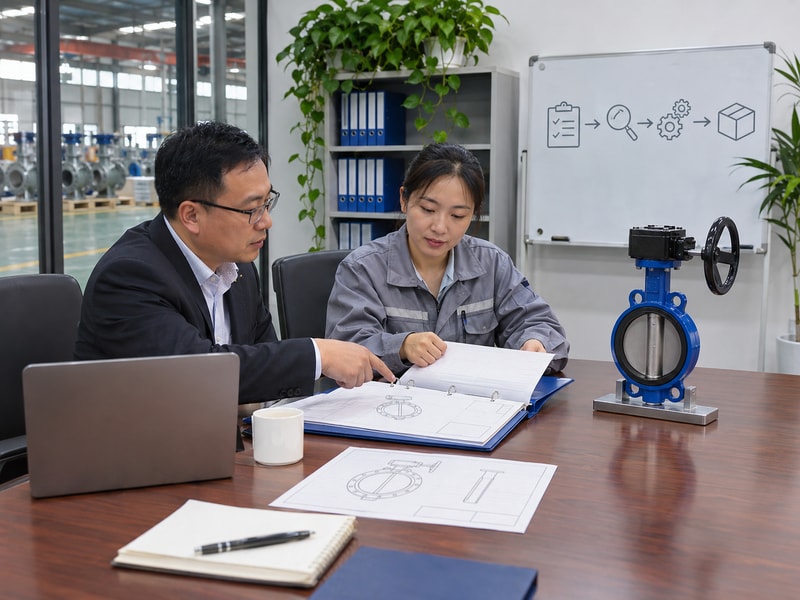
Q1: Can I audit the factory remotely?
Yes, for an agreed scope. Ask for a live walk-through tied to product identities, current work orders and original records, with close views of the requested details. Use an on-site or independent inspection where access, measurement or witness requirements cannot be satisfied remotely.
Q2: How do I know if the factory makes the whole valve?
Trace the manufacturing route. Ask which operations occur at the site, which are subcontracted and how returned work is accepted. Outsourced casting or coating can fit an approved route when the factory controls identification, specifications and inspection.
Q3: Can I accept one sample pressure report for a batch?
Only if your agreed inspection plan permits that evidence for the stated purpose. A sample report cannot establish that every unit passed a required individual test. Reconcile the unit list with the production reports before release.
Q4: What’s the best way to check seat material?
Connect the approved compound specification with purchasing, incoming acceptance and assembly batch records. Visual appearance cannot reliably distinguish similar compounds. Agree any additional material verification with the factory before production, including its method and acceptance criteria.
Q5: Can a water valve audit qualify a high temperature order?
No. A water valve audit may verify shared production controls, but the proposed high temperature configuration still needs its own material, pressure–temperature, sealing, torque and qualification evidence. Keep that technical approval separate from the general site audit.