
Fix high-platform pneumatic butterfly valve selection mistakes by checking the process duty, mounting interface, and actuator output as one assembly. A valve that fits the pipe can still stall when instrument-air pressure falls. Start with the approved valve drawing and torque requirements, then check the drive, controls, installation clearance, and acceptance tests before placing an order.
Images are AI-generated illustrations of configurations and review tasks.
1. What is a high-platform pneumatic butterfly valve?
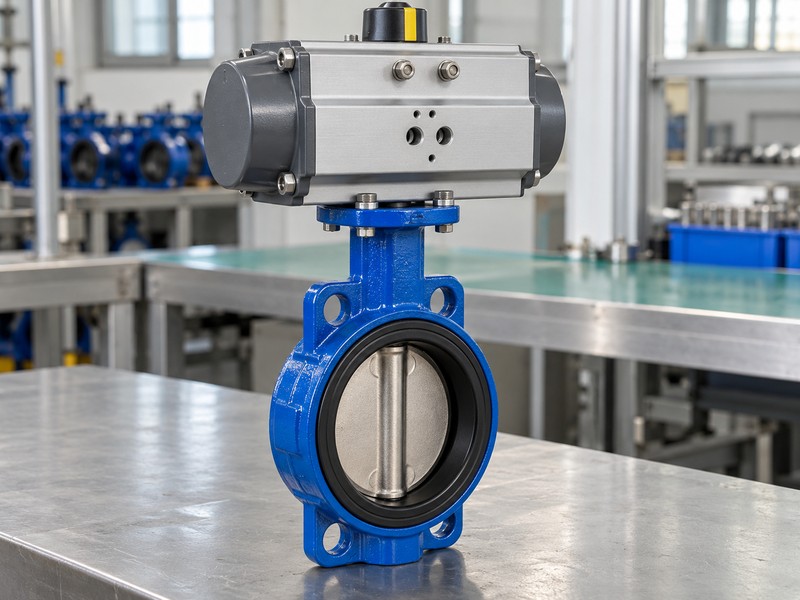
A high-platform pneumatic butterfly valve has an elevated mounting pad above the valve body and a compressed-air drive that turns its disc. The platform describes the mounting arrangement. It does not establish a pressure class, seat material, or temperature limit. Those properties belong to the exact valve configuration and must appear on its data sheet.
How should you read a supplier's description?
Check the drawing behind the name. Some assemblies allow direct mounting while others need a coupling or intermediate support. A tall neck can change the assembly envelope, but it does not by itself provide enough clearance for insulation or maintenance. For example, a compact actuator may clear a bare pipe and clash with its insulation jacket once the line is finished.
- Identify the valve body construction and nominal size.
- Check mounting height and the complete actuator envelope.
- Ask which drawing and revision define the quoted assembly.
| Description | What it tells you | What still needs checking |
|---|---|---|
| High platform | Mounting arrangement | Actual dimensions |
| Pneumatic | Compressed-air drive | Torque and air pressure |
| PN designation | Pressure designation | Pressure-temperature limits |
Put the approved assembly drawing number on the purchase order so a mounting description cannot substitute for an agreed configuration.
2. How does the pneumatic drive move the disc?
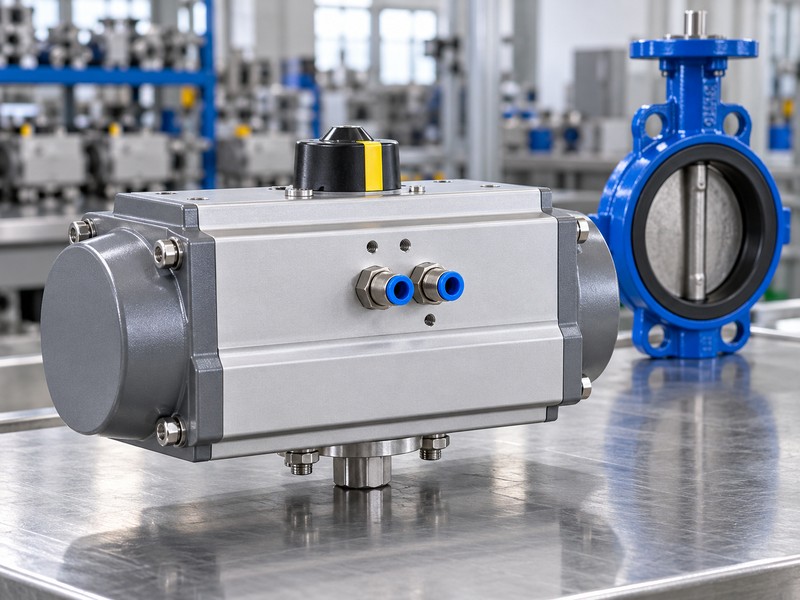
A high-platform pneumatic butterfly valve uses an actuator to turn the valve shaft through its specified quarter-turn travel. In a rack-and-pinion drive, air moves opposed pistons whose racks turn a central pinion. The coupling transfers that rotation to the valve shaft. Disc angle changes the available flow passage, while the seat provides the specified closure seal.
Which return action does your process require?
Define the failure response before choosing the actuator. Double-acting units use air for both directions; their position after air loss depends on loads and the pneumatic circuit. Spring-return units use stored spring force for the return stroke. A cooling-water branch may require fail-open operation, while another isolation duty may require fail-close operation after a process risk review.
- State the required response to air loss.
- State the required response to control-power loss.
- Check the complete circuit rather than the actuator label alone.
| Arrangement | Driving method | Review item |
|---|---|---|
| Double acting | Air in both directions | Position after supply loss |
| Spring return | Air and spring force | Return-stroke torque |
| Modulating | Positioner-controlled air | Signal and travel response |
Write the required valve position for each utility failure into the control description and verify it during assembly testing.
3. How much actuator torque does the valve need?
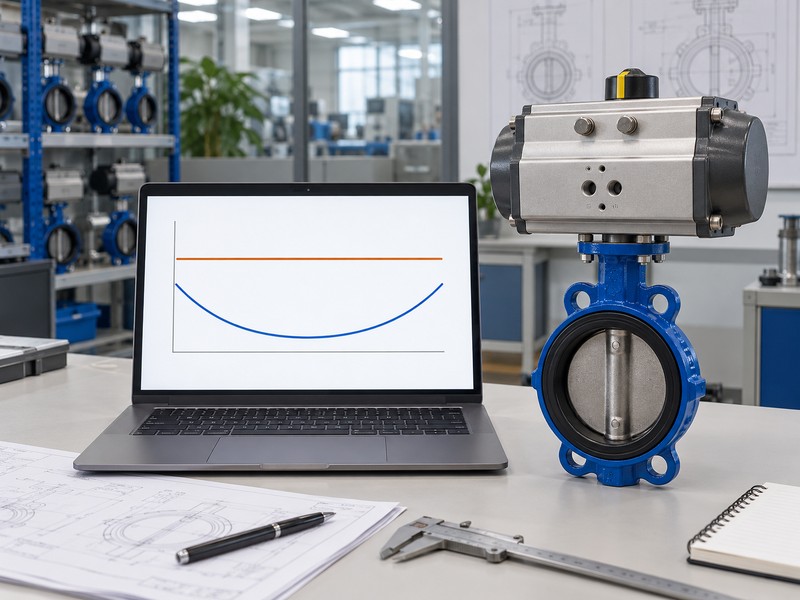
A high-platform pneumatic butterfly valve needs sufficient actuator output throughout opening and closing at the minimum available air pressure. Compare the valve’s breakaway, running, and seating requirements with the actuator’s corresponding output. Closing differential pressure, seat friction, temperature, and cycling history affect the required torque. Nominal diameter alone cannot size the drive.
How should you apply a torque allowance?
Read the torque table notes before adding a margin. A valve supplier may already include an allowance in its published values. Adding another allowance without checking can oversize the drive and overload the shaft or coupling. For a worked review, use the proposed valve’s actual torque data and the actuator’s minimum-air output; do not transfer a torque value from another seat or pressure duty.
- Confirm whether published valve torque includes an allowance.
- Check the full spring-return stroke when springs are fitted.
- Compare maximum output with shaft and interface limits.
| Input | Use in sizing | Typical error |
|---|---|---|
| Minimum air pressure | Available actuator output | Using compressor pressure |
| Valve torque profile | Required output by position | Using running torque only |
| Drive-train limit | Permitted transmitted load | Choosing the largest actuator |
Approve a torque comparison tied to the actual valve, actuator, air-pressure range, and duty before releasing the assembly for manufacture.
4. Which seat and wetted materials match the fluid?
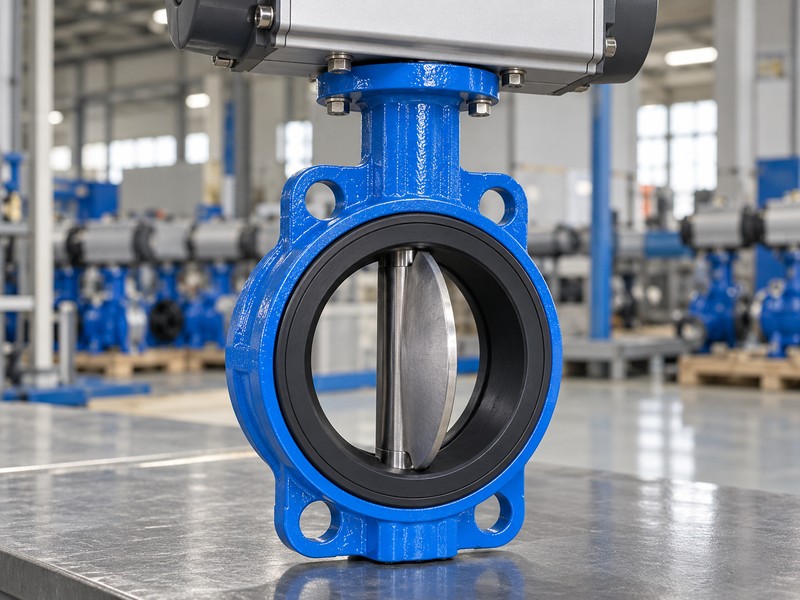
A high-platform pneumatic butterfly valve needs a seat, disc, shaft, and body configuration compatible with the complete fluid and operating range. Include concentration, contaminants, cleaning chemicals, and temperature excursions in that review. An EPDM water configuration does not automatically suit mineral oil. A stainless-steel disc designation does not establish resistance to every chloride level or chemical mixture.
Which RUITO configuration boundaries should you check?
Keep each material package within its stated duty. RUITO’s documented general water configurations use EPDM with application-specific pressure and temperature limits. NBR oil configurations and continuously lined chemical configurations require separate review. For instance, treated cooling water, mineral oil, and a chemical dosing liquid need different compatibility checks even when the three valves share a nominal size and a similar external appearance.
- Identify every wetted material, including auxiliary seals.
- Provide fluid composition and cleaning conditions.
- Confirm pressure and temperature together for the same configuration.
| Duty | Configuration to review | Boundary to confirm |
|---|---|---|
| General clean water | EPDM water package | Model-specific operating limits |
| Compatible mineral oil | NBR oil package | Oil additives and temperature |
| Chemical dosing | Continuous PTFE or PFA lining | Exact chemical and concentration |
Use a separate compatibility decision for each fluid; appearance and nominal size cannot identify an interchangeable material package.
5. Will the high-platform pneumatic butterfly valve mount fit?
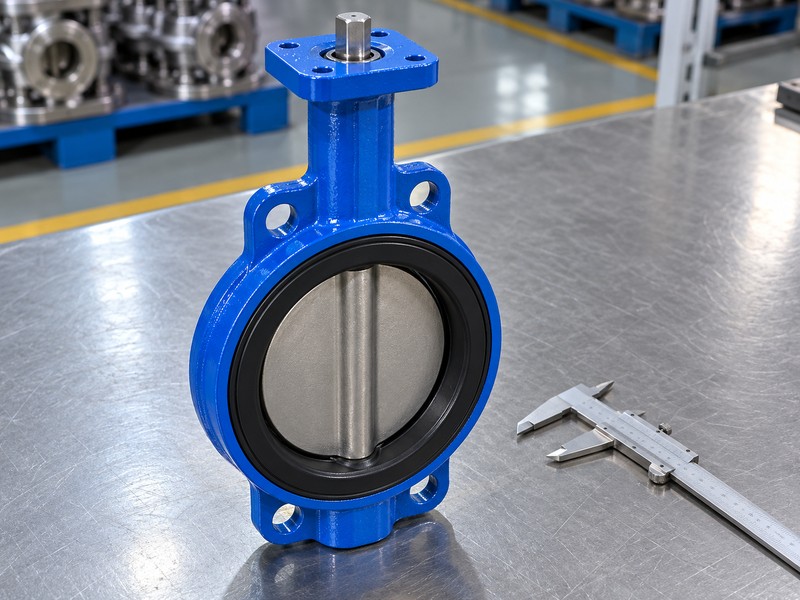
A high-platform pneumatic butterfly valve fits its drive only when the mounting flange, shaft connection, engagement length, and load limits agree. An ISO 5211 mounting designation helps define interface geometry, but it does not complete the assembly review. Check the actual driven shaft and actuator output connection. A matching bolt pattern can still conceal a loose or shallow coupling.
What should the dimensional check include?
Check engagement as carefully as bolt spacing. Compare the valve’s shaft projection with the coupling depth and actuator recess. Verify concentric alignment without using the mounting bolts to pull a misaligned drive into place. For a retrofit, measure the existing assembly and obtain the replacement drawing; a similar catalog photograph cannot reveal the internal engagement or the available maintenance clearance.
- Confirm flange size, hole pattern, and fasteners.
- Verify drive shape, engagement, and permitted backlash.
- Check alignment and the space needed for removal.
| Interface | Check | Reject when |
|---|---|---|
| Mounting flange | Drawing dimensions and bolts | Holes require forced alignment |
| Shaft coupling | Shape and engagement length | Connection is loose or shallow |
| Assembly envelope | Insulation and service access | Drive cannot be removed |
Record the coupling and mounting details in the approved bill of materials so replacement parts preserve the verified fit.
6. Which air controls and feedback devices do you need?
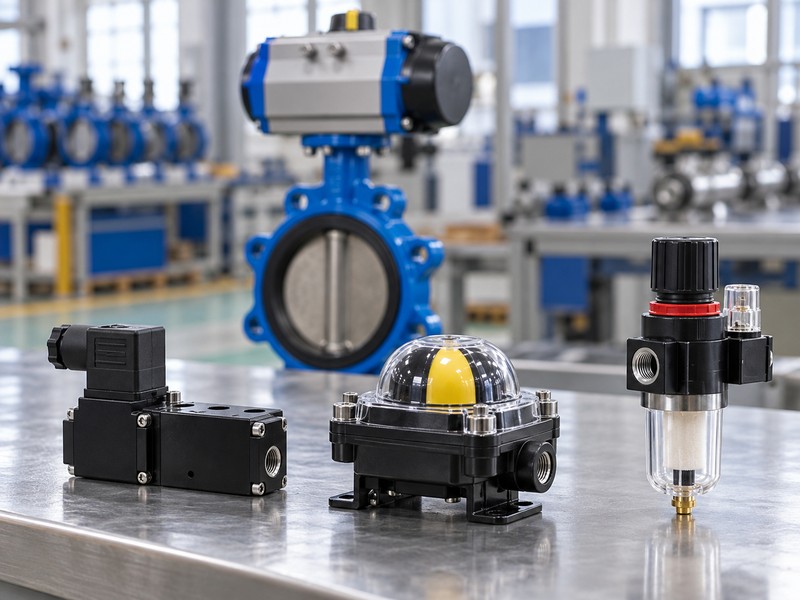
A high-platform pneumatic butterfly valve needs control accessories selected for its operating mode, air supply, environment, and required feedback. A solenoid directs air for on-off movement. A positioner controls intermediate travel when the valve and process suit modulation. A limit switch reports an adjusted travel position; it does not prove that the valve seat meets its leakage requirement.
How do you prevent a controls mismatch?
Check electrical signals and air connections separately. Confirm supply voltage, signal type, enclosure requirements, and the accessory’s pneumatic function. Size tubing and air capacity for the agreed stroke time at the point of use. A valve can move slowly despite normal static pressure if tubing restricts flow, exhaust passages are blocked, or the supply pressure falls during movement.
- Specify on-off or modulating operation and signal type.
- Confirm air quality and minimum dynamic supply pressure.
- Match accessory approvals to the actual installation environment.
| Accessory | Job | Acceptance check |
|---|---|---|
| Solenoid valve | Direct operating air | Correct circuit and voltage |
| Positioner | Control travel position | Response to input signal |
| Limit switch box | Report travel limits | Indication matches actual movement |
Test command, movement, and feedback together; a changing electrical indicator alone does not demonstrate successful valve operation.
7. How is a high-platform pneumatic butterfly valve installed?
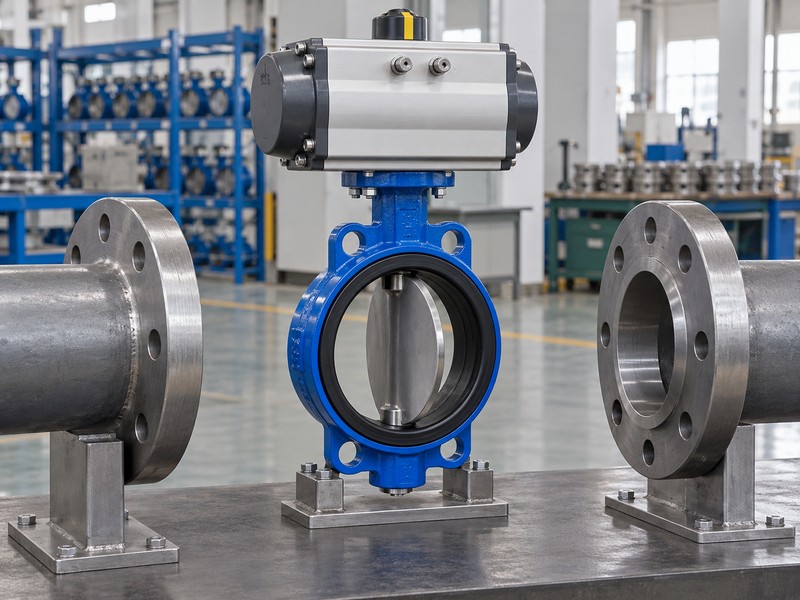
A high-platform pneumatic butterfly valve must fit the mating flange bores and move through its approved travel without disc interference. Check the installation drawing before inserting the valve between flanges. Pipe misalignment, an unsuitable gasket, or the wrong flange bore can distort the seat or obstruct the disc. The actuator cannot correct a mechanical clash inside the pipe.
What should you verify before tightening the joint?
Keep the valve in the position required by its installation manual. Protect the seat during insertion and follow the specified gasket and bolt sequence. Some resilient-seat constructions provide the flange seal and do not accept an added gasket unless the manufacturer specifies one. For lug constructions, confirm bolt length and thread engagement; end-of-line service needs its own approved pressure and configuration limits.
- Check adjacent pipe, flange, and gasket clearances.
- Support the pipe without loading the valve or actuator.
- Verify free travel before commissioning the line.
| Installation item | Required evidence | Problem avoided |
|---|---|---|
| Disc clearance | Approved bore and envelope | Disc strikes the pipe |
| Flange joint | Specified gasket and tightening method | Seat distortion |
| Lug connection | Bolt and service limits | Thread or end-load failure |
Stop installation if the disc binds; identify the interference instead of forcing travel with a larger actuator or altered stops.
8. Which factory and site checks should you specify?
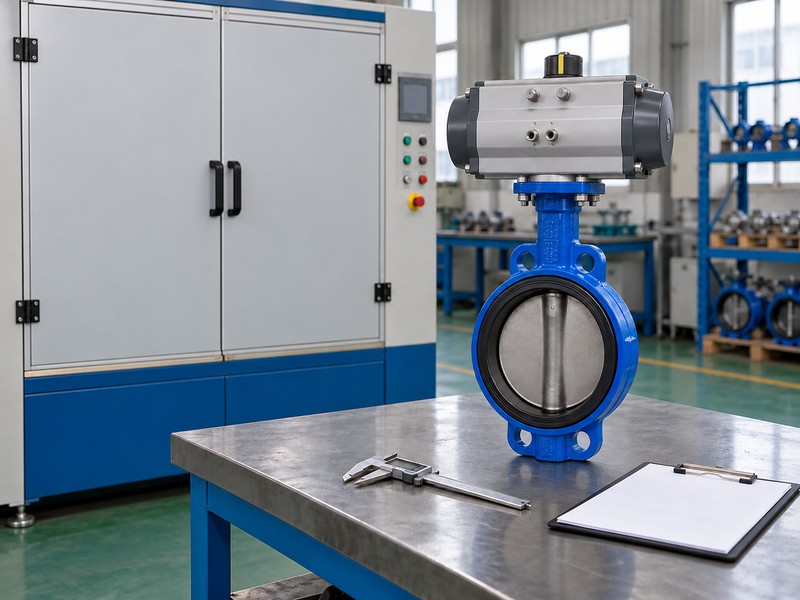
A high-platform pneumatic butterfly valve needs separate checks for pressure integrity, closure performance, actuator function, and control response. Agree on the applicable test method, medium, direction, pressure, duration, and acceptance criteria. A shell test checks the pressure boundary under defined conditions. It does not replace a seat-leakage test or prove that the actuator has enough torque at minimum air pressure.
How should you handle test records?
Connect every result to the delivered configuration. Record the product identity, materials, actuator selection, and document revision with the test report. RUITO uses configuration-specific inspection and acceptance requirements rather than a universal performance figure for every butterfly valve. At site, qualified personnel should verify travel, indication, interlocks, and the agreed failure response under a controlled commissioning procedure before routine operation begins.
- Separate shell, closure, and functional acceptance criteria.
- Check operating air pressure during the functional test.
- Record actual results and resolve deviations before release.
| Check | Demonstrates | Does not establish |
|---|---|---|
| Shell test | Pressure-boundary integrity | Seat leakage performance |
| Closure test | Specified seat performance | Chemical compatibility |
| Assembly function test | Travel and control response | Every possible process condition |
Approve the inspection plan before testing so the supplier and buyer apply the same conditions and acceptance criteria.
9. What information should you send before ordering?
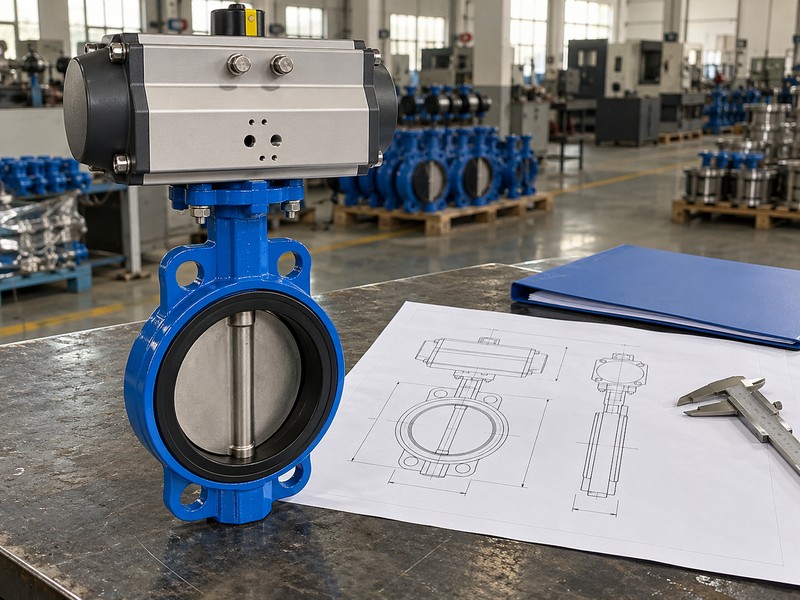
A high-platform pneumatic butterfly valve inquiry should define the fluid, operating envelope, connection, closure duty, and available instrument air. Include the maximum closing differential pressure rather than line pressure alone. Add the required fail position, cycle rate, stroke time, feedback, and site environment. These inputs let the supplier review a complete assembly instead of guessing from a size designation.
How can RUITO review the proposed assembly?
Send the missing operating details with the drawing. RUITO can review the applicable valve construction, material package, mounting arrangement, and inspection requirements against the stated duty. For a replacement, include the existing drawing and installation envelope. For a new skid, include its process and control requirements; the two inquiries need different evidence even when the required pipe connection is identical.
- Attach the process data sheet and installation drawing.
- State document, inspection, and destination requirements.
- Request a written list of assumptions and deviations.
| Inquiry input | Why the supplier needs it | Useful attachment |
|---|---|---|
| Fluid and temperature | Material and rating review | Process data sheet |
| Closing differential pressure | Valve and actuator sizing | Operating scenarios |
| Space and controls | Mounting and integration | Assembly and control drawings |
For a configuration review, contact us with the operating data and drawings so RUITO can identify the checks needed before a quotation.
10. What questions should buyers ask before approval?
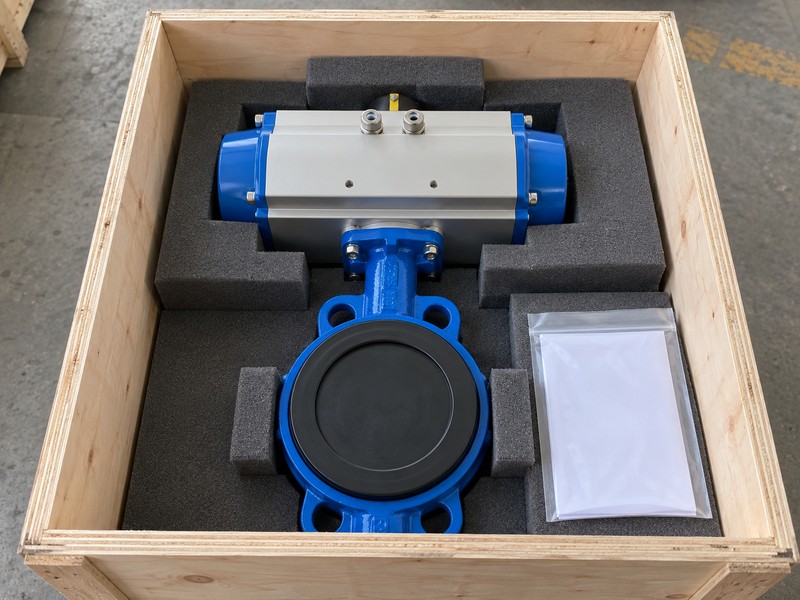
Approve a high-platform pneumatic butterfly valve only after its stated duty, drawings, and test requirements agree. The questions below address common purchasing shortcuts that can leave an assembly unsuitable for the intended service.
Q1. Can I use platform height to judge pressure capability?
No. Platform height describes the mounting arrangement. Check the exact valve's pressure-temperature limits, closure differential pressure, materials, and connection rating before selecting the assembly.
Q2. Can I replace a D800G listing by matching its name?
No. A catalog identifier does not confirm interchangeable dimensions or performance. Obtain the issuing supplier's drawings and compare the actual valve, coupling, actuator, materials, and operating limits.
Q3. How do I know whether the actuator is large enough?
Compare its output over the full stroke at minimum available air pressure with the valve's required torque profile. Check the applicable allowance and the shaft and coupling load limits.
Q4. What's the best fail position for cooling water?
The process review must decide. Fail-open may preserve cooling, but the complete system can impose other requirements. State the required response to both air loss and control-power loss.
Q5. Can a limit switch confirm that the valve is leak-tight?
No. A limit switch indicates an adjusted travel position. Seat performance needs the agreed closure test, including its specified pressure, medium, direction, duration, and leakage acceptance criteria.