
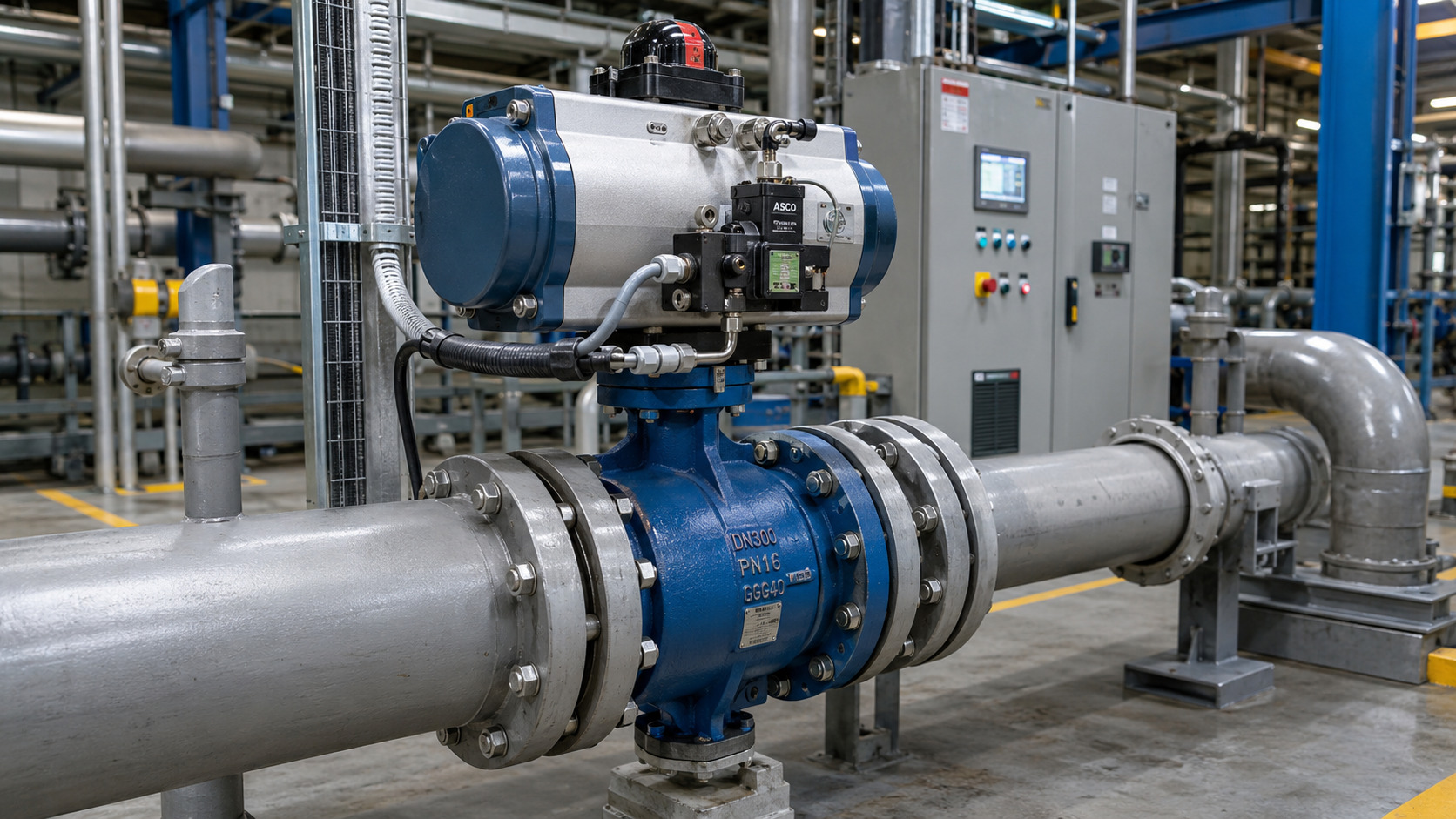
A solenoid valve uses electromagnetic force to switch a flow path, while a butterfly valve rotates a disc inside a pipe. If you manage a crowded process line, choosing between them can feel deceptively simple until poor sizing causes restricted flow, slow isolation, coil failure, or unplanned downtime. A properly specified solenoid butterfly valve assembly can also combine electrical signaling with pneumatic quarter-turn control when your system needs both technologies.
Consider a packaging plant where a small dosing line and a DN300 water header both require automatic shutoff. Installing one valve type across both services may simplify purchasing, yet it can create high pressure loss in one line and weak control in another. The practical answer comes from comparing function, construction, operating method, capacity, response, cost, and failure behavior against your real process conditions.
What Is a Butterfly Valve?
A solenoid butterfly valve uses a butterfly valve as its main flow-control element, and that valve moves a circular disc through a quarter turn. At 90 degrees open, its disc sits nearly parallel with flow; at closed position, the disc crosses the bore and seals against its seat.
Why Does Its Simple Geometry Help You?
Here’s the practical point: fewer major moving parts keep installation weight and operating time relatively low. Your application still governs seat, disc, stem, body, and actuator choices.
- Wafer bodies fit between mating flanges.
- Lug bodies support easier line-side service.
- Resilient seats suit many water and air duties.
| Feature | Typical Butterfly-Valve Trait | Buyer Impact |
|---|---|---|
| Motion | 90-degree rotation | Fast opening and closing |
| Flow path | Disc remains in bore | Low but measurable pressure loss |
| Size range | Small through very large | Strong fit for high-volume lines |
This comparison shows why butterfly valves often reduce space and weight on large piping.
Key Takeaway: You gain compact, rapid control for high-flow service, provided disc, seat, and actuator match process duty.
What Is a Solenoid Valve?
A solenoid butterfly valve differs from a stand-alone solenoid valve, which uses an energized coil and movable plunger or spool to open or close a passage. A direct-acting unit moves its seal through magnetic force alone, while a pilot-operated model uses line pressure to handle more flow.
What Happens When You Energize Its Coil?
Watch what happens next: current creates a magnetic field, which shifts an armature against spring force. Removing power returns a normally closed or normally open design to its specified resting state.
- Normally closed units stop flow without power.
- Normally open units pass flow without power.
- Direct-acting models can work near zero differential pressure.
| Feature | Typical Solenoid-Valve Trait | Buyer Impact |
|---|---|---|
| Motion | Linear plunger or spool | Very fast switching |
| Signal | Electrical voltage | Direct PLC or relay control |
| Port size | Usually small | Best fit for modest flow |
The table separates electrical switching behavior from mechanical pipeline isolation.
Key Takeaway: You get fast electrical control in compact flow circuits when voltage, pressure differential, media, and orifice size align.
How Do Their Functions Differ?
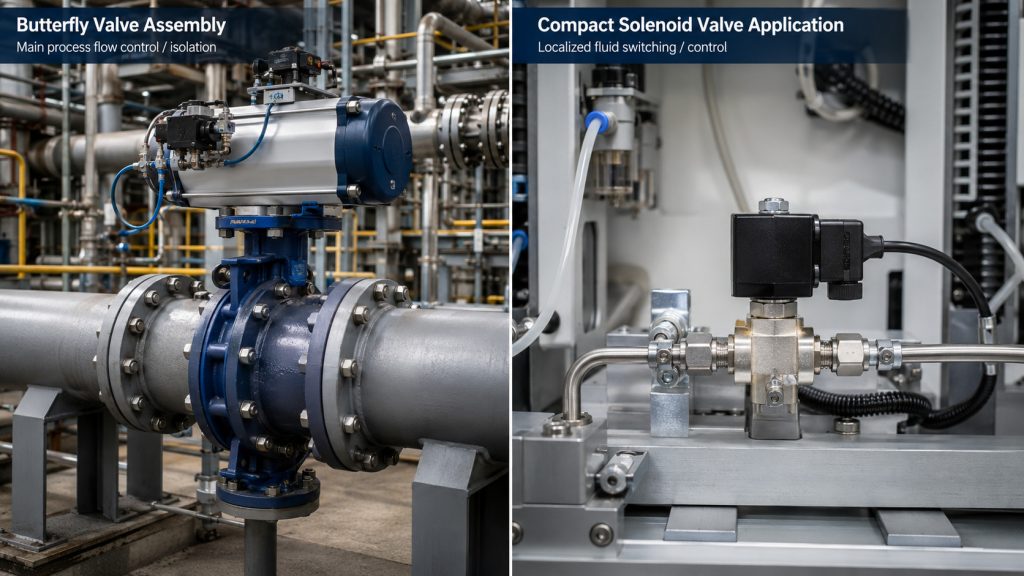
A solenoid butterfly valve combines two distinct functions, but stand-alone versions solve different flow problems. A butterfly valve manages bulk flow through a rotating disc, whereas a solenoid valve switches a smaller passage through electromagnetic movement.
Which Job Should Each Valve Perform?
The distinction matters: one design serves pipeline-scale isolation or throttling, while another provides direct electrical switching. In pneumatic automation, a small solenoid may route instrument air that commands a much larger butterfly valve actuator.
- Choose a butterfly valve for large process lines.
- Choose a solenoid valve for pilot air, dosing, or small utility lines.
- Combine them when an electrical command must move a pneumatic actuator.
| Process Need | Better Starting Point | Reason |
|---|---|---|
| Large-bore isolation | Butterfly valve | High capacity with compact body |
| Small rapid switching | Solenoid valve | Direct electrical actuation |
| Remote pneumatic shutoff | Combined assembly | Signal and power functions are separated |
This mapping helps prevent a control component from being mistaken for a main line valve.
Key Takeaway: You can define each device correctly by separating process-flow duty from actuator-control duty.
How Do Their Constructions Compare?
A solenoid butterfly valve assembly includes a valve body, disc, stem, seat, actuator, and solenoid pilot, while a stand-alone solenoid valve usually contains a body, coil, armature, spring, and seal. Solenoid construction concentrates movement inside a much smaller passage, making contamination sensitivity a larger concern.
Which Materials Deserve Your Closest Review?
Here’s where selection gets specific: every wetted component must resist fluid chemistry and temperature. External housings and coil enclosures must also suit washdown, dust, corrosion, or hazardous locations.
- Match EPDM, NBR, PTFE, or metal seats with media.
- Check disc and body corrosion resistance separately.
- Confirm coil insulation class and enclosure rating.
| Component Area | Butterfly Valve | Solenoid Valve |
|---|---|---|
| Main closure | Rotating disc | Plunger, poppet, or diaphragm |
| Main seal | Circumferential seat | Small orifice seal |
| Drive | Handle or external actuator | Integrated electromagnetic coil |
The narrower solenoid flow path generally demands cleaner media than a comparable butterfly line.
Key Takeaway: You reduce wear and leakage by checking every wetted material, seal, enclosure, and debris exposure point.
How Does Each Valve Operate?
A solenoid butterfly valve operates through a signal chain: electricity shifts a solenoid spool, compressed air enters an actuator, and actuator torque rotates a butterfly disc. A stand-alone solenoid valve stops at the electromagnetic step because its plunger directly controls process media or pilots a diaphragm.
What Operating Sequence Should You Verify?
Follow the signal: control logic, electrical power, air quality, actuator torque, and valve movement must agree. A missed interface can leave a correct valve unable to reach its commanded state.
- Confirm supply voltage and electrical load.
- Verify clean, regulated actuator air.
- Check opening and closing torque margins.
| Command Stage | Stand-Alone Solenoid | Pneumatic Butterfly Assembly |
|---|---|---|
| Electrical input | Energizes coil | Energizes pilot coil |
| Intermediate action | Moves plunger or diaphragm | Routes compressed air |
| Flow action | Opens or closes small port | Rotates main disc |
The extra pneumatic stage adds torque capacity but also adds interfaces for commissioning.
Key Takeaway: You can avoid startup faults by verifying every energy conversion from control signal through physical shutoff.
Where Does Each Valve Work Best?
A solenoid butterfly valve works best where a large process stream needs rapid remote isolation through plant air and electrical control. Stand-alone solenoid valves fit instrument air, water dispensers, dosing skids, burner trains, irrigation branches, and compact machinery.
How Can You Match Service Conditions With Design?
Use duty as your filter: pipe size alone cannot settle valve selection. Media cleanliness, differential pressure, cycling rate, temperature, leakage class, and available utilities shape a dependable choice.
- Use resilient seats for compatible low-temperature fluids.
- Consider offset butterfly designs for demanding service.
- Select direct-acting solenoids for low differential pressure.
| Application | Likely Choice | Main Check |
|---|---|---|
| Cooling-water header | Butterfly valve | Disc torque and seat compatibility |
| Instrument-air branch | Solenoid valve | Pressure range and filtration |
| Automated large line | Combined assembly | Fail position and air supply |
This duty-based view narrows candidates before detailed sizing begins.
Key Takeaway: You save engineering time by matching valve architecture with media, line scale, cycle pattern, and available power.
How Do Size and Flow Capacity Differ?
A solenoid butterfly valve lets a small pilot control a large valve, which avoids forcing full process flow through a small solenoid orifice. Butterfly valves support much larger diameters and usually present lower pressure loss at full opening.
Which Sizing Data Should You Request?
Numbers settle this choice: nominal diameter alone does not describe capacity. Ask for Cv or Kv, pressure-drop limits, minimum pilot differential, velocity limits, actuator torque, and permitted operating range.
- Calculate minimum, normal, and maximum flow cases.
- Check pressure drop across each operating state.
- Keep throttling duty within a stable disc-angle range.
| Sizing Factor | Butterfly Valve Focus | Solenoid Valve Focus |
|---|---|---|
| Capacity | Disc-angle Cv or Kv | Orifice Cv or Kv |
| Line size | Broad diameter range | Commonly smaller ports |
| Pressure basis | Body, seat, and shutoff rating | Working and pilot differential |
These data reveal whether apparent compactness will create excessive hydraulic loss.
Key Takeaway: You protect pump capacity and response by sizing with flow data, pressure conditions, and actuation demand together.
Which Valve Offers Better Precision and Response?
A solenoid butterfly valve offers fast on/off response for a large line, but a stand-alone solenoid valve usually switches its small passage faster. Precision depends on your meaning: solenoids provide repeatable binary action, while an actuated butterfly valve can regulate broader flow through controlled disc positions.
Do You Need Switching or Continuous Control?
Ask one decisive question: must your process reach only open and closed states, or hold intermediate flow values? That answer determines whether a coil, actuator, positioner, feedback device, or different control-valve style belongs in your specification.
- Use a solenoid for rapid binary commands.
- Use an on/off actuator for repeatable isolation.
- Add a positioner for modulating butterfly service.
| Control Goal | Suitable Arrangement | Design Caution |
|---|---|---|
| Fast small-port switch | Solenoid valve | Coil heating and contamination |
| Fast large-line isolation | Pneumatic butterfly assembly | Air capacity and torque |
| Intermediate flow control | Positioned butterfly valve | Disc-angle sensitivity |
This split prevents “precision” from becoming an unclear purchase requirement.
Key Takeaway: You get better control by defining speed, repeatability, modulation accuracy, and fail action as separate needs.
How Should Cost and Maintenance Shape Your Choice?
A solenoid butterfly valve costs more than a manual butterfly valve because it adds an actuator, pilot, mounting hardware, wiring, and air preparation. A small solenoid valve may carry a lower purchase price, though replacement coils, clogged pilots, and pressure losses can change lifecycle cost.
What Should Your Lifecycle Review Cover?
Look past the quotation: maintenance access and spare-part strategy affect years of ownership. A low-cost unit becomes expensive if technicians must remove piping or wait weeks for a unique coil.
- Price wiring, tubing, brackets, and air treatment.
- Track energy use and pressure-loss penalties.
- Stock common coils, seals, and pilot parts.
| Cost Area | Butterfly System | Solenoid Valve |
|---|---|---|
| Purchase | Rises with size and actuator | Rises with material and certification |
| Installation | Flanges, actuator, and controls | Wiring plus threaded or flanged joint |
| Maintenance | Seat, shaft seal, and actuator | Coil, plunger, diaphragm, and orifice |
Lifecycle review often changes which option appears least expensive.
Key Takeaway: You make a stronger purchase decision by comparing acquisition, installation, energy, spares, service access, and downtime.
When Does a Solenoid Butterfly Valve Make Sense?
A solenoid butterfly valve makes sense when an electrical command must open or close a medium-to-large pipeline quickly through pneumatic power. This arrangement fits plants with reliable compressed air, PLC control, remote operation, and a defined loss-of-power position.
Which Specification Points Confirm a Good Fit?
Before you approve it: treat valve, actuator, and pilot as one engineered package. Each interface must support required speed, torque, environment, and safety response.
- Define fail-open, fail-close, or fail-in-place action.
- Select spring-return or double-acting actuation.
- Match solenoid porting with actuator type.
| Package Decision | Typical Option | Selection Driver |
|---|---|---|
| Actuator action | Spring return or double acting | Required failure state |
| Pilot format | 3/2, 5/2, or 5/3 | Actuator and control sequence |
| Coil supply | DC or AC | Site control power |
This package view exposes interface gaps before equipment reaches site.
Key Takeaway: You gain dependable remote isolation when every package component shares one documented operating and failure philosophy.
What Should You Remember Before Selecting a Valve?
A solenoid butterfly valve suits large automated pipelines, a standard butterfly valve provides compact high-capacity isolation, and a stand-alone solenoid valve delivers rapid electrical switching in smaller passages. You now know how these choices differ in function, construction, operation, applications, size, flow capacity, control precision, purchase cost, maintenance needs, and failure behavior. Use those factors as one connected specification rather than choosing from a product name or pipe diameter alone.
Before requesting a quotation, document media, minimum and maximum flow, pressure, temperature, leakage target, cycle rate, available utilities, control signal, and required fail position. Ruitoflow can review that duty data, match compatible materials, check actuator torque, and prepare a practical valve package for your project. If you are planning a new line or correcting an unreliable installation, contact us today for technical support and a tailored quotation. Our position remains clear: dependable flow control starts with transparent engineering, predictable valve behavior, and equipment selected for real operating conditions.
What FAQs Matter Most to Valve Buyers?
Can I Use a Solenoid Valve on a Large Water Main?
Usually no. A direct process solenoid can become restrictive or impractical as line diameter and flow rise, while an actuated butterfly valve handles bulk flow more efficiently. You can still use a small solenoid as the pneumatic pilot for that actuator.
Can I Throttle Flow With a Butterfly Valve?
Yes, within a properly sized and controlled operating range. Ask for valve flow curves and check disc angle at minimum, normal, and maximum demand because operation near either travel limit may reduce control stability.
What’s the Best Valve for a Power-Loss Safety Action?
A spring-return actuated valve often provides the clearest mechanical fail position. Your hazard review must define whether flow should stop or continue, then confirm behavior during loss of electricity, compressed air, or both.
How Do I Know If a Pilot-Operated Solenoid Will Work?
Check its required pressure differential. Pilot-operated models depend on process pressure across an internal diaphragm or piston, so low-pressure or zero-differential service may require a direct-acting or assisted-lift design.
Can I Control a Butterfly Valve Directly From a PLC?
Yes, with suitable actuation and interface hardware. A PLC output can command an electric actuator or energize a pneumatic pilot, while limit switches return open and closed status for safer sequencing.