
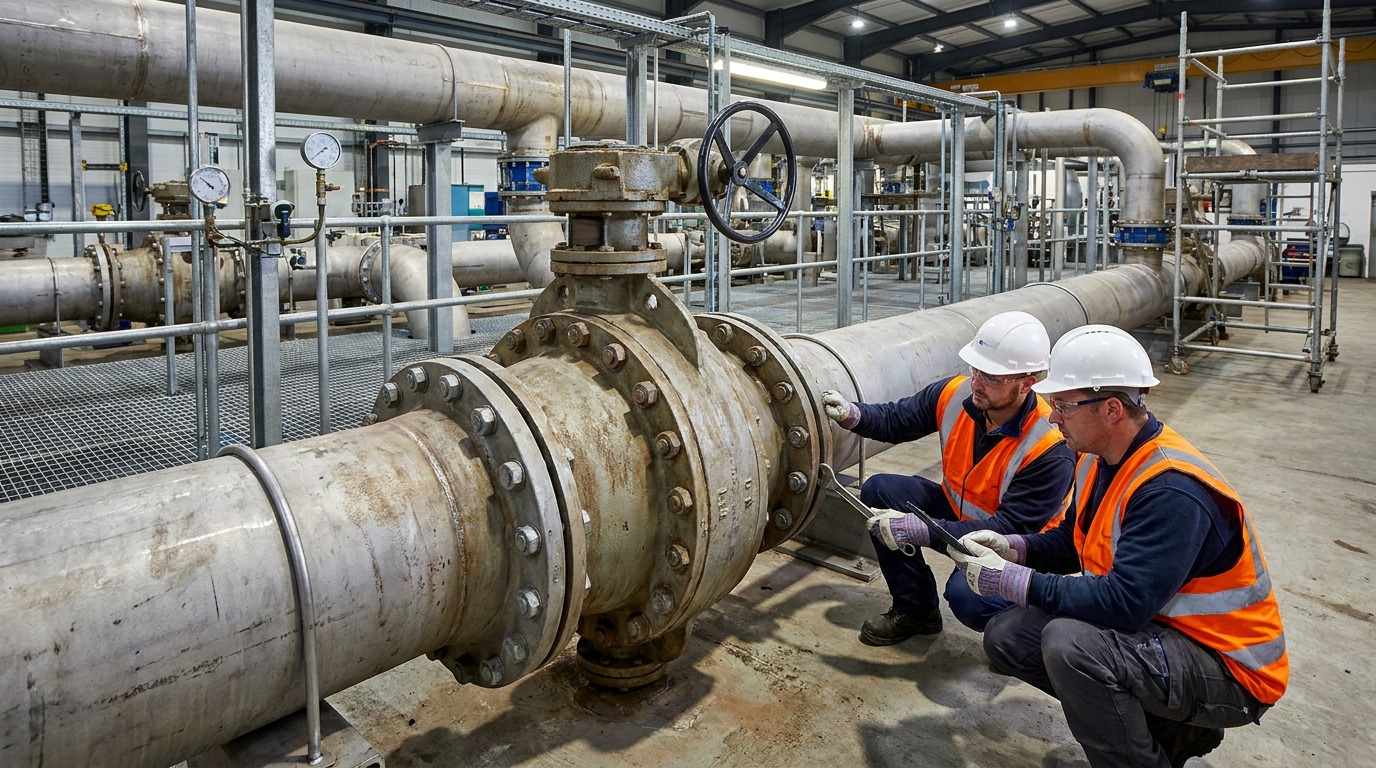
System failures frequently stem from improper techniques applied during a routine setup. Engineers often encounter catastrophic pipeline leaks after commissioning a new fluid system. Those leaks cause expensive downtime and pose severe safety hazards for operators nearby. A proper lug type butterfly valve installation provides a reliable method for securing tight shutoffs.
What Are The Risks Of Over-Tightening Bolts During Lug Type Butterfly Valve Installation?
Excessive torque warps metal flanges and destroys resilient elastomer seating materials. Applying too much force during lug type butterfly valve installation creates permanent structural damage. Operators might mistakenly believe tighter bolts guarantee a better seal. This misconception leads directly toward cracked castings and warped pipe connections.
Torque limits exist for a specific mechanical reason. Manufacturers specify exact values based on material tensile strength ratings. Ignoring these limits causes internal components binding together tightly. Actuators will struggle against increased friction.
Why Do Flanges Crack Under Extreme Pressure?
Cast iron components possess limited flexibility under heavy physical stress. Extreme compression forces concentrate around mounting holes rapidly. But here’s the kicker… once a hairline fracture appears, structural integrity vanishes entirely.
Engineers must monitor applied forces using calibrated measurement tools.
- Always use a certified torque wrench
- Follow factory specified tightening values
- Tighten fasteners symmetrically across flanges
How Can Operators Avoid Torquing Mistakes?
Applying force gradually prevents uneven compression across seating surfaces. Technicians should tighten hardware using a star pattern sequence. This method distributes clamping pressure evenly around circular mating surfaces.
Key Takeaway: Precise torque application prevents flange deformation and protects internal sealing components from catastrophic crushing forces.
| Torque Issue | Physical Consequence | Operational Impact |
|---|---|---|
| Over-tightening | Flange cracking | Total catastrophic failure |
| Uneven torquing | Seat distortion | Internal fluid leakage |
| Under-tightening | Poor mating contact | External pressure loss |
Applying correct torque specifications protects expensive hardware from unnecessary mechanical degradation.
How Does Debris Cause Leaks After Lug Type Butterfly Valve Installation?
Foreign particulate matter prevents flat mating surfaces from forming tight seals. Contamination remaining on pipe faces ruins any lug type butterfly valve installation attempt. Leftover welding slag or rust creates microscopic gaps between connecting flanges. These tiny spaces allow pressurized fluids escaping into surrounding environments.
Workers often rush through preparation phases before assembling piping segments. This hasty approach leaves abrasive materials near sensitive rubber parts. A single metal shaving can gouge an elastomer seat permanently.
What Contaminants Threaten Piping Connections?
Common industrial sites generate massive amounts of abrasive dirt daily. Wind blows grit directly onto exposed pipe ends waiting for assembly. Ready for the good part? Proper wiping procedures eliminate nearly all contamination threats instantly.
Cleaning requires only basic tools and minimal physical effort.
- Wire brushes remove heavy surface rust
- Solvent wipes dissolve residual cutting oils
- Compressed air blasts away loose dust
How Should Technicians Prepare Mating Surfaces?
Inspect every inch along both flange faces before bringing parts together. Run a gloved finger lightly across metal finishes checking for burrs. A smooth finish ensures optimal compression against rubber gaskets.
Key Takeaway: Meticulous surface cleaning prevents abrasive damage and guarantees a perfect seal between adjoining mechanical components.
| Contaminant Type | Source | Prevention Method |
|---|---|---|
| Welding Slag | Pipe fabrication | Wire brushing |
| Residual Oil | Machining process | Chemical solvent wipe |
| Environmental Dust | Jobsite exposure | Compressed air blast |
Clean mating surfaces provide a flawless foundation for reliable long-term pressure retention.
Why Is Misalignment A Hazard For Lug Type Butterfly Valve Installation?
Forcing misaligned pipes together creates severe bending stresses across metal housings. A skewed lug type butterfly valve installation inevitably causes external leakage over time. Workers sometimes use mounting bolts trying pull crooked pipes straight. This dangerous practice transfers massive unnatural loads directly onto fragile castings.
Piping networks must align perfectly before hardware insertion begins. Heavy mechanical strain distorts internal operating clearances rapidly. The central disc might scrape against its housing during rotation.
How Does Pipe Strain Affect Functionality?
Unnatural bending forces compress rubber seats unevenly along their circumference. What’s the real story? Uneven compression creates high friction zones where moving parts intersect constantly. Actuator motors draw excessive electrical current fighting this resistance.
Proper alignment verifies that everything fits without external forcing.
- Check parallel gap distances thoroughly
- Verify centerlines match perfectly
- Ensure bolts slide through manually
Can Flexible Joints Correct Alignment Issues?
Installing rubber expansion bellows helps absorb minor dimensional variations naturally. These flexible components isolate rigid valves from thermal expansion forces. They also reduce vibration transmission from nearby heavy machinery.
Key Takeaway: Perfect pipe alignment eliminates destructive bending stresses and preserves smooth mechanical actuation capabilities permanently.
| Alignment Error | Physical Stress | Long-Term Result |
|---|---|---|
| Angular offset | Bending moment | Cracked cast housing |
| Parallel offset | Shear force | Broken mounting bolts |
| Improper spacing | Tension load | Stretched thread pitch |
Accurate dimensional alignment guarantees structural safety across pressurized fluid handling systems.
What Happens If Flow Direction Is Ignored During Lug Type Butterfly Valve Installation?
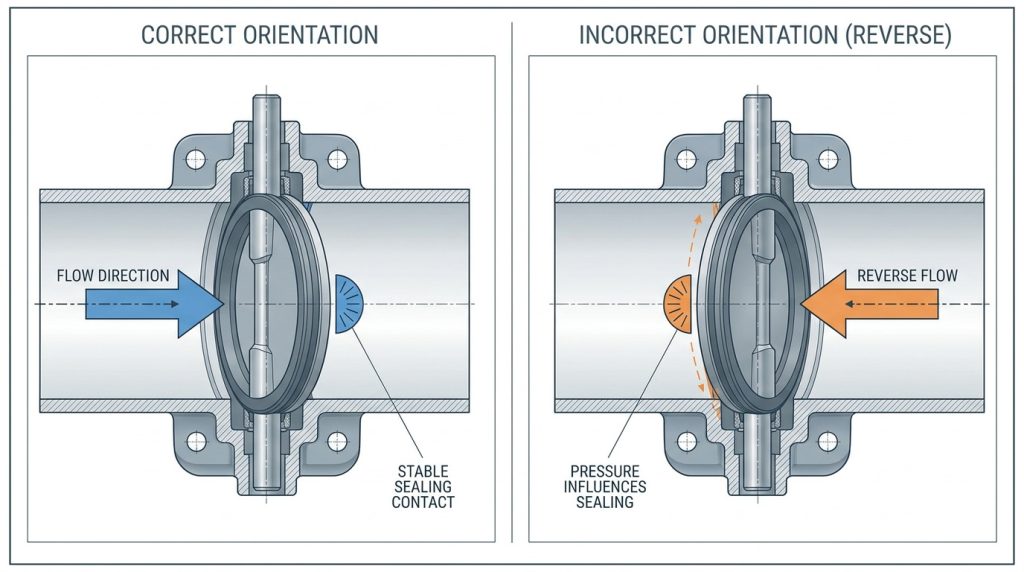
Installing hardware backwards compromises directional sealing effectiveness against high pressures. Ignoring flow arrows during lug type butterfly valve installation leads directly toward internal leaking. Many high-performance designs feature asymmetrical seating arrangements for specific applications. These engineered seats resist fluid pressure effectively only from one side.
Reversing the intended orientation forces liquid against weaker retaining structures. The resulting backward pressure pushes flexible components away from metal surfaces. Operators lose complete isolation capability during critical maintenance periods.
Why Do Certain Designs Have Flow Arrows?
Double eccentric configurations utilize fluid energy helping seal gaps tighter. This is where it gets interesting… directional orientation utilizes system pressure acting against closed discs. This hydraulic force wedges moving parts into rubber linings securely.
Ignoring casted markings guarantees sub-optimal performance under heavy loads.
- Locate directional indicators before lifting
- Verify system schematics match physical orientation
- Ask supervisors if markings seem unclear
How Does Reverse Pressure Damage Components?
Continuous reverse flow washes against exposed seat edges aggressively. This turbulent action accelerates wear rates across soft synthetic materials. Eventual material degradation requires full system shutdowns for part replacement.
Key Takeaway: Observing flow direction indicators ensures maximum sealing pressure utilization and extends operational lifespans significantly.
| Flow Condition | Sealing Action | Wear Rate |
|---|---|---|
| Correct direction | Pressure assists seal | Minimal degradation |
| Reverse flow | Pressure pushes seat | Accelerated erosion |
| Bi-directional | Equalized forces | Normal mechanical wear |
Following casted directional arrows maximizes hydraulic efficiency across complex industrial piping networks.
How Do Expansion Joints Affect Lug Type Butterfly Valve Installation?
Expansion joints absorb thermal growth preventing stress transfer into rigid bodies. Integrating these accessories alongside lug type butterfly valve installation protects fragile equipment continuously. Temperature fluctuations cause metallic pipes lengthening and contracting predictably. Without flexible compensators, this dimensional shifting crushes stationary mechanical devices completely.
Directly connecting rigid pipes creates a highly stressed structural anchor point. Lugs transfer these extreme loads straight into central operating mechanisms. Components bind tightly causing complete actuator stalling during critical commands.
Why Are Thermal Shifts Dangerous?
Metal piping networks grow millimeters per meter under high temperatures. But here’s the kicker… that tiny growth multiplies across long straight runs massively. The accumulated distance pushes against any fixed barrier with incredible force.
Proper engineering design incorporates flexibility wherever rigidity causes problems.
- Install rubber bellows upstream
- Use sliding pipe supports
- Calculate thermal expansion rates accurately
How Should Technicians Position Flexible Elements?
Mount flexible compensators close enough for effective stress absorption. Leave adequate spacing allowing normal maintenance access around bolt circles. Ensure piping supports carry weight loads rather than relying on flanges.
Key Takeaway: Strategic placement of thermal expansion compensators isolates sensitive mechanisms from destructive pipe elongation forces.
| Thermal Event | Pipe Reaction | Compensator Action |
|---|---|---|
| Heat increase | Linear expansion | Compresses safely |
| Cooling cycle | Linear contraction | Stretches naturally |
| Pump start | Hydraulic shock | Absorbs vibration |
Isolating rigid equipment from thermal forces maintains structural integrity during extreme temperature fluctuations.
Can Incorrect Gasket Usage Ruin Lug Type Butterfly Valve Installation?
Adding unnecessary gaskets prevents resilient seats from protruding properly into flanges. Incorrect sealing methods ruin an otherwise perfect lug type butterfly valve installation. Most designs incorporate molded rubber linings acting as integrated face seals. Adding extra material creates uneven compression zones across mating surfaces.
Double gasket situations cause rapid failure under high fluid pressures. The extra layer slips outward when technicians apply final torque values. This slippage creates an immediate pathway for liquid escaping outwards.
When Are Separate Gaskets Actually Required?
Certain metal-seated high-temperature applications require specialized graphite sealing rings. Ready for the good part? Standard elastomer-lined models never need additional face sealing components. The molded rubber extends slightly past metal edges naturally.
Always consult manufacturer manuals regarding specific sealing requirements.
- Check liner protrusion levels manually
- Verify metal-to-metal contact limits
- Discard unnecessary flat gaskets immediately
How Does Double Stacking Cause Failures?
Two soft materials compressed together behave unpredictably under heavy mechanical loads. They squish outward unevenly creating localized high-stress points along edges. These stress points rupture eventually sending pressurized fluid spraying everywhere.
Key Takeaway: Trusting integrated rubber linings eliminates redundant components and prevents dangerous double-stacking sealing failures.
| Seal Design | Additional Gasket? | Failure Risk |
|---|---|---|
| Molded rubber liner | Never required | High if used |
| Metal-to-metal seat | Always required | Low if specified |
| PTFE encapsulated | Rarely required | Medium based on type |
Correct gasket application logic prevents redundant material stacking and ensures tight fluid isolation.
How Does Valve Position Impact Lug Type Butterfly Valve Installation?
Leaving discs fully closed during assembly causes permanent edge distortion. The physical state during lug type butterfly valve installation determines future operational success. A closed disc protrudes slightly past its surrounding metal housing framework. Mating pipes scraping against these protruding edges shear off rubber materials.
Technicians must open rotating elements slightly before maneuvering heavy parts. Leaving discs partially open protects delicate sealing margins from blunt impacts. Once pipes align perfectly, operators can safely close everything for final torquing.
Why Does Disc Position Matter During Transport?
Vibration during shipping damages fully open discs striking against crate walls. What’s the real story? Manufacturers ship products slightly cracked open avoiding edge compression. This neutral position prevents rubber stickiness forming over long storage durations.
Handling large equipment requires careful attention regarding moving parts.
- Keep discs at ten degrees open
- Avoid resting weight on exposed edges
- Check clearance before closing manually
Can Pipe Interference Occur Inside?
Thick pipe walls sometimes interfere with disc rotation arcs internally. Heavy schedule pipes possess smaller internal diameters than standard sizes. Rotating elements might strike these thicker walls causing severe internal damage.
Key Takeaway: Maintaining a partially open position during assembly protects vulnerable sealing edges from mechanical shearing forces.
| Disc Position | Risk Factor | Assembly Recommendation |
|---|---|---|
| Fully closed | Edge shearing | Avoid entirely |
| Fully open | Impact damage | Avoid during transport |
| Partially open | Minimal risk | Recommended state |
Proper disc positioning prevents accidental damage and ensures smooth operational clearances post-assembly.
Why Does Torquing Sequence Matter For Lug Type Butterfly Valve Installation?
Tightening fasteners randomly creates uneven pressure zones across circular flanges. A systematic approach during lug type butterfly valve installation prevents localized hardware stress. Securing one side completely before starting another warps metal plates diagonally. This warping forces internal rubber linings shifting out of their designated grooves.
Symmetrical tightening distributes clamping forces gradually around entire circumference perimeters. Technicians should move across centerlines rather than working circularly around edges. This crisscross pattern slowly brings mating surfaces together perfectly parallel.
What Is A Star Pattern Sequence?
A star pattern alternates tightening points diametrically opposite each other. This is where it gets interesting… this method mimics how mechanics secure automotive wheels. It prevents binding while ensuring uniform compression across flat surfaces.
Proper sequencing requires patience and methodical execution.
- Hand tighten all fasteners initially
- Apply fifty percent torque using star pattern
- Apply final torque repeating identical sequence
How Does Uneven Clamping Affect Performance?
High-pressure zones pinch soft materials aggressively causing immediate permanent deformation. Low-pressure zones opposite these pinched areas fail maintaining fluid containment. The resulting imbalance guarantees a messy leak appearing soon after startup.
Key Takeaway: Methodical star-pattern tightening procedures ensure uniform compression and prevent destructive flange warping during assembly.
| Tightening Method | Force Distribution | Leakage Probability |
|---|---|---|
| Star pattern | Perfectly uniform | Extremely low |
| Circular pattern | Uneven pulling | Very high |
| Random order | Chaotic stress | Guaranteed failure |
Executing proper tightening sequences guarantees mechanical stability and uniform sealing pressure distribution.
What Are The Repercussions Of Skipping Testing Post Lug Type Butterfly Valve Installation?
Skipping pressure tests allows hidden assembly errors remaining undiscovered until catastrophic failure. Mandatory testing following lug type butterfly valve installation verifies structural integrity completely. Introducing full system pressure immediately stresses untested joints dangerously. A controlled hydrostatic test reveals minor weeping before major blowouts occur.
Facilities often rush commissioning phases attempting meeting aggressive production deadlines. This dangerous haste ignores basic safety protocols regarding pressurized fluid handling. A failed connection spraying hazardous chemicals creates massive environmental liabilities instantly.
How Should Systems Be Pressurized Initially?
Operators must introduce fluids slowly while venting trapped air completely. But here’s the kicker… air pockets compress violently creating dangerous pneumatic energy stores. Venting ensures water fills cavities gently without causing destructive shockwaves.
Testing requires careful monitoring and clear safety boundaries.
- Isolate test sections thoroughly
- Raise pressure incrementally over time
- Hold peak pressure checking for drops
What Defines A Successful Hydrostatic Test?
Holding maximum rated pressure without any visible weeping indicates success. Pressure gauges must remain perfectly stable over specific duration periods. Any needle movement downwards suggests internal bypassing or external escaping fluids.
Key Takeaway: Controlled hydrostatic testing validates assembly quality and prevents dangerous blowouts during normal facility operations.
| Test Phase | Action Required | Success Indicator |
|---|---|---|
| Filling | Vent trapped air | Solid water stream |
| Pressurizing | Increase slowly | Stable gauge needle |
| Holding | Monitor closely | Zero visible weeping |
Rigorous post-assembly testing ensures mechanical reliability and operator safety before active production begins.
How Can Routine Checks Extend Life After Lug Type Butterfly Valve Installation?
Ignoring maintenance guarantees premature degradation across hardworking mechanical fluid controllers. Scheduled inspections after lug type butterfly valve installation identify minor issues early. Small drips left unattended corrode expensive metal fasteners rapidly. Corroded hardware becomes impossible removing during future scheduled replacement outages.
Preventative care involves simple visual checks performed regularly by trained personnel. Walking past equipment listening for unusual noises catches problems quickly. A grinding sound during actuation indicates internal interference requiring immediate attention.
What Should Inspectors Look For?
Visual signs of rust indicate moisture escaping past primary barrier seals. Ready for the good part? Catching these small leaks requires merely tightening packing nuts slightly. This quick adjustment stops weeping before structural damage occurs.
Routine schedules prevent unexpected catastrophic breakdowns.
- Check stem areas for moisture
- Verify indicator arrows align properly
- Lubricate exposed gear mechanisms periodically
How Does Documentation Help Maintenance?
Recording inspection results builds historical data tracking equipment degradation rates. Engineers use this data predicting when specific parts require replacement. This proactive approach eliminates expensive unplanned emergency shutdowns entirely.
Key Takeaway: Consistent preventative maintenance identifies minor issues early preventing expensive mechanical failures later.
| Inspection Area | Common Issue | Corrective Action |
|---|---|---|
| Stem packing | Minor weeping | Tighten gland nuts |
| Exposed threads | Surface rust | Apply protective grease |
| Actuator housing | Loose bolts | Re-torque specifications |
Proactive equipment monitoring maximizes operational lifespan while minimizing unexpected production interruptions.
Secure Your Pipeline Performance Today
Preventing mechanical failures requires strict adherence toward proven engineering principles constantly. Every successful project relies upon careful planning and meticulous execution during assembly. A robust pipeline ensures steady production flow without dangerous environmental contamination risks. Upgrading your infrastructure demands high-quality components paired alongside expert guidance. We deliver premium industrial fluid control solutions designed for extreme durability. If your facility requires dependable flow management technology, contact us to discuss your specific engineering requirements.
FAQ
Q1: Can I use lug valves for dead-end service?
Yes, they handle dead-end service well. Their threaded inserts hold them securely against one flange.
Q2: What’s the best way to clean flange faces?
Use a wire brush followed by solvent. This removes abrasive rust and oily residues effectively.
Q3: How do I know if my bolts are too tight?
Check your torque wrench settings against factory manuals. Deformed metal flanges indicate extreme over-tightening immediately.
Q4: Can I install this valve sideways?
Yes, horizontal stem orientation works perfectly fine. It actually prevents sediment accumulating around bottom bearings.
Q5: What’s the best disc position for installation?
Keep rotating parts slightly open initially. This prevents rubber edges tearing against metal pipes.