

The flow coefficient (Cv) of a butterfly valve represents the volumetric flow capacity at specific opening angles, serving as the core determinant of its overall hydraulic efficiency. Imagine managing a complex chemical processing system and experiencing severe pressure drops or cavitation due to poor sizing. Sizing your system with incorrect data can lead to catastrophic pipe damage and operational failure, but utilizing the precise flow characteristics of a butterfly valve resolves these critical performance mismatches.
To achieve maximum piping efficiency, engineers must look beyond basic dimensions and analyze real-world hydraulic coefficients. This comprehensive B2B guide provides the critical formulas, standardized tables, and design comparisons you need to de-risk your procurement.
What are flow characteristics of a butterfly valve?
The flow characteristics of a butterfly valve describe how fluid flow rates change dynamically as the valve disk rotates through different angular positions. Sizing and system design depend entirely on this operational profile to prevent high pressure drops. Properly analyzing these flow curves ensures that you select a valve suited for either tight isolation or sensitive modulation.
What is the primary flow control behavior?
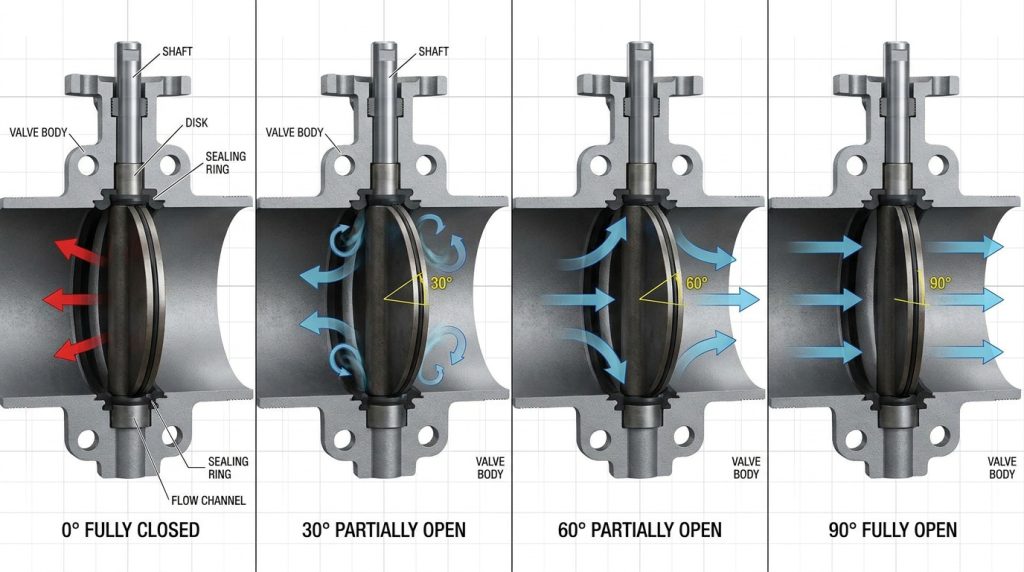
Here is the thing: you must realize that a butterfly valve behaves differently depending on its operational angle. The disk remains in the flow stream even when fully open, creating a permanent hydraulic obstruction. This design ensures rapid action but also means you must account for localized turbulence.
- On-Off Isolation: Minimizes flow restriction when fully open.
- Throttling Capability: Allows variable flow regulation based on disk angle.
- Turbulence Generation: Occurs at small angles due to disk interference.
Key Takeaway: Flow characteristics dictate the relationship between disk angle and fluid flow rate, helping engineers prevent cavitation.
| Valve Angle | Flow Behavior | Turbulence |
|---|---|---|
| 0° – 30° | High restriction | High |
| 30° – 70° | Linear increase | Moderate |
| 70° – 90° | Maximum capacity | Low |
Analytical Guidance: Keep throttling activities strictly within the stable 30-degree to 70-degree envelope to minimize turbulence.
How does Cv alter flow characteristics of a butterfly valve?
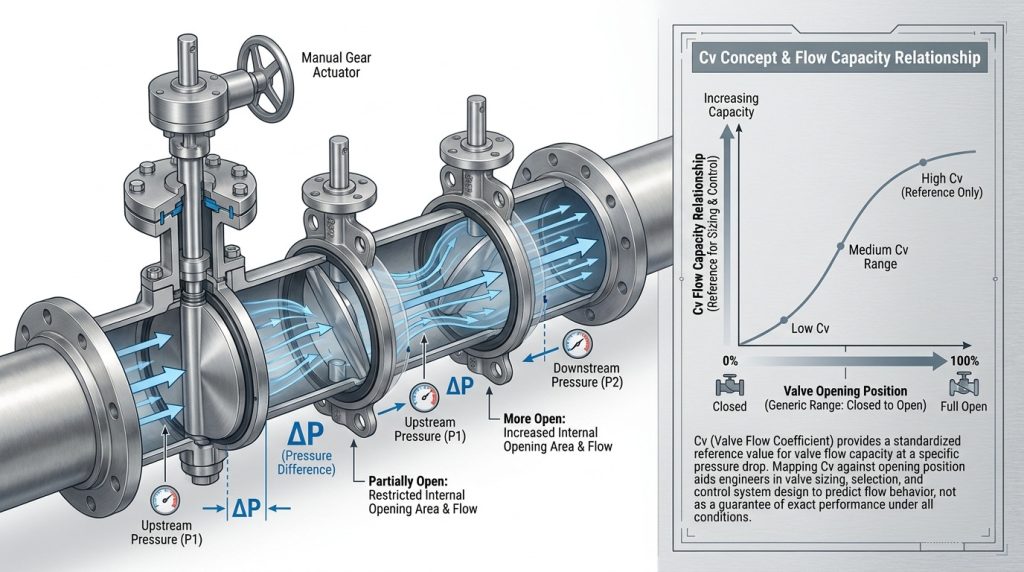
The flow coefficient (Cv) directly affects the flow characteristics of a butterfly valve by defining the water flow in GPM at a 1 PSI pressure drop. Higher Cv ratings indicate less internal obstruction and greater flow capacity. Calculating Cv values across all operating angles allows you to predict pressure drop and size downstream components accurately.
What exactly is the flow coefficient Cv?
Think about it: you cannot safely design a system without treating the Cv value as your primary reference metric. This coefficient acts as a standardized rating that allows you to compare different valve brands and designs. Matching Cv to your design flow rate prevents system bottlenecks.
- Volumetric Flow: Measured in GPM of water at 60°F.
- Pressure Drop: Fixed at a constant differential of 1 PSI.
- Geometry Influence: Determined by valve size and disc thickness.
Key Takeaway: Accurate Cv mapping is essential for precise control loop tuning and actuator power sizing.
| Size (DN) | Cv at 10° | Cv at 50° | Cv at 90° |
|---|---|---|---|
| DN50 | 0.1 | 45 | 135 |
| DN100 | 0.5 | 139 | 600 |
| DN200 | 3.0 | 727 | 3,136 |
Analytical Guidance: Analyze this Cv progression to understand why low-angle throttling is discouraged.
Do designs change flow characteristics of a butterfly valve?
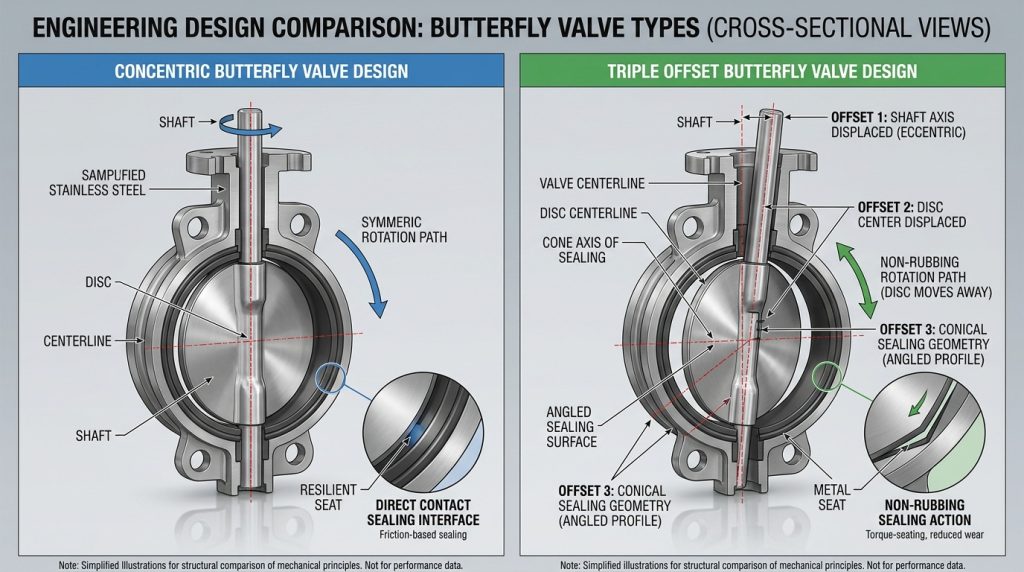
Different mechanical designs significantly alter the flow characteristics of a butterfly valve by modifying the disk’s rotational path and its contact with the sealing seat. Concentric designs feature centered shafts and soft elastomer seats that provide reliable shut-off but higher wear. High-performance eccentric designs offset the shaft to minimize friction and deliver distinct equal-percentage control profiles.
Are concentric designs inherently linear?
Here is the thing: you will experience higher operating torque if you use concentric valves for continuous throttling. The flow curve of these valves is relatively linear between 30 and 70 degrees, making them highly predictable. However, because the disc is constantly in contact with the seat, you will face increased wear on elastomeric surfaces.
- Centered Shaft: Aligned perfectly with the valve body center.
- Elastomer Seat: Soft rubber seat ensures tight zero-leakage shut-off.
- Symmetric Flow: Splits the fluid stream equally on both sides.
Key Takeaway: Concentric designs offer symmetrical, near-linear flow but suffer from high seat wear during modulating services.
| Design Feature | Concentric | Triple Offset |
|---|---|---|
| Flow Curve | Symmetrical, near-linear | True equal-percentage |
| Seating Friction | High | Zero friction (cam-action) |
Analytical Guidance: Select concentric valves for basic utility and water services to minimize capital expenditure.
Does disc shape alter flow characteristics of a butterfly valve?
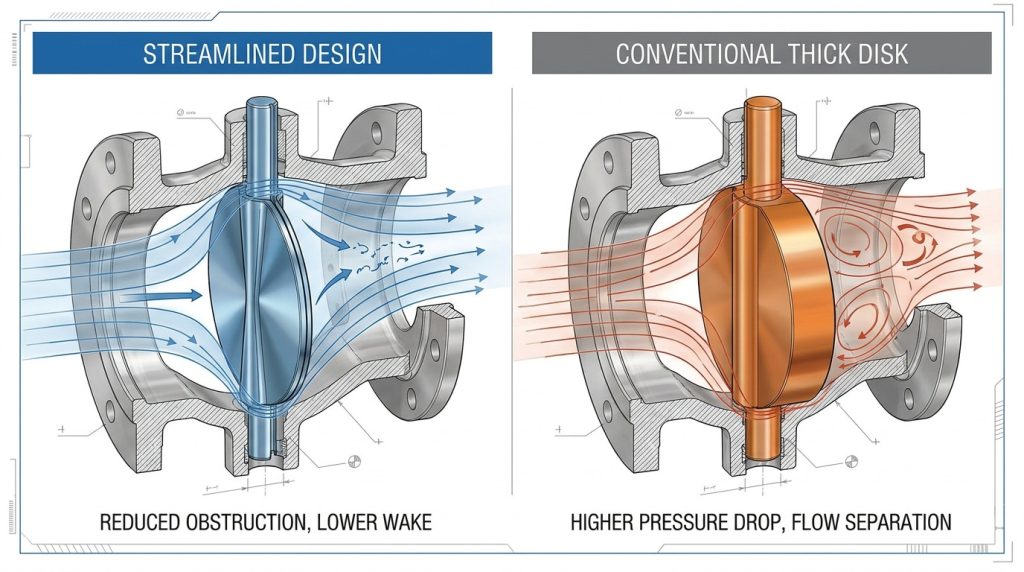
The specific geometry and profile of a disc alter the flow characteristics of a butterfly valve by dictating fluid resistance and wake turbulence. Thick, flat discs create massive flow separation zones that drop system pressure. In contrast, contoured, streamlined discs allow fluid to glide past smoothly, which reduces cavitation risk.
Do thin discs reduce flow resistance?
Think about it: you immediately optimize your pipeline’s fluid dynamics when you install a valve with a thin disc design. The reduced cross-sectional profile allows the fluid to maintain its velocity with minimal disruption. If you are running high-volume water networks, this design choice directly translates to lower utility bills.
- Reduced Obstruction: Less physical metal blockages in the flow stream.
- Lower Delta-P: Minimizes overall pressure drops across the valve.
- Energy Savings: Reduces pumping power required to maintain system flow.
Key Takeaway: Streamlined discs minimize wake turbulence and protect downstream pipes from mechanical vibrations.
| Disc Type | Drag Coeff. | Cavitation Risk |
|---|---|---|
| Thin/Streamlined | Low | Low |
| Flat/Thicker | High | High |
Analytical Guidance: Always specify streamlined disc profiles for continuous throttling processes to prevent downstream pipe fatigue.
Do angles impact flow characteristics of a butterfly valve?
Opening angles impact the flow characteristics of a butterfly valve because they directly control the variable cross-sectional area available for fluid passage within the valve body. Sizing calculations must account for these geometric changes to prevent rapid velocity increases at small openings. As the valve opens, flow resistance decreases exponentially.
Why is control difficult below 30 degrees?
Here is the thing: you are operating in an extremely unstable zone when attempting to throttle flow below 30 degrees. The fluid is forced through tiny gaps, which can cause severe erosion of your elastomer seats. If you do not avoid this range, you will quickly destroy the valve’s tight-shutoff capability.
- High Velocity Jets: Narrow gaps accelerate fluid to destructive speeds.
- Seat Erosion: Rapid flow near the sealing surface causes localized wear.
- Control Sensitivity: Small physical movements cause disproportionately large flow changes.
Key Takeaway: Avoid operating butterfly valves below 30 degrees to prevent seat erosion and control loop hunting.
| Opening Angle | Stability | Seat Wear Rate |
|---|---|---|
| 0° – 30° | Poor | Extremely High |
| 30° – 70° | Excellent | Low |
| 70° – 90° | Poor | Negligible |
Analytical Guidance: Limit the modulating travel range between 30° and 70° to guarantee predictable control.
Can size control flow characteristics of a butterfly valve?
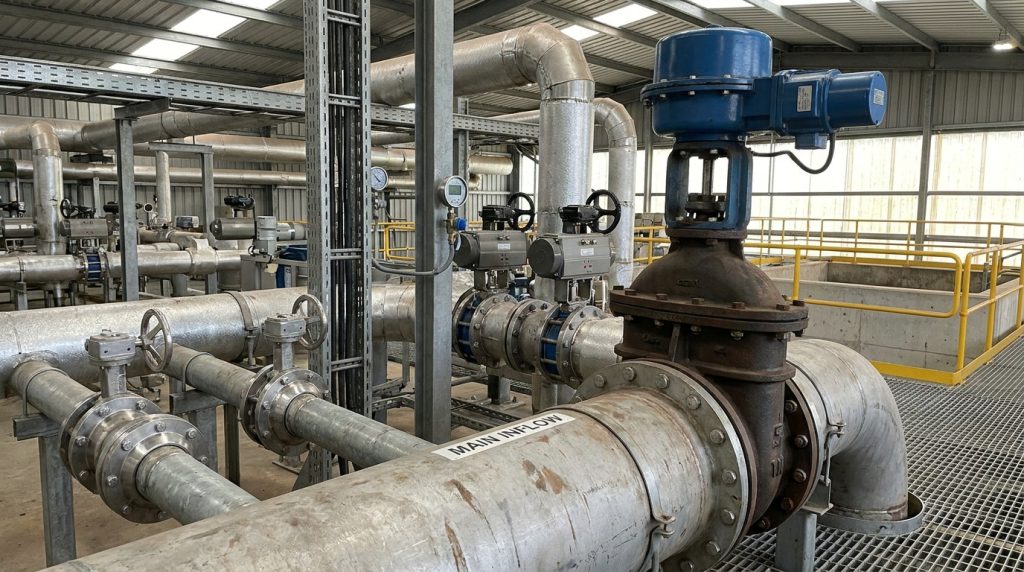
Valve size controls the flow characteristics of a butterfly valve by establishing baseline fluid throughput and angular control sensitivity. In smaller systems, modest changes in disk angle yield easily managed volumetric changes. However, large valves feature massive flow paths where minor adjustments release huge flow volumes.
Do smaller valves behave more predictably?
Think about it: you will find smaller valves incredibly easy to automate on compact dosing skids. Because the overall volume is low, you can achieve fine-grained control without complex actuator programming. When you make a minor adjustment, the flow responds smoothly without pressure spikes.
- High Resolution: Fine adjustment steps yield small, manageable flow changes.
- Lower Torque: Smaller disc areas require less power to rotate.
- Predictable Curves: More forgiving of minor piping design errors.
Key Takeaway: Smaller valves provide excellent control resolution and are highly forgiving of minor mechanical variances.
| Size Class | Sensitivity | Dynamic Torque Risk |
|---|---|---|
| Small (DN50-DN150) | Low | Negligible |
| Medium (DN200-DN300) | Moderate | Low-Medium |
Analytical Guidance: Perform a formal fluid velocity analysis to determine if a reduced-port valve is needed.
Who determines flow characteristics of a butterfly valve?
International standards organizations and manufacturers determine the flow characteristics of a butterfly valve by establishing dimensions, tolerances, and testing protocols. Standards such as API 609 provide a foundation for uniform valve geometry worldwide. Meanwhile, high-precision manufacturing execution ensures actual performance conforms closely to design values.
What are the primary governing standards?
Here is the thing: you can only guarantee global compliance and high performance by using certified valves. These standards dictate everything from the face-to-face dimensions to the precise wall thicknesses of the valve body. When you source certified valves, you know they will fit seamlessly into your existing piping layouts.
- API 609: Standard for double-flanged, lug, and wafer types.
- EN 593: European standard defining industrial butterfly valve specifications.
- API 598: Core testing standard governing pressure and leakage rates.
Key Takeaway: International standards ensure physical interchangeability and baseline performance across municipal and industrial sites.
| Standard | Focus Area | Performance Guarantee |
|---|---|---|
| API 609 | Design Standards | Assures physical fit |
| API 598 | Pressure Testing | Guarantees zero-leakage |
Analytical Guidance: Demand full material test reports to verify that manufacturing matches international compliance standards.
How do fluids impact flow characteristics of a butterfly valve?
Different fluid media impact the flow characteristics of a butterfly valve by altering the flow regime, shear rates, and friction losses as the medium passes around the disk. Viscous fluids drag heavily against the disk, which increases overall system pressure drops. Abrasive slurries can wear down metal surfaces, altering the valve’s geometric profile.
Why does viscosity disrupt flow dynamics?
Think about it: you will find that viscosity increases the drag on the valve disc, altering the velocity profile. When you handle highly viscous fluids, standard water-based Cv charts are no longer sufficient. If you do not apply viscosity correction factors, your control valve will be severely undersized.
- Laminar Flow: Viscous fluids trigger laminar flow, reducing Cv effectiveness.
- Increased Drop: Thicker fluids require higher differential pressures to move.
- Higher Torque: Increased fluid drag demands more powerful actuators.
Key Takeaway: Viscous fluids require viscosity-corrected Cv calculations to prevent undersizing and actuator stalling.
| Fluid Type | Impact on Valve | Seat Recommendation |
|---|---|---|
| Clean Water | Low wear | EPDM / NBR |
| Viscous Oil | Laminar flow, drag | PTFE / Metal |
Analytical Guidance: Apply viscosity correction formulas during sizing to ensure correct actuator and alloy compatibility.
Why choose Ruito for flow characteristics of a butterfly valve?
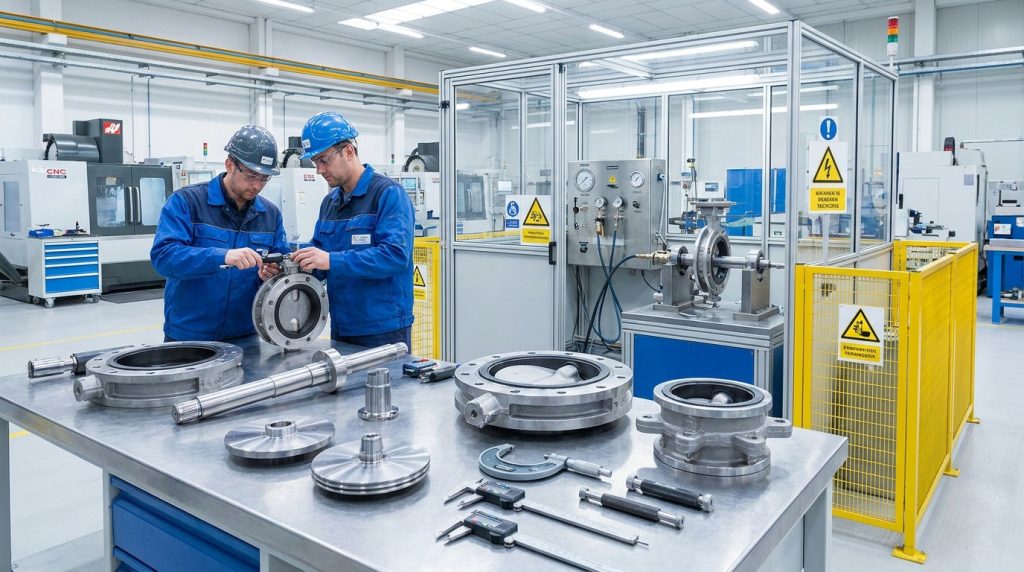
Choosing Ruito Flow Control for managing the flow characteristics of a butterfly valve ensures you receive precision-engineered, ISO-certified valves designed for optimal fluid dynamics and long-term reliability. Our advanced manufacturing facility leverages high-tolerance CNC machining to build discs that deliver highly accurate Cv ratings. This focus on precision reduces pipeline turbulence and protects downstream components.
Do they offer precision-machined discs?
Here is the thing: you are investing in top-tier machining accuracy that ensures predictable flow control. Their automated CNC cells manufacture discs with highly streamlined profiles, reducing wake turbulence and pipeline vibration. This precision directly translates to smoother flow characteristics and lower system energy consumption.
- Strict Tolerances: CNC machined discs with dimensional accuracy within ±0.1 mm.
- 100% Tested: Every single valve undergoes pressure testing per API 598.
- Premium Alloys: Options include Ductile Iron, Carbon Steel, and SS316.
Key Takeaway: Ruito’s CNC-machined discs ensure predictable, high-precision flow control and reduced energy losses.
| Service Metric | Standard Performance | Custom Option |
|---|---|---|
| Size Range | DN50 – DN300 (Stock) | DN25 – DN1200 |
| Testing Protocol | 100% Hydro-tested | Third-party (SGS) |
Analytical Guidance: Partner with Ruito early in the design phase to utilize their expert engineering consultation.
Can FAQs clarify flow characteristics of a butterfly valve?
These frequently asked questions clarify the flow characteristics of a butterfly valve to help you optimize system performance and avoid common sizing mistakes. Real-world operator questions often center around wear, cavitation risks, and sizing variables. Reviewing standard answers enables you to prevent premature equipment failure.
How do you resolve common operator queries?
Think about it: when you operate high-pressure piping networks, several technical questions are bound to arise. You must have quick, accurate answers to prevent costly errors on the production floor. By reviewing these proven industry guidelines, you can make informed decisions.
- Operator Confidence: Clear guidelines reduce operational risk.
- Reduced Downtime: Quick troubleshooting saves engineering hours.
- System Safety: Knowing mechanical limits prevents premature failure.
Key Takeaway: Correct operational knowledge prevents system wear and ensures continuous uptime.
| Query Category | Operational Risk | Solution Method |
|---|---|---|
| Sizing | Poor control resolution | Analyze Cv curve |
| Wear | Seat degradation | Limit modulating angle |
Analytical Guidance: Refer to the specific troubleshooting protocols below to quickly address real-world hydraulic problems.
FAQs
Can I use a concentric butterfly valve for high-cycle throttling?
No, you should not use standard concentric butterfly valves for continuous, high-cycle throttling applications. Concentric designs feature constant contact between the disc and the elastomer seat, which generates high friction during modulating movements. If you ignore this, the rapid wear will destroy the seal, causing bypass leakage.
What’s the best angle range for throttling flow with a butterfly valve?
The best range is strictly between 30 and 70 degrees of opening. Within this range, the flow curve is highly predictable, and the valve provides stable resistance to regulate volume smoothly. Operating below 30 degrees creates high-velocity jets that erode seats, while operating above 70 degrees offers almost no flow change.
How do I know if my butterfly valve is experiencing cavitation?
You can identify cavitation by listening for a distinct “flowing gravel” noise or monitoring localized high-frequency pipe vibrations. Cavitation occurs when high-velocity flow through a partially open valve drops pressure below the vapor limit, forming micro-bubbles that collapse violently. This physical phenomenon can quickly pit the disc surface and cause catastrophic mechanical failure.
Can I achieve equal-percentage flow control with a butterfly valve?
Yes, double and triple-offset eccentric butterfly valves naturally exhibit a modified equal-percentage flow characteristic. The shaft offsets allow the disc to rotate with a cam-like motion, creating a flow path that opens slowly at first and accelerates as the angle increases. This non-linear behavior is ideal for systems requiring fine control at low flow rates.
How do I know if water hammer is a risk for my system?
Water hammer is a risk if your pipeline has high velocities and large valves. When a large valve closes too quickly, it halts a massive column of moving fluid, creating a destructive pressure shockwave. Installing slow-acting pneumatic actuators or manual gearboxes resolves this issue.
Conclusion
Managing the flow characteristics of a butterfly valve is the key to achieving precise, efficient, and reliable fluid control across any B2B piping application. Sizing errors, incorrect disc profiles, or operating outside the optimal 30-to-70-degree throttling range can lead to costly cavitation, seat erosion, and system downtime.
As a trusted industrial partner, Ruito Flow Control combines ISO 9001 quality management with advanced CNC machining to deliver valves that perform exactly as engineered, batch after batch. If you are struggling with pipeline turbulence, rapid seat wear, or actuator sizing issues, our dedicated team of bilingual engineers is ready to provide custom solutions. Please contact us today to receive a comprehensive technical consultation and optimize your fluid control systems.