
Find reliable double acting butterfly valve factories by checking the quoted valve, actuator, manufacturing records, and acceptance tests as one assembly. A sample may open on a workshop air line yet stall after installation because the available air pressure falls during a stroke. Your supplier review should catch that mismatch before a production order. Start with a service data sheet, then ask the factory to connect every selection and test record to the same configuration.
1. What should double acting butterfly valve factories prove?
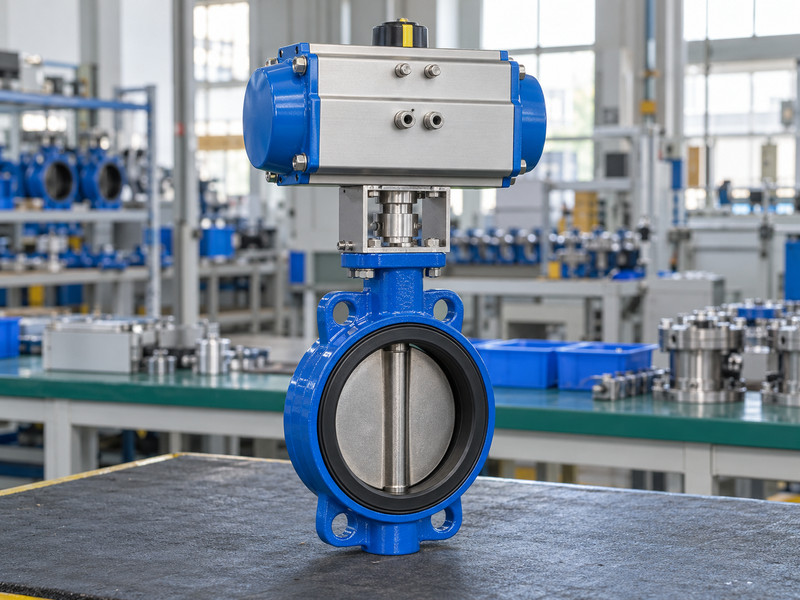
Qualified double acting butterfly valve factories should prove that they can build and verify the complete assembly you intend to buy. The word “double acting” describes pneumatic operation in both directions; it does not identify the seat design, offset geometry, pressure rating, or loss-of-air position. Separate those questions before comparing quotations.
Which responsibilities belong in your enquiry?
A valve manufacturer may buy its actuator from another company, which can be acceptable when responsibilities remain clear. Request one party to approve the valve torque, actuator output, coupling, controls, and final functional test. Otherwise, a stalled assembly can become a dispute between two component suppliers. Record subcontracted activities and the records available for each activity, including any inspection performed outside the quoted factory.
- Identify the valve manufacturing and actuator assembly locations.
- Name the party responsible for sizing and final testing.
- Record the approved drawings and any subcontracted operations.
| Review point | Evidence to request | Hold approval when |
|---|---|---|
| Manufacturing scope | Process list and sample records | The quoted assembly has no clear owner |
| Configuration | Valve and actuator data sheets | Different revisions appear in one quotation |
| Support | Named technical contact | Sizing questions remain unanswered |
Key takeaway: A clear assembly responsibility helps you close technical questions before placing an order.
2. Which material records should you check?
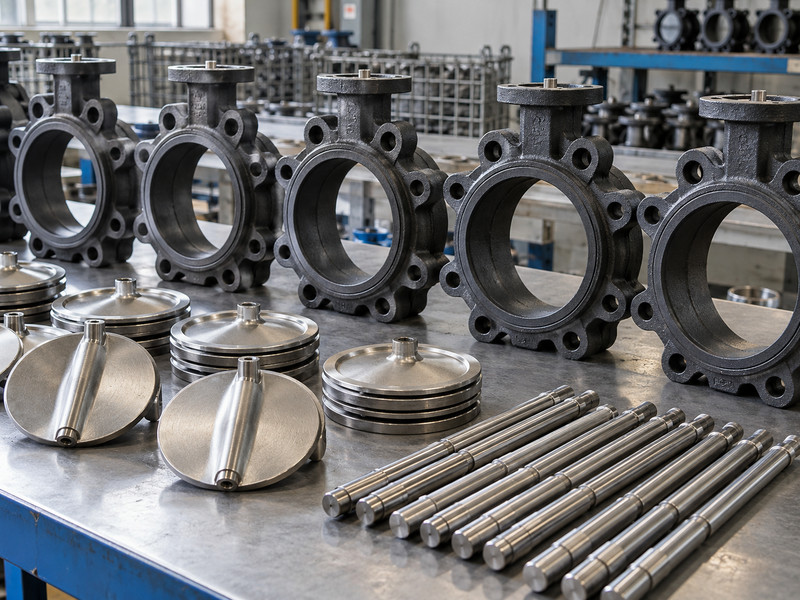
Material records from double acting butterfly valve factories should identify the body, disc, shaft, seat, and other wetted parts separately. A stainless disc does not make the whole flow path stainless steel. The seat and shaft seals may set a lower temperature or chemical limit than the body.
How do you connect materials to the service?
Specify concentration, additives, solids, cleaning chemicals, and the temperature range together. An EPDM water configuration should not migrate into an oil order through a generic “rubber seat” description. For lined valves, review the continuous wetted surface, backing material, and shaft sealing arrangement. Ask the factory to identify which raw material certificates and elastomer batch records it can trace to the delivered product; a certificate with no product connection has limited value during a complaint.
- List every wetted material in the bill of materials.
- Confirm the seat compound against the full fluid composition.
- Agree how material batches connect to product identification.
| Component | Detail to confirm | Procurement consequence |
|---|---|---|
| Body and disc | Actual grades and coating scope | Avoid a broad material description |
| Shaft | Grade and allowable load | Check the drive path as well as corrosion |
| Seat and seals | Compound and service limits | Prevent an unapproved substitution |
Key takeaway: Purchase a defined material combination rather than a valve described by its most expensive metal.
3. How can you review machining capability?
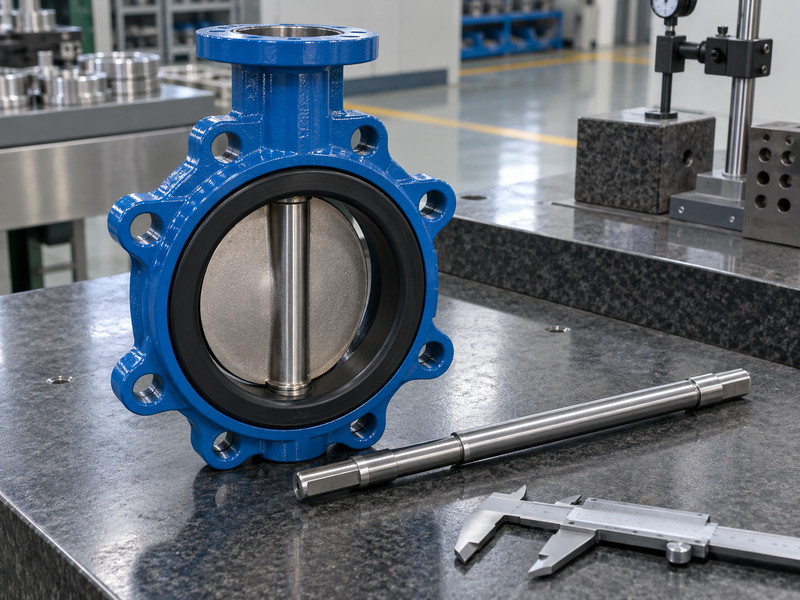
Review double acting butterfly valve factories through the dimensions that affect assembly, sealing, and interchangeability. A machine list alone cannot show whether the factory controls a shaft fit or mounting interface. Request an inspection record for the same type of valve, with drawing revision and measuring equipment identified.
Which dimensions deserve closer attention?
Check the shaft, bearing locations, mounting pad, coupling engagement, and bracket faces. Then check flange drilling, face-to-face length, and disc clearance against the mating pipework. A valve can meet a nominal bore description yet clash with a nearby flange bore or lining. For a lug butterfly valve, thread form, usable engagement, and bolt length also require review.
- Review critical dimensions against an approved drawing.
- Check measuring equipment status and inspection frequency.
- Require written approval for deviations affecting installation.
- Agree how the factory records nonconforming dimensions and who can approve a deviation.
| Interface | Record to request | Common installation effect |
|---|---|---|
| Mounting pad | Hole pattern and pilot dimensions | Actuator or bracket mismatch |
| Drive | Shaft and coupling dimensions | Lost motion or concentrated stress |
| Pipe connection | Drilling, face length, bore clearance | Site rework or disc interference |
Key takeaway: Choose inspection points that protect the interfaces your installation actually uses.
4. What should an assembly inspection cover?
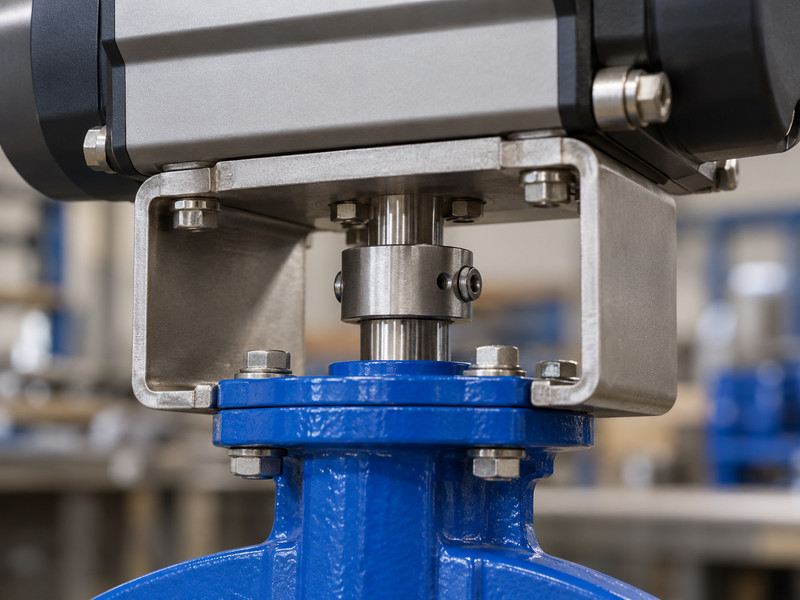
An assembly inspection at double acting butterfly valve factories should confirm alignment, support, fastener engagement, and unobstructed travel. The actuator must transmit torque through the intended coupling. Its mounting bolts should not pull an incorrectly aligned drive into position.
How should the factory check the assembled drive?
Request evidence that the coupling fully engages the intended shaft surfaces and that the bracket supports the assembly without distortion. Compare the valve disc position with the actuator indication at both travel limits. A pointer can look correct even when a coupling has been indexed incorrectly. Review access for solenoid replacement, cable glands, air fittings, and actuator end caps.
- Verify coupling engagement and mounting alignment.
- Match actual disc position with end-position indication.
- Check that service access remains available after installation.
- If the quoted assembly includes a manual override, confirm its engagement method and operating restrictions in the instructions.
| Assembly item | Acceptance check | Evidence |
|---|---|---|
| Coupling | Correct fit and engagement | Drawing and assembly check |
| Bracket | Supported, aligned mounting faces | Inspection record |
| Travel | Agreed open and closed positions | Functional test result |
Key takeaway: A complete movement check should follow a satisfactory mechanical assembly inspection.
5. How should you evaluate actuator sizing?
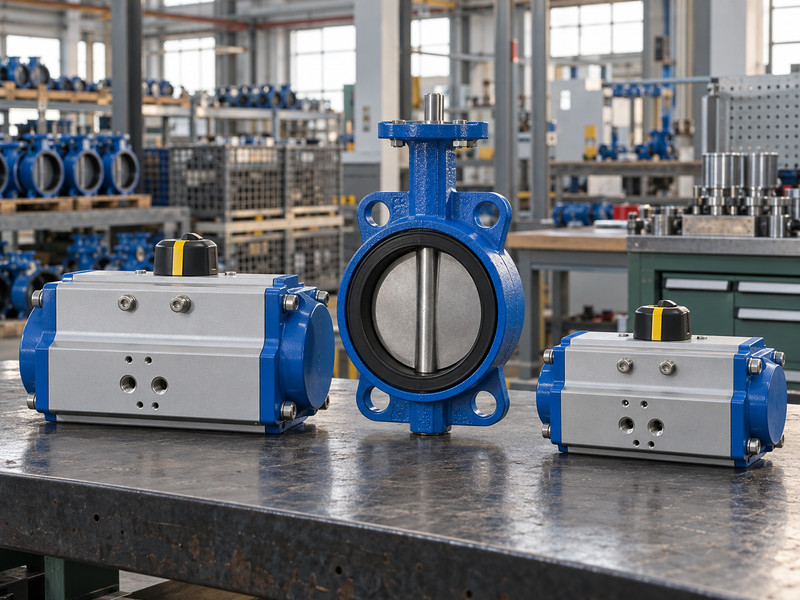
Actuator sizing from double acting butterfly valve factories should compare available output with valve torque throughout the required stroke. Use the minimum air pressure available at the actuator while it moves. A compressor setpoint or a static gauge reading upstream does not establish that value.
Which calculation inputs should remain visible?
Valve torque depends on seat design, differential pressure, temperature, fluid, and operating history. The calculation should identify breakaway, running, and seating requirements as applicable, with a documented sizing allowance. Check the maximum permissible shaft torque and drive limits as well; a larger actuator can create another problem. For double-acting operation, review both opening and closing.
- State maximum closing differential pressure and fluid conditions.
- Compare output at the minimum dynamic air supply.
- Check shaft, coupling, and bracket limits separately.
- If air pressure can vary widely, confirm how the system prevents excessive output under the highest permitted supply condition.
| Input | Required basis | Reject this shortcut |
|---|---|---|
| Valve torque | Defined configuration and duty | One torque for every valve size |
| Air pressure | Minimum at the actuator during motion | Compressor discharge pressure alone |
| Sizing allowance | Stated project method | An unexplained percentage |
Key takeaway: Keep the sizing inputs with the approved assembly so later substitutions can be checked.
6. Which control accessories need separate approval?
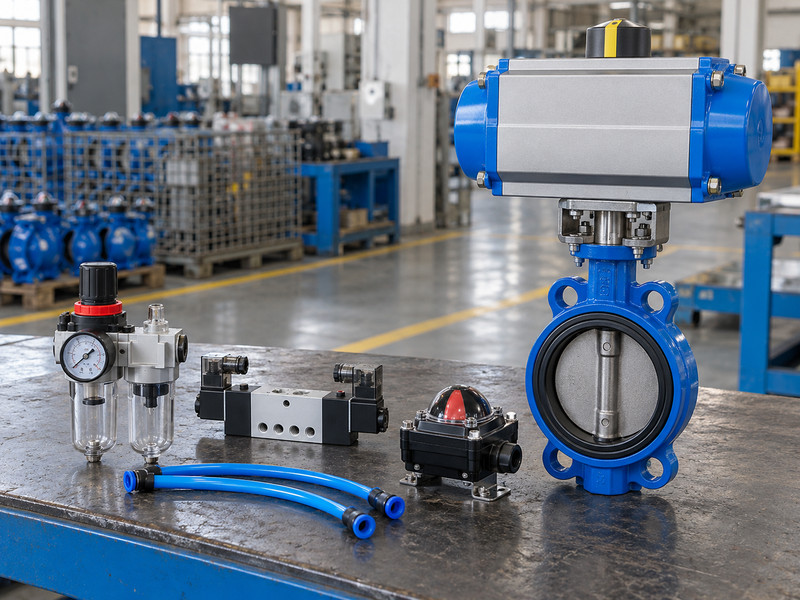
Control accessories supplied by double acting butterfly valve factories need their own specifications and functional checks. A double-acting actuator commonly uses a suitable directional solenoid for on/off duty, while modulating duty requires an appropriate control arrangement. Neither description defines the complete electrical or pneumatic package.
What should you freeze before production?
Confirm supply voltage, connector, enclosure, environmental limits, air quality, and required end-position feedback. Specify what should happen after loss of power, loss of air, and restoration of either supply. Those are different tests. A double-acting actuator without a suitable stored-energy or other engineered arrangement does not inherently provide a guaranteed return stroke.
- Freeze voltage, connector, feedback, and enclosure requirements.
- Review solenoid flow capacity and exhaust restrictions.
- Define power-loss, air-loss, and restart responses.
- For hazardous locations, check the exact accessory and assembly approval scope rather than assuming that pneumatic operation qualifies every attached electrical component.
| Accessory | Selection detail | Assembly test |
|---|---|---|
| Solenoid | Function, voltage, flow capacity | Command response and de-energized state |
| Limit switch | Signal and environmental suitability | Actual end-position feedback |
| Regulator | Supply range and capacity | Pressure during a stroke |
Key takeaway: Approve the controls as part of the valve package rather than as interchangeable catalogue extras.
7. What does a useful factory test demonstrate?
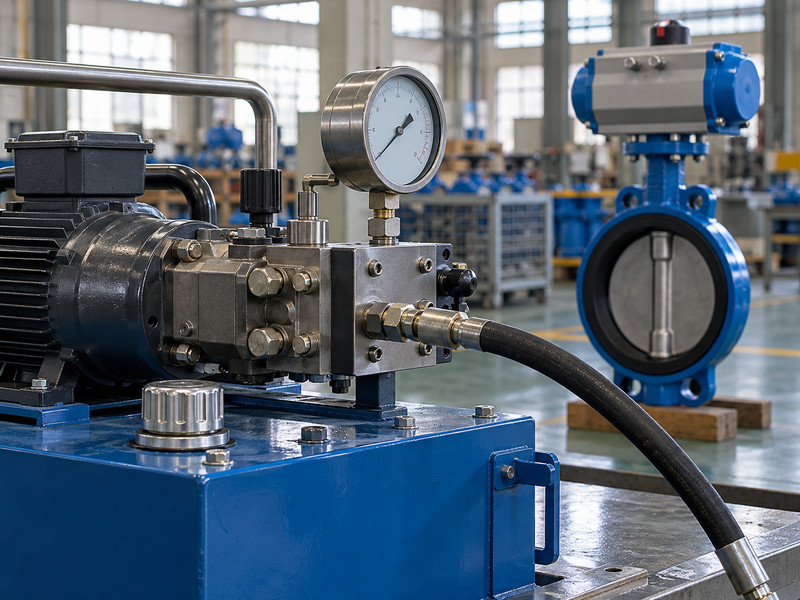
A useful test at double acting butterfly valve factories demonstrates the requirements stated in an agreed inspection plan. Separate pressure integrity, seat leakage, external leakage, and assembly operation. One successful movement at no differential pressure cannot prove shutoff performance or loaded actuator capability.
How should acceptance criteria be written?
State the applicable procedure, medium, pressure, duration, direction, and acceptance limit for each test; where ISO 5208 is specified, confirm its contracted scope. Test pressure is an inspection condition, not the allowable operating pressure. Directional seat ratings also require attention; a declared reverse-pressure limit may differ from the forward limit. If the order needs operation against differential pressure, identify a suitable loaded test and its limitations explicitly.
- Separate shell, closure, leakage, and functional checks.
- State test direction and configuration on the record.
- Connect every result to an identifiable valve assembly.
- Review the safety arrangement and witness points before the test date so access does not become a last-minute dispute.
| Test | What it checks | What it does not establish alone |
|---|---|---|
| Shell pressure | Pressure boundary integrity | Seat leakage acceptance |
| Closure | Defined shutoff requirement | Actuator output at minimum air |
| Functional cycle | Assembly movement and signals | Every possible process duty |
Key takeaway: An agreed test matrix makes a witness visit measurable and prevents broad claims from a narrow test.
8. Which records should travel with the shipment?
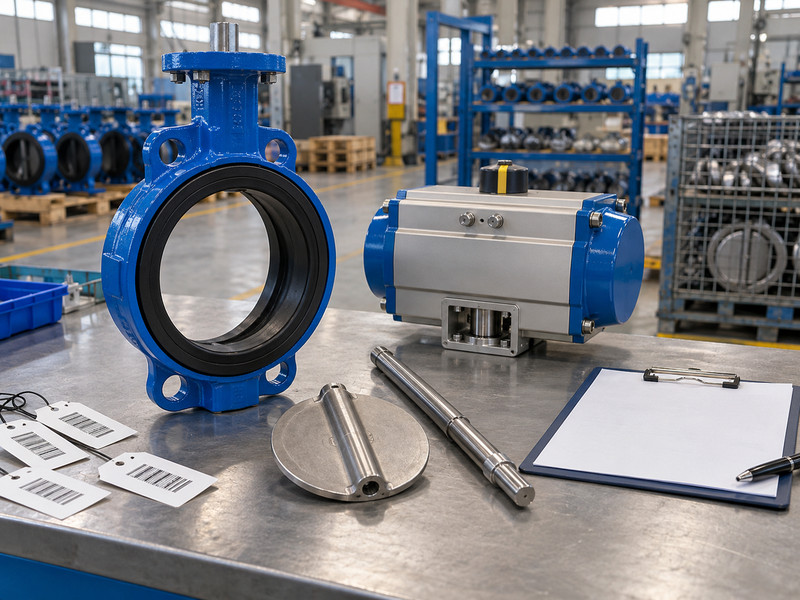
Shipment records from double acting butterfly valve factories should let you identify what arrived, how it was inspected, and which instructions apply. The required package depends on the order. Agree it before manufacture rather than asking for missing certificates after the crate reaches your warehouse.
How much traceability does your project need?
Product identification should connect the delivered valve to its configuration, relevant materials, test results, and approved changes. For project assemblies, retain the actuator and accessory details as well. Request the final drawing revision, operating instructions, and a list of any approved deviations. Then decide how spare seats, shaft seals, and replacement actuators will be identified.
- Agree the document index and delivery format.
- Match product identification across inspection and packing records.
- Retain approved deviations and replacement-part information.
- A practical record package supports a future repair without forcing your maintenance team to infer the original build from a photograph.
| Record | Needed connection | Later use |
|---|---|---|
| Final drawing | Delivered assembly revision | Installation and replacement |
| Test report | Product identification | Acceptance and fault investigation |
| Parts information | Actual materials and configuration | Controlled maintenance |
Key takeaway: Traceability should help your team make a repair decision after the original purchasing staff have moved on.
9. How do you turn an audit into an approved order?
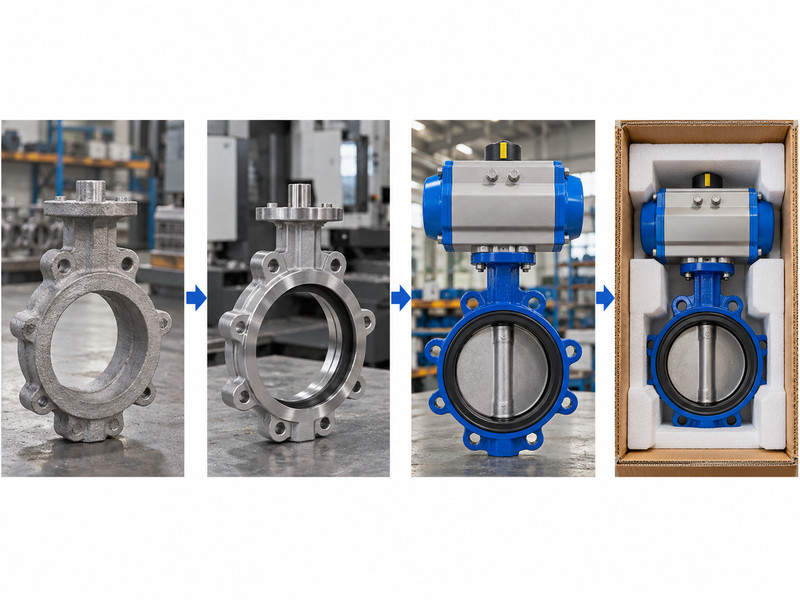
Approve double acting butterfly valve factories against a closed technical enquiry, an agreed sample or verification plan, and a controlled production configuration. An audit can identify capability, but it does not automatically approve every size, material, or service offered by that factory.
What should your purchase release include?
List accepted documents, unresolved exceptions, inspection points, packing requirements, and the conditions that start the delivery period. If the first order contains multiple sizes or seat materials, confirm which variants the sample actually represents. Use a small initial release when the project permits it, then review results before committing the remaining quantity. For a flanged butterfly valve, retain the actual face length and flange interface rather than assuming another approved body style proves fit.
- Freeze the approved configuration and substitution process.
- Define acceptance records and shipment hold points.
- Review sample coverage before releasing additional variants.
| Release stage | Required decision | Owner |
|---|---|---|
| Technical review | Accept configuration and deviations | Engineering and procurement |
| Verification | Accept sample and test evidence | Quality and engineering |
| Production release | Confirm quantity and inspection plan | Authorized purchasing team |
Key takeaway: Send RUITO your service conditions, required drawings, and acceptance list when you contact us. We can review the requested configuration and identify the information needed for a quotation.
10. What else should buyers ask before ordering?
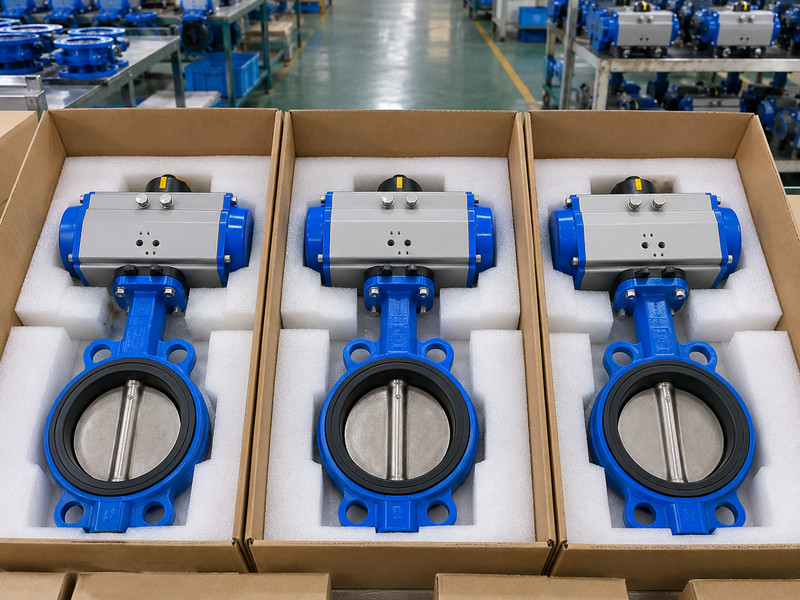
Ask double acting butterfly valve factories about the limits behind each promise before accepting a sample or quotation.
- Q1: Can I assume a double-acting valve closes after air loss? No. A standard double-acting actuator needs pneumatic energy in both directions. Define and verify the required loss-of-air response for the complete system.
- Q2: How do I know if a factory made the valve itself? Review its declared process scope, manufacturing location, subcontracted activities, and product-specific records. A workshop photograph alone cannot establish responsibility for the quoted assembly.
- Q3: What’s the best sample size for a new supplier? It depends on configuration differences and project risk. Select samples that represent the body styles, materials, drives, and interfaces requiring approval rather than using quantity alone.
- Q4: Can I replace an actuator with a larger unit? Only after reviewing output, shaft and coupling limits, bracket loads, controls, and travel. Extra output does not resolve every cause of a valve that stalls.
- Q5: How do I compare two factory quotations fairly? Use one service data sheet and document schedule. Compare the same materials, operating conditions, tests, control accessories, and delivery assumptions before evaluating the price difference.