
You can fix ductile iron butterfly valve sourcing mistakes by specifying the iron grade, wetted materials, installation interfaces, and separate shell and seat acceptance requirements. When several quotations say only “ductile iron, PN16,” you cannot tell whether they describe the same valve. Compare ductile iron butterfly valve manufacturers through controlled drawings, traceable materials, and tests for your actual duty before choosing a unit price.
1. Which ductile iron butterfly valve manufacturers fit?
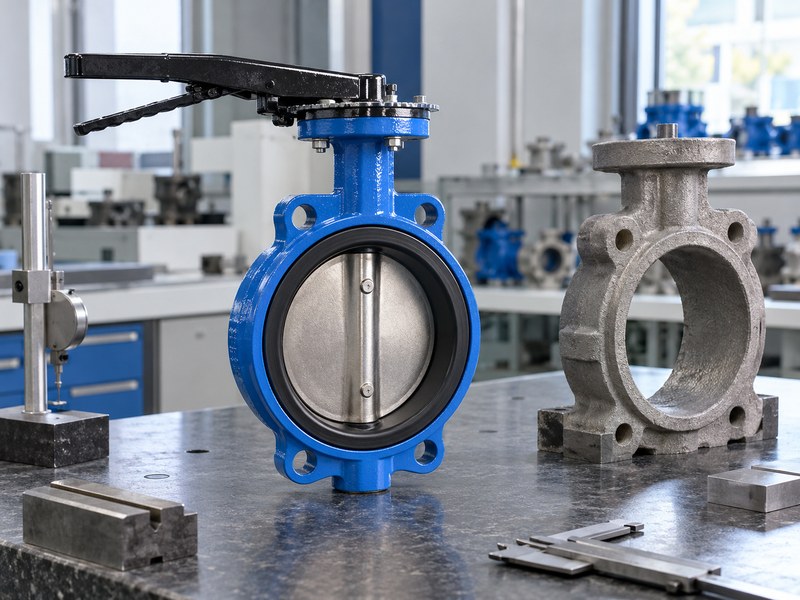
Suitable ductile iron butterfly valve manufacturers can document the exact structure, material configuration, and operating limits your installation needs. A clean water isolation valve, a compatible mineral oil valve, and a seawater valve require different wetted material decisions. Body material alone leaves the disc, shaft, seat, coating, and allowable closing differential unresolved.
Separate the purchasing applications
- Identify fluid composition, temperatures, normal pressure, and transients.
- State forward and reverse closing differentials where both apply.
- Give installation dimensions, operating frequency, and manual or powered operation.
RUITO's butterfly range includes concentric wafer, lug, flanged, U-type, and grooved configurations, plus separately specified double offset and lined constructions. Each needs its own drawing and acceptance scope. Use the required structure to screen suppliers before comparing their quoted materials or delivery dates.
| Application | Configuration question | Evidence before selection |
|---|---|---|
| Clean water isolation | Which wetted materials? | Defined water-duty parts list |
| Mineral oil | Which NBR compound? | Oil compatibility review |
| Seawater | Which isolated flow path and alloy? | Corrosion review |
| Large transmission line | Which direction ratings? | Double offset drawing and plan |
Reject substitutions that leave an application question unanswered, even when the flange size matches.
2. How do ductile iron butterfly valve manufacturers prove grade?
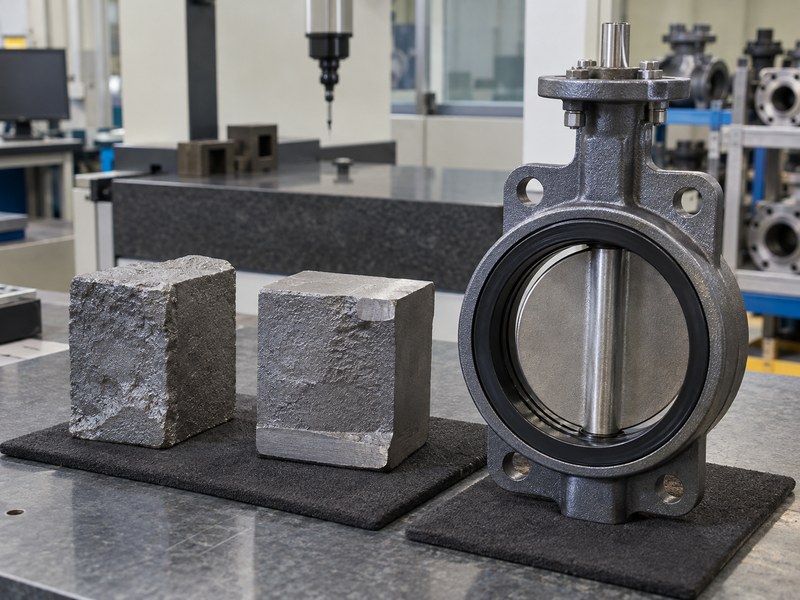
You need a named iron grade, its governing material specification, and records traceable to the body supplied by ductile iron butterfly valve manufacturers. RUITO's standard water configuration uses EN-GJS-450-10 for its ductile iron body. Avoid replacing that grade with a generic material description or assuming another national designation is interchangeable without review.
Trace the casting to the finished valve
- State required material properties and any project-specific supplementary tests.
- Identify the heat or batch through casting receipt and machining.
- Link the material record to the finished product identification number.
Ask how test specimens represent the supplied castings and which material results the supplier will provide. If your project needs metallographic examination or additional testing, define that scope during quotation. A pressure test checks the assembled pressure boundary under stated conditions; it does not establish the complete material grade by itself.
| Purchase requirement | Required record | Review question |
|---|---|---|
| Named body grade | Material certificate | Does the designation match? |
| Batch identity | Heat and work-order linkage | Can this valve be traced? |
| Supplementary properties | Agreed test results | Are project limits satisfied? |
| Substitution | Approved deviation | Who accepted the change? |
Resolve a missing material link before machining or coating makes the casting identification harder to verify.
3. How should a supplier control the casting?
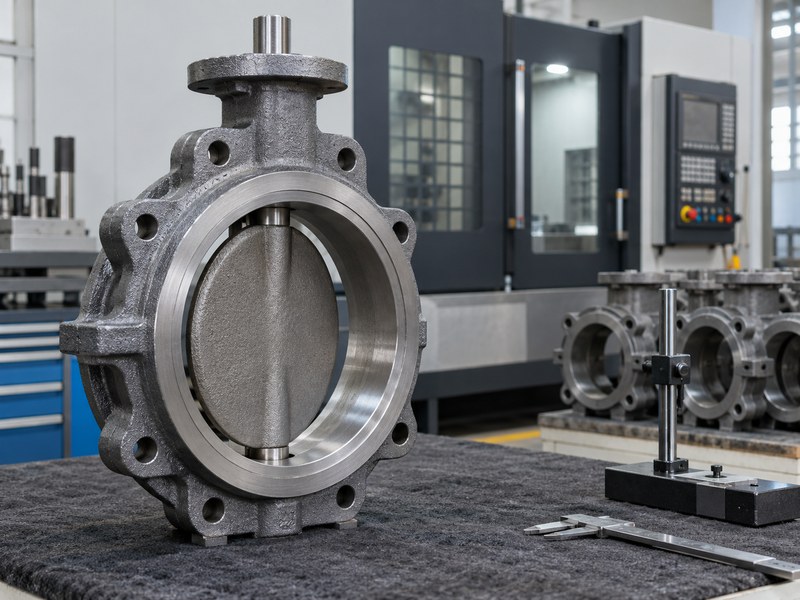
A supplier should control casting acceptance, machining allowances, critical dimensions, and nonconforming material before assembly; ductile iron butterfly valve manufacturers should show how those steps connect. A smooth painted surface can conceal a poor casting or an unauthorized repair. Review the uncoated pressure boundary at the inspection point agreed for your order.
Examine the features that affect assembly
- Inspect specified casting surfaces and wall dimensions before coating.
- Measure shaft bores, seat geometry, flange features, and machining datums.
- Require a documented disposition for defects, repairs, or rejected castings.
Ask the supplier to show a completed dimensional report with readings from your valve size. Check the machining method for maintaining shaft alignment and seating geometry across a batch. A casting that reaches assembly with dimensional variation may require extra force to close, and that force can make actuator selection unreliable.
| Production stage | Supplier action | Procurement evidence |
|---|---|---|
| Incoming casting | Check material and specified condition | Acceptance record |
| Machining setup | Confirm datum and tooling | Approved setup instruction |
| Completed machining | Measure critical geometry | Actual dimensional readings |
| Defect disposition | Segregate and review | Closed nonconformance record |
Set a hold point where later coating or assembly would prevent your inspector from seeing a specified feature.
4. Which disc and shaft materials suit the fluid?
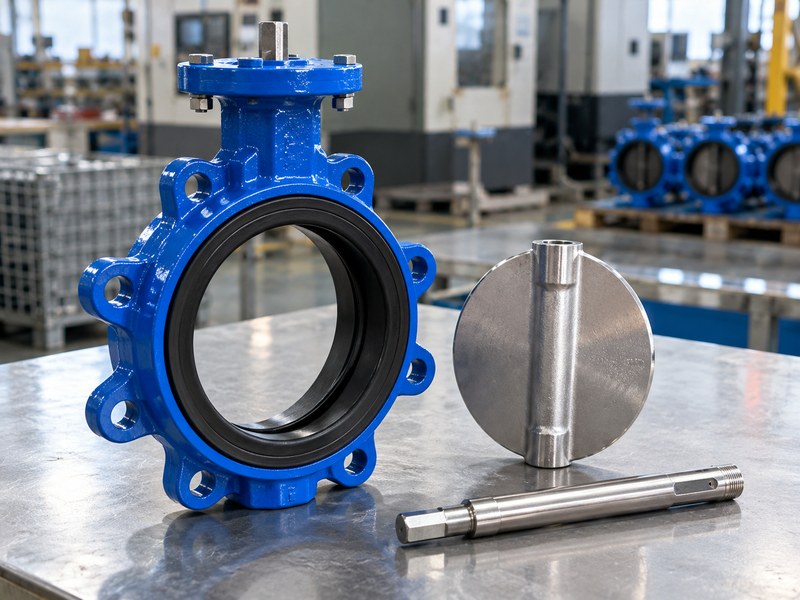
Disc and shaft materials must suit the complete fluid and mechanical loads, and ductile iron butterfly valve manufacturers should identify them separately from the body. RUITO's standard water construction uses a CF8M disc and a strength-checked stainless steel shaft. That configuration does not establish suitability for every chloride concentration, seawater system, or chemical solution.
Review corrosion and torque together
- Identify wetted surfaces, crevices, fasteners, and any exposed shaft sections.
- Give chloride content, treatment chemicals, solids, and flow conditions where relevant.
- Check shaft strength against valve torque and maximum actuator output.
For seawater, RUITO uses a dedicated construction with an isolated flow path and C95800 aluminium bronze or another alloy accepted through corrosion review. External salt spray and internal seawater exposure require separate decisions. A freshwater valve installed aboard a vessel does not become a seawater valve because its external coating resists that environment.
| Duty | Material decision | Supporting check |
|---|---|---|
| Defined clean water | Approved disc and shaft | Fluid and strength review |
| Chlorinated water | All wetted materials | Treatment concentration |
| Seawater | Dedicated alloy construction | Crevice and galvanic effects |
| Powered isolation | Shaft and connection strength | Maximum delivered torque |
Require the final parts list to identify the supplied alloys rather than accepting “stainless trim” as a complete description.
5. How do EPDM and NBR choices differ?
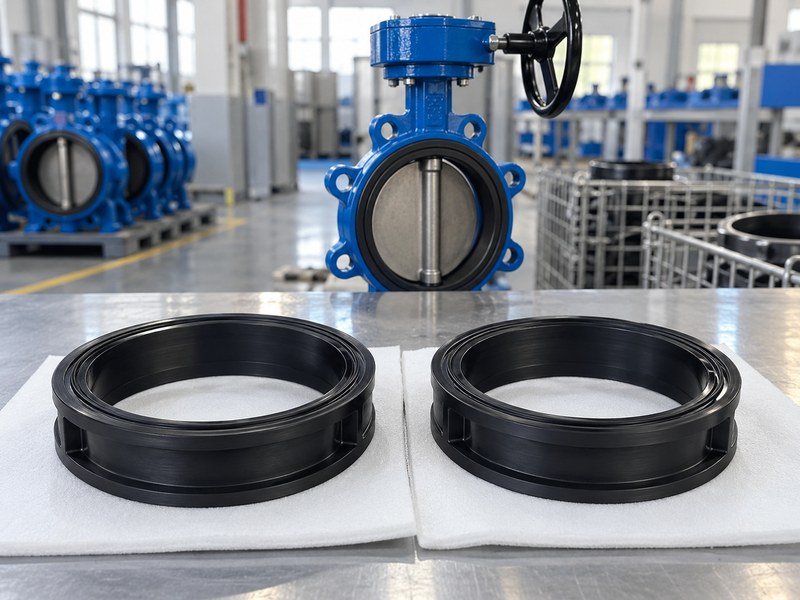
EPDM is the starting seat choice for RUITO's defined water duties, while NBR is used in separately reviewed compatible mineral oil configurations; ductile iron butterfly valve manufacturers should confirm the exact compound. These names identify material families, so you still need the fluid composition, temperature, contact requirements, and seat geometry approved for the order.
Compare complete operating envelopes
- Provide oil grade, additives, aromatics, or water-treatment chemicals.
- Include cleaning fluids, shutdown temperatures, and pressure changes.
- Request compound identification and batch traceability for replacement seats.
For example, RUITO's standard clean water duty is 5–60°C within the exact model's pressure-temperature limit. Its NBR mineral oil butterfly configuration is separately bounded at 5–70°C and no more than 10 barg, subject to compatibility review. Do not transfer either envelope to another compound or combine catalogue endpoints from different configurations.
| Selection factor | EPDM water configuration | NBR oil configuration |
|---|---|---|
| Fluid input | Defined water or approved mixture | Compatible mineral oil |
| Review focus | Treatment and contact approval | Additives and swelling |
| Replacement seat | Approved compound and geometry | Approved compound and geometry |
| Release basis | Actual configured duty | Actual configured duty |
Approve a seat specification with an identifiable compound before agreeing the spare-parts list.
6. Which flange and bore details need checking?
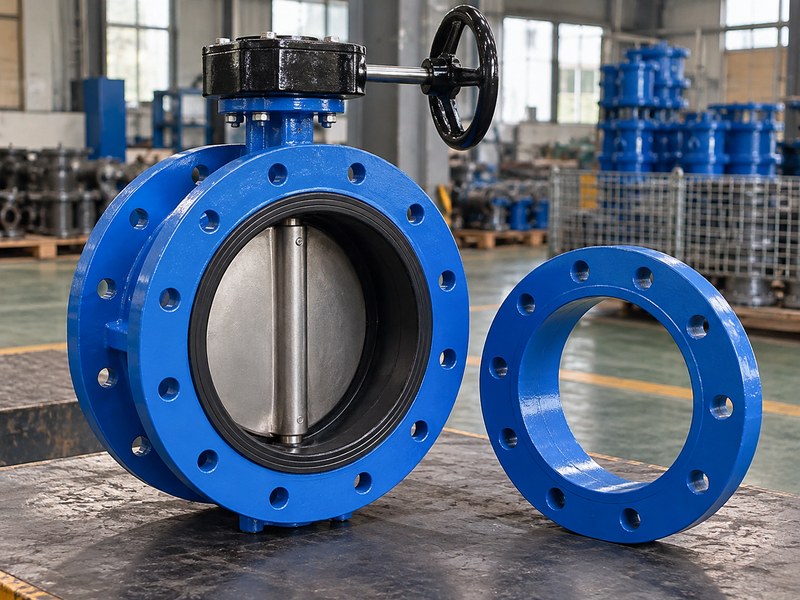
Check drilling, face-to-face length, mating bore, disc travel, and fastening details with ductile iron butterfly valve manufacturers before approving the installation drawing. Matching DN and PN labels leave several physical interfaces unresolved. A wafer disc can strike an adjacent pipe or flange bore even when the bolt pattern appears correct.
Review the assembled pipe joint
- Give the mating flange standard, pressure designation, bore, and pipe wall details.
- Verify disc clearance throughout travel and the required installation position.
- Check bolt lengths, engagement, tightening procedure, and support requirements.
RUITO's wafer face-to-face arrangement follows the applicable EN 558 Series 20 configuration. Flanged and U-type valves need their own approved dimensions. Lug end-of-line isolation requires a specifically accepted structure, differential rating, and test; do not infer it from the presence of threaded lugs.
| Interface | Drawing detail to confirm | Avoidable installation problem |
|---|---|---|
| Flange | Drilling and mating faces | Bolt or sealing mismatch |
| Bore | Disc opening envelope | Contact during travel |
| Face-to-face | Structure-specific dimension | Pipework gap mismatch |
| Lug fastening | Thread and effective engagement | Inadequate joint support |
Use the valve, mating flanges, fasteners, and pipe geometry in one installation review rather than accepting separate catalogue sketches.
7. What proves a coating is suitable?
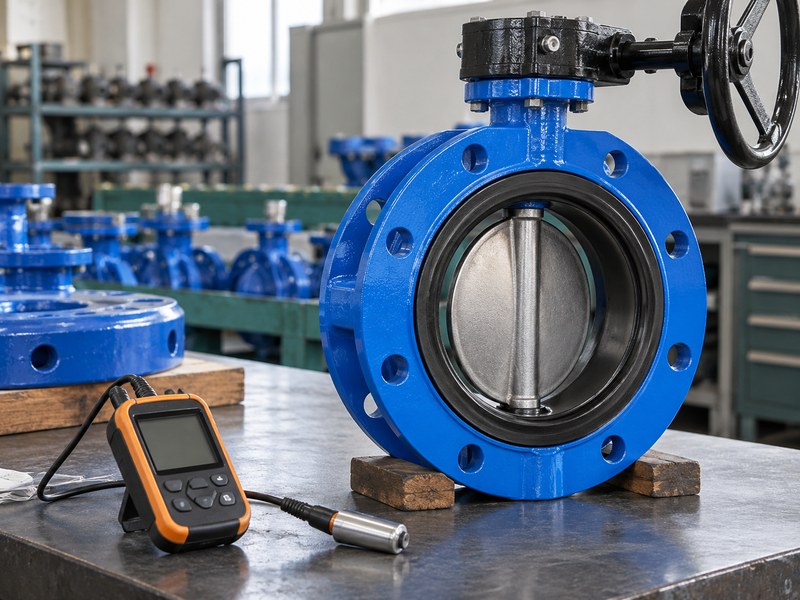
A coating is suitable when its approved system, application records, and inspection results match the intended exposure; ductile iron butterfly valve manufacturers should provide that connection. Thickness alone cannot establish adhesion, correct curing, or drinking-water contact suitability. Define the internal and external environments before selecting the coating product and inspection procedure.
Specify the condition beneath the finish
- Agree preparation, application, curing, and local thickness acceptance.
- Identify masked interfaces and the treatment of edges or difficult locations.
- Define repair methods and final inspection after handling and assembly.
RUITO's drinking-water configurations require review of every contact material, including coating, elastomer, and lubricant. Their stated drinking-water application is 5–40°C and no more than 10 barg, with the lower of approval and model pressure-temperature limits controlling. A general water design temperature does not expand that contact scope.
| Evidence | What you can check | Remaining boundary |
|---|---|---|
| Coating identification | Correct product and batch | Exact exposure suitability |
| Application log | Approved process followed | Inspection acceptance |
| Thickness report | Local measured values | Cure and surface condition |
| Contact documents | Model and material coverage | Destination and temperature |
Reinspect damaged lifting points and flange edges before packaging, then document any accepted repairs against the valve identity.
8. When does a low temperature package need review?
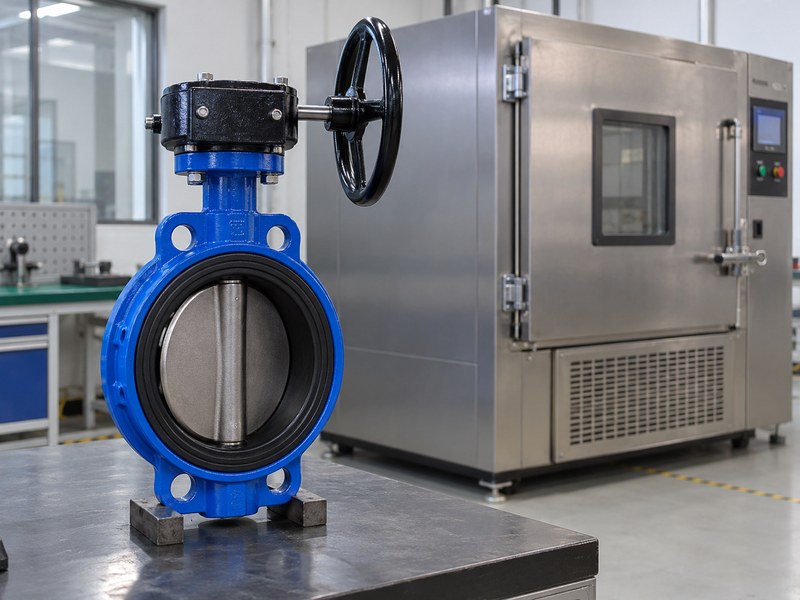
A low temperature package needs review whenever fluid or ambient conditions fall outside the accepted standard configuration, and ductile iron butterfly valve manufacturers must examine the entire assembly. Body toughness, elastomer behaviour, coating, lubrication, actuator function, and leakage can each limit suitability. An antifreeze mixture does not establish those properties for the valve.
State the coldest credible condition
- Provide minimum fluid and ambient temperatures, including shutdown exposure.
- Give glycol type, concentration, inhibitors, and verified freezing point.
- Request the agreed material, operation, and leakage validation at low temperature.
RUITO's defined low temperature wafer package covers DN50–300, PN10/16, a reviewed 40–45% by volume inhibited ethylene glycol solution, and a measured freezing point no higher than −20°C. Its stated operating envelope is −10–60°C at no more than 10 barg, subject to configuration review. It is not a valve for freezing water.
| Review item | Evidence needed | Purchasing consequence |
|---|---|---|
| Body material | Low temperature suitability | Grade may need revision |
| Seat compound | Cold operation and leakage | Standard compound may differ |
| Complete assembly | Agreed cold test procedure | Warm bench test insufficient |
| Fluid mixture | Composition and freezing point | Site mixture must match |
Keep low temperature packages under separate part numbers so ordinary stock cannot enter the order unnoticed.
9. How do ductile iron butterfly valve manufacturers test?
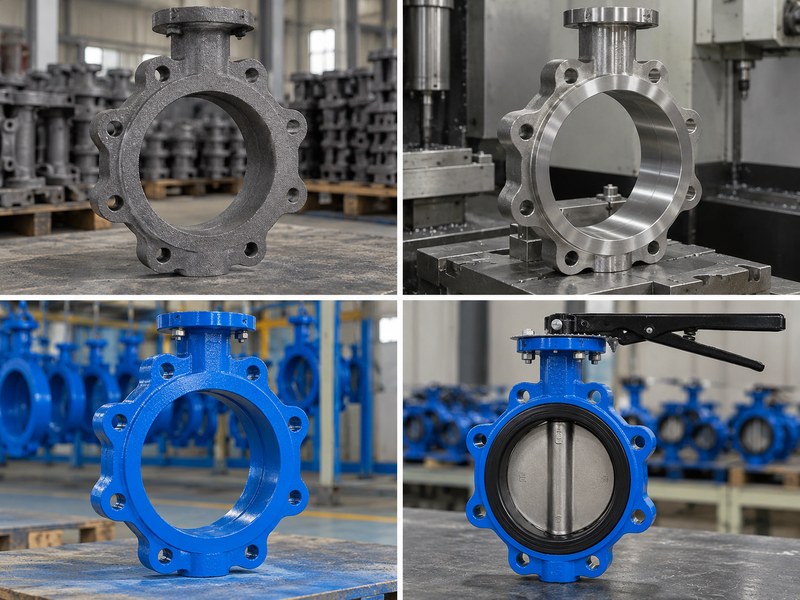
Shell testing should prove pressure boundary integrity, while seat testing should prove leakage performance under stated closure conditions; ductile iron butterfly valve manufacturers must record both. Neither result sets the working pressure-temperature rating. Select the governing test method and exact acceptance conditions in the order before the supplier schedules inspection.
Keep each acceptance question separate
- Record valve identity, medium, pressure, duration, direction, and result.
- Check calibrated instruments and the suitable restraint arrangement.
- Link repairs and repeat tests to the original product record.
For applicable RUITO PN16 soft seated configurations, 24 bar shell and 17.6 bar closure pressures are specified inspection inputs, subject to model and seat differential limits. A reverse closing rating can differ on a double offset valve. Clean gas service needs its specified gas leakage checks in addition to the relevant hydraulic programme.
| Test | Evidence established | Separate requirement |
|---|---|---|
| Shell | Pressure boundary under test | Service pressure-temperature curve |
| Seat | Leakage in stated direction | Other differential or direction |
| Functional | Travel and mechanical operation | Specified operating torque |
| Gas leakage, if required | Leakage with agreed test gas | Actual process suitability |
Use “no visible leakage” only with the agreed standard, test conditions, and acceptance designation attached.
10. How do you approve a repeatable production order?
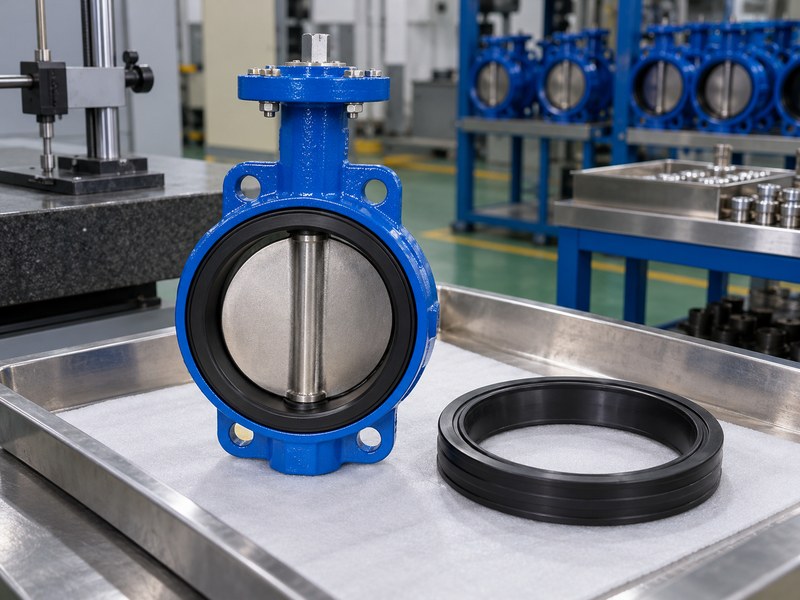
Approve a repeatable order by freezing documents, accepting a traceable sample, and closing deviations with ductile iron butterfly valve manufacturers before batch release. Record the material grade, seat compound, coating, interface drawing, operating method, and inspection revision. Repeat orders should cite that approved package rather than rely on an old quotation description; contact us to request a configuration review.
- Identify which material, process, or subcontractor changes require approval.
- Agree batch records, spare-seat identification, and inspection documents.
- Set release milestones around your installation or equipment schedule.
Questions to settle before the purchase order
Q1. Can I replace a specified iron grade with an equivalent?
Only after engineering review and written approval. Compare the governing specifications, required properties, casting conditions, and project requirements before accepting the substitution.
Q2. How do I know if a material certificate belongs to my valve?
Follow the heat or batch identification through the casting, machining work order, and finished product record. An unlinked certificate leaves that question open.
Q3. Can I use the same seat for water and mineral oil?
Only if the exact compound and both duties receive approval. RUITO manages its standard EPDM water and NBR mineral oil configurations separately.
Q4. Does a 24 bar shell test mean PN16 works at 24 bar?
No. That pressure is an applicable inspection condition. Service limits follow the configured valve's pressure-temperature rating and the other system constraints.
Q5. What is the best way to prevent repeat-order changes?
Use approved drawings and parts-list revisions with formal change notification. Require approval and any necessary verification before a changed component enters production.
Send RUITO your fluid data, required iron grade, mating flange details, coating requirements, and acceptance plan. Request a configuration review, traceability sample, and proposed inspection package before releasing the production order.