
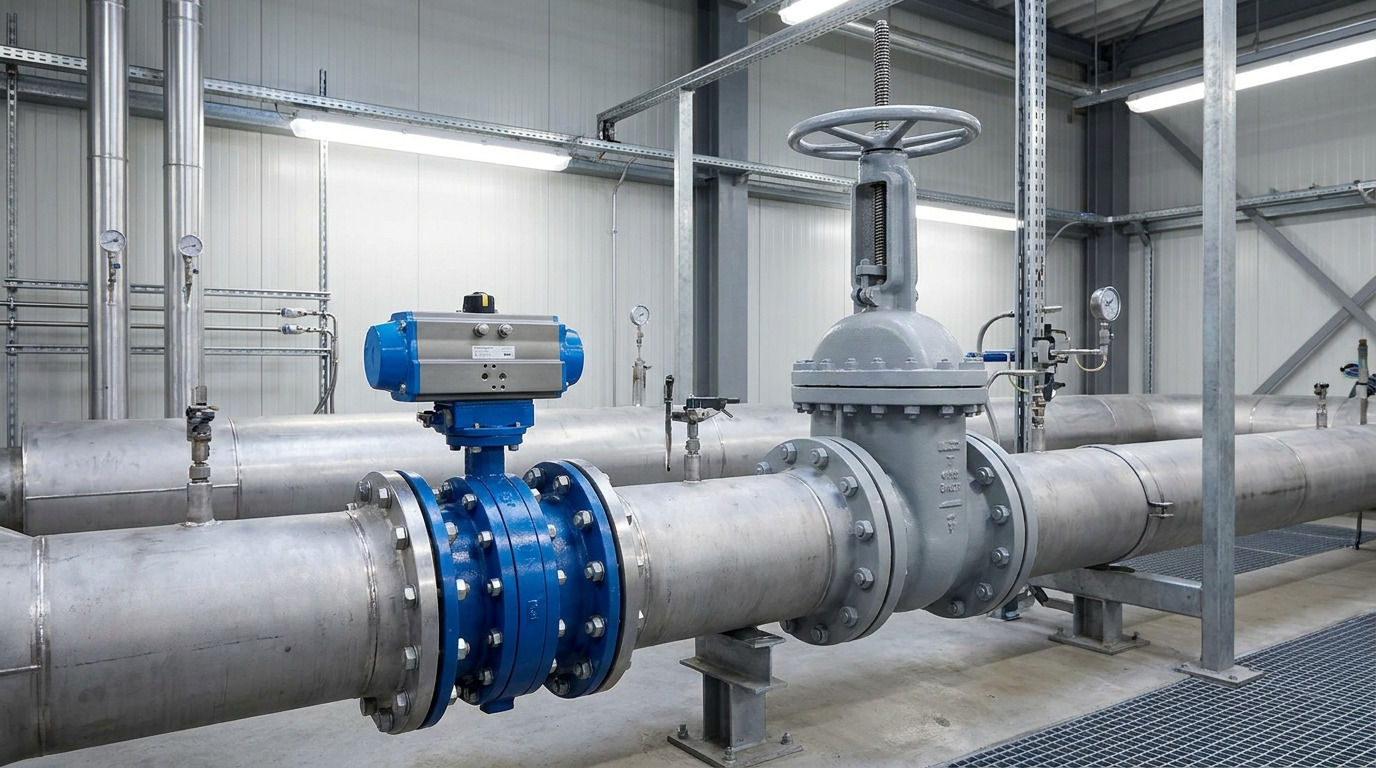
Selecting between a gate valve and a butterfly valve requires balancing pressure limits, physical space, media characteristics, and budget requirements to find the ideal match for your pipeline. Imagine you are designing an industrial pipeline and need reliable flow isolation. If you pick the wrong valve, you face catastrophic pressure drops, rapid seal wear, fluid leakage, and expensive unscheduled downtime that blows your budget. The definitive way to resolve this design dilemma is to analyze the core mechanical trade-offs of a butterfly vs gate valve to select the exact technology for your application.
What is a butterfly vs gate valve?
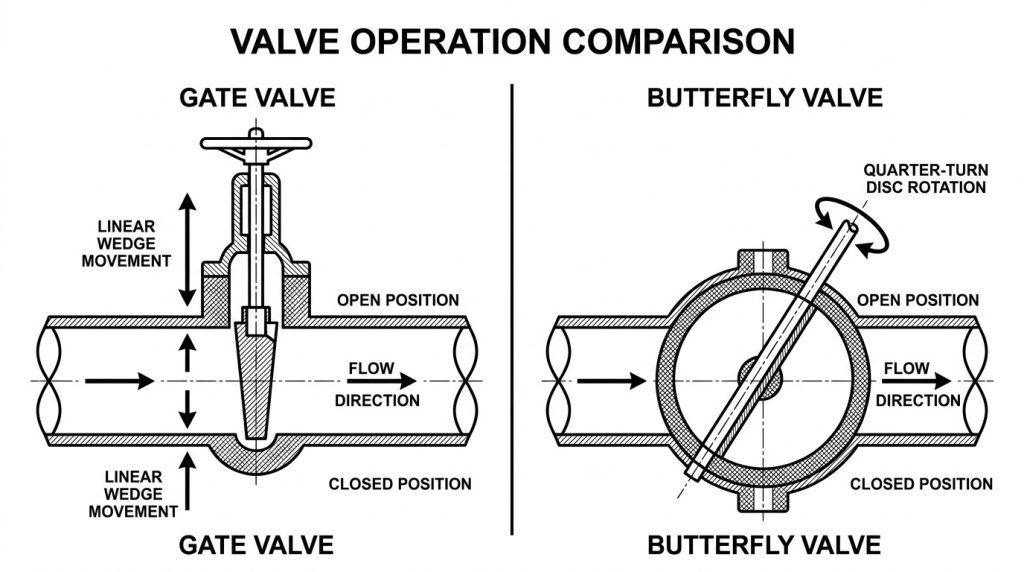
A butterfly valve is a compact, quarter-turn rotary device that uses a disc to regulate flow, while a gate valve is a multi-turn linear device that utilizes a sliding wedge to completely block or allow passage.
To fully grasp the mechanics of a butterfly vs gate valve, you must evaluate how flow paths are altered; for instance, a sliding wedge creates an unobstructed path, whereas a rotating disc remains directly inside the stream even when fully open.
How Do Quarter and Multi-Turn Valves Operate?
Let’s face it: the operating mechanism dictates the speed and efficiency of your fluid isolation. The gate valve requires multiple turns of a handwheel or stem to raise or lower the internal wedge, which makes it slow but safe from sudden pressure spikes. In contrast, the butterfly valve only requires a simple ninety-degree rotation to go from fully open to fully closed.
- Gate Valve: Slow, multi-turn linear motion that prevents water hammer.
- Butterfly Valve: Fast, quarter-turn rotary motion ideal for rapid isolation.
- System Footprint: Gate valves require vertical clearance, while butterfly valves fit in tight spaces.
| Parameter | Gate Valve | Butterfly Valve |
|---|---|---|
| Action Type | Multi-Turn Linear | Quarter-Turn Rotary |
| Obstruction | Unobstructed when open | Disc remains in flow path |
| Operation Speed | Slow | Rapid |
The structural difference in flow obstruction directly impacts the long-term hydraulic performance of your piping system.
Key Takeaway: Choose gate valves when you require an unobstructed, full-bore flow path, and opt for butterfly valves when quick operational cycles and compact footprints are your primary design drivers.
How does a butterfly vs gate valve seal?
A butterfly valve seals using a continuous elastomer or metal seat against its rotating disc, whereas a gate valve seals by wedging a flat or tapered gate into matching body seats.
Understanding how a butterfly vs gate valve handles sealing is essential because soft rubber components degrade much faster under high-velocity streams than metal-to-metal seating configurations. Metal-seated gate valves provide a robust barrier capable of meeting stringent API 598 standards in harsh industrial environments.
Which Valve Type Prevents Leakage Best?
The reality is: choosing between resilient (soft) and metal-to-metal seats will determine your system’s long-term leakage rates. Butterfly valves typically utilize elastomer liners to achieve bubble-tight shut-off in lower-pressure utility applications. Meanwhile, gate valves rely on heavy-duty wedge designs that can handle extreme chemical media without risking seal failure.
- Resilient Seats: Perfect for bubble-tight seals in low-temperature lines.
- Metal Seats: Designed for extreme temperatures and highly aggressive chemicals.
- Tightness Rating: High-performance designs in both types achieve zero-leakage standards.
| Sealing Aspect | Gate Valve | Butterfly Valve |
|---|---|---|
| Seat Material | Metal-to-Metal or Resilient | Elastomer, PTFE, or Metal (Offset) |
| Leakage Class | Class IV to VI (API 598) | Bubble-Tight (Class VI) |
| Seat Wear | Low during open/close | Moderate due to disc friction |
Evaluating the compatibility of seat materials with your media is the most critical step to prevent environmental leakage.
Key Takeaway: Use soft-seated butterfly valves for low-pressure, zero-leakage gas or water utility lines, but specify metal-seated gate valves for high-temperature and critical chemical processes.
Which butterfly vs gate valve holds pressure?
A gate valve is highly superior at holding high pressures because its sturdy wedge is fully guided and supported by the valve body, whereas a butterfly valve disc is subjected to bending forces in the flow path.
Testing standard compliance dictates which system pressure ratings can handle a butterfly vs gate valve without risking housing deformation, particularly in systems utilizing high-pressure isolation configurations. Standard rubber-lined models are typically constrained to lower pressure tiers, making heavy-duty gates the default choice for deep-well or high-pressure steam distribution.
What Are the Pressure Limits for Each Design?
Think about it: exposing a weak disk to high-pressure differentials can bend the stem and cause catastrophic system failure. Gate valves excel in heavy-duty setups because their design handles pressure loads symmetrically against the body guide rails. While high-performance triple-offset butterfly valves can manage elevated pressures, standard models remain limited.
- Standard Gate: Rated easily up to ASME Class 1500 and higher.
- Standard Butterfly: Typically limited to Class 150 or Class 300 ratings.
- Structural Deflection: Butterfly discs face high bending stress under high delta-P.
| Pressure Metric | Gate Valve | Butterfly Valve |
|---|---|---|
| Max Pressure Rating | ASME Class 2500+ | Typically up to ASME Class 600 (Triple Offset) |
| Stem Stress | Low (tensile/compressive) | High (torsional and bending) |
| Delta-P Limits | Excellent at high differentials | Limited on standard concentric models |
Analyzing the maximum pressure ratings prevents permanent shaft deformation and structural packing failure.
Key Takeaway: Always specify gate valves for applications exceeding 50 bar to ensure structural safety, reserving butterfly valves for low-to-moderate pressure water and utility lines.
Where is a butterfly vs gate valve installed?
A butterfly valve is installed in tight, space-constrained piping runs due to its narrow wafer or lug face-to-face dimensions, whereas a gate valve requires a wide installation envelope and significant vertical clearance for its rising stem.
When designing piping arrays, physical spacing dictates your selection of a butterfly vs gate valve because structural frameworks often lack the vertical clearance required to fully open a heavy-duty rising stem. Wafer-style designs slip effortlessly between standard ANSI flanges, eliminating the need for massive pipeline offsets.
How Do Spatial Footprints and Dimensions Compare?
The reality is: narrow pipe galleries and modular skid systems simply do not have the room for bulky multi-turn valves. Butterfly valves boast extremely short face-to-face dimensions, saving precious installation space and simplifying alignment. Conversely, gate valves demand significant structural support to accommodate their tall handwheel assemblies.
- Face-to-Face: Butterfly valves are up to 70% narrower than gate valves of the same bore size.
- Vertical Clearance: Non-rising stem gates save some space, but rising stems require massive clearance.
- Ease of Installation: Lightweight wafer configurations require fewer installers and less rigging.
| Installation Factor | Gate Valve | Butterfly Valve |
|---|---|---|
| Face-to-Face Standard | Long (ASME B16.10) | Ultra-short (API 609 / ISO 5752) |
| Vertical Clearance | High (rising stem clearance) | Minimal (compact stem and handle) |
| Flange Bolting | Standard circular flange | Through-bolt wafer or threaded lug |
Comparing spatial envelopes early in the piping layout phase prevents expensive field modifications and alignment issues.
Key Takeaway: Choose butterfly valves for skids, overhead lines, and narrow pipe galleries, while selecting gate valves only when spacious outdoor or open-concept plant areas allow for full stem travel.
Why compare butterfly vs gate valve weight?
Comparing the weight of these valves is crucial because butterfly valves are significantly lighter than gate valves, which reduces the structural load on your piping hangers and eliminates the need for expensive foundation supports.
When designing pipelines, calculating dead loads requires looking closely at a butterfly vs gate valve to ensure structural hanger ratings are compliant with ASME pipeline stress regulations. Massive cast-iron gate valves can easily strain joint connections, creating hazardous structural vulnerabilities over years of thermal expansion.
How Does Valve Weight Impact Piping Support?
Let’s face it: heavy piping components drive up your structural engineering costs and installation times. A large-diameter gate valve requires dedicated concrete piers or heavy-duty pipe hangers to prevent line sagging. Switching to a compact quarter-turn valve eliminates these expensive requirements, making your entire structural support network much lighter and cheaper.
- Weight Savings: Butterfly valves weigh up to 80% less than gate valves in sizes above DN300.
- Structural Impact: Lower weight reduces stress at flange joints during seismic or thermal events.
- Logistics Costs: Lighter valves are far easier and cheaper to ship, store, and lift into place.
| Size (DN) | Typical Gate Valve Weight | Typical Butterfly Valve Weight |
|---|---|---|
| DN150 (6″) | ~75 kg (165 lbs) | ~15 kg (33 lbs) |
| DN300 (12″) | ~280 kg (617 lbs) | ~45 kg (99 lbs) |
| DN600 (24″) | ~1,200 kg (2,645 lbs) | ~180 kg (396 lbs) |
This dramatic divergence in weight shows how component selection alters your structural foundation budgets.
Key Takeaway: Utilize lightweight butterfly valves in elevated or large-diameter pipelines to slash structural support costs, reserving heavy gate valves for underground bury or ground-level installations.
When to choose butterfly vs gate valve flow?
You should choose a gate valve when you require a high flow coefficient with zero restriction, and select a butterfly valve when you can tolerate moderate pressure drops in exchange for throttling capability.
Evaluating flow resistance is a critical phase of fluid engineering because choosing the wrong butterfly vs gate valve profile can lead to excessive pumping energy costs over time. A gate valve opens to reveal a completely unobstructed bore, making it the supreme choice for main transmission lines.
Which Design Minimizes Pressure Drop and Turbulence?
Think about it: every pound of pressure lost to valve friction forces your pumps to work harder, consuming precious electrical power. The butterfly disc sits permanently in the center of the flow stream, creating continuous turbulence and a permanent pressure drop. Conversely, a fully open gate valve acts exactly like a straight piece of pipe, offering zero resistance.
- Flow Coefficient ($C_v$): Gate valves possess exceptionally high $C_v$ values compared to butterfly options.
- Pumping Efficiency: Full-port gate valves optimize system hydraulics and lower long-term operating costs.
- Throttling Performance: Butterfly valves allow moderate throttling, while gate valves suffer severe seat damage if used to regulate flow.
| Hydraulic Characteristic | Gate Valve | Butterfly Valve |
|---|---|---|
| Flow Profile | Full-bore, completely clear | Obstructed (disc in stream) |
| Pressure Drop ($\Delta P$) | Near zero | Moderate |
| Throttling Suitability | Highly discouraged (vibration) | Acceptable for basic control |
Analyzing the hydraulic efficiency of your system helps prevent localized erosion and excessive energy consumption.
Key Takeaway: Specify gate valves for high-volume, continuous-flow mainlines where pressure drops must be kept to a minimum, and choose butterfly valves when mild throttling is needed.
Who benefits from butterfly vs gate valve cost?
Procurement managers and project engineers benefit most from the cost efficiency of butterfly valves, which are far more economical to manufacture, purchase, and install than heavy gate valves.
Project managers must assess the overall CapEx budget when selecting a butterfly vs gate valve, as the cost efficiency of wafer-style discs increases exponentially with larger bore configurations. For major municipal and wastewater installations, choosing a lightweight option can slash component acquisition costs by thousands of dollars per line.
Which Valve Delivers the Best Long-Term Value?
The reality is: every dollar saved during procurement must be weighed against potential long-term maintenance and replacement cycles. While butterfly valves require a much smaller upfront investment, their elastomer seats may need more frequent replacement in abrasive service. Gate valves demand higher upfront capital but offer an exceptionally long service life in heavy-duty environments.
- Acquisition Cost: Butterfly valves are significantly cheaper, especially in larger sizes.
- Installation Labor: Lighter weight means faster installation times and lower crew costs.
- Maintenance Lifecycle: Gate valves allow for easy seat refurbishment, while butterfly liners are often discarded.
| Financial Factor | Gate Valve | Butterfly Valve |
|---|---|---|
| Upfront Capital (CapEx) | High | Low to Moderate |
| Installation Expense | High (requires heavy rigging) | Low (easy handling) |
| Replacement Parts | Medium (seats can be rebuilt) | Low (liners are easily replaced) |
Evaluating the total cost of ownership ensures you balance short-term budgets with long-term system reliability.
Key Takeaway: Deploy butterfly valves to minimize upfront CapEx on large-scale municipal or HVAC projects, but invest in rugged gate valves for high-reliability process lines where downtime costs are extreme.
How does butterfly vs gate valve wear happen?
Butterfly valve wear occurs primarily through abrasive media eroding the soft elastomer seat and disc edges, while gate valve wear is characterized by frictional scraping on the sliding metal-to-metal wedge guide surfaces.
Analyzing how a butterfly vs gate valve wears out under erosive conditions is crucial for preventing dangerous process leaks and keeping your operations running smoothly. High-velocity slurries and solid particulates will rapidly scour away soft-seated discs, making robust wedge-style gates superior for sand and slurry pipelines.
What Causes Component Erosion in Erosive Media?
Let’s face it: aggressive fluids will ruthlessly destroy internal components if your valve materials are not perfectly matched to the media. When a butterfly valve is partially open, the high-velocity stream crashes directly into the disc, causing severe localized cavitation and erosive wear. Gate valves keep their sealing elements safely out of the flow stream, protecting them from continuous media abrasion.
- Erosive Mechanics: Continuous disc exposure causes turbulence-induced erosion in butterfly valves.
- Sliding Friction: Metal wedges in gate valves experience mechanical friction during open/close strokes.
- Slurry Compatibility: Knife gate valves are specifically designed to slice through thick slurry particles.
| Wear Parameter | Gate Valve | Butterfly Valve |
|---|---|---|
| Primary Wear Cause | Metal friction & sliding abrasion | Elastomer degradation & disc erosion |
| Slurry Tolerance | High (especially Knife Gates) | Poor (solids tear elastomer seats) |
| Cavitation Risk | Low (when fully open) | Moderate (when throttled) |
Understanding these degradation mechanisms is vital to selecting a valve that won’t fail prematurely.
Key Takeaway: Specify hard-faced gate valves (or knife gates) for abrasive slurry and high-solid applications, leaving butterfly valves for clean, non-abrasive liquid and gas streams.
Why avoid butterfly vs gate valve water hammer?
You must avoid fast-closing quarter-turn butterfly valves in long pipelines to prevent water hammer, whereas the multi-turn slow closure of a gate valve inherently mitigates destructive pressure surges.
Water hammer represents a major threat to pipeline integrity, and selecting a butterfly vs gate valve requires deep consideration of how quickly you plan to shut down your fluid flow. If a high-velocity liquid stream is halted too rapidly by a swift quarter-turn disk, the resulting kinetic shockwave can rupture joints, destroy pumps, and buckle pipe walls.
Which Valve Geometry Prevents Destructive Surges?
Think about it: a sudden pressure wave traveling through your pipes at the speed of sound can easily cause thousands of dollars in equipment damage. Because gate valves operate via a fine-threaded stem, they require many complete revolutions of the handwheel to close, which naturally slows down fluid deceleration. This gradual shut-off absorbs the kinetic energy safely, keeping your entire piping structure secure.
- Closing Profile: Gate valves provide an inherently slow, linear closing curve.
- Actuation Risk: Solenoid or pneumatic actuators on butterfly valves can trigger instant, dangerous shutoffs.
- Surge Control: Slow-closing multi-turn valves protect downstream instrumentation from shockwaves.
| Dynamic Feature | Gate Valve | Butterfly Valve |
|---|---|---|
| Inherent Closing Speed | Slow (Multi-Turn) | Rapid (Quarter-Turn) |
| Water Hammer Risk | Extremely Low | Moderate to High (with fast actuators) |
| Shock Mitigation | Natural and passive | Requires slow-gear or damping actuators |
Managing closing speeds carefully is a crucial engineering practice to preserve the physical life of your pipeline systems.
Key Takeaway: Use slowly operated gate valves on long, high-velocity liquid mainlines to eliminate the risk of water hammer, and fit butterfly valves with slow-acting gear operators when used in liquid service.
How to clean a butterfly vs gate valve line?
You can clean a gate valve line using mechanical pigging pigs because its fully open bore is completely unobstructed, whereas a butterfly valve line cannot be pigged because the central disc and shaft block the pipe.
Mechanical cleaning and system maintenance require a careful evaluation of a butterfly vs gate valve because pigging tools will become jammed or damaged if they strike an internal disk. For pipelines that carry crude oil, wastewater, or solid-forming chemical mixtures, maintaining an unhindered inner diameter is non-negotiable.
Which Option Is Fully Compatible with Pigging?
The reality is: sending a cleaning pig down a line with a butterfly valve will result in a catastrophic blockage and require you to cut open the piping. Gate valves allow the pig to travel completely unimpeded, removing buildup, paraffin, and debris without any risk of getting stuck. If your process requires routine mechanical purging, you must plan your valve selection around this maintenance reality.
- Pigging Capability: Gate valves are 100% compatible with pipeline cleaning pigs.
- Obstruction Hazard: The central disk and stem of a butterfly valve completely split the flow path.
- Maintenance Efficiency: Unobstructed bores prevent the accumulation of stagnant media and simplify flushing.
| Cleaning Aspect | Gate Valve | Butterfly Valve |
|---|---|---|
| Pigging Compatibility | Yes (Fully compatible) | No (Completely blocked by disk) |
| Debris Accumulation | Low (unobstructed flow) | High (slurry can collect behind disk) |
| Bore Clearance | Full-port opening | Split-stream opening |
Matching your valve choice to your long-term cleaning and purging protocols prevents massive maintenance headaches.
Key Takeaway: Specify full-port gate valves for any pipeline system that requires mechanical pigging or regular line swabbing to ensure smooth maintenance operations.
Making the Definitive Choice for Your Pipeline
Selecting the ideal flow control device requires balancing operational pressures, fluid properties, spatial footprints, and financial budgets. This guide has resolved the critical engineering dilemmas surrounding valve geometry, weight limits, flow coefficients, and pipeline cleaning compatibilities to help you make an informed decision. At Ruito Flow, we specialize in delivering high-integrity valve solutions engineered to withstand the most demanding operating conditions across global industries.
To secure the performance of your system, minimize operational downtime, and receive a customized technical evaluation tailored to your specific process parameters, contact us today to speak with our application specialists. We are committed to pushing the boundaries of flow control excellence and serving as your trusted partner in precision industrial engineering.
Frequently Asked Questions
Can I use a butterfly valve in a high-pressure line?
Yes, you can, but only if you select a high-performance double or triple-offset butterfly valve designed to handle higher pressure classes. Standard concentric, rubber-lined butterfly valves are limited to low-pressure applications and will fail under high delta-P conditions where a rugged gate valve is much safer.
What’s the best valve option for abrasive slurries?
No single standard valve is perfect, but a knife gate valve is the absolute best option for managing abrasive slurries. The knife-like gate easily cuts through suspended solids to seal tightly, whereas slurry particles will rapidly erode the soft elastomer seat of a butterfly valve disk and cause leakage.
How do I know if my system requires bi-directional flow control?
You will know your system requires bi-directional flow control if there is any risk of backflow, pressure reversals, or dual-source feeding within the pipeline. Gate valves are naturally bi-directional by design, whereas many high-performance butterfly valves are uni-directional and will fail to seal if installed backwards.
Can I automate both butterfly and gate valves for remote operations?
Yes, you can automate both types using electric, pneumatic, or hydraulic actuators. However, quarter-turn butterfly valves require much less operating torque than multi-turn gate valves, allowing you to use smaller, lighter, and far more cost-effective actuators.