
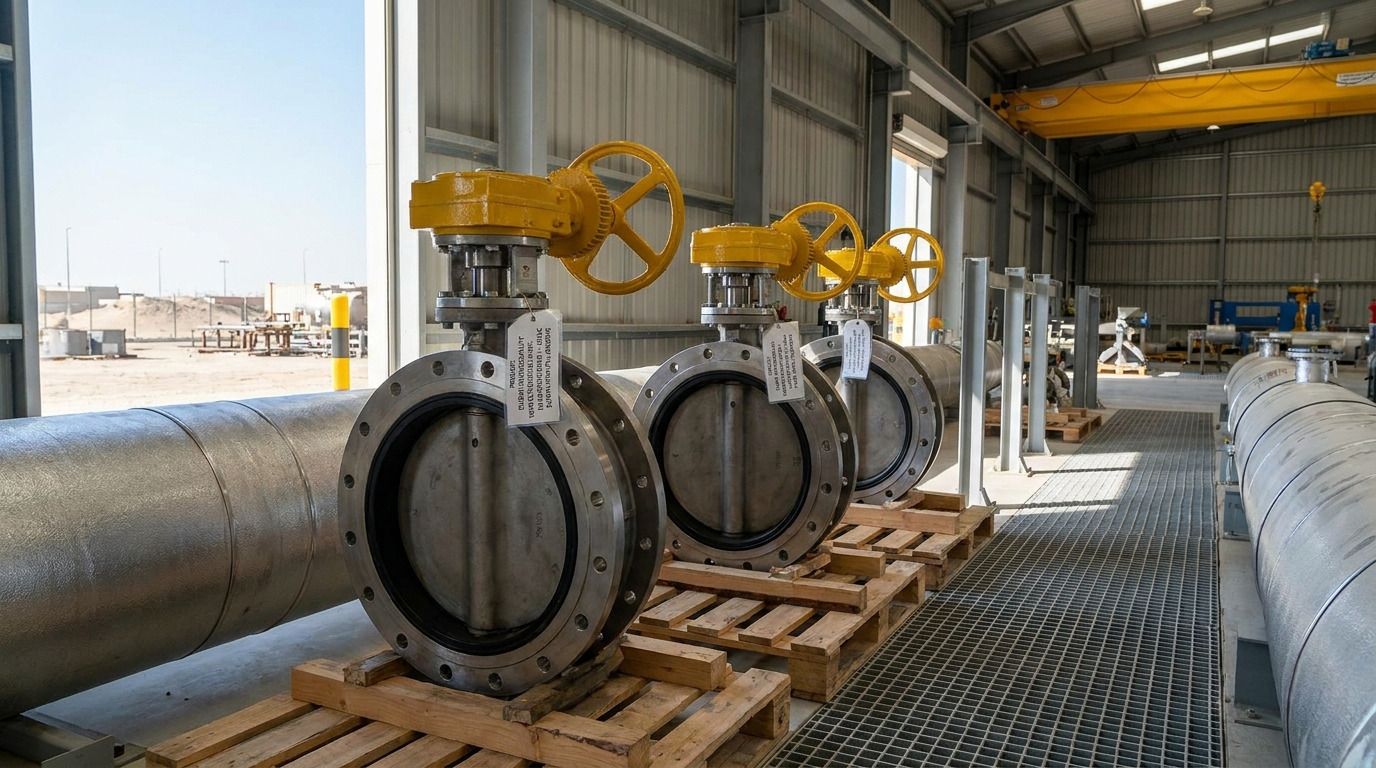
The butterfly valve suppliers in Dubai worth shortlisting are those that can prove the requested configuration, test scope, documentation, delivery basis, and after-sale responsibility before you award the purchase order. A reliable Dubai supplier should let you compare its offer against a defined industrial butterfly valve range, not a vague claim that every model is available.
Dubai buyers normally have three sourcing routes: local stock, a regional engineering distributor, or a factory-direct manufacturer. The right route depends on whether you need an urgent standard replacement, a locally coordinated package, or project-specific valves with controlled materials and documentation.
What Should Butterfly Valve Suppliers in Dubai Provide?
Butterfly valve suppliers in Dubai should provide an exact technical offer, verifiable quality records, a realistic delivery basis, and a named party responsible for resolving deviations.
A complete offer should identify:
- Valve type and design: concentric, double-offset, or triple-offset.
- Size, pressure rating, body pattern, and face-to-face standard.
- Body, disc, stem, seat, coating, and fastener materials.
- Manual, pneumatic, electric, or hydraulic operation.
- Design, inspection, testing, and flange standards.
- Available stock or manufacturing status for each line item.
- Required drawings, material certificates, test reports, manuals, and certificates of conformity.
- Incoterm, shipment point, delivery scope, warranty, and technical-support boundary.
Do not treat a catalog, brand authorization letter, or ISO certificate as proof that the quoted valve fits your service. Those documents answer different questions. The quotation still needs to connect the offered configuration to your fluid, temperature, differential pressure, operating frequency, flange system, and shutoff requirement.
Key takeaway: A supplier becomes shortlist-ready when every commercial line item can be traced to a technical datasheet and every required certificate has a named deliverable.
Which Supplier Route Fits Your Purchase?
The best supplier route is the one whose operating model matches your delivery risk and engineering scope.
Use this matrix to decide which companies should receive the RFQ.
| Supplier route | Best fit | Evidence to request | Main limitation to control |
|---|---|---|---|
| Dubai stockist | Standard emergency replacements and MRO | Stock photo or serial list, age and storage condition, datasheet, test record | Available model may not match the complete project specification |
| Regional engineering distributor | Multi-brand packages and local coordination | Manufacturer authorization, named factory, document responsibility, local support scope | Technical and commercial responsibilities may be split |
| Factory-direct manufacturer | Custom materials, large quantities and controlled project documentation | Factory scope, drawings, manufacturing plan, inspection plan, traceability records | Manufacturing and international transit must be planned |
| Hybrid route | Standard valves from local stock plus custom units from a factory | One consolidated schedule showing source and responsibility for every item | Mixed documents and warranties can create interface gaps |
Local stock is valuable only when the exact valve is verified. “DN200 PN16 available” is not enough if the line also requires a specific face-to-face dimension, disc material, bidirectional shutoff, actuator torque, coating system, or end-user document package.
A transparent factory-direct option
RUITO’s published manufacturing and export scope identifies the company as a China-based, export-oriented manufacturer. RUITO is not presented as a Dubai stockist and does not claim local installation or localized field service.
Its relevant role is factory-direct supply for EPC, OEM and project orders that require controlled materials, custom interfaces, batch consistency and export documentation. This distinction lets a Dubai buyer compare RUITO fairly against local stock and regional support options.
Key takeaway: Do not ask every supplier to behave like a stockist. Select the channel first, then judge whether that channel has proved the capability it claims.
What Must Go Into the RFQ Before You Compare Quotes?
A comparable RFQ must define the service, valve configuration, evidence package and delivery scope before suppliers calculate price.
Define the service conditions
State the medium, normal and maximum temperature, operating and design pressure, maximum differential pressure, solids or chloride exposure, flow duty, shutoff direction and expected operating frequency. If the valve will throttle, provide the design flow and acceptable pressure drop rather than asking for a pipe-size valve by default.
Also identify whether the service is clean water, district cooling water, seawater, wastewater, chemical duty, hydrocarbon service or another process medium. Material compatibility cannot be confirmed from nominal size and pressure class alone.
Lock the valve and interface data
Give the supplier enough information to confirm mechanical fit:
- DN or NPS and pressure class;
- wafer, lug or double-flanged body;
- flange standard and drilling;
- face-to-face requirement;
- body, disc, stem and seat preferences;
- fail-open, fail-close or fail-in-place action;
- available air supply or electrical power;
- control signal, accessories and hazardous-area requirements;
- installation orientation and surrounding space.
State the commercial and QA scope
The following RFQ table prevents apparently similar quotations from hiding different supply scopes.
| RFQ field | Required buyer action | Risk signal |
|---|---|---|
| Quantity and schedule | Separate urgent, standard and custom items | One delivery date is applied to every configuration |
| Inspection scope | State review, witness and hold points | Testing is described only as “standard” |
| Documents | List drawings, MTCs, test reports, manuals and certificates | Documents are promised without document names |
| Spare parts | Specify commissioning and operating spares | Supplier excludes seats or actuator parts without notice |
| Delivery basis | Request the same Incoterm from all bidders | One quote excludes freight or export packing |
| Deviations | Require a clause-by-clause deviation list | Supplier silently substitutes materials or standards |
Once these fields are fixed, compare compliant offers first. A lower-priced deviation is not a saving until engineering has accepted its effect.
Which Valve Configuration Suits Dubai Projects?
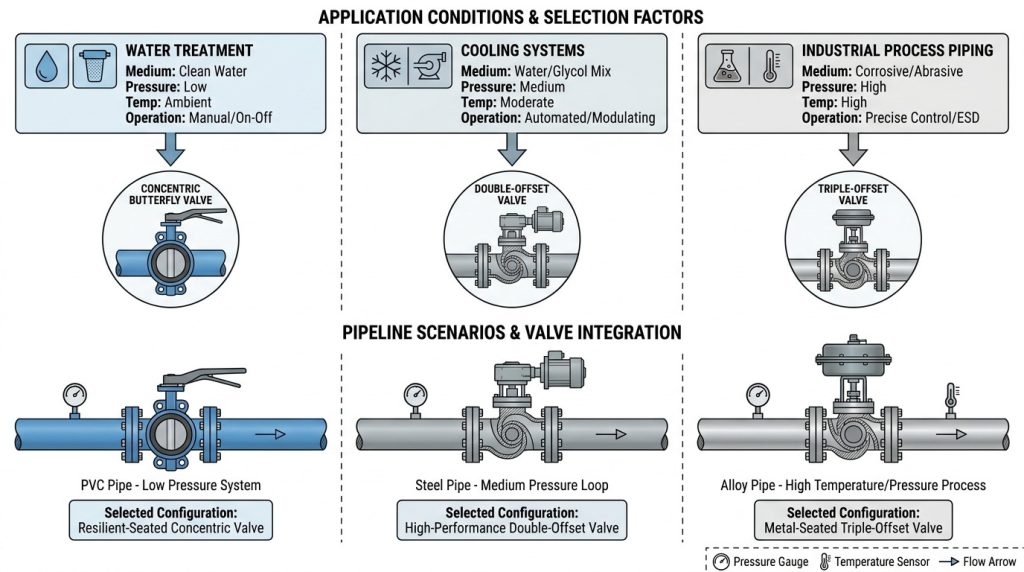
The suitable configuration depends on the medium, isolation duty, pressure differential, cycling rate and project standard—not on the supplier’s most convenient inventory.
This application table identifies the decisions that should appear in the quotation.
| Application | Starting configuration | Material focus | Question the supplier must answer |
|---|---|---|---|
| District cooling and HVAC | Concentric or double-offset, depending on duty and cycling | Compatible elastomer, corrosion protection, actuator torque | Will the valve close at maximum differential pressure? |
| Municipal water and wastewater | Resilient-seated butterfly valve or application-specific eccentric design | Potable-water compatibility, coating, solids exposure | Which document proves the offered materials and coating? |
| Seawater cooling | Corrosion-resistant disc and stem with compatible body protection | Chloride resistance and bidirectional sealing | How were materials, coating and seat leakage verified? |
| Oil, gas and process service | Double- or triple-offset when temperature, pressure or shutoff duty requires it | Process-compatible trim, seat and fire-safe scope where specified | Which design and test standard applies to this exact configuration? |
| Chemical service | PTFE, compatible elastomer or metal seat as the medium requires | Chemical compatibility across wetted parts | Has the supplier reviewed concentration and temperature together? |
For district energy service conditions, buyers should pay particular attention to treated-water compatibility, operating frequency, available actuator torque and installation space. In water and wastewater applications, the media can range from potable water to chemical dosing and solids-bearing sludge, so a single material combination cannot cover every node.
RUITO’s published butterfly-valve scope covers DN25–DN3000 and PN10–PN25, with wafer, lug and flanged configurations. Published material options include ductile iron, carbon steel, stainless steel and duplex bodies; EPDM, NBR, PTFE, FKM and metal seats; and coated ductile iron, stainless steel, aluminum-bronze and duplex discs. Each proposed combination still requires application review.
A first-party Gulf seawater cooling project provides a useful evidence pattern: PN16 concentric valves used coated ductile-iron bodies, corrosion-resistant plate and stem materials, confirmed DIN/EN interfaces, 1.5-times-pressure shell tests, bidirectional sealing checks and protected batch packaging. The value is not that one configuration fits every Gulf project; it is that materials, interfaces, testing and delivery were treated as one approval chain.
Key takeaway: Specify the operating problem first. Valve structure and materials should follow the service conditions, not the supplier’s stock list.
How Should You Verify Quality and Documentation?
You should verify quality by matching physical valve identity to approved drawings, material records and completed test results.
Evidence to approve before the PO
Before placing the order, request:
- Technical datasheet and dimensional drawing;
- Bill of materials identifying wetted components;
- Applicable design and testing standards;
- Inspection and test plan;
- Proposed material traceability format;
- Coating specification when corrosion protection matters;
- Actuator sizing calculation for actuated valves;
- Document register with submission dates;
- Written list of all deviations.
When a process specification calls for API requirements, the official API standards plan identifies API 609 as the butterfly-valve standard and API 598 as Valve Inspection and Testing. Do not accept “API compliant” without confirming which standard, edition, valve category and test acceptance criteria apply.
For rubber-seated valves in qualifying water service, the official AWWA standards list identifies AWWA C504 as Rubber-Seated Butterfly Valves. Use it only when the project specification and application require that standard.
Evidence to close before shipment
RUITO’s published quality-control outline describes spectral verification of incoming metals, dimensional checks of critical interfaces, hydrostatic shell testing and seat-leakage testing. It also states that the shell is tested at 1.5 times rated pressure for at least five minutes, while soft-seated valves receive a 6 bar air seat test. These are RUITO’s published process details, not universal acceptance criteria for every project.
Before shipment, close the evidence loop by checking that:
- Heat or batch references match the material documents;
- Valve size, rating, materials and tag number match the approved drawing;
- Pressure and seat-test results identify the tested valve or batch;
- Test equipment calibration is valid for the inspection date;
- Coating records match the approved system where applicable;
- Actuator accessories and fail action match the control datasheet;
- Nameplate or serial identity matches the final document package;
- Packing and flange protection match the transport route.
Key takeaway: A certificate is useful only when it identifies the supplied valve and proves the requirement that prompted the certificate.
When Does Local Stock Beat Factory-Direct Supply?
Local stock beats factory-direct supply when the requirement is urgent, standard, physically verified and available with the necessary documentation.
Use local stock for a shutdown replacement when the supplier can confirm the exact body pattern, interface, materials, storage condition, actuator and test records. If any critical field differs, engineering must approve the deviation before collection or dispatch.
Factory-direct supply is usually stronger when the order needs custom materials, non-standard dimensions, project-specific testing, controlled batch production or a coordinated document dossier. RUITO states that it holds buffer stock for common items, typically produces custom items in 15–25 days and can start urgent production within 72 hours. These are manufacturing-stage targets that must be reconfirmed in the quotation; they do not include international transit, customs clearance or local delivery.
A hybrid route often works best for large projects: obtain genuinely standard urgent units from verified Dubai stock while placing custom or documentation-heavy items with the factory. Assign one party responsibility for interfaces, document consistency and warranty boundaries.
The Dubai Supplier Evidence Gate
The Dubai Supplier Evidence Gate is a five-stage pass, hold or reject framework for preventing incomplete offers from entering commercial comparison.
Use the following gate before issuing a technical recommendation.
| Gate | Pass condition | Hold or reject signal |
|---|---|---|
| Application fit | Media, temperature, pressure, differential pressure and duty are reviewed | Supplier selects from size and pressure alone |
| Interface fit | Flange drilling, face-to-face, actuator mounting and space are confirmed | Drawing is missing or marked generic |
| Evidence fit | Materials, standards, tests and documents are named | “Certificates available” without a document register |
| Delivery fit | Stock, production, transit and local delivery are separated | One unsupported delivery promise covers every stage |
| Commercial fit | Incoterm, exclusions, spares, warranty and deviation responsibility are clear | Lowest price depends on hidden exclusions |
If an offer fails one gate, place it on hold and request the missing evidence. Reject it when the supplier changes materials without disclosure, refuses traceability, cannot identify the factory behind a manufacturer claim, or will not document a critical deviation.
This method prevents commercial urgency from overriding technical approval while still allowing qualified stockists and factories to compete on their real strengths.
Frequently Asked Questions About Dubai Valve Sourcing
Can I buy from an overseas manufacturer for a Dubai project?
Yes, provided the project accepts that sourcing route and the manufacturer can supply the required technical, inspection and import documents. Confirm who controls freight, customs, local delivery, commissioning support and warranty communication before placing the order.
What is the best supplier type for an emergency replacement?
A verified local stockist is usually the best starting point for a standard emergency replacement. Match the existing nameplate, drawing, flange interface, materials and actuator requirements before accepting a valve from stock.
How do I know whether a quote matches my flanges?
Compare the offered flange standard, pressure class, drilling, face-to-face dimension and body pattern with the piping drawing. Request a dimensional drawing and resolve every mismatch before purchase rather than relying on nominal size.
What Else Do Buyers Ask Before Ordering?
Two additional questions commonly decide whether a technically acceptable offer is also commercially safe.
Should I require API 609 for every butterfly valve?
No, the required standard must follow the project specification and application. API 609 may be relevant to specified industrial butterfly valves, while water projects may call for AWWA or EN requirements; do not add a standard that conflicts with the end-user specification.
Can I compare suppliers by unit price alone?
No, compare the compliant landed scope instead. Include the valve, actuator, accessories, testing, inspection, documents, export packing, freight basis, spares, warranty and cost of resolving deviations.
Next Steps for a Verifiable Quote
A defensible supplier decision combines the right sourcing route, a complete RFQ, an application-matched valve configuration and traceable evidence. It also distinguishes immediate Dubai stock from factory-direct engineering instead of treating them as interchangeable services.
RUITO can review your datasheet, operating conditions, materials, standards, documentation scope and delivery requirements as a China-based export manufacturer. To receive a configuration review and itemized proposal, send your RFQ and operating data.