
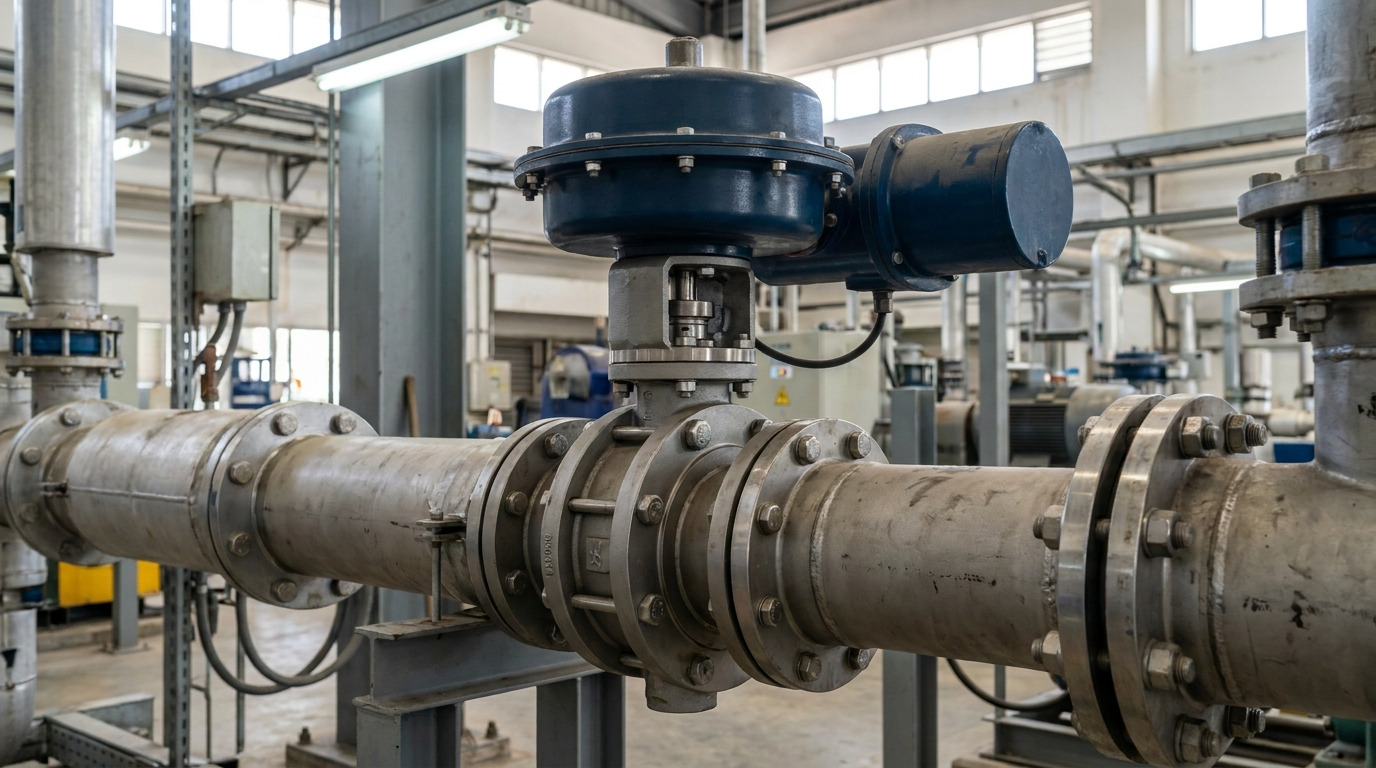
Choosing between a concentric butterfly valve and an eccentric butterfly valve depends on your system’s operating pressure, temperature limits, and sealing requirements. Plant designers often specify low-cost concentric valves for general water service, assuming they can handle harsher environments. However, applying these standard resilient-seated valves in high-pressure steam, hydrocarbons, or aggressive chemicals leads to catastrophic seal failure. When an elastomeric liner degrades, it causes rapid process fluid leakage and unplanned system shutdowns. Upgrading your process architecture to a high-performance eccentric butterfly valve removes the localized friction that destroys traditional seals, ensuring bubble-tight isolation and lasting durability in severe conditions.
What is an eccentric butterfly valve design?
An eccentric butterfly valve design features a shaft that is offset from the center of the disc and the valve body to minimize friction. By moving the shaft away from the sealing centerline, you can prevent the disc from rubbing continuously against the seat. This geometry changes the contact mechanics from a continuous sliding action to a smooth, cam-like sealing engagement. As a result, you achieve tighter sealing with a fraction of the wear seen in standard designs.
What are concentric valve basics?
Concentric designs feature a stem that passes directly through the centerline of both the disc and the valve body. You will typically find these valves in low-pressure utility lines where simple elastomeric liners provide the sealing force.
Let’s face it:
- Continuous friction occurs across the entire 360-degree rotation of the disc.
- Elastomer wear increases rapidly due to constant compression during opening and closing cycles.
- Pressure limits remain low because the soft seat cannot handle high mechanical stress.
How do offsets define eccentric models?
Eccentric models use strategic offsets to separate the shaft axis from the valve centerline. By placing the shaft behind and to the side of the sealing plane, you allow the disc to lift cleanly away from the seat.
But that’s not all:
- Single offset designs shift the shaft axis behind the sealing plane to ease initial compression.
- Double offset designs move the shaft off-center from both the disc and flow paths to eliminate rubbing.
- Triple offset designs add an angled, cone-shaped seating geometry for frictionless mechanical sealing.
| Metric | Concentric Design | Eccentric Design |
|---|---|---|
| Shaft Position | Co-axial with disc | Offset along X and Y axes |
| Seat Material | Elastomer / Rubber | PTFE, RTFE, or Metal-to-Metal |
| Friction Angle | Continuous 360-degree contact | Minimal contact until closure |
Evaluating these structural profiles allows you to choose the correct mechanical setup for your pipeline’s stress levels.
Key Takeaway: While concentric designs rely on continuous mechanical compression to seal, offset eccentric geometry eliminates seat friction during travel to maximize hardware life.
How does an eccentric butterfly valve function?
An eccentric butterfly valve functions by rotating an offset disc so that it contacts the seat only at the final point of closure. This kinematic approach changes how the internal components interact when you initiate a stroke. The double or triple offset shaft configuration acts like a cam, lifting the disc away from the seat instantly. Because of this movement, you do not have to worry about the disc scraping against the sealing surface.
The kinematics of eccentric disc movement
The kinematics of an offset disc create an eccentric rotation path rather than a pure circular pivot. When you open the valve, the disc swings out and away from the seat immediately.
Think about it:
- Instant clearance prevents the disc from dragging across the seat material during the stroke.
- Cam-like action converts rotational force into direct axial sealing pressure at the end.
- Unobstructed flow paths are achieved quickly as the disc clears the main seal zone.
Why is disc friction eliminated?
Disc friction is eliminated because the offsets prevent continuous contact throughout the 90-degree operating cycle. You will notice that the seat only experiences compression during the last few degrees of closure.
Look at this:
- Reduced wear extends the service life of both soft and metal seats.
- Lower torque requirements allow you to use smaller and more affordable actuators.
- Consistent sealing is maintained over thousands of cycles without manual adjustment.
| Operating Phase | Concentric Torque Profile | Eccentric Torque Profile |
|---|---|---|
| Breakout | Very high due to liner squeeze | Moderate mechanical torque |
| Mid-stroke Travel | High frictional resistance | Near-zero friction |
| Seating | Pure compression | Cam-action torque seating |
Analyzing these mechanical torque profiles shows why offset kinematics perform better under continuous operation.
Key Takeaway: Because the disc clears the seat almost instantly during opening, eccentric valves suffer virtually zero seat wear during travel compared to concentric options.
Why select an eccentric butterfly valve over others?
You should select an eccentric butterfly valve because it tolerates higher pressures and temperatures than traditional concentric models. Standard concentric designs are highly vulnerable to high velocities, severe temperatures, and aggressive chemicals. Choosing an eccentric butterfly valve gives your piping system the structural stability it needs to survive demanding chemical lines. This design maintains tight sealing even when thermal cycles cause physical pipes to expand or contract.
Handling higher pressure ratings
Industrial piping lines often experience sudden pressure spikes that destroy standard rubber-lined valves. Offset designs feature robust physical bodies and reinforced shafts that easily manage severe system pressures.
Here is why:
- Higher pressure limits let you run systems at ANSI Class 150, 300, or 600 ratings.
- Blowout-proof shafts ensure operator safety by preventing dangerous stem displacement under pressure.
- Sturdy disc construction resists bending or warping when facing high differential pressures.
Longevity under severe cycling conditions
Frequent cycling will degrade typical soft-seated concentric valves within a matter of weeks. The offset geometry protects the seal interface, ensuring your system continues to isolate tightly after thousands of operations.
Look at this:
- Extended service cycles reduce the frequency of shut-off failures in critical lines.
- Stable seating torque remains constant over the lifespan of the valve assembly.
- Decreased maintenance means you spend less time replacing torn or deformed seats.
| Performance Metric | Concentric Valve Standard | Eccentric Valve Standard |
|---|---|---|
| Pressure Limit | PN10 to PN16 maximum | PN25 up to PN100 (Class 600) |
| Temperature Range | -10°C to +120°C max | -196°C up to +600°C |
| Cycle Life | 10,000 to 50,000 runs | Over 500,000 runs |
Evaluating these performance metrics demonstrates why high-performance valves are preferred for demanding chemical lines.
Key Takeaway: Selecting offset designs for harsh processes prevents premature seat blowout, cutting maintenance costs and protecting process uptime.
Where does an eccentric butterfly valve perform best?
An eccentric butterfly valve performs best in heavy-duty utility pipelines, petrochemical processing plants, and marine systems. These applications expose valves to rapid flow velocities, corrosive fluids, and extreme environmental conditions. While standard concentric valves struggle in these harsh areas, the offset design easily resists internal wear. You will find that these valves maintain bubble-tight isolation where other options fail completely.
High-integrity water treatment systems
High-pressure water treatment facilities require reliable isolation valves to protect downstream filters and pump networks. You need a robust valve to handle raw intake water that contains abrasive grit or corrosive salt.
Let’s face it:
- Abrasive resistance prevents suspended solids from wearing down the seating surface.
- Corrosion-proof trims ensure that brackish water does not degrade internal components.
- Consistent isolation protects sensitive filtration equipment from unexpected backflow surges.
Demanding oil, gas, and power operations
Power generation and petrochemical operations deal with highly flammable and hazardous fluids daily. You must use valves that offer absolute shutoff and comply with fire-safe testing standards.
But that’s not all:
- Firesafe designs utilize backup metal seats to stop leaks during extreme thermal exposure.
- Volatile emission seals prevent toxic vapors from escaping into the atmosphere.
- High-velocity tolerance allows the valve to operate safely in turbulent gas lines.
| Industry / Application | Concentric Valve Suitability | Eccentric Valve Suitability |
|---|---|---|
| HVAC & Clean Water | Excellent (Cost-Effective) | Over-Engineered |
| Hydrocarbons & Gas | Unsuitable (Safety Risk) | Excellent (Industry Standard) |
| Abrasive Slurries | Good (with Soft Liners) | Excellent (with Hardened Seats) |
Reviewing these industry suitability parameters helps you place each valve type where it is most cost-effective.
Key Takeaway: Save concentric valves for clean, low-pressure utility lines, and deploy high-performance eccentric valves in high-demand process loops.
Is an eccentric butterfly valve suited for steam?
Yes, an eccentric butterfly valve is highly suited for high-temperature steam when equipped with a metal-to-metal seat. Steam pipelines present a combination of high temperatures, moisture erosion, and thermal cycling. Concentric valves with rubber or soft plastic seats will melt or deform under these harsh conditions. By choosing an eccentric butterfly valve with a hard metal seat, you protect your plant from dangerous steam leaks.
Managing high thermal expansion limits
Steam lines experience extreme temperature swings that cause internal valve components to expand physically. You must use a valve that can absorb this movement without jamming or leaking.
Think about it:
- Flexible metal seals flex dynamically to accommodate thermal expansion inside the body.
- High-strength alloys resist structural warping when subjected to rapid temperature changes.
- Anti-galling trims prevent the disc from sticking inside the seat during hot runs.
Why elastomer liners fail in steam?
Elastomer liners cannot survive the continuous thermal energy and moisture of steam systems. The soft materials quickly harden, crack, and tear away from the valve body.
But there is a catch:
- Thermal degradation destroys the rubber’s flexibility, leading to immediate bypass leaks.
- Steam cutting occurs when high-velocity wet steam carves deep grooves into soft seats.
- System downtime increases dramatically as you are forced to replace degraded liners repeatedly.
| Steam Type | Concentric Performance | Eccentric Performance (Metal Seat) |
|---|---|---|
| Low-Pressure Condensate | Acceptable (with EPDM) | Excellent |
| Saturated Steam | Not recommended | Highly recommended |
| Superheated Steam | Danger of catastrophic failure | Excellent operational stability |
Analyzing how different valve seats react to steam stages helps you prevent catastrophic line failures.
Key Takeaway: Avoid soft-seated valves in high-pressure steam; instead, use metal-to-metal eccentric valves to prevent thermal seal blowouts.
Can an eccentric butterfly valve prevent leakage?
An eccentric butterfly valve prevents seat bypass leakage by using double or triple offsets to achieve a continuous tight seal. When you are dealing with hazardous chemicals or high-pressure water, any small leak can disrupt your entire process. Standard concentric valves rely purely on rubber squeeze, which degrades and loses its sealing force over time. Utilizing an eccentric butterfly valve ensures that you maintain high-performance isolation under the most challenging conditions.
What defines bubble-tight shutoff?
Bubble-tight shutoff means zero visible leakage of liquid or gas during rigorous pressure testing. You need this level of performance when isolating lines for critical downstream maintenance.
Here is the proof:
- API 598 standards certify that the valve meets strict zero-leakage requirements.
- Bi-directional sealing ensures that flow is completely blocked from either direction.
- Tight mechanical contact prevents high-pressure fluids from carving out leakage paths.
How do dual offset designs protect seats?
Dual offset designs protect the seat by moving the shaft centerline away from the sealing plane. This movement allows the disc to swing clear of the seat immediately when you open the valve.
Look at this:
- Frictionless operation preserves the physical profile of soft PTFE or RTFE seats.
- Uniform compression is applied evenly around the seat circumference upon closing.
- Zero sliding wear eliminates the scraping that causes traditional soft seats to leak.
| Sealing Classification | Concentric Soft Seat | Eccentric Triple Offset |
|---|---|---|
| ISO 5208 Rate A | Achievable (New) | Achievable (Long-Term) |
| FCI 70-2 Class VI | Yes (Elastomer limit) | Yes (Metal-to-Metal) |
| Fugitive Emissions | Moderate risk at stem | Zero-leakage packing options |
This mechanical sealing efficiency allows plants to meet modern environmental safety rules.
Key Takeaway: Double and triple offset designs achieve true gas-tight shutoff without relying on elastomer seats that wear out.
Which eccentric butterfly valve offset is ideal?
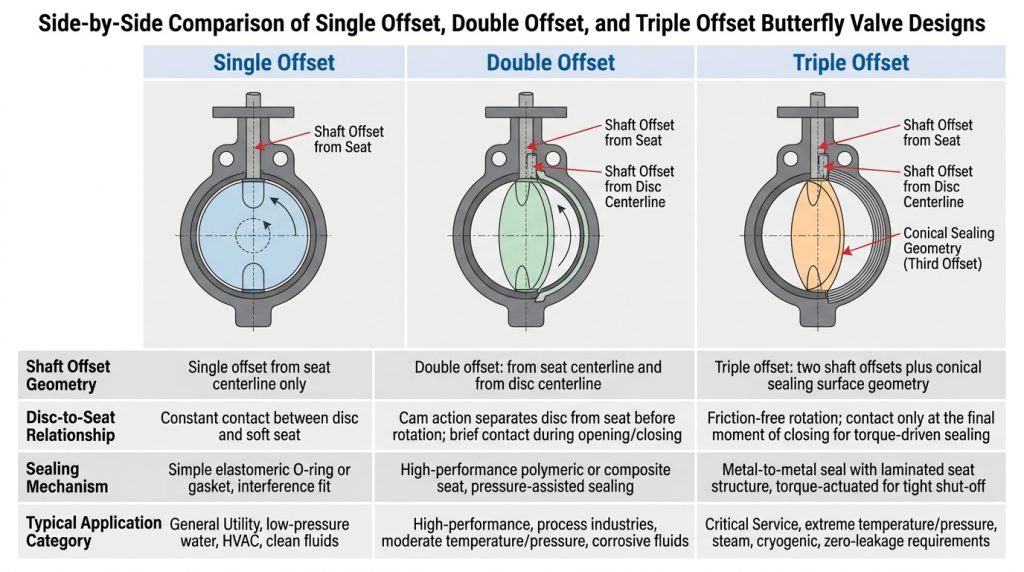
The ideal eccentric butterfly valve offset is determined by the pressure range and the media passing through the line. You must match the physical design of the valve with your system’s specific operating limits. For basic high-velocity water lines, a double offset configuration provides exceptional reliability and sealing. If you are handling high-pressure hydrocarbons or superheated steam, a triple offset design is the industry standard.
Double offset vs. triple offset design
Double offset designs feature two distinct shaft displacements that eliminate seat rubbing during travel. Triple offset designs add a third offset: an angled, conical sealing profile that ensures frictionless mechanical sealing.
Let’s break that down:
- Double offset uses resilient PTFE seats to achieve tight sealing in chemical lines.
- Triple offset uses laminate metal-to-metal seats to survive extreme heat and pressure.
- Torque-seated sealing in triple offsets ensures tighter contact as operating pressure increases.
Selecting offsets for specific applications
Selecting the wrong offset can lead to either an over-engineered budget blow-out or a rapid valve failure. You need to analyze your system’s fluid type, maximum pressure, and temperature extremes carefully.
Here is why:
- Chemical processing applications run safely and affordably with double offset PTFE valves.
- Refinery operations require the fire-safe metal seats found in triple offset designs.
- Low-pressure water networks can be reliably managed with simple single or double offset setups.
| Offset Level | Sealing Type | Primary Target Application |
|---|---|---|
| Single Offset | Soft / Resilient | Low pressure, water services |
| Double Offset | PTFE / RTFE Seat | Chemicals, water utilities, low steam |
| Triple Offset | Metal-to-Metal | Hydrocarbons, high steam, power loops |
Matching the offset geometry to your operating pressures keeps costs down while ensuring safety.
Key Takeaway: Double offset valves are ideal for general chemical lines, while triple offset designs are needed for high-temperature and high-pressure steam.
Does an eccentric butterfly valve lower torque?
An eccentric butterfly valve lowers operating torque requirements because the disc disengages immediately upon opening. In standard concentric designs, the disc is squeezed tightly inside the rubber seat throughout its entire rotation. This constant friction requires a massive amount of mechanical force to open and close. By switching to an eccentric butterfly valve, you eliminate this continuous resistance and reduce your system’s power needs.
Impact of eccentric movement on torque
The offset shaft geometry alters how torque is distributed during the valve’s operating cycle. You will see a major drop in torque once the disc breaks free from the seat.
Think about it:
- Minimal running torque is required because the disc does not rub against the seat.
- Lower breakaway torque prevents sudden pressure spikes and water hammer in your line.
- Smooth travel ensures precise flow control and modulates smoothly under throttling conditions.
Sizing actuators cost-effectively
High torque demands require large, expensive pneumatic or electrical actuators that take up valuable space. By choosing an offset valve, you can safely specify smaller, more compact actuation packages.
Case in point:
- Lower hardware costs result from buying smaller actuators and positioners.
- Reduced weight on your piping supports simplifies your overall system design.
- Lower air consumption saves energy across your plant’s compressed air network.
| Valve Type (DN200) | Seating Torque (Nm) | Running Torque (Nm) | Actuator Weight |
|---|---|---|---|
| Concentric Rubber | ~350 Nm | ~120 Nm | Standard pneumatic |
| Eccentric Double | ~210 Nm | ~45 Nm | Compact, lightweight |
| Eccentric Triple | ~290 Nm (Metal) | ~60 Nm | Precision compact |
Lower operating torque translates directly to savings when selecting automated valve systems.
Key Takeaway: Using offset geometry cuts operating torque, allowing plants to use smaller, cheaper actuators.
How to maintain an eccentric butterfly valve?
Maintaining an eccentric butterfly valve requires periodic inspection of the seal ring and cleaning of the seating face. Because the internal parts do not suffer from continuous rubbing, maintenance cycles are much longer. You will find that these valves are engineered for quick, straightforward maintenance in the field. This ease of upkeep helps you minimize scheduled maintenance windows and keep your operations running.
Inspecting metal and soft seat rings
Regular inspections allow you to catch small wear patterns before they turn into major bypass leaks. You must focus your attention on the seat interface and the stem packing area.
Here is how it works:
- Visual seat checks let you identify localized pitting or chemical degradation early.
- In-line testing helps you confirm that the valve still meets its original shutoff class.
- Stem seal checks ensure that volatile emissions do not escape through the packing.
How to replace damaged seals?
Replacing a worn seal ring is a straightforward process that does not require a full valve teardown. You can easily swap out the sealing components while the valve remains in the piping system.
But that’s not all:
- Retaining rings secure the seat, allowing for rapid replacement with basic tools.
- No disc removal is needed, which prevents alignment issues during reassembly.
- Reduced repair time gets your process line back online in a fraction of the time.
| Maintenance Step | Concentric Valve | Eccentric Valve |
|---|---|---|
| Seat Replacement | Replace entire rubber liner | Swap only the outer seal ring |
| Body Inspection | Full teardown required | Inspect seal face inline |
| Stem Sealing | Static non-adjustable | Live-loaded adjustable glands |
Simplified maintenance steps reduce repair times during planned plant shutdowns.
Key Takeaway: Replaceable seat rings in offset valves allow for faster in-line repairs than concentric models, which require full liner replacements.
Will an eccentric butterfly valve reduce costs?
An eccentric butterfly valve reduces long-term operational costs by lowering maintenance frequency and extending the valve’s working life. While standard concentric options have a lower initial purchase price, they fail frequently in demanding services. Replacing cheap valves repeatedly leads to high labor costs and lost production time. Investing in a high-performance eccentric butterfly valve ensures continuous reliability and a much stronger return on investment.
Calculating the total cost of ownership
To find the true cost of a valve, you must look beyond the initial price tag. You need to calculate the costs of labor, replacement parts, and lost production over several years.
Let’s face it:
- Fewer replacements save you from purchasing new hardware every few months.
- Reduced spare parts inventory cuts down on your warehouse storage costs.
- Longer service life ensures that your capital investments stretch much further.
Energy savings from low torque operations
Running high-torque valves continuously consumes a significant amount of electrical and pneumatic power. Because offset valves require much lower torque, they help you run a highly energy-efficient plant.
But that’s not all:
- Smaller actuators draw less electrical current or compressed air during operation.
- Lower system stress reduces wear on your automated control systems.
- Reduced air leaks in your pneumatic lines lower your overall utility costs.
| Cost Category (5-Year Run) | Concentric Installation | Eccentric Installation |
|---|---|---|
| Initial Purchase | Low cost | Moderate to high |
| Replacement Frequency | 2 to 3 times | 0 times |
| Downtime Costs | High risk | Minimal risk |
Evaluating lifecycle costs reveals the true economic benefit of selecting high-performance valves.
Key Takeaway: While concentric valves cost less upfront, eccentric models deliver a lower total cost of ownership through superior durability and fewer shutdowns.
How to Make the Right Choice for Your System
Selecting the right valve design is a critical decision for high-performance process piping. Concentric valves remain a solid, cost-effective choice for low-pressure water loops and building services. However, when process conditions involve high temperatures, high pressures, or corrosive chemicals, deploying an offset eccentric valve is essential to prevent seal failures and process leaks.
Ensure your piping networks operate at peak reliability under pressure. If you are designing high-cycle processing systems, our engineers can help you choose and configure the ideal offset configurations to fit your exact specifications. To request custom dimensions, CAD files, or a quick pricing quote, contact us today at Ruitoflow.
Common Questions About Valve Offsets
Can I use a concentric butterfly valve for high-temperature steam pipelines?
No, you should not do that. Elastomeric seats in concentric designs degrade rapidly under thermal stress, whereas a metallic eccentric butterfly valve handles high-temperature steam safely.
What’s the best way to determine if my system needs a triple offset valve?
You must evaluate your pressure and leakage standards. If your application demands zero-leakage, bubble-tight shutoff under extremely high pressures, a triple offset valve is the only reliable choice.
How do I know if my eccentric butterfly valve is installed backwards?
Check the flow direction arrow on the body immediately. Installing an eccentric valve against the preferred flow direction leads to seat bypass and increased opening torque.
Can I replace a gate valve with a high-performance eccentric butterfly valve?
Yes, this is highly recommended. Eccentric valves offer the same zero-leakage isolation as gate valves but occupy a fraction of the physical footprint and reduce structural weight.
How do I choose between double offset and triple offset designs?
Base your decision on temperature and pressure limits. Double offset valves are ideal for moderate pressures and soft-seated applications, while triple offset designs excel in metal-to-metal sealing for severe services.